At the Apex

Theme Songs Page | Previous Theme Song | Next Theme Song

At the Apex

Dockland, Music by Darryl Runswick, Lyrics by Lee Crabbe, Sung by If (1970), Encountered 1974

Buy it here  |  See it here  |  Lyrics here

I tend to acquire new interests at the same time as everyone else, but I seldom abandon them when the memo goes out to move on. Case in point: as the 70s progressed and people stopped thinking of Chicago or Blood, Sweat & Tears as cutting-edge, I just doubled down on jazz-oriented rock groups (or was it rock-oriented jazz groups?) by following bands with forgotten names like If, Dreams, and The Flock.  If was a group I particularly liked: a British septet with two reedmen atop a standard rock band foursome fronted by a tenor vocalist named J.W. Hodginkson.

Working Class World

I must have picked up If’s eponymous debut album in a remainder rack. I still have the LP, clad in a silvery reflective jacket, punched in one corner: the telltale mark of a remaindered record. No surprise it was remaindered: despite coming out on a major U.S. label, If obviously was not meant for great things in the overheated U.S. record market of that era. It was too foreign, too jazzy, its members equipped with insufficiently big hair for the 70s (two of them are perceptibly balding on the jacket photos). But they came into my life at an opportune time for me, because I was attempting a self-taught crash course in up-to-date working-class-world British culture. If, and especially its song Dockland, were playing a lot throughout the process.

Offenses Against Decorum
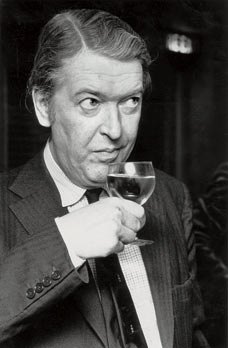
Amis
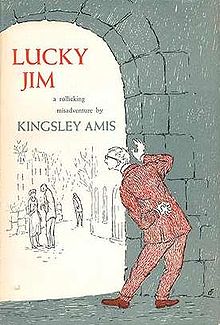
The crash course was necessitated by the decision I’d made around the same time I bought the album to do a dissertation on Kingsley Amis, the British novelist and poet. I’ve mentioned this at various other spots in these pages.[1] I wanted to do a dissertation on someone I could actually talk to; I was sick of the inability to ask questions.[2] More than anything else, though, and more than even I recognized at the time, my dissertation choice was a declaration of independence from the Hopkins English Department. Educated people everywhere had guffawed their way through Amis’ freshman effort, Lucky Jim (1954), of course, but it was light humor, my dear, not Joyce or Nabokov, and it was, after all, a sendup of academia, and we do have to be careful not to be too disrespectful. Amis’ offenses against decorum had then multiplied: bedroom farces, a pastiche murder mystery and a pastiche ghost story, science fiction criticism and anthologizing, a book on James Bond, an actual James Bond sequel, jazz criticism, a column about drinks, television scripts, and a drift to the right politically. To be sure, the man had his respectable lit-crit side as well, but in choosing Amis to write about I knew I was detouring from the approved path of giving serious attention to serious writers working in serious genres.

All that messing in popular genres did not mean Amis (born 1922) was exactly contemporary from that era’s vantagepoint. Contemporary would have been Swinging London. One of Amis’s novels, Girl, 20, explicitly dealt with that scene. But it was an acidulous and huffy approach, focusing primarily on an older character, a conductor who could be great but throws away his talent in a ridiculous effort to fit in with London’s gilded youngsters. Amis clearly was not going to be buying his duds on Carnaby Street.

Rock and Jazz

The music of If wasn’t a perfect match for either the times or my dissertation topic, but a significant step in that direction. Swinging London was rock, not jazz, and If was jazz as much as rock, and its members a bit long in the tooth to be fabulous in that era’s eyes. [3] That said, its musicians were and certainly felt more contemporary than the jazz Amis had written about for The Observer in the 1950s (and I’d photocopied and read through for my dissertation).[4]  Read the liner notes of the album, and you get a sense you’re being served up a compleat blending of up-to-date rock and up-to-date jazz.
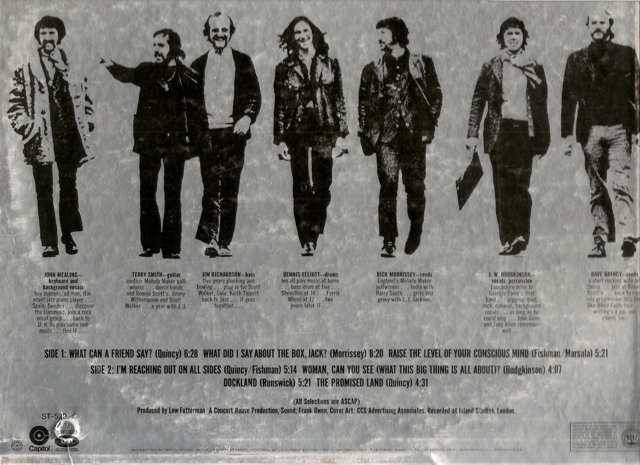
(To read the blurbs, click here: If Jacket Detail.)

Big Brick Walls

But that was okay. On the page, Amis sounded and felt like a product of the big brick walls of industrial Britain, the world of I’m All Right Jack. Lucky Jim plays a practical joke on Johns, his dim colleague, writing a threatening letter as if it came from an irate workingman:

This is just a freindly letter and I am not threatenning you, but you just do as I say else me and some of my palls from the Works will be up your way and we sha’nt be coming along just to say How do you can bet.

Don’t these Works sound as if they come from the same factory neighborhoods you see in the background in A Hard Day’s Night? Or, more to the point, don’t they sound like the neighborhood conjured up in the lyrics of Dockland?

It’s a dockland scene
Where the water runs
There’s a big lock gate
And it runs in tons
While the big ships wait
While the water runs…
There’s a factory wall
Where the flour-bags lie
And they’re stacked so tall
That they reach the sky
By the factory wall

To be technical about it, these are all different places. Lucky Jim takes place at a provincial British university, reportedly based in part on the University of Leicester in the British Midlands, in an area where “the Works” were indeed to be found;[5] A Hard Day’s Night was mainly shot in London;[6] and Lee Crabbe’s lyrics, quoted above, describe a canal and docklands in Ipswich, Suffolk,[7] on England’s east coast. But the slightly drab, slightly run-down world still pulsing with industrial life was common to them all.[8]

A Visit With the Great Man

So I felt that by playing this record and humming the melody, I was truly helping myself (in a small way at least) to get ready to tackle my subject. My other preparations, in addition to mounting a determined effort to lay my hands on everything Amis wrote or which had been written about him, consisted of writing the man himself, and asking if I could interview him.

The answer I got back was both cordial and noncommittal. He “might buy [me] a drink.” Armed with little more than that level of commitment on Amis’ part, I got myself and S. to London in July 1974. Amis and I agreed to meet on the 16th, at the Garrick Club, I believe in the very room pictured here.[9] I think he wanted to look me over, to decide if I was the sort to whom he wished to extend his help.  Originally he told me he would have to leave at around one. However, as I was apparently making the right impression, he then invited me to come along with him to what I later learned was a fixture in his life at the time, a Tuesday lunch gathering with various conservatively-minded writers at Bertorelli’s, an Italian restaurant.[10] The day I was there, I met John Braine, author of Room at the Top, the movie of which I’d seen (and I’d also read the book), and Sovietologist and Amis co-author Robert Conquest.

I was very impressed, though none of these people was what I had expected. I might have articulated it differently to myself at the time, but it was as if the entire left-wing British intelligentsia had turned right. (No solidarity with “palls from the Works,” and no romanticizing “flour bags … by the factory wall” or “big lock gates.”)

At the conclusion of the lunch, Amis and I made arrangements for me to come up to his suburban home in High Barnet and do an extended interview, which occurred on July 24. This is not the place to go into the specifics of my visit to his home or our conversation, much of which turned up in my dissertation. All I need report is that Amis was a delightful host, that I met Amis’ formidable then-wife, the novelist Elizabeth Jane Howard, and that I got back on the Tube sated in body and mind.

This generous helping of rubbing elbows with literati was supplemented by my going to Bloomsbury and actually doing some research at the British Museum.

And a Not-So-Great One

And I also had one other literary adventure on this trip. I’ve mentioned earlier in these pages that I had also written a book-length edition of some Romantic-era poetry, even before I had gotten going on the Amis project. This had led to the discovery that there was something of a fight going on over a new standard edition of one of those poets. There was a Big Name Professor in America and a Big Name Professor in England on opposite sides. In the course of a year or so, I would meet the American. But while in the U.K., I had an exceedingly odd dinner with the Briton. I think he was going senile or mad or both, but he was still in the game at that point, and trying to recruit me for his faction. This, despite my making it plain that with my newfound focus on contemporary literature, I was somewhat hors de combat when it came to the  Romantic poet in question. I don’t think my disclaimers made the least impression on him. Nor was literary factionalism all he was trying to recruit me for; despite his denunciations of certain academic rivals as “bum-boys,” I could sense a definite disappointment when I mentioned that I was traveling with my wife, and even more when I made it plain that I was headed back to her immediately after my strictly business get-together with him.[11]

It was thrilling to be among these people of literary achievement, and it was a heady thought that I might one day be their equal. (I certainly aspired to be as accomplished and celebrated as Amis and as Big a Professorial Name as my host the editor.) Of course, it was not going to happen, but I didn’t know that then. It’s fair to say that, because my anticipated glowing writing career misfired so badly, this couple of weeks turned out to have been the apex of my literary life, both for whom I was associating with and for what I was doing.

Britrail, July 1974

And I and S. were playing tourist all the while, too. In among these literary activities, S. and I traveled all over England, courtesy of our Britrail Passes: Cornwall, Cambridge, and Edinburgh, Greenwich, York and generous helpings of London.

Just a Great Song

During all those travels, I continued from time to time to think of that Dockland song. It is a wondrous thing, because the melody, chords, and lyrics are so tightly integrated, and they all tell the same tale in the same way: that there is a lustrous beauty and consolation (“when I’m feeling down”) in these industrial landscapes, similar to what Wordsworth would have found in a natural scene:

See, the harbor lights are winking far and wide
Hear the water lapping at the old keyside
See, where the oily swans are breeding
There’s a morning tide receding
Leaving all the scrapmetal clean
It’s a dockland scene

 In the first two lines, the melody moves downward in a minor chordal progression to the second “See,” sung at the deliciously wrong E directly above the Eb which is the key,[12] and when the lyrics turn to the “oily swans breeding,” and it resolves down to the Eb, there’s a burst of rightness that mirrors the quiet, inexplicable consolation the song is all about. When the lyrics mention someone sounding a ship horn, the band’s horns not only capture the pitches of a ship horn, but the sonority, and the whole strange gamut of feelings hearing one can evoke. Throughout, the song is full of strange, jazzy, exciting chords that underline the unexpected wonder of the harbor view.

Unexpected like my encounter with literary London in 1974.

As Wordsworth wrote in a very different context: “Bliss was it in that dawn to be alive.”[13] I was not going to feel that kind of bliss as a literary man ever again. But I would never forget it.


[1]  See here and here.

[2]  I was also sick of the Deconstructionist notion that an author could speak with no particular authority about his/her text. I never believed that my teachers really believed this, because they kept slipping bits of an author’s biography into their disquisitions, and why the biography should mean something if the text were so darned autonomous is a question I never heard an answer to. Well, hell, there was no answer. When it came to doing a dissertation, however, I felt like Aristotle, or Roger Bacon, or whoever it really was who wanted to settle the philosophical question how many teeth a horse had by marching over to the stable and counting.

[3]  J.W. Hodginson, the lead singer, born in 1949 like me, was the only Boomer.

[4] See my book Kingsley Amis: A Checklist at 25-36 (1976).

[5] The 1972 Webster’s New Geographical Dictionary’s entry on Leicester, at 658, describes the town in part as “railroad junction; hosiery, knitwear, footwear.”

[6]  See the detailed rundown of where the movie was filmed in entries in http://www.beatlesbible.com/history/ for March and April 1964.

[7]  E-mail from Darryl Runswick, composer, November 6, 2012.

[8] Times change. The University of Leicester and the Ipswich docklands are now gleaming bits of modernity, to judge from photos posted on Yahoo. The places where A Hard Day’s Night was filmed are mostly gone, except for the train stations. (Twickenham Film Studios, where the bulk of it was filmed, has closed and is set to be demolished.)

[9] Source: http://www.garrickclub.co.uk/.

[10]  Amis’ biographer, Zachary Leader, references the:

Weekly ‘fascist’ lunches at Bertorelli’s restaurant in Charlotte Street.  These lunches, held first on Thursdays, then on Tuesdays, seem initially to have been an outgrown of the lunching arrangements Amis made with London friends on his weekly visits from Cambridge. Bertorelli’s was cheap, conveniently located near the Spectator offices, and arge enough not to book ahead. It served unpretentious Ango-Italian food unpretentiously… The fascist label was coined by the lunchers themselves.

Leader quotes Amis’ son Martin: “Both Kingsley and Bob [Robert Conquest], in the 1960s, were frequently referred to as ‘fascists’ in the general political debate. The accusation was only semi-serious.”  Leader continues:

[H]ere they would chat and carouse with other fascists, among them the journalist Bernard Levin, the novelists Anthony Powell and John Braine …, and the defector historian Tibor Szamuely. Other regular participants included Anthony Hartley of the Spectator, D.C. Watt, the historian and political scientist, Russell Lewis, Director of the Conservative Political Centre … and the American Journalist Cy Friedin.

Z. Leader, The Life of Kingsley Amis at 565 (2006). Bertorelli’s is now a chain, and not highly esteemed by its Web reviewers, not even the Charlotte Street branch, at least as I gather based on this link, as accessed November 18, 2012. But filled with literary men of achievement (I don’t think there were any women present) it was very impressive that 1974 day.

[11]  I always felt sorry for him, so obviously in decline, and so clearly marked out to lose the fight over his edition of the poet, which ran to one more volume the next year and then was stopped by the university press that had been publishing it. The American Big Name not only was part of the group that had a stop put to the older man’s edition, but has since been bringing out his own.

[12]  In the wonderful original recording sung by the composer, Darryl Runswick, audible here, the key is C, and the tension-causing “See” is a Db.

[13] William Wordsworth, French Revolution (1805).

Copyright (c) Jack L. B. Gohn, except for all images other than the last

Theme Songs Page | Previous Theme Song | Next Theme Song

Lives Through Clothes: Love, Loss and What I Wore at FPCT

Theater Reviews Page | Previous Theater Review | Next Theater Review

L to R: Kate McKenna, Beverly Shannon, Andrea Bush, Anne Shoemaker, Helenmary Ball

Lives Through Clothes: Love, Loss at FPCT

Posted on BroadwayWorld.com November 18, 2012

            Sometimes there are shows you’d like to like more. Nora and Delia Ephron’s 2009 show Love, Loss and What I Wore, now gracing the Fells Point Corner Theatre’s downstairs stage, is a case in point. I don’t know much about Delia Ephron’s work, but I adored her late sister Nora. I was hoping for bright flashes of Nora’s mordant wit, but it’s not quite that kind of show. Nor is it exactly a dramatization of Ilene Beckerman’s faintly-poignant-despite-the-stoicism 2005 autobiography-told-through-clothes of the same title. Instead, it is Beckerman’s book plus the gleanings of 100 e-mail questionnaires the Ephrons sent out to female friends about their lives with clothes, and little of it bears the stamp of the Ephron wit.

The theater piece (it can’t exactly be called a play) thus becomes a series of monologues, choral spoken pieces, and a few dialogues, articulating the collective encounter between women’s lives and clothes. The humor, such as it is, lies in the shock of recognition some of the comments are at least intended to evoke. I found it pretty weak, with the conclusions of the skits often being obvious from the first word. Take, for example, the moment where all five of the performers stand in front of imaginary closets, noting in frustration that with all the garments inside, they feel as if they have nothing to wear. What are the odds, with all that frustration and negativity, that they’re going to find anything by the end? And even if, like me, you’d heard next to nothing about the show in advance, how surprising would it be that they’d have a segment on the entropy that inevitably overtakes the contents of a purse, or one on the embarrassing and frustrating time one has shopping for a bra?

Even the tentpole of the show, Beckerman’s contribution, a series of episodes telling the history of “Gingy” (Beckerman’s nickname), illustrated with Beckerman’s minimalist drawings, are so restrained as to resonate very little. And the show doesn’t do much to make it resonate. All the details Gingy shares (street addresses in New York, names of clothing stores, descriptions of the fabric) had better already mean something to you, because the show isn’t going to supply much additional context.

It’s not that there’s anything wrong with Love, Loss; it’s just that there isn’t enough right with it.

Which is not the fault of the performers. The four who each handle several roles (Andrea Bush, Kate McKenna, Anne Shoemaker, and Beverly Shannon) and Helenmary Ball, who mostly just channels Gingy, are fine, and occasionally even shine, in those too-rare moments when the material permits. Shannon did an attention-grabbing turn as a Chicano chica in Chicago reminiscing about wearing a gang sweater and being blissfully groped by the gang leader. Shoemaker catches fire as a lesbian finding a tuxedo to wear to her wedding. Bush (a plus-size actress) showed something in a monologue about plus-size clothes. And I laughed at McKenna in a raunchy skit about a jailbird’s wife wearing pants with a hole in the crotch so she could be pleasured while visiting him. Steve Goldklang seems to have directed them all well.

It’s not them; it’s the show. The Ephrons seem to have set out to make the point that on some profound level, women’s clothes are themselves, and that women’s very lives are bound up with their clothes and vice versa. But the case is not well-documented. There are a couple of stabs at seriously supporting that argument. For instance there’s a skit in which a woman mourns the misplacing of the perfect shirt, a loss that occurred at the same time as she was losing a boyfriend; well, neither loss caused the other. Partly because of that fact, the agonizing over the shirt sounds superficial and silly. There’s another in which a woman stops wearing miniskirts after she’s been raped; this is a more plausible case-in-point because obviously the injury to the woman’s feelings about her own sexuality is being communicated through the language of clothes. But one would expect a greater change in the clothes to make the point. The lengthening of skirts is presented as a minor mid-course adjustment, since the main emphasis in the piece is on the thigh-high boots the woman wore both before and after the rape.

While I wish it had been stronger, I’d be loath to drive anyone away. In the end, it’s a gentler show than I’d have liked, but even at a somewhat dilute strength, it was quietly enjoyable. So go, but keep your expectations under control.

Copyright (c) Jack L. B. Gohn, except for photograph

Theater Reviews Page | Previous Theater Review | Next Theater Review

Lovestruck and Crazy Like Foxes: BUS STOP at Spotlighters

Theater Reviews Page | Previous Theater Review | Next Theater Review


 Lovestruck and Crazy Like Foxes: BUS STOP at Spotlighters

Posted on BroadwayWorld.com on November 4, 2012 

William Inge seems to have read his William Shakespeare.  To prevent the highborn types who people Shakespeare’s comedies from growing too monotonously similar, the Bard generally salts in one or two “rustics,” simple folk, often from the countryside, who echo in low comedy ways the more elegant doings of their betters. Inge is obviously drawn to rustics. In fact, in Bus Stop (1955), now being revived by Baltimore’s Spotlighters, Inge seems to have dispensed with the highborn altogether. All of the characters are rustics to one extent or another, even the mysterious defrocked academic, Dr. Gerald Lyman (Jose Teneza), who can and does quote Shakespeare at will. Whatever Lyman’s true story is, in some region of his heart he is as simple and unschooled as any of the rest of them.

The rest of the characters all come from and/or work in the hinterlands: Grace (Carol De Lisle), proprietor of the titular bus stop café 30 miles west of Kansas City; Elma (Erin Hanratty), the high school girl who waits tables for Grace; Will (Richard Brandt), the local sheriff; Cherie (Rachel Verhaaren), refugee from an Ozarks town trying to make it as a Kansas City chanteuse; Carl (Steve Izant), who drives a bus route from Kansas City westward; and two cowboys Bo (James Morton) a bumptious young Montana rancher, and Virgil (Robert Scott Hitcho), an older rancher who has acted as Bo’s parent. The lot of them, like Shakespeare’s rustics, are both country-bred and unsophisticated. But that is not the same as being bereft of either aspirations or brains. We are meant to fall in love with them all because in some sense they all take intelligent care of business, mostly the business of the heart.

Three couples pair off as the play progresses: Grace the proprietor and Carl the bus driver, Cherie the chanteuse and Bo the rancher, and Elma the literary high schooler and the mysterious Dr. Lyman. On their face these pairings are as different as can be. Grace is really looking for nothing more momentous than a roll in the hay (and Carl proves glad to oblige); Cherie is terrified and fascinated by the overbearing Bo, and Bo, it proves, needs to find a way to be less terrifying to win her hand; Dr. Lyman’s interest in Elma is borderline creepy and yet very close to being right for them, and it is up to him to sort it out. Common to all three stories, however, is that the longings that bring or threaten to bring these couples together are strong yet in various ways outlawed. In 1955 much more than today, hookups like Grace and Carl’s were widely viewed as disgraceful. Then and now, romantic demands that amount to abducting a woman, as Bo has tried to do to Cherie, are unacceptable, and thrice-divorced professors cannot pay court to high schoolers, the way Dr. Lyman would like to do with Elma.

Obviously in various ways all of these would-be lovers struggling with socially unacceptable desires are avatars of Inge himself, a closeted homosexual in an era where gay playwrights frequently tried to address their closeted and socially-unaccepted desires through odd, misfit, and lonesome, albeit heterosexual characters (think Tennessee Williams and Terrence Rattigan, for example). The resolutions Inge reaches fall on a spectrum: Grace and Carl are fine; Cherie and Bo have some major adjusting to do before she can bring herself to get back on the bus with him; and Dr. Lyman must recognize that his budding amour fou for Elma simply cannot be. But no doubt what Inge wished to convey through these diverse stories and to have audiences accept, is that love, in whatever crazy form it importunes us, should not be lightly denied.

How successful all this is now or ever was as theater is an interesting question. The biggest challenge is the Cherie/Bo plot. In a sense, this should be the least problematical: the two are young, single, attractive, and attracted to each other. But there are two impediments. Bo is an impetuous blowhard, raised, apparently, under a rock, as ignorant of the ways of the female of the species as is Frederic in The Pirates of Penzance, who has spent 21 years in the exclusive company of male pirates. Cherie, at 19, has been “around the block” more than a few times with other guys, perhaps, it seems to be hinted, commercially, and she is afraid that Bo will reject her if he finds this out, even though they have been, as Bo puts it, “familiar” already. Cherie’s apprehension would have been somewhat credible, albeit probably unusual, in 1955; today it’s almost ludicrous. But Bo’s character always was, I submit, unintentionally unbelievable. And the quick resolution of the standoff between them, even given the suspended disbelief that stage time imposes on an audience, also is impossible to swallow. And if it’s impossible to swallow, it is, I also submit, an emotionally and intellectually unconvincing glorification of crazy love, a failure by Inge to reach his dramatic objective.

None of this is the fault of the director, Fuzz Roark, or the above-mentioned cast, who, in keeping with Spotlighters’ traditional high standards, seem to do as fine a job as possible under the circumstances. The circumstances are the script, which I’ve already discussed, and the house, which I’m about to.

This is Spotlighters’ 50th season, and, as a part of that celebration, it is reviving, in Bus Stop, the very first show it put on the boards. It is a tribute to their staying power that few things have changed much in 50 years, but it may not be entirely a display of the best sense. I gather that for 50 years Spotlighters has been ambitiously putting on shows of all sorts in the cramped basement of a residential hotel, a space that cannot readily be enlarged. Even with good acoustics, this theater-in-the-square’s seats are impeded by four large columns, columns which make every seat (many of them also without reasonable legroom) a bad one; I have sat in all different parts of the house over the years, and can attest that not once was my view of the action not partly obstructed.

This hurts particularly in Bus Stop, an ensemble piece where for long stretches all or nearly all of the cast is onstage at the same time, and the reactions or non-reactions of the characters while others are talking are critical to a full enjoyment of the show.  If there are one or two characters you can’t see, you are missing out. I did miss out, and I’d be willing to bet every other member of the audience did as well.

I understand that the company is engaged in a $175,000 capital campaign right now; is it inconceivable that that money could be used to move to a better venue? Though I write without knowledge of the numbers involved, I’m aware that the Everyman company, for instance, is vacating its longtime digs on Charles Street. Is it inconceivable the Spotlighters could move to that space? Or to Load of Fun, if it reopens? Or to the Meadow Mill complex? Any one of these Baltimore venues would provide an infinitely better visual experience than the current one.

I mean no offense to the dedicated Mr. Roark or his company; I’d just like to see them better, and in greater comfort.

What there is to see of them, however, is still worthwhile, and recommended. The flaws I’ve mentioned are real, but are far from detracting altogether from the enjoyment Bus Stop has to offer. Inge not only speaks up for crazy love, but for rustics who in their own ways are crazy like foxes in their pursuit of it. Crazy like a fox is usually good, especially when presented by as fine an ensemble as The Spotlighters have assembled here.

Copyright (c) Jack L. B. Gohn, except for illustration

Theater Reviews Page | Previous Theater Review | Next Theater Review

Lessons From the Mother Road About Government

 The Big Picture Home Page | Previous Big Picture Column | Next Big Picture Column

Lessons From The Mother Road About Government

Published in the Maryland Daily Record November 5, 2012

            The Mother Road, John Steinbeck called it:[1] U.S. Route 66, which once linked Lakeshore Drive in Chicago with the Santa Monica Pier, spanning eight states and three time zones in the process. They decommissioned it in 1977, but, like a glorious zombie, it lives a postmortem life, preserved with maps, books, road signage, and of course the song about getting your kicks on Route 66 popularized by Nat King Cole, still covered to this day.

I recently had the privilege of driving the 2400+ miles[2] of what remains of it.

And yes, while driving it I certainly contemplated what a great and beautiful and just big country we inhabit. But I also thought about the power of government programs. They’re hard not to think about on 66.

Highway 66 itself is one of three arguably redundant programs you see, frequently in the same glance, as you travel from Tulsa through Oklahoma City, Amarillo, Albuquerque, Winslow, Flagstaff, Kingman, Needles and Barstow.

Transcontinentals

This bracelet of towns was largely strung together by one of the misleadingly-named “transcontinental” railroads,[3] the old Santa Fe, whose conveyor belt of freight trains still thunders eastwards[4]along the same course, about one every ten minutes.

About Every Ten Minutes

The railroads may have been private companies, but they were quintessentially government programs. Historian Richard White has commented: “The transcontinentals, more obviously than other railroads, were entwined with the state. Governments subsidized them, secured their rights of way, regulated them, and protected them.”[5] This entwinement began with the Pacific Railway Acts of 1862[6] and 1864,[7] and continued with a constant stream of government bonds, tariffs, franchises, land patents and the like.

White believes that for the promoters, the government benefits were the actual name of the game, and that there was no fundamental economic rationale for the railroads at all, at least not when they were built, meaning that at the time they were a bad deal both for the taxpayer and the market. (The Panics of 1873 and 1893 were directly tied to railroad failures.)

But one good thing is for sure: the rails bound the towns together. This was by design; the Arthur Wellington treatise Location of Railways, the bible of 19th-Century railway engineers, laid it down as a rule that rights-of-way should be designed to link major centers of population.[8]  And of course every few miles along the railroad, you had to have a depot. (The Union Pacific had one every eight miles.)[9] Many small towns were born as rail depots.


U.S. Highways

Along 66, the tracks and the roadway are seldom far from each other. And this was no surprise. They had to go the same places. In that era, public highways also linked town to town. This was less by design than necessity; the first federal appropriation intended to promote a national highway system was in 1916, for “rural post roads.”[10] But by the time the state highway commissioners got together in 1925 and 1926 for the great log-rolling session that gave us the familiar white-shield U.S. Routes,[11] those Routes were about the cities and the towns strung along them.

Wigwams

And all along 66, you can see the benign effects of this “stimulus program” on those cities and towns. For a generation or two, Route 66 was the way most Americans drove west, causing motels and diners and other businesses to spring up. Whether the travelers were Steinbeck’s Okies fleeing the Dust Bowl or the young men whose trip from upstate New York to college in Arizona is reconstructed at the Route 66 Museum in Chandler, OK, there seems to have been an optimism and good cheer about travel along this road. And it called forth an amazing crop of “follies,” idiosyncratic outpourings of architecture, sculpture, murals and neon, that glorified the cars, trucks, and motorcycles passing by. Motels made of plaster wigwams, restaurants topped with gargantuan sombreros or milk bottles, Burma Shave jingles in cornfields, jauntily-skewed Route 66 signs outlined in neon on archways decorated with Native American designs, it is sometimes close to insane, and all, all quintessentially American.

Yet now much of dynamism has now been reduced to nostalgia, some of it on beyond threadbare. Again and again on Route 66 you pass through ghost towns like Glen Rio, Texas, from which all humanity has fled, where graffiti-covered buildings without windows or roofs bear witness that once there had been communities.  More typical are hardscrabble main streets like those in Galena, KS, Ash Fork, AZ or Ludlow, CA, where a few merchants hold extinction at bay, typically by playing 66 nostalgia for all it’s worth.

Interstates

Ash Fork

What happened was that government programs gave, and they took away. The taking away took the form of the Federal-Aid Highway Act of 1956,[12] which established the Interstates. The Interstates did not turn out to be about downtowns, especially small-town downtowns, although they were sold to Congress that way.[13] The American Association of State Highway and Transportation Officials’ Policy on Design Standards – Interstate System (sort of a latter-day successor to Wellington’s book on railway design) ordains that in rural areas exits should be three miles apart. And when I-40 replaced much of U.S. 66, it went through the hearts of the Oklahoma Citys, but left the Glen Rios by themselves.

Glen Rio

So now as you drive along the remains of 66, you can frequently see I-40, often up close, sometimes off in the distance under the big Western skies. Much of the time you can hear the rustle of the traffic. But you can only get to it about once every three miles. And so perfectly good small highway-oriented towns were left to wither, and in their place we got exitvilles: colonies of gas stations, convenience stores, and chain eateries that grew up around the Interstate cloverleafs. Exitvilles are generally functional, but in their sameness they repudiate the wild idiosyncrasies that made old Route 66 so colorful.

Crumbling

Once I-40 came through, maintaining both it and the Mother Road made little sense. Even so, the quantity of sheer waste is staggering when you see it. 66 was a huge achievement in its day. Much of it lies abandoned now: rough brownish Portland pavement, at best relegated to the role of service road to the new Interstates, at worst crumbling or totally crumbled in the middle of nowhere. Which is not to say that the Interstates haven’t brought us the speed and geographic connection they promised. When you build 41,000 miles of new road, some good things are bound to happen.

Lessons

In the course of the current election, you hear candidates talk as if government programs are pointless or powerless.  Do not be taken in. An immense amount occurs as the results of government programs, both good and bad. Without the Pacific Railway Acts, two Panics might have been avoided, but that Santa Fe superhighway of container cars might never have come to pass. And it is hard to guess what America would have been without the large-scale national system created by the state highway commissioners in 1925 and 1926. Would World War II have been as winnable without highways for trucks carrying airplane and tank parts? And modern America without its Interstates is simply unimaginable; this point requires no discussion. When government acts, people’s lives change, both for the better and the worse. The three layers of government programs visible from Route 66 exemplify that.


[1] John Steinbeck, The Grapes of Wrath, Kindle Edition, page 118, Location 2937 (1937).

[2] Michael Wallis, Route 66: The Mother Road, at 1 (rev. ed. 2001).

[3] In quotes because none of them ever got east of Chicago, and in their 19th-Century heyday they seldom got even that far east. But it was what people called them.

[4] What goes east must come west, of course. That said, I don’t know where the westbound trains were, but over several days, the eastbound trains unmistakably predominated.

[5] Richard White, Railroaded: The Transcontinentals and the Making of Modern America, Kindle Edition, Location 385 (2012).

[6] 12 Stat. 489 (1863).

[7]13 Stat 356 (1965).

[8] As quoted in White, Kindle Edition, Page 148, quoting the 1891 edition of Wellington’s book, at 719-21. The theory, of course, was that major centers of population gave rise to traffic, and the railroad should go where the traffic was greatest.

[9]  The theory being that four miles each way was as far as a farmer bringing produce in for shipment would be willing to go in a day’s round trip.

[10] 39 Stat. 355 (1916).

[11] Described at length in Richard F. Weingroff’s entertaining and erudite paper, From Names to Numbers: The Origins of the U.S. Numbered Highway System (1997), reprinted here.

[12] Public Law 84-627 (1956).

[13] Tom Lewis, Divided Highways at 120-21 (1997).

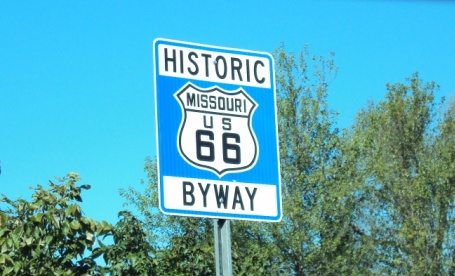
NOTE ON THE FINAL IMAGE: If it looks to you as if the road was only one lane wide, you’re right.  At this spot near Afton, Oklahoma, the right-of-way is two lanes wide, but the paved portion only one, doubtless a concession to the limited financial resources available to pave this section. I’m guessing the idea was that the original travelers would at least have one-half paved lane for their tires to grip.

Copyright (c) Jack L. B. Gohn

The Big Picture Home Page | Previous Big Picture Column | Next Big Picture Column

Well-Made Dramas

 Theater Reviews Page | Previous Theater Review | Next Theater Review

Well-Made Dramas

 Published in The Hopkins Review New Series 5.4 (Fall 2012)

          Enumerating Shakespeare’s supposed defects, Dr. Johnson wrote:

His first … is that … [h]e sacrifices virtue to convenience, and is so much more careful to please than to instruct, that he seems to write without any moral purpose. From his writings indeed a system of social duty may be selected, for he that thinks reasonably must think morally; but his precepts and axioms drop casually from him; he makes no just distribution of good or evil, nor is always careful to shew in the virtuous a disapprobation of the wicked; he carries his persons indifferently through right and wrong, and at the close dismisses them without further care, and leaves their examples to operate by chance.

          Johnson’s diagnosis is both spot-on and, to modern ears, preposterous. He has called Shakespeare out for relying on a key part of the formula for the well-made contemporary drama. To the audiences thronging recent New York productions of The Common Pursuit and Clybourne Park, any effort by the playwrights to make a “just distribution of good [and] evil” would surely have seemed both unpalatable and dishonest. And the revival of Gore Vidal’s The Best Man [sic] shows the dangers of labeling choices and characters too confidently.

Karmic Diversity

          In most modern drama, everyone gets some good karma and some bad. Every character, “be he ne’er so vile,” exhibits some virtue and some insight, and every character’s moral armor has a chink or two, accompanied by blind spots of one sort or another in his or her vision of the world. The action thus becomes a collective one, a picture of a community as a whole moving, through the clash of personalities and outlooks, from one point to another.

          The community in The Common Pursuit is a brace of Cambridge graduates, whom we first meet in the 1960s, embarking on publication of a journal fittingly to be called The Common Pursuit. Playwright Simon Gray assumes that his audiences will recognize the allusion, which is to the title of a 1952 collection of essays on British writers, mostly poets, by F.R. Leavis. Leavis in turn borrowed the phrase from T.S. Eliot, feeling that it encapsulated the business of the critic: “the common pursuit of true judgment.” That the phrase – and Leavis its proponent – could have plausibly electrified a group of 1960s undergraduates is an index to how much things have changed – and indeed how much they change in the play.

Neither Common Nor a Pursuit

          The students’ own pursuit, to maintain a journal of new poetry plus criticism along Leavisite lines, which is to say along the lines of the critical review Scrutiny, which Leavis published from 1932 to 1953, becomes neither common nor even a pursuit as the play progresses.

          Instead, it emerges, as we follow the group deep into middle age, in one instance to the grave, and in another to its vicinity, that the actual object of their common pursuit is lives as literati of varying stripes. Humphry (Tim McGeever) continues in the academy as historian and dean, Stuart (Josh Cooke) the would-be editor, ends up as a literary commentator, his friend Martin (Jacob Fishel) becomes a publisher, Peter (Kieran Campion) an author of high-end potboiler non-fiction and wangler of foundation grants, and Nick (Lucas Near-Verbrugghe) a TV theater critic. Marigold (Kristen Bush), first the wife of one of them, then of another, leaves the purlieus of criticism to pursue a solid career as a teacher and administrator at girls’ schools. If there is a theme to their lives, it is not the rigorous scrutiny of received texts, but rather the quotidian drama of getting on with careers, marriages, betrayals, infidelities, and loss. In other words, we are not in F.R. Leavis territory, but rather that of Frederic Raphael’s The Glittering Prizes and Anthony Powell’s A Dance to the Music of Time.

          What these characters come to exemplify has little to do with the Leavisian moral seriousness they stared with. In fact, in some instances the characters are revealed to lack any sense of seriousness; most notably a couple of them displaying the callous boys-will-be-boys attitude toward adultery (and husbandly solidarity in covering for each other’s escapades) that comes straight out of Kingsley Amis. In this world adultery, much more than literature, is the Brownian motion that keeps the molecules of the characters’ lives moving around and recombining. And of course that motion is the very stuff of drama.

Tonic Diversity

          To return to Dr. Johnson for a moment, he also noted Shakespeare’s uneven tone:

Shakespeare’s plays are not in the rigorous and critical sense either tragedies or comedies, but compositions of a distinct kind; exhibiting the real state of sublunary nature, which partakes of good and evil, joy and sorrow, mingled with endless variety of proportion and innumerable modes of combination; and expressing the course of the world, in which the loss of one is the gain of another…

This mingling is exactly the effect modern audiences crave, and exactly what Gray was aiming at.

          Gray wrote in An Unnatural Pursuit, his journal of the original 1984 Hammersmith production of his play (directed by Harold Pinter), that “I’d intended [the scene in which Humphry’s death is announced] to be, if not light, then at least matter of fact.” It would be an “obvious trap” to “play the play for laughs in the funny bits and seriously in the serious bits. We’ll have to make sure that the funny and the serious are simply played naturally, leaving the audience to find out for themselves which is which.” His conclusion: the play is “about the way things go on.”And the way they go on is mixed throughout.

          Gray favors a mixture which is 90% humor, 10% gall. For instance, as Act I winds down, Stuart is working his way toward the conclusion that he must give up the magazine, because it is ineffectually elitist, and, worse, destroying his efforts to build a life with Marigold. Yet the substantiating information is built up entirely by humorous indirection: hints that Stuart has been ducking out on his creditors and moved out of his home with Marigold so they can take in a lodger with an indescribable foreign accent, farce involving a piece that Nick has submitted to the magazine and now wants back so he can sell it to Vogue and which Stuart wishes to give back because it is not up to editorial standards but which, despite both their wishes, cannot be returned because Peter is using it to obtain an emergency grant from the Arts Council only likely to be granted if Nick’s piece stays with The Common Pursuit. Finally, a note of crisis: Marigold is pregnant – at the same time as Martin’s dog, a coincidence which allows for confusing and witty byplay comparing their situations.

          Then the denouement in a series of three announcements in a devastating order: a) Stuart’s that he will end the magazine in favor of marriage and parenthood with Marigold; b) Marigold’s that, to save the magazine, she has just had an abortion; and c) Peter’s that he has obtained the grant which could have allowed Marigold and Stuart to proceed with both magazine and parenthood. The sacrifice of the pregnancy was for naught: an O. Henry irony that will fuel lifelong regret. And yet when Peter sees Marigold’s expression, we are slammed back into the world of comedy:

PETER. …But God, you look ravishing … but distraught. Are you distraught?

MARIGOLD. No, perfectly traught, thanks.

Take That, F.R.!

          Perhaps it was this inconsequential-seeming mixture of tones that led Gray to observe that “there really isn’t a plot.” But then he gives himself away, with the remark that follows on the heels of this self-deprecation. In place of a plot, Gray writes, there are: “Simply happenings. Love affairs, abortions, adulteries, treacheries, compromises, lingering deaths, sudden deaths. The routine stuff of English social comedy, in fact.” Not only are these exactly the sort of thing most of us mean when we speak of plot, but, as the example just reviewed illustrates, Gray is actually an outstanding architect of tragicomic plotting.

          Still, in denigrating his own work this way, Gray sounds suspiciously Leavisite. Leavis would doubtless have demanded something higher and finer, not so attainted with popular culture. That Gray might have been tempted in that direction is in keeping with the early part of his biography; by his own account, he was a regular at Leavis’ lectures and hung around with if not precisely in the circle around the great man.

          But in my estimation, the play ultimately repudiates the Leavisite perspective. One must acknowledge the very coda to the play, which re-immerses the audience in the lives of the characters at the very moment in which we had first met them. There they warn each other to be careful to set down and adhere to strict standards. Having seen where they subsequently go, we know they will do no such thing. But the effect, at least in this production, directed by Moisés Kaufman, is not so much horrifying as ironic and comical. As the play graphically and persuasively illustrates, the standards were never realistic. That being the case, it is hard to lament their not being lived up to.

          And it can hardly be that if the characters’ standards are unlivable, their creator would have failed to see the moral. Surely Gray must have come to understand that, for all its self-proclaimed seriousness, Leavisianism was principally about gratuitous snotty putdowns. For example, in Leavis’ Common Pursuit, Leavis observes that D.H. Lawrence and the Bloomsbury crowd didn’t care for each other; Leavis likes Lawrence; and therefore, on the basis of little more than unsupported pronunciamentos, denigrates Bloomsbury. This leaves Leavis, disastrously, only half-right. And certainly that sense of superiority extended to all manifestations of popular culture including popular drama, the cinema and the small screen. In other words, to the very arts by which Gray both expressed and fed himself.

          So the play may be something of a regretful and nostalgic backward glance, but it must be viewed as an endorsement of all that messiness in the characters’ lives, a messiness to which moral relativism and tonal inconsistency are not merely appropriate, but vital.

Clybourne Park: Thoroughly Blended

          It would be hard to find the tragic and the comic more thoroughly blended and shaken up than in Bruce Norris’ Clybourne Park, which as of this writing was due to hold over at the Walter Kerr Theatre until mid-August, having arrived there after a long gestation period that included (among stops at places like Steppenwolf and Woolly Mammoth) an off-Broadway run with the same cast in 2010. This work plays off Raisin in the Sun in a fashion somewhat reminiscent of the ways Rosenkrantz and Guildenstern Are Dead played off Hamlet and Wide Sargasso Sea played off Jane Eyre. In Lorraine Hansberry’s masterpiece, the black Younger family ready themselves to move from inner city Chicago to the fictional white neighborhood of Clybourne Park; in the first half of this play, set at the same moment, Clybourne Park readies itself to receive the Youngers, and in the second half, the neighborhood deals, half a century later, with the consequences of their arrival. We are thus in what might be called fictional adjoining rooms.

          To be sure, Clybourne Park is not Raisin’s equal. Few plays are. Raisin was nothing less than a summation of 1959’s African American issues in the urban North (residential integration, women’s hair, reaffirmation of African ties, gender roles), woven together with cunning humor and masterful plotting. Yet Clybourne Park takes Raisin in a very interesting direction, and moves on to other concerns in a respectful if determined way.

          Hansberry placed her characters firmly in their time. Their time had made the Youngers what lawyers and economists would call willing buyers. But there are counterparties in every transaction, and the times also select willing sellers. Clybourne Park intelligently asks two questions: what would make for willing sellers, and what would be the consequences of that sale?

Willing Sellers

          The questions have to be answered together. Lest we forget, Northern cities of that era did not so much integrate as change boundaries. Antero Pietila’s invaluable Not in My Neighborhood (2010) explores the process at a granular level in Baltimore, but it was essentially the same process in most places, and certainly occurred in Chicago. After World War II, restrictive covenants and mortgage redlining had kept blacks pent up in areas too small for their numbers and had made them desperate to move away. If a single black family like the Youngers slipped free and moved into a white neighborhood, then real estate brokers would show the remaining houses on the block to black families only, and at prices lower than what the market would have bourne earlier; panic selling by white homeowners, eager to salvage something of their home equity, would ensue; brokers would pocket commissions as a mass of black home buyers, acting on the basis of (literally) pent-up demand, surged into newly opened areas and whites fled. But before the process could start, though, some white homeowner would have to break ranks. That homeowner would have to know and not care that he was condemning everyone else in his neighborhood to pull up stakes too.

          The first half and the coda of Clybourne Park are about the white family that breaks ranks and sells. As the action starts, they are under contract, and apparently do not know the race of their buyers, though obviously their offstage broker, Ted Driscoll, does. But when Karl Lindner (Jeremy Shamos), the representative of the Clybourne Park Improvement Association, the same character who in Raisin attempted to buy off the Youngers, appears in Clybourne Park making a last-ditch effort to get Russ (Frank Wood) and Bev (Christina Kirk), the white homeowners, to think about the impact on the neighbors, he is met with escalating hostility and implacable refusal. It gradually becomes plain that Russ and Bev, though they may not have been deliberately selling to blacks, have little interest in protecting their neighbors. There is some history there.

          We learn that Russ and Bev are trying to survive the suicide of their son, a Korean War veteran, a victim of what today would be called PTSD, who had apparently snapped and killed some innocent civilians in Korea. And this history has led to ostracism:

RUSS: … ya mean the community where every time I go for a haircut, where they all sit and stare like the goddamn grim reaper walked in the barber shop door? That community?

So the sellers are unconstrained by loyalty to their neighbors. Moreover, the son had actually hanged himself in the very house, and, as we learn, is in some wise haunting it. So the sellers are very willing.

Fuck You, Casual Good Cheer Style

          In keeping with the norms discussed above, however, this tragic history is delivered in comic, even hilarious fashion. The white Clybourne Park of the first act is a sort of Prairie Home Companion parody of a Protestant community where all interactions, including the most devastating confrontations, proceed with a veneer of casual good cheer. When the clergyman drops by, and tries ineffectually but persistently to provide unwelcome ministry to Russ’ grief, Russ finally draws the line in these confused terms:

… if you do keep going on about those things, Jim, well, I hate to have to put it this way, but what I think I might have to do is … uh, politely ask you to uh, (clears his throat) … well, to go fuck yourself.

          The full consequences of Russ and Bev’s apostasy are revealed in Act II. Predictably, their sale of the house triggers the transformation of Clybourne Park into an all-black neighborhood. And now, fifty years later, white gentry, in the persons of expectant yuppie Lindsey (Annie Parissee) and her husband Steve (Jeremy Shamos again), are beginning to take an interest in moving back. This time the local opposition is black, led by Lena (Crystal A. Dickinson), grand-niece of Mama Younger, and somewhat abetted by broker Tom Driscoll (Brendan Griffin), who seems to have taken over his father’s business. (To complete the list of echoes from both Raisin and Act I, Lindner’s lawyer daughter Kathy (Christina Kirk again) is trying to advocate for Lindsey, Steve, and their offstage architect.) Officially the issue facing the gathering is the nonconformity to neighborhood architectural standards of the house Steve and Lindsey want to build in place of the now-derelict Younger home; actually the issue is the nonconformity of their white skin. And again, just as when the Youngers sought to trespass on another race’s turf, there is no comfortable way for the opposition to be expressed or discussed.

What You Can’t Say

          The problem is that in our society saying directly and explicitly that you’re rejecting a person on account his or her race cannot be done, and for good reason: it contradicts the most fundamental American ideals (however consonant it may be with American realities). The discourse must therefore be couched as an invocation of a lesser ideal, neighborhood cohesion, coupled with a disingenuous disavowal of one’s real motivation. In playwright Norris’ hands (as in Hansberry’s), that kind of circumlocution is always bound to fail, exposing (in the most hilarious way) dishonesty, shoddy thinking, and racism.

          Thus Karl in 1959:

The children who attend St. Stanislaus. Once a year we take the middle schoolers up to Indianhead Mountain, and I can tell you, in all the time I’ve been there, I have not once seen a colored family on those slopes. Now, what accounts for that? Certainly not any deficit in ability, so what I have to conclude is that, for some reason, there is just something about the pastime of skiing that doesn’t appeal to the Negro community.

          And Lena in 2009:

That’s just a part of my history and my parents’ history – and honoring the connection to that history – and, no one, myself included, likes having to dictate what you can or can’t do with your own home, but there’s just a lot of pride, and a lot of memories in these houses, and for some of us that connection still has value, if that makes any sense.

          Karl’s diatribe ignores the obvious economic and social barriers that explain the absence of what he calls “the skiing Negroes.” Lena’s takes two ideas that have no inherent connection (architectural restrictions and pride in family history) and tries to act as if they were connected – for if they are not, then an exclusionary impulse is the only remaining explanation for her stance.

In the Racial Stew Together

          These are but two examples from dozens in the play chronicling the extreme discomfort people have discussing race, and particularly so (though by no means exclusively) when they are behaving badly because of it. Pillorying the motives behind the guarded language and the covert attempts to lower the neighborhood portcullis is Norris’ business, and he does it with far greater skill than there is space to praise here. At the same time, he is far too canny a playwright to write a play to Dr. Johnson’s prescription. There are no utterly bad people and no utterly good ones, including his racists. His Karl Lindner, for instance, is a kind and protective spouse to his deaf and pregnant wife. Lena has the good grace to be so embarrassed by her message that she cannot even render it in intelligible fashion. And everyone in the 2009 segment seems nicer in a way when they degenerate into telling racist (and sexist and homophobic jokes). We are all in this racial stew together, Norris seems to be suggesting, doing the best we can.

          At the end, the play circles back quietly to the tragedy of Russ and Bev’s son. In the face of that unimaginable sadness, all the racial tension fades like so much dimly-heard static. It is a sobering moment, like Chaucer’s Retraction at the end of the Canterbury Tales, one that both diminishes the importance of and forgives much of the folly that went before. Racist barriers are eventually breached, neighborhoods change, and individual acts of human perversity decay, Norris seems to be saying, but death is forever.

The Best Man: A Self-Satisfied Flourish

          No such retraction in Gore Vidal’s The Best Man, in a limited-run revival with an all-star cast at the Gerald Schoenfeld Theatre. The play pounds without much subtlety to its conclusion, and then stops with a self-satisfied flourish. Not coincidentally, it is shocking to see how thoroughly this play has aged, in large measure because the world it depicts has so thoroughly vanished. Here major political party nominating conventions are where presidential nominees are chosen; being anti-Communist is still a selling-point for a candidate; parties are big tents that can include a committeewoman (Angela Lansbury) who is “the only known link between the N.A.A.C.P. and the Ku Klux Klan.” Rather than resist the period piece nature of the play, the current production has doubled down, decking the auditorium in campaign posters done in the simple color processes of the era, showing events on old-fashioned black-and-white CRT televisions.

          But it goes well beyond that. The characters themselves are no longer found in nature. Specifically, the play is a contest between the ghosts of Adlai Stevenson and Richard Nixon, revivified in the antagonists William Russell (John Laroquette) and Joseph Cantwell (Eric McCormack) respectively. We know Vidal means us to admire candidate Russell because he quotes Bertrand Russell and has a self-deprecating sense of humor, as did Stevenson. We know Vidal means us to dislike Cantwell because he has come to prominence, as Richard Nixon did, conducting legislative inquisitions into the Communist threat, because he is humorless and not perceptive about other people, and because he is willing to smear Russell by publicly revealing Russell’s history of minor depression. (In the screenplay of the 1964 movie, screenwriter Vidal gave him an additional sin: pandering to segregationists, but that is not in the play.) Their wives are similarly coded; Alice Russell (Candice Bergen) is a good egg because she is willing to overlook her husband’s Stevensonian past infidelities in view of his political rightness, and Mabel Cantwell (Kerry Butler) is not so good an egg because she engages in catfight tactics dealing with Alice, endorses her husband’s release of the smear, and speaks with a Southern accent (which carries a certain cultural and political freight with New York audiences). In this production, her husband also speaks Southern (although that is not called for in the script, nor was it that way in the movie).

          The central conflict is over the use of smears. To force Russell to capitulate, Cantwell is prepared to release information about Russell’s depressive episode; Russell in turn very reluctantly decides to release information that appears to out Cantwell as homosexual. When it emerges that Cantwell is heterosexual after all, Russell decides that Cantwell still needs to be stopped, and therefore throws his support to a third candidate, an unknown, but at least not Cantwell. He thus proves himself “the best man,” even if he does not achieve the nomination.

Quaint But Confused

          There is a quaint quality about all this. Word of depressive episodes could be truly poisonous to a campaign then (Thomas Eagleton had to renounce his vice presidential nomination in 1972 because it came out he’d had them.) And homosexuality was hard even to talk about (the ex-president fumbles to reach the vague word “degenerate”); it would have been unthinkable for most politicians (the threat of outing led to the suicide of a senator in 1959’s Advise and Consent, it should be recalled – and this was loosely based on an actual senatorial suicide in 1954). Either kind of revelation would still be burdensome to a campaign today, but neither would necessarily prove fatal. And in any event, modern versions of personal destruction by press release are infinitely more refined and far more damaging than they used to be, and a staple of most campaigns. In a post-Lee Atwater world, the threatened exposures of Best Man seem kind of lightweight.

          Lightweight is not so bad as confused, however. Russell’s initial resolution to release the smear is heavily influenced by a former president (James Earl Jones), who keeps barking out warnings that to be worthy of the presidency, a man needs to be willing to get his hands dirty; and we never learn what Vidal really thinks about this advice. Russell’s subsequent reconsideration may pass too quickly for the audience to think through its implications, but they bear contemplation.

          Russell decides not to release the smear because it turns out not to be true; in other words he will not stoop to a lie. So far so good; this distinguishes him from Cantwell, who knows that the smear on Russell, though factually accurate, is trivial and irrelevant to Russell’s qualifications. Cantwell is, then, willing to mislead with the truth, which is not to his credit. But apparently if the homosexual rumor about Cantwell had been true, Russell would have been willing to publicize it. It is hard to accept that Vidal, gay and at times a serious candidate for political office himself, could possibly have been implying that being gay makes you less worthy to hold office. Yet there seems to be no other explanation for Russell’s “principled” decision other than a belief on his part that if Cantwell were actually gay, it would legitimately throw Cantwell’s competence into question. In short, it seems that Russell buys into homophobia and is at least reluctantly willing to smear with it, so long as he is confident in the accuracy of the smear. In this light, it is hard to see him as all that much better than Cantwell.

Quaint But Sanctimonious

          Now we could of course take this as some kind of “no good guys, no bad guys” dramatic sophistication we saw in The Common Pursuit and Clybourne Park, but I don’t buy it. Consider Russell’s big speech to Cantwell at the end, after he has removed them both from contention, explaining why taking Cantwell down was the right thing:

Because you have no sense of responsibility toward anybody or anything and that is a tragedy in a man and it is a disaster in a president! You said you were religious. Well, I’m not.  But I believe profoundly in this life and what we do to one another and how this monstrous “I,” the self, must become “we” and draw the line at murder in the games we play with one another, and try to be good even when there is no one to force us to be good.

It is hard even to parse this speech or to see exactly how it fits into the story of the play (no one was murdering anyone), but its dramatic function is clear: to establish Russell as a morally superior person and the hero of the piece. Russell is supposed to be a good guy and Cantwell is supposed to be bad guy, and that is that.

          But to share that perspective despite the homophobia that necessarily informs it, a modern audience must make the same kinds of moral allowances demanded by Merchant of Venice’s anti-Semitism. However, to state the obvious, this play has a long way to go to stake the kind of claims on our imagination that Merchant does. Perhaps there is even more method than is first apparent to the “madness” of decking this production of Best Man out so graphically in the trappings of a 1960s campaign, by allowing us to suspend our moral disbelief, and take pleasure, à la Mad Men, in attitudes we now usually find reprehensible, a dissociation we can pull off precisely because those attitudes hark back to a safely distant and clearly-labeled past.

Warhorses Doing Warhorses

          The cast, mostly extremely well-seasoned veterans, largely harks back as well, and jointly constitutes at least as big a draw as the play itself. It’s fascinating to see how differently Best Man has been cast over the years. William Russell has been portrayed by Melvyn Douglas (1960), Henry Fonda (the 1963 movie), Spalding Grey (2000) and now John Laroquette. That is a jaw-dropping breadth of character types. Previous Cantwells have included Clint Robertson and Chris Noth. And it would be difficult to find two more dissimilar Alice Russells than the movie’s Margaret Leighton (all slim and elegant superiority and arched eyebrows) and Candice Bergen, who brings a winning vulnerability to the role, making use along the way of her incipient stoutness to characterize the kind of spouse of a certain age a libidinous politician might leave by the wayside and then double back to retrieve for many good reasons.

          I can recall seeing the movie as a youngster, back when politics had far more glamor, and I recall particularly being buzzed by the insider air and the portentousness of some of the speeches. But politics is so different today, there is nothing legitimately insider-ish in the plot, the characterizations, or the conflict, to capitalize on now. Today, the value must be fundamentally in the acting, which probably explains the all-star lineup.

          Modern audiences may indeed enjoy seeing extremely familiar faces headlining warhorses, but those pleasures pale beside what is on offer in Common Pursuit or Clybourne Park.  And it is not merely a matter of different political times. The black hat/white hat dichotomy is just as dated. The fire and the fun of drama have largely migrated to the corner of the stage in which no one wears a sign that says hero or villain, and in which the elements of comedy and tragedy are more artfully mingled.

Copyright (c) Jack L. B. Gohn

Theater Reviews Page | Previous Theater Review | Next Theater Review

The Challenge Is Still There In The Color Purple at Toby’s

 Theater Reviews Page | Previous Theater Review | Next Theater Review

Shayla Simmons in The Color Purple

The Challenge Is Still There in The Color Purple at Toby’s

Posted on BroadwayWorld.com on September 17, 2012

The 2005 musical of Alice Walker’s epochal novel The Color Purple, now revived at Toby’s Columbia, is a more-than-honorable attempt to capture the principal themes and incidents of the book in the musical medium. The book is a relatively short read, but an epic for all that, embracing, among other things, conflicts of the sexes, the mysteries of the changing human character, the fluidity of sexuality, colonialism, tribalism, religion, transgression and forgiveness, all in the context of African American and African history in the first four decades of the 20th Century. To make room for all this material, the book zooms ahead from the opening instant. The very first page drags us through one birth, another pregnancy, and the rape of the heroine, Celie, by the man she believes is her father. It seldom lets up from that point.

The standard musical format is not ideally adapted to carry so much important freight. A century of development of the format has geared our expectations. We look for a structure mainly built of songs that are either hummable or styled like operatic recitative. To be hummable, the songs must have hooks, and repeat those hooks often enough to sink them in the audience’s ears. And the recitative must be of a certain quality that somewhat substitutes for absent hooks, for instance motifs (see almost anything by Sondheim). In short, there is a built-in bias toward sticking around with plot and musical points long enough to make the flavor last.

The Color Purple doesn’t and probably couldn’t work that way, even musically. It has to rush forward, covering new ground, even in the midst of songs. The songs, by Brenda Russell, Allee Willis, and Stephen Bray, three journeyman songsmiths, are heavy with recitative but light on operatic intelligence. Instead, they gravitate toward pastiche, for instance jitterbug music, African tribal dance (AFRICAN HOMELAND), or agricultural work songs (BIG DOG). There are two or three songs that are traditional big numbers, two of them anthems (I’M HERE and THE COLOR PURPLE). (In a sense, they’re pastiche as well, since almost every first and second act in almost every show closes with an anthem.)

Hence, the selling-point of The Color Purple is not really the music, which is always serviceable but not often more than that. Instead, it is the book, by Marsha Norman, and of course the underlying Alice Walker novel, that give the show life. It needs to be acted, watched, and appreciated more like a play than like a musical. Fortunately, the Toby’s production, directed by Toby Orenstein and Lawrence B. Munsey, who usually helm true musicals for Toby’s, are well able to muster the resources to serve up this eminently play-like production. The leads (Dayna Marie Quincy as Celie, Jessica Coleman as her sister Nettie, Mark Anthony Hall as Celie’s husband Mister, Shayla Simmons as Shug, the bisexual lover of both Celie and Mister, Theresa A. Cunningham as Celie’s friend Sofia, David Little as Sofia’s husband Harpo, and Ashley Johnson as Harpo’s girlfriend Squeak) are all terrific actors, and Simmons, Cunningham and Johnson are also great singers, with very separate kinds of vocal missions to perform. Simmons is called upon to be sultry, Cunningham to channel the gravelly-voiced Bessie Smith, and Johnson, as her character’s name Squeak implies, is called upon to the explore the nasal upper register pioneered by the late Nell Carter. It is one of the weaknesses of the show as a musical that Celie, the central character, is given only routine singing chores (she gets to sing each of the anthems at least once). It matters very little to the show as a play.

What one thinks of the show as a play really depends on how one responds to the themes of the novel. It is not to everyone’s taste; at the time of its publication, there arose a loud chorus of denunciation, mostly black, mostly male, at the portrayal of the black male characters who were brutal, neglectful, violent, uninteresting in bed, and weak. School libraries were challenged by its frank advocacy of lesbian and bisexual love as reasonable alternatives for women. And Walker’s pantheism and dismissal of conventional Christianity must have offended some.

To me, the male indignation was misplaced; the men’s brutality is explored, and presented as something of a response to having been objects of brutality themselves, and two of the offenders, Harpo and, surprisingly, Mister, are thoroughly reformed and forgiven by the end. The business with sexual orientation may once have been more shocking than it is today, but there is still much challenging and interesting in the larger subject of tangled, non-monogamous, and evolving relationships. On the evidence of the book, and as echoed in the show, Walker finds permanence and monogamy rarer than more fluid arrangements. I mentioned forgiveness, and it plays large in this context; the characters find, in various ways, that they must accept that their loved ones love them back only with divided hearts. And as to the religious theme, at least more conventional Christian believers in the audience can find something to identify with in the COLOR PURPLE anthem, which seems to limn God as the source of nature rather than an emanation of it.

To those with a willingness to confront Walker’s challenges, the show is more than satisfying. And Toby’s stages it beautifully.

Copyright (c) Jack L. B. Gohn

Theater Reviews Page | Previous Theater Review | Next Theater Review


In the Free Speech Tug of War, the Internet Is the Rope

The Big Picture Home Page | Previous Big Picture Column | Next Big Picture Column

In the Free Speech Tug of War, the Internet Is the Rope

 Published in the Maryland Daily Record October 1, 2012

            On its face, the ongoing rioting in the Muslim world over the Innocence of Muslims video may seem like a clash of mutually uncomprehending cultures.

Anti-Blasphemy Laws: Western as Apple Pie

            There are things the rioters may not realize. They may think the government can easily stop the video. Anti-blasphemy laws are not just found in totalitarian theocracies, but in many Western nations. Such laws can be found in the Netherlands, Germany, Denmark, Norway, Finland, Italy, and Greece.[1] They allow speech to be suppressed or penalized if it threatens to offend the sensibilities of religious believers. And a recent European Court for Human Rights decision[2] affirmed an Austrian court’s blasphemy conviction of a film whose offense lay in its depiction of “God the Father . . . as a senile, impotent idiot, Christ as a cretin, and Mary Mother of God as a wanton lady.” (Which obviously sounds like a close analog to what Innocence of Muslims has done with the prophet Mohamed.) The prevalence of such laws in most other countries has reportedly helped fuel the Muslim rioters’ disbelief that the U.S. government could not prevent the filmmaker’s speech if it wanted to.[3]

            Conversely, we Americans find it difficult to comprehend how sacrilege, especially sacrilege committed in the United States, can justify bloodshed in anyone’s mind somewhere else. But we take as an unspoken norm the Establishment Clause of our First Amendment, and the resulting absence of a state religion. Where a state religion does hold sway, however, blasphemy becomes treason and a threat to the entire established order. Preservation of the faith becomes preservation of everything one holds dear. Bloodshed from such a combination of causes is not unheard of on these shores.

            So there is an overlay of mutual incomprehension. But I would submit that both sides still have pretty clear ideas about what is at stake.

On the Line for Them

            Salafist Muslims are reported to be at the heart of these riots. The Salafist agenda, though reportedly not homogenous throughout the Muslim world, is believed to be return to a pure 7th Century faith. A 7th Century purity demands an interdependence of faith, culture and politics. Mohamed did not set up his religion to be one that people might freely choose among other free choices; he intended it to be, and his early adherents implemented it as, the exclusive heart of a state.

            But religious totalitarianism is fragile, exposed at many more points than freely-chosen religion is. Culture and politics must be policed or defended, or the structure may crumble. Western modernity, which exposes everything to challenge, would overwhelm it. It can be sustained only in modernity-free environments, and it takes political force to banish modernity. The Innocence of Muslims, albeit a ludicrously bad movie, can be made a test case. Riots and murders can be perpetrated in its name, and local authorities dared to punish the perpetrators, knowing that such punishment will label them traitors to Islamic purity. Picking a fight over Innocence is thus an important step in internal Islamic culture wars.

On the Line for Us

            Meanwhile, Innocence becomes just as important a test for America, a fact we all sense. Indeed, it can be argued that there is no serious test at all if Innocence is thought to be anything better than a scabrous slander produced by shady people with disreputable motives. Clearly, by refusing to rein it in, we affirm a great deal. Lee Bollinger has summarized[4] what freedom of speech means for us: it allows us to test competing views in the so-called market of ideas, it appears to us to be an absolute precondition for true democracy, and it expresses our social commitment to the dignity of each individual that we allow everyone to speak, not to mention that to us it is closely bound up with freedom of religion. Free speech is truly sacred to us.

The Tug-of-War

            If there is a tug-of-war between these ideals, the Internet is the rope. As long as it exists, one side or the other is going to pulled away from its essence. Now, in most places, the Net is run according to American models of free speech; allowing political debate, pornography, and blasphemy free rein.

            In essence, because the Internet is everywhere, this issue takes the fight to everyone’s homeland. As long as there is an Internet, Muslims in other lands will enjoy the freedom to view and be persuaded, seduced, or inspired by whatever is posted in the West. Promoters of a singularity of Islamic faith, culture, and politics must endure the existence in their midst of a challenge they can neither endure nor control.

            Similarly, as long as there is an Internet, our unusual permissiveness toward blasphemy means that we will face demands to change what we permit in our midst. But compliance with such a demand would existentially destructive. Although we do not always completely honor it, we as a nation and a culture know that allowing even a little bit of censorship to save listeners’ sensibilities would be immensely perilous. Once the precedent were set, every ethnic group, sect, and political party would demand some kind of protection from insult, slur or disagreement. After all, anything worth saying will offend someone. Everything of substance on the Net would have to be “taken down.” After the feeding frenzy, little would be left of the carcass of free speech.

No Surrender

            So we cannot surrender on this, and I have little fear we shall.

            I have written in this space before about how we should treat the legal views and precedents of the rest of mankind with greater respect. But here is one place where I think we should stick by our guns, and I have to say I’m disappointed by what I’ve learned of the anti-blasphemy laws of our European counterparts.

            We know that while everyone can speak freely, many listeners will indeed experience offense and pain and outrage. That is a risk whose acceptance we drank in with our mothers’ milk. We believe, along with Louis Brandeis (although he meant something different by the phrase), that sunlight is the best disinfectant. If sentiments or views offend when expressed in the forum of the Net, that forum can be counted on to expose them to such a withering blast of truth and reason that they will more likely die a deserved death. But if, on the other hand, Net-based speech is reasonable, however crudely or cruelly expressed, it may add something of value to public discourse. It may even be persuasive. That salutary effect is worth a lot of hurt feelings – and challenged faith.

            Faith is admittedly hard to come by, and it is fragile in the face of a universe which is usually ambiguous at best about ultimate realities. Unquestioning adherence to a holy book is easier to inculcate in a world where no one get to raise questions, especially rude ones about holy books and their authors. But a faith that cannot abide the challenge of free, even scabrous, discourse is probably false, and deserving of overthrow.

            We Americans know this in our bones. And that is why we shall not yield.


[1].         Robert A. Kahn, A Margin of Appreciation for Muslims? Viewing the Defamation of Religions Debate Through Otto-Preminger-Institut v. Austria, 5 Charleston L. Rev. 401 (2011), citing http://www.caslon.com.au/blasphemyprofile9.htm

[2].         Otto-Preminger-Institut v. Austria, 295-A Eur. Ct. H.R. (ser. A) (1994), described at length in Kahn (see previous Note).

[3].         This has been widely reported. For instance, the Civil Rights Director of Council of American-Islamic Relations acknowledged this on an interview with Iranian televison.

[4].         Article on the First Amendment in The Oxford Companion to the Supreme Court of the United States, Kermit Hall, ed. at 345 (2d ed. 2005).

Copyright (c) Jack L. B. Gohn

The Big Picture Home Page | Previous Big Picture Column | Next Big Picture Column

A Mad Men-Themed Temperamentals at REP Stage

Theater Reviews Page | Previous Theater Review | Next Theater Review

Nigel Reed and Alexander Strain


A Mad Men-Themed Temperamentals at REP Stage

Posted on BroadwayWorld.com on September 8, 2012

The poster for the Rep Stage’s new production of Jon Marans’ The Temperamentals unambiguously apes the Mad Men color scheme, font, and artwork. The publicity materials describe the play as “Mad Men meets Milk.” Mad Men red is a bold accent in the set and furniture. Clearly, this is a Mad Men-themed Temperamentals.  It is an interesting choice for a play set mostly a decade earlier than Mad Men, in LA as opposed to New York, with no ad people in it, and, most important, all about the first flickerings of gay politics (Mad Men being mostly preoccupied with straight experiences and themes). The common element already existing in the play that arguably allies it with Mad Men is the theme of double lives in bygone times, regular-looking gray flannel-suited exteriors concealing complex, unruly, flaming red ids inside.

It’s a nice conceit, but probably superfluous.

Probably Superfluous

There’s nothing this superimposed theme brings to the play that this 2010 Drama Desk Award play doesn’t already have. There is even a two-colors metaphor (polished versus raw stone) already in the show. This docu-drama about the men who created the Mattachine Society, probably the second American organization to advance what Justice Scalia would later sneeringly dub “the so-called homosexual agenda,” says plenty about the conflicts between regular-looking exteriors and the ids inside – which is to say, for these characters at least, the closet. But the closet is a much more destructive and differently driven place than the hotel rooms where Don Draper has his hetero hookups. Don Draper’s double-life sort of works; the double lives that Harry Hay, Rudi Gernreich, and their colleagues struggled with are killing them. And unlike Draper, who seldom seeks to understand himself or explain, the need to identify their natures and thoughts, and to act upon them, drives the men of The Temperamentals.

It can fairly be said that what motivates Harry Hay (Nigel Reed) is at least as much the need to understand and explain himself as it sexual desire. When playwright Marans first presents him to us, he is a married man sneaking out on his wife for a furtive rendezvous with fashion designer Rudi Gernreich (Alexander Strain). Almost everyone in this world is married (for instance director Vincente Minelli, amusingly portrayed by Vaughn Irving) or, like Gernreich, willing to go out on public dates to camouflage his real social life. Few of them can visualize, even to themselves, what it would be like to regard the gay halves of their lives as normal, continuous, and public. (In fairness I should point out here that the question whether the historical Minelli was actually gay or even bisexual at all remains open.)

Wonkery Against Fear

But Hay, in a wonkish way, persists in attempting manifestos, petitions, think pieces on what he and his friends are and how they should be treated and viewed, by others and by themselves. At one point early in the play, Hay expostulates that gays are not “broken heterosexuals,” in an era when that was exactly the way psychotherapy treated them and even their friends, even they themselves, regarded homosexuals. There is nothing, he comes to feel, that should prevent gays from asserting that they are unbroken, from living openly, yet leaving the closet is almost unimaginable for most of his mates. Even the Mattachine Society is organized like a Communist cell, there are no photos at meetings, and the telephone is hidden under a pillow, lest it be bugged. It is not only an era of considerable pecknsiffery, but McCarthy time, and the Mattachine members are terrified. The play does a good job of showing how the LA homosexual underground was thoroughly intertwined with the Communist Party, meaning that its members had two separate unmaskings to fear.

The play follows Hay as he tries, sometimes failing, sometimes succeeding, to get his fellow-“temperamentals” to gather, to organize, to be public, and of course to be proud. The first act culminates in the decision of Mattachine to allow Dale Jennings (Brandon McCoy) a member who had been entrapped by an LA police officer and charged with vice crimes, to stand trial. It will be, Harry hopes, an act of witness that will cause the public to reevaluate its views about sexuality. The second act starts with showing how the Jennings trial was both a success and a failure: it succeeded in getting Jennings acquitted, but flopped in changing public opinion, because the press refused to cover it. From there, the play follows as Hay proceeds, personally and politically, to try forging both an authentic identity and a political movement.

Familiar and Different

It is both touching and interesting to watch. Touching, because one can only marvel at Hay’s courage in coming out to and leaving his wife (though the historical Mrs. Hay knew of Hay’s orientation when she married him), and in decking himself out with shawls and hats more associated with women, and refusing to care about the impact of his sartorial choices, regardless of who might be upset by it. (Of course, untold multitudes have trod the same general path, but Hay had to do it as a pioneer.) Interesting, because in some respects we have come so far; for instance the group one night sets out to discuss the subject whether homosexuals should marry, and after a few moments the audience is clued in, by a gust of derisive laughter from the group when someone mentions the concept, that no one is even thinking about the possibility of gays marrying each other, the question being understood to mean simply whether gays should marry women. I guess the strangeness here is akin to the shock one sometimes feels watching Mad Men, a shock that comes from seeing a world from which ours has grown, and which is more like ours than not, but in which some very important things were very different.

In the end, as the play shows, even if the personal is political, personal trajectories and political ones can diverge. The sundering of Mattachine’s founders from the Society, and then from each other, is deftly rendered, along with the disagreements, persisting to this day, between those who embrace queer culture and wish to stay somewhat aloof from the straight world and assimilationists who view homosexuals as another marginalized minority that must strive for acceptance and integration.

A Big Play

In short, this is a big play, with big themes. I wonder if it is too big for a five-man cast to render properly. I am not knocking the marvelous actors gracing the REP’s stage, all of whom but Nigel Reed must double, triple, or quadruple to fill all the roles. It is not their fault. It just gets confusing, especially the dream sequence in Act Two, which has the four actors putting on women’s hats and playing female roles that are so swiftly and vaguely sketched we do not have the time to sort them out. (I am not the only critic to have flagged this flaw.) But the modern theatrical economy being what it is, perhaps it is necessary.  I would rather have an underpopulated play than none at all.

That is literally my only cavil. Kasi Campbell’s direction is unexceptionable, J.D. Madsen’s set is bold, attractive, and functional, and Dan Covey’s lighting design is outstanding. Nor should I fail to mention Rick Hammerly, who portrays Bob Hull, probably the most self-accepting and emotionally stalwart member of the Mattachines, combining, in a remarkable way, solidity and a hint of swish. The standout performance, however, is Alexander Strain’s Rudi Gernreich. Historically, Gernreich was a Viennese Holocaust survivor, and Strain plays up the Viennese element, wry, wistful, cynical, charming, with just a trace of an accent.

This is great theater.

Copyright (c) Jack L. B. Gohn, except for artwork

Theater Reviews Page | Previous Theater Review | Next Theater Review

Working Up Some Indignation on Labor Day

The Big Picture Home Page | Previous Big Picture Column | Next Big Picture Column

Working Up Some Indignation on Labor Day

Published in the Maryland Daily Record September 4, 2012

Hope you enjoyed your Labor Day. You can bet the unions did not, given organized labor’s dwindling membership and growing unpopularity. A 2010 Pew Research poll showed that over half of Americans have a negative view of unions, and 61% agreed with the proposition that unions have too much power. Gallup polling shows similar results. In some critical part of the national psyche, the whole rationale of organized labor has come to seem suspect.

No More Bias For Unions

I thought about that rationale recently upon encountering yet another of those loud demonstrations against a non-union employer that have become so constant a feature of downtown life. “Shame On ____,” the signs read, naming a company that was either non-union itself or, more likely, using a non-union contractor to do site work in the company’s offices. Shame? That word invoked a norm, an accepted moral standard under which business people should feel guilty if they choose not to do business with unionized companies. But it’s not a standard most of us hold to anymore, as those polls showed.I think if you asked follow-up questions of the poll respondents, you’d soon encounter a variety of arguments based on freedom of contract. For instance: a) The picketed company had a right to contract with whatever contractor it pleased, and since unionized contractors often cost more, why should the company feel bad about hiring the non-unionized variety? Or b) If enough workers at the non-unionized contractor wanted to unionize, they could seek and win an NLRB election; what about their freedom not to unionize and deal directly, one-on-one, with the boss?

Status to Contract

They taught us in law school that a great movement of Western civilization has been “from status to contract,” a phrase coined by Henry Sumner Maine in an 1861 treatise on Ancient Law. Maine’s notion was that the development of Western law and culture turned serfs and slaves into freely contracting workers, endowing them with dignity and agency where previously they had had none. And public attitudes towards unions are surely partly bound up with this, with a fear that the control a worker exercises in negotiating with a boss directly is lost if the worker is dependent on union negotiators. It’s nice to have such concern for worker autonomy, but awfully convenient for employers, too.

In that connection, there have been other developments in Western society that also bear remembering. Back before the Middle Ages, when almost all economic activity was agricultural, much of it was also communal. Villages, tribes, or families owned the fields and the pasturage in common (hence the term “commons” to describe such plots). There might be chiefs or kings, but they were not thought of as being owners. As a result, among those who worked the land, there were not employers or employees in the modern sense, because an employer’s ownership of the enterprise is critical to the distinction. Everyone was an owner. In fairness, there probably were employers and employees as we would understand the term even at that time, in urban occupations, but not in the farming which was any country’s principal industry.

The status of serfdom and of noble ownership of the land worked by serfs was a medieval development that arose only with feudalism. Historian Daniel Richter has piquantly characterized this feudal innovation as “the bizarre European custom according to which individual warriors were entitled to possess land in perpetuity, pass it on to their lineal descendants in the male line, and force others to do the work of making it productive.”1 Otherwise put, the worker’s former status of stakeholder was lost to medieval protection rackets, and the new status of serf substituted for it.

Serfdom to Statuslessness

It is true enough, then, that the subsequent move from serfdom to contract, towards a world where one only assumed voluntarily “the work of making productive” someone else’s land was a glory of Western civilization. But it is arguable that the feudal distinction between one’s own land – or workplace – and someone else’s was not so glorious, and it wasn’t reversed in the move from status to contract, in fact it became perpetuated. One could see the trap snap shut, for instance, when the “owners” of previously common land would enclose it as their own personal economic preserve – a practice that in England was protested as far back as Thomas More and as recently as Karl Marx. At that point, anyone who wanted to work the land would have to contract with the “landlord.” The worker now had “freedom” to contract to work where before his or her status would have guaranteed the right to do so – and along with that right, the worker might have expected some say in how the enterprise was run.

The English colonists brought this pattern with them, and it displaced the Native Americans’ notion of tribal ownership and an economic system based largely on gift exchange. In consequence, by the time contract completely superceded status for determining workplace arrangements in America (i.e. at the point U.S. slavery finally was ended), the unconscious archetype all U.S. workplaces hewed to was freedom of contract of the rawest sort, one in which the employer was the equivalent of a landlord, with all the disproportionate bargaining power that implied. Workers had lost their status as stakeholders, in exchange for a questionable freedom of contract.

Restoring Status Through Job Protections

The union movement seeks to restore in modern workplaces not merely bargaining power but some of the stakeholder status pre-feudal workers had earlier enjoyed. In most collective bargaining agreements, for instance, there is a protection against dismissal of employees without just cause coupled with layoff protection rights. Together, they curtail the freedom of employers to fire at will.

Protected job tenure enrages some. As Mitt Romney famously said, he likes being able to fire people who provide him services. The oft-expressed justification for this rage is the feeling that the proprietor of the business should have flexibility to arrange his workplace as he pleases to maximize profits and best meet competition, and that governmentally-guaranteed or, worse, governmentally-imposed restrictions on the right to fire impede that flexibility.

The Union Antidote

That flexibility does, as business apologists claim, help American workplaces face the challenge posed by the comparatively high cost of U.S. labor. But American workplaces are equally challenged by the voracious demand of owners, senior executives, and investors for profit. Companies run more as commonweals and less as plantations could offset some of the labor cost disadvantage. There was a time before bosses; their role and their compensation are not utter givens. They hark back, not to some divine decree or brute economic necessity, but only, as historian Richter has reminded us, to the armed thugs who dubbed themselves nobility and carved up the common landscape during the Middle Ages, and whose successors completed the work with enclosure. Unions could be viewed as a modern antidote.

I know, I know: Labor Day, not May Day. But it needs to be said from time to time that the workers came first, and that the entrepreneurs who succeeded the landlords who succeeded the knights are the arrivistes. Recognizing that unions seek to offset an ancient imbalance provides at least an argument for the indignation they seek to invoke against non-union shops.

[1] Daniel K. Richter, Before the Revolution: America’s Ancient Pasts at Location 476 in Kindle edition (2012).

Copyright (c) Jack L. B. Gohn

The Big Picture Home Page | Previous Big Picture Column | Next Big Picture Column


Someone Must Have Sent That To Kemp, Or, Not Enough Friends

Theme Songs Page | Previous Theme Song | Next Theme Song

Someone Must Have Sent That To Kemp, Or, Not Enough Friends

Abaddon’s Bolero, by Keith Emerson, Performed by Emerson, Lake & Palmer (1972), encountered 1973

Buy it here | See it here

             I have always loved big, long, over-the-top and slightly apocalyptic rock numbers. I was passionate about the 7-minute version of Light My Fire, I was intrigued by the full version of In-a-Gadda-da-Vida, and even more by Procol Harum’s Repent Walpurgis, the Animals’ We Love You Lil, and (as these pieces will presently reflect), War’s Seven Tin Soldiers. Take a half-hour and listen to the links I’ve just provided, and see if you aren’t blissful afterwards.  There’s something wonderful about a bunch of rockers casting caution to the winds and, musically speaking, saying what they really think, omitting nothing. But really thinking is key; one of the problems, for instance, with so much of the Grateful Dead’s oeuvre was that they went on and on and not everything actually had a musical point. Their jams were great for lying down in a field with hundreds of other people and letting your mind wander – an experience I had in 1969 – but not for seriously listening to.

Ham, Lamb & Strawberry Jam

One other piece that, for me, belongs in this pantheon of truly great over-the-top rock, is Keith Emerson’s Abaddon’s Bolero, a classic of the kind of music British rockers with formal training, synthesizers, and big hair were putting together then, featured on Emerson, Lake & Palmer’s 1972 Trilogy release. As the name indicates, Abaddon is in a musical form, the Spanish- (not the Cuban-) style bolero, suitable for classical framing.[1] Once you hear it, you know that it’s mostly true to classical form,[2] in that the triplet-heavy melody keeps repeating itself, but every time louder and with more bells and whistles, even cranking in a phrase from the folksong The Girl I Left Behind Me[3] before it’s all over – a total all-in effect, what the composer William Walton called “ham, lamb, and strawberry jam.”[4] And the whole effort is carried on Keith Emerson’s keening synthesizer, carrying a weird melody that seems to be constantly readjusting keys, although it ultimately keeps returning to the same place, a sort of E minor orientation. I still go nuts when I hear it.

The way I became familiar with the piece is a sort of a shaggy dog story of lonely young people leveraging what social assets they had, and making do with what was available.

Catchment Area

The natural catchment area for friendships for us when we got to Baltimore and Hopkins would have been the graduate English program. And we did make a few friends there, most notably a fundamentalist Christian couple who enjoyed our company even though they seriously believed we were going to Hell. (They belonged to something called, with no sense of irony, the Church of the Open Door.) But the husband was much better at playing the Department’s political games than I was, and this, much more than theological class differences, did in the relationship after a year or two.[5] Another couple, Canadians, in a Gentile/Jewish relationship like ours that might have afforded more of a basis for sharing, were so devastated by their own problems (the Jewish parents weren’t cool with Junior dating the shiksa) that they became socially unavailable in time.

So we had to look elsewhere. Most of our other connections in this town came from my wife’s family, which was local, but not thickly populated with S.’s contemporaries whom we could have made friends of. But I had a few as well; as I’ve mentioned before, I was a legacy of the Hopkins English program from days of old. There were some relics of the world my mother and stepdad had inhabited as well. One was Martha.

Martha’s Kindness

In attempting to describe Martha I find I must first attempt something else: the world of what we called the Blue Hairs. This won’t be easy. Let me start by saying that in its heyday, Baltimore had been a town with a very definite Society, a world of genteel, often but by no means always wealthy folk whose social lives largely took place in the area roughly running two miles to the north of the Hopkins Homewood campus. That world had largely ended before I turned up in 1971, but the survivors of it, mostly elderly women, hung on, many of them in the large and gracious apartment houses along University Parkway and nearby. Baltimore may have been (barely) a Northern town but the Blue-Haired ladies definitely had Southernness stamped on them, whether they spoke with a drawl or not. Few had bloodlines that ran North, most had connections to great Southern families. They tended to have elderly doctors and elderly servants and elderly bankers, and memories that stretched back generations, and ideas about race relations that did the same. But they were also tough and strong and practical, and in their own way quite admirable.

I remember making my first acquaintance of one literally the moment I arrived in Baltimore, parking a U-Haul truck beside the fire escape steps to our new apartment – not leaving adequate room in the alley for her to get her car past while visiting a doctor. “What the hay-ull” she asked “do you think yoah doing?” This, the voice conveyed in only a few words, was an admonition from someone accustomed to being obeyed. I think I moved the truck.

I said that some of these ladies were wealthy, but not all. One way into the sisterhood without being rich was through Hopkins connections. Martha was of that ilk. She had been a humanities librarian at Hopkins during my parents’ glory years, and had been very helpful to and close with all the graduate students of their era. My folks insisted that I look her up when I got to Baltimore. She was not wealthy, but she drank sherry with the Blue-Haired ladies who were. She had a voice cured by a lifetime of cigarettes and probably significant alcohol intake, and I suspect her life had also been shaped for the worse by spending it in the closet, but I have zero proof as to that.

In any case, she took a parental interest in us as she had in my parents. And during the summer of 1973, after we had been two years in Baltimore, she did us a very important favor, providing a connection to Inez Malone. It was a wonderful piece of matchmaking. We had complementary needs.

Working for Inez

Inez was the widow of the great Hopkins philologist and linguist Kemp Malone, former president of the Modern Languages Association, specialist in northern European languages, explicator of Beowulf. “Kempie,” as my mother called him, had long been retired, but had died only weeks after we arrived in Baltimore. He left behind not only Inez, but two adjoining row houses on Maryland Avenue whose double-basement was full of thousands of books. And Inez decided to convey all of those books to Emory University, her husband’s alma mater. Which meant she needed to have them catalogued.

Both I and my wife were literary people, and my wife, upon leaving Hopkins after one year, had gone to library school. Between us, then, we had the talent to assemble the catalogue. I think Martha was aware of my unsatisfactory job the preceding summer (also written about in these pages), as well as of S.’s librarian credentials, and put us all together.

Inez

            Now, of course, Inez was not a friend, not in the sense of a contemporary we could hopefully grow up alongside. But she was definitely someone to know. She was a Blue-Hair who had strayed a little off-course geographically, as there were no fashionable blocks of Maryland Avenue then, and south of Hopkins was the wrong side of the tracks. But she stuck it out.     And she made a social event of our cataloguing experience. We would break in the middle of each day, and she had the maid put together some kind of genteel collation for us, old lady cakes, maybe tea, that kind of thing. We would come upstairs from the basement and enjoy them with her. She was entertainingly outspoken, if given occasionally to malaproprisms; she sometimes seemed to be losing a little control of her speech.

They Don’t Collect ‘Em Like That Anymore

It was quite an experience helping S. catalogue those books. The collection legitimately took most of the summer to put together, being in effect three collections (or at least so it seems in my recollection): what must have been damn near a reference set of all important works of and reference sources on Germanic philology, a more general literary collection, and odds and ends.

None of the three would exist today.

As to the Germanic philology collection, there are surely still linguists toiling in the fields of Old Norse and Old English and their kin, but just as surely no one now devotes the vast resources necessary to acquiring every book, every journal, every festschrift; I’m pretty sure Malone had them all, or something pretty close. The more general literary collection, more of a reader’s than a writer’s collection, would now largely be on Kindles. And the odds and ends were ephemera whose time has definitely passed since then, and had probably passed already by the early Seventies: I remember city directories (which no one creates now, or at least not in hard copy) and naughty nature magazine erotica.

Of the latter, I remember thinking even at the time that leaflets with nude young ladies tossing around beach balls was the strangest way to satisfy one’s pornographic needs (the word “porn” wasn’t in common usage yet). I’d grown up with Playboy, and when I started sorting the mail for Bennett Hall, back at Penn, to earn a few bucks, I’d come upon some of the professors’ porn, which was of the far more graphic Tab-A-in-Slot-B variety. This stuff was almost too quaint to be sexy. Since we had to decide whether to catalogue it, we asked Inez about it, and she commented innocently: “Someone must have sent that to Kemp.” Yup, in a plain brown wrapper, as I’m sure Inez knew damn well. But give her credit for defending her man. I don’t recall whether she told us to catalogue the nature mags or not, however. The answer can be found in the catalogue, which is still preserved at Emory University, but at the Emory library’s imaging rates it’s too expensive to digitize the list and confirm it one way or the other.

Introduced to David

Inez also did one other thing for us, again by way of making connections. Through her own Confederate roots (she was a Chastain of, I think, Richmond), she had been asked to keep an eye on a Southern young man whose career had brought him to Baltimore. She either had David to dinner with us or had him drop by during one of our mid-day teas. Based on that, we struck up a friendship for a while.

David was a recent graduate of Elon College, and he had taken some kind of sales job up north.[6] Per Wikipedia, “In the early 1970s, Elon was an undergraduate college serving mainly local residents commuting from family homes, attracting ‘regional students of average ability from families of modest means.’”[7] David probably fit that description to a T, which meant that he had little in common with S. and me, products of Ivy educations pursuing advanced degrees, products of a more cosmopolitan north. David had been a frat boy, to boot.

But his apartment was only a block away from our apartment, and he was lonely, and we were lonely, so, as I say, we tried to patch together a friendship. So we sat in his living room or we sat in his, drinking Mateus or Cherry Kijafa or some dreadful thing that young drinkers or limited means and even more limited taste drank in those days, and tried to make something happen. One time-honored way to do that was to play records together. His collection was lacking the brainy stuff, but of course, as you’ve been anticipating since the beginning of this essay, one of the records he played us was Trilogy, the Emerson, Lake & Palmer album that contains Abaddon’s Bolero. I took it home and taped it, and must have played Abaddon’s Bolero dozens of times, meaning that I must have rewound it as many times. I really loved the song.

What I’ve Forgotten

I’m ashamed to say that after this recollection of David, that is to say, after remembering David lending me the record, I don’t remember a thing. In my work, thirty years later, I have represented and advised dozens of young men and women who remind me of David, engaged in sales of medical or engineering products, constantly in conflict over territories and commissions, and very, very geographically transient. I’m guessing he was transferred or changed employers and moved along. But in my memory all that remains is David-who-lent-me-the-ELP-album. He deserves better than that, I’m sure, but it’s all I’ve got to give him. Sorry, David.

As for Inez, her husband’s library was donated to Emory University in 1974, right on schedule. She was reportedly in her glory at the reception for the collection, although with her characteristic slightly shaky diction, she started out: “Kemp Malone had a long and a happy wife.” I think she had it more right than wrong. The library, especially its Germanic philology side, was a family project, nature mags and all, and she had brought the project to fruition by transmitting it to further generations of scholars. And it did make her happy.

Archibald MacLeish wrote that a poem should not mean but be. I never endorsed that view entirely, because much of poetry does mean, in fact most of it does. Actually, the proposition is more apt to be right with music than with poetry. I believe Abaddon’s Bolero is one of those pieces that does not mean, but just is. The name Abaddon is that of an angel of destruction referenced among other places in the Book of Revelation,[8] though his name is also used as a synonym for Hell. But the bolero does not seem to be “about” destruction or the torments of the damned. It is a cathartic thing to sit through the number to its over-the-top end. But I wouldn’t call it hellish. I suspect Keith Emerson chose the name for its evocative qualities and just its strangeness. Because, really, strangeness is the key to the experience of the song.

Saying Thank You

A very pleasant kind of strangeness, I may add. Thanks to Martha, and Inez, and David.


[1]. A list of classical settings of the bolero, including ones by Chopin, Debussy, and Bizet, as well as the inevitable one by Ravel, along with the distinction between Spanish and Cuban bolero, is to be found here.

[2]. Although I understand that three-beat boleros are more common than the four-beat variety executed by Ravel, and by Emerson, Lake and Palmer. See, e.g. this online music dictionary, that only acknowledges the three-beat bolero.

[3]. Sort of the way Procol Harum dropped Bach’s Prelude in C Major into Repent Walpurgis.

[4]. Actually, this was Walton’s stylistic note on the opening of his piece Shakespeare Suite: Con prosciuto, agnello e confitura di fragiole. Or so, at least, it is reported in Muir Matheson’s 1964 liner notes to a recording of Music from Shakespearean Films.

[5]. Now that I come to think of it, these issues may not have been dissimilar. What the graduate English program did with stipends at the end of the first couple of years bore more than a passing resemblance to the rewarding of the faithful and punishment of all others at the Last Judgment. And we know that, however mingled we mortals may be in this life, in the fundamentalist Christian vision, there will be no fraternizing of the Elect and the Damned in the hereafter.

[6]. Yes, fellow-Michiganders, I know that for us, the initiated, “up north” will always have a precise meaning that few strangers will grasp, and that technically speaking I’m misusing the phrase.

[7]. Quoting a study of Elon (published by Hopkins Press, interestingly). The quotation goes on to say that nowadays, Elon University is a much grander institution. I have no reason to doubt this.

[8]. In Rev. 9:11, Abaddon appears as the leader of a horde of stinging locusts. “They had as their king the angel of the abyss, whose name in Hebrew is Abaddon and in Greek Apollyon.”

Copyright (c) Jack L. B. Gohn, except commercial artwork

Theme Songs Page | Previous Theme Song | Next Theme Song