Trying To Have It Both Ways

Theme Songs Page | Previous Theme Song | Next Theme Song

Trying to Have It Both Ways

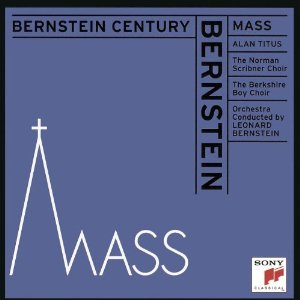
Hymn and Psalm: “A Simple Song,” from Leonard Bernstein’s Mass, Performed By Alan Titus (1971), encountered 1972

Buy it here | See it here | Sheet Music here

Sharm el Sheikh, by Ran Eliran (1967), encountered 1972[1]

See it here | Lyrics here

             When I was a young adult, religious faith came easily to me. I might have tired of the nuns who’d taken me through eighth grade, but that didn’t keep their certainty from having proved both contagious and durable. Many of my contemporaries had experienced the clerical corruption you hear so much about (the Vatican Bank-pedophilia-love-of-luxury side of things), and I guess I’d seen a little, but most of the nuns and priests who’d brought me along had been extraordinarily good people, and, deservedly, they’d made a great impression. I was no fool for trusting in them or what they told me. And if that were not enough, I had the example of my mother’s more literary and sophisticated faith to bolster me.[2]

As a result, at the time I got married, I had shed little of the committed, intellectual Catholicism in which I had been raised. I’d stopped going to confession,[3] and obviously my sex life was not in accordance with the official Catholic line, but I remained a true believer, or at least one with an asterisk for matters related to sex.

Affirming Them Both

This posed quite a problem when I found myself married to a Jewish woman who took her own religion seriously. (Our union was concelebrated by a priest and a rabbi.)[4] This led me to try to find ways to affirm both of our traditions, together if possible.

Part of it was a joint project of me and my wife, both of us bookworms, to read up and educate ourselves on the intersections between our faiths, for instance common history, both biblical and recent. It also expressed itself musically.

A prime case of the latter was my interest in Leonard Bernstein’s Mass, a theater piece based on and inspired by the Catholic Mass. Fittingly, I was introduced to the original recording by a Catholic priest, in fact the priest who had officiated at our marriage. I knew the records; I’d taped the priest’s version. I think I also knew the PBS version that aired in 1973.[5] This is a work I’ve written a lot about since, but it intrigues me how different are the things I found interesting about it in 1972 or 1973 and the things that interest me about it today.

For those who don’t know it (and my own writings are a decent introduction to it), the work follows (for the most part) the sequence of the Catholic Mass, but on that path follows the Mass’s Celebrant as he and his flock move from a simple, secure confidence in God through a crisis of faith, a dark night of the soul, and thence into an uneasy return to something like faith at the very end. To me, at that point, it was the initial confidence that interested me the most.

The Simplest of All Things?

This confidence is expressed strikingly at the outset by the first entrance of the Celebrant. As the piece begins, a jangling, atonal, modernistic Kyrie is pouring out of the sound system. The Celebrant strides into the light and dispels the annoying music by strumming a single loud G chord on a guitar, and then launches into A Simple Song.

Sing God a simple song 
Lauda, Laudē … 
Make it up as you go along 
Lauda, Laudē … 

Shortly thereafter, the Celebrant is quoting from one of the most serene of the Psalms, No. 121:

For the Lord is my shade, 
Is the shade upon my right hand 
And the sun shall not smite me by day
Nor the moon by night

            Actually, however unmitigated by doubt are the words the Celebrant sings, and however directly lyrical those words may be, the music is anything but simple (just try to pick it out on the piano and you’ll see what I mean), a mixture of Eastern and Western scales in keys that are constantly changing. It is a measure of Bernstein’s artistry that this still seems simple.

But to me at the time that song was the heart of it.  As the Celebrant’s faith gradually broke down over the course of the piece, the proceedings seemed more and more conventional and even hackneyed.  The two points where I was completely back on board were the equally confident Word of the Lord segment, and the echoes of A Simple Song at the very end.  I just couldn’t buy into the existential angst that fuels most of the rest of the piece to one degree or another.

Today, it’s reversed.  In recent years, as later Theme Songs pieces will reveal, I’ve had my own dark nights of the soul, and I’ve come to appreciate how well Bernstein conveys what the process feels like. It’s the happy talk parts I so closely identified with then that sound superficial to me now.  (“God is the simplest of all [things]”? Not bloody likely.)

But hearkening back to what I liked about it then, I think I also saw in Bernstein someone Jewish who saw in Catholic ritual and faith something entirely complementary to his own spirituality, as I saw it in his Judaism.

Folk Mass Man

Music was becoming more important to my religious life then in any event. I had joined the Newman community[6] at Hopkins, and shortly found myself (without the benefit of any training worthy the name)[7] leading the music at Sunday Mass, standing up on a platform at the front of a classroom, armed only with a chromatic harmonica. To my great good fortune, I was assisted in that effort by a number of talented undergrads and grads with enormously more developed instrumental skills. But it meant that I was constantly listening for music that might work for our Mass.

About which a word. This was the era of so-called folk Masses.[8] That label covered a multitude of things which differed from congregation to congregation. At Hopkins Newman in that era, the folk Mass canon allowed in a lot of pure pop like the Beatles’ Nowhere Man and Simon & Garfunkle’s Sounds of Silence, songs which lacked a specific religious referent, but which raised questions to which we were trying to come up with answers that honored our religious perspectives. It went nicely with the sermons by our pastor, Father Phil, a man with a remarkable facility for drawing moral and theological lessons from the latest movies.

Our congregation used an improvised hymnal of our own devising, of which I hope all copies have since vanished. I hope that because it was reissued while I was there, and I made a couple of anonymous contributions to the new edition. Each song was a rendering into English and a religious context of songs I’d heard on a compilation album belonging, I think, to my in-laws called Jerusalem of Gold.[9] Let’s just say that, when it comes to literary callings, mine, if I have one, is as an essayist, not as a lyricist.

Inspired

But for present purposes, it really matters not whether I was a budding Alexander Pope or on the contrary, a budding Colley Cibber.[10] The point is that I was listening to and drawing inspiration from an album of Hebrew songs. And not just any songs, but specifically songs in an album inspired by the Six-Day War, the war that tripled Israel’s land mass and gave a tremendous shot in the arm to the morale of all of my in-laws and their connections. One of the songs that spoke most to me was Sharm el Sheikh, by Ran Eliran, an evocation of the port down at the bottom of the Sinai captured from Egypt in 1967.

The chorus goes (in transliterated Hebrew)

At Sharm a-sheikh,
chazarnu elaich
shenitat belibeinu,
libeinu tamid

(and in translation)

You’re Sharam A Sheikh,
we’ve returned to you once again
You are in our hearts,
always in our hearts

            The rest of the lyrics are a poetic evocation of the town (reportedly largely a fishing village) together with a strong message that the singer and his people belong there. In other words, given the events that are implied, it is a message that Israel’s being in Sharm el Sheikh was a reversion to something right and natural.

Not Quite Our Own

I turned this stirring music into a song about – some Christian doctrine or other, let’s just leave it at that. When I listen to Ran Eliran’s song today, the music continues to stir me, more now that I have a better idea what the Hebrew lyrics portend than I did then. They have to do with feeling one has returned to a place that is right and appropriate (dare I say, in the Catholic phrase, meet and fitting?) for one.

That is what I was trying to feel about a marriage with one foot in a faith that was not my own. I think Eliran got closer to really feeling it, though, given the subsequent history of the town (restored to Egypt in 1982), one cannot help wondering. Perhaps a lot of us sing loudly of feelings that are not quite our own, assert kinships and allegiances we do not exactly feel, try to feel familiar and comfortable in places where we are not thoroughly welcomed.


[1]. This cover for Jerusalem of Gold may or may not be the current cover of the album I’m trying to describe. See Note 9 below.

[2]. I wish I had spoken more with my mother about the origins of her faith. My best guess, piecing together various clues, was that she came to it, not in the course of her own Catholic schooling, but in her late 20s and early 30s. She had turned her back on the Church and affiliated with the Unitarians in college, and married my father, a secularized Jew who had embraced a not-exactly theistic Quakerism, and then her marriage to him had crumbled once, flickered back to life, and then crumbled again. I think her belief dated to that second marital collapse.

One can draw various conclusions about the emotional forces that might have made her particularly receptive to a reconversion at that point in her life, but I have to say I’m skeptical that it was by any means all about her heart. England, where this happened to her, was home to some of the smartest Christians then teaching and writing, including G. K. Chesterton, Hilaire Belloc, and especially C.S. Lewis, and she read deeply of their writings. I think that she was deeply influenced as well by some Dominicans whom she fell in with. I, who came in the midst of this, was baptized by a Dominican, one Fr. Hugh Halton. My mother was as certain as any nun I encountered, and a good deal better read than most. In later life, unfortunately, her mind may have gotten slack and maudlin, but it was nothing of the kind in her 30s.

[3]. A ghastly priest by the name of Fr. Macek had driven me away from the confessional for all time when he spluttered, in response to some comment I’d made about faith, “Why, that’s existentialism!” To be sure, Sartre was exactly where I’d gotten whatever idea I was trying out, but my attitude was: So What? I never came back.

I wish I could brag that my abandonment of the confessional was purely a matter of not wanting to waste my budding philosophical sophistication on ignoramuses who dealt only in labels. But in truth, it surely also had a lot, maybe more, to do with disagreements about sex. What healthy adolescent is going to put up with being told the things he most desires and enjoys are sinful?

[4]. Rabbis willing to concelebrate or even to officiate at the marriage of a Jew to a non-Jew were hard to find. While acknowledging that those who discouraged mixed marriage often acted from some benevolent motives, I bitterly resented being told, implicitly, that simply by virtue of my faith, I was unworthy of my wife’s hand and/or such a threat to sectarian survival that I should be resisted in this way. Having been born white, male, and middle-class, I may not have encountered much in the way of second-class citizenship before, and I predictably hated it.

[5]. I do not remember this fact, but apparently the 1973 PBS version was not the original Kennedy Center production with Alan Titus as the Celebrant, but rather a Vienna production; so, at least, say posters commenting on a YouTube clip of what may have been the 1973 PBS version or the 10th Anniversary Kennedy Center PBS version. I’m not sure that I knew the 1973 PBS version, because my wife and I did not own a television in those years, and I’m not sure where I would have seen it. Still, I have this sense I knew it.

[6]. Named after John Henry, Cardinal Newman (1801-1890), Newman Centers are Catholic congregations on secular college and university campuses in the United States

[7]. I’d sung in the St. Thomas grade school choir, where I’d learned one critical skill: how to hear the difference between singing on-key and singing off-key. When I got to the Hopkins Newman Center, I think I spent a year being schooled in the basics of song-leading by a guitar-playing senior named Jeff. But obviously it’s a lot easier to lead the congregation with a guitar (which, besides being a rhythm instrument, gives you the ability to sing as you play) than it is with a harmonica.

[8]. An interesting take on where we are with the development through and past folk Masses as of this writing can be found here.

[9]. This may or may not be part of later popular album called Jerusalem of Gold which obviously contains more than a single LP’s worth of material; I note that one of the commenters on the Amazon site says she remembered listening to it as a child around 1967. The album I recall was a single LP and I’m almost certain the cover was in the light blue and white Israeli colors, not those darker ones on the 2004 album which appears from the comment to be a reissue. Perhaps there was a Volume II I did not know about at the time.

[10]. Cibber was the plodding poet who was butt of Pope’s great satire, The Duniad (in the 1743 version, anyhow).

Copyright (c) Jack L. B. Gohn, except for graphic elements

Theme Songs Page | Previous Theme Song | Next Theme Song


“In a Conventional Dither”: Rodgers and Hammerstein’s Camouflaged Critique of Race Relations at Mid-Century

Theater Reviews Page | Previous Theater Review | Next Theater Review 

 “In a Conventional Dither”: Rodgers and Hammerstein’s Camouflaged Critique of Race Relations at Mid-Century

Published in The Hopkins Review, New Series 5.3, Summer 2012 Issue

            Standard histories of the African American experience in America like John Hope Franklin’s or Manning Marable’s agree that in most respects the years 1949-51 fell in the middle of a fallow period.  The wave of political and social betterment for American blacks achieved during the New Deal and World War Two had crested, culminating with the 1947 admission of Jackie Robinson to the white major leagues and Harry Truman’s 1948 order integrating the Armed Forces.  After that, with few exceptions, the movement had reached a “one step back” moment.

Red Scare

            The Red Scare was largely to blame.  Segregationists could with remarkable success tag all integrationist aspirations as Communistic, via the syllogism that international Communism sought to destabilize the U.S., integration would differ from and hence be destabilizing to the existing state of affairs in much of the country, and hence integration was Communistic.

            Moreover, American Communists who had been, by all accounts, the most principled and consistent foes of Jim Crow laws and segregation in the workplace, were in full flight, being hunted into what would prove a permanent exile from the U.S. labor movement, academia, government, and entertainment.  Incidental to that purge was fratricidal infighting on the American left between Communists and anti-Communists which took a particularly heavy and distracting toll on the NAACP and Congress of Racial Equality.

            True, Charles Houston and Thurgood Marshall were continuing their careful case-by-case assault on the legal citadel of Jim Crow, an assault that would reach its apex in 1954 with Brown v. Board of Education, and Brown would change everything.  But while some of the five cases consolidated in Brown had already been filed by 1951, it is significant that in four of them segregation was upheld.  Fundamentally, Jim Crow laws and what might be called the Jim Crow state of mind, a sense that white privilege was a norm which could never fundamentally be overturned, continued to hold sway in 1949-51.

            The anti-Communist hysteria also had well-known implications in the world of entertainment.  Though the infamous Hollywood “blacklist” turned out not to affect Broadway employment much, there was so much travel back and forth between the venues that the habits of circumspection the Red Scare brought to Hollywood could hardly fail to affect Broadway productions.  And since, as noted, support for African American civil rights was viewed as a sign of Communist sympathies, it would not in turn be easy to espouse those civil rights on Broadway.

Indirection

            In short, during the three-year stretch in which Richard Rodgers’ and Oscar Hammerstein II’s South Pacific (1949) and The King and I (1951) reached the Broadway stage, theatrical expressions of support for the equality of black and white were a dicey proposition, courting charges of Communist sympathies.  And yet in these two musicals, lyricist and librettist Hammerstein found a way to voice that support.  However, in keeping with the times as well as his temperament, he did so by indirection, and also with what might be called camouflage: presenting the “destabilizing” message about race relations in a matrix that included remarkably conventional and reassuring, even retrograde, messages concerning the relations of the sexes and colonialism.  The conservative American Weltanschauung was being challenged, but only a little.  Both the indirection and the camouflage were bound up with the showmanship and the temperaments of Hammerstein and his collaborator Richard Rodgers.

            These two shows came at the fulcrum of R&H’s career.  Richard Rodgers and Oscar Hammerstein II created eleven musicals over the years 1941-1959.  Five of them (Oklahoma!, Carousel, South Pacific, The King and I, and The Sound of Music) were indisputably great: game-changers as to the whole genre of the musical theater, long-running, sources of popular hits and standards, and destined to be revived continuously through the changing tastes and mores of the succeeding years.

Hammerstein the Integrationist

            As chronicled by Jim Lovensheimer, author of the phenomenally well-researched and insightful study South Pacific: Paradise Rewritten (2010), Hammerstein was an inveterate inegrationist.  He had been part of the Writers’ War Board, a group formed two days after Pearl Harbor whose official mission was to help sell war bonds, but which was also dedicated to fighting racial prejudice as a form of American fascism.[1] Before that, during his movie-writing years, he had been the chair of an “interracial commission” of the Hollywood Anti-Nazi League.[2]  Lovensheimer also recounts that Hammerstein served as a member of the Board of the National Association for the Advancement of Colored People “from the late 1940s.”[3]  Yet R&H never wrote a great civil rights musical.  They never even wrote together a musical in which the rights and status of African Americans were directly addressed.

            Instead we have South Pacific and The King and I, two masterpieces that express abhorrence for American racial prejudice and segregation, which was mostly about black and white at that time.  Yet remarkably they do not include a single necessarily black character.  (There were at least two African American actors in the original South Pacific cast.  One was a member of the male chorus with no individual lines but given the name Abner, portrayed by Archie Savage,[4] who was given to jitterbugging, understood as a race-specific activity then.  The other was Juanita Hall, but portraying the Tonkinese Bloody Mary, not an African American character.)

            As is well-known, South Pacific was hewn from James A. Michener’s Pulitzer Prize-winning Tales of the South Pacific(1947), sometimes called a novel but really more a collection of related and interwoven short stories following a military campaign in the New Hebrides (the area being a part of the nation now known as Vanuatu).[5]  In the course of the book, various characters appear, disappear, and sometimes reappear.  There is no one coherent tale.  Of course that would hardly work for a musical, especially one of that era.  So a drama had to be located and shaped within that raw material.

Our Heroine

            The most important story chosen was “Our Heroine,” the story of the romance of Nellie Forbush, a Navy nurse who comes “from a small town in Arkansas,” (in the musical a self-described “little hick”) and Emile De Becque, expatriate French plantation-owner.  The dissimilarity of these characters was emphasized by R&H’s disparate original casting for these roles (Broadway-seasoned Texas gamine Mary Martin and Italian operatic basso Ezio Pinza).  The audience is asked, nay forced by the plangent power of Rodgers’ music and especially the song SOME ENCHANTED EVENING, to believe that these dissimilar souls are attracted, that they recognize something elementally alike in each other.  Hammerstein tries to make this more credible by giving Nellie a line not suggested by Michener: “We’re – we’re the same kind of people fundamentally – you and me.  We appreciate things! We get enthusiastic about things!”  This attempt to explain is both unnecessary (as Hammerstein the lyricist himself has Emile sing: “Fools give you reasons–/ Wise men never try”) and beside Michener’s point.  Michener makes it clear enough that what draws them together is an expatriate spirit, a willingness to cut ties with an old life and to make a new one in an out-of-the-expected, if beautiful place.  And ultimately R&H follow suit in that characterization.

            The conflict in “Our Heroine,” and what undoubtedly drew Hammerstein to the material, was of course racial, posed not by the white skins of Nellie or Emile, but by the multi-colored skins of Emile’s daughters, who are the products of Emile’s various extramarital liaisons: Javanese, Polynesian, and Tonkinese.  Nellie must learn to overcome the racism she was raised with to accept Emile’s children as step-children, and she very nearly does not.

Fo’ Dolla’

            The Michener story which Hammerstein chose as counterpoint to “Our Heroine” was by far the longest of the tales in the book, “Fo’ Dolla’,” which concerns a romance in which the parties are indeed of different colors: white and Philadelphia-and-Princeton aristocratic Marine Lt. Joe Cable and Tonkinese Liat.  All the chemistry is auspicious, and the love is never in question: “He and Liat were experiencing a passion that few couples on this earth are privileged to share.”  But he cannot see any way to bring her back into his Stateside life, and embraces the opportunity to escape from her provided by orders that move him to a different theater of combat.  We learn later, in the concluding pages of the concluding story, “A Cemetery at Hoga Point,” that Cable was so distraught over the experience that he effectively threw his life away by exhibiting excessive heroism invading a beachhead.

            So R&H had two stories, one with a happy outcome, one tragic, both demonstrating how racial prejudice can threaten romance.  And these became the core of the show.  Cumulatively, they illustrate the point that racism causes unhappiness, not only to the non-white Others and those who, like Emile, love them, but also to the racists themselves.  Nellie manages to overcome hers, thereby insuring her own happiness and that of Emile and his children.  Cable cannot, and so brings misery to Liat, who must marry a French planter she does not love, and destruction to himself.

The N-Word

            But this story is told without black people, at least without them being directly involved or placed on the stage in front of the audience.  This reflects what appears to be a similar pulling of punches in the source material.  Michener’s Emile has no fewer than eight daughters, with various mothers: Javanese (Indonesian), Polynesian, and Tonkinese (Vietnamese).  But this story takes place in the New Hebrides, whose natives are Melanesian.  Melanesian skins are blacker on average, than those of the mothers of Emile’s children.[6]  In his autobiography, Michener commented on the comparatively darker skin of Melanesians – and on his observation that whites generally find Polynesians comelier.[7]  One wonders whether Michener hesitated to have Emile actually fathering half-Melanesians, even in the midst of the New Hebrides where Melanesians predominated.

            On the other hand, perhaps Michener was making a tougher point in a roundabout way.  Michener’s Nellie, unlike Hammerstein’s, is aware, before she meets any of Emile’s eight children, that his children are of mixed race.  She decides to await an actual meeting to gauge her own reaction.  When she encounters his two Polynesian children, she clutches.  Michener makes the language harsh, and quite applicable to U.S. race relations: 

But before her were … indisputable facts!  Two of them!  Emile De Becque, not satisfied with Javanese and Tonkinese women, had also lived with a Polynesian.  A nigger!  To Nellie’s tutored mind any person living or dead who was not white or yellow was a nigger.  And beyond that no words could go!  Her entire Arkansas upbringing made it impossible for her to deny the teachings of her youth.  Emile  De Becque had lived with the nigger.  He had nigger children.  If she married him, they would be her step-daughters.  She suffered a revulsion which her lover could never understand.

Arguably, Nellie’s bracketing of Polynesians with American blacks as “niggers” more thoroughly illustrates the unreasoning quality of Nellie’s racism than would be possible if the children were part-Melanesian instead.

            In any case, there is no use of the n-word in Hammerstein’s adaptation and even the word “colored” was stripped from the 1949 script (though it was reinstated in the archival 2008 Lincoln Center production).  There are only two children, and only one mother (and she a deceased wife).  The children are half-Polynesian, and that in itself, bracketing aside, seems enough to turn Hammerstein’s Nellie away for a time.

 NELLIE          It means that I can’t marry you.  Do you understand?  I can’t marry you.

EMILE            Nellie– Because of my children?

NELLIE          Not because of your children.  They’re sweet.

EMILE            It is their Polynesian mother then–their mother and I.

NELLIE          … Yes.  I can’t help it.  It isn’t as if I could give you a good reason.  There is no reason.  This is emotional.  This is something that is born in me.[8]

 Cable, who has witnessed the exchange, then gives voice to the most pointed commentary Hammerstein permits himself in the musical, the song YOU’VE GOT TO BE CAREFULLY TAUGHT, a bombshell that lasts only 1:19 on the original cast recording.  The song concludes:

 You’ve got to be taught before it’s too late,
Before you are six or seven or eight,
To hate all the people your relatives hate –
You’ve got to be carefully taught!

 It gives the lie to Nellie’s “born in me” excuse, and suggests the path to her redemption, which is a process of unlearning what she had been carefully taught.  And of course it would also be Cable’s path to redemption, could he but take it.  Again, not once is there anything explicitly about the American black-and-white situation, but the song is nonetheless aimed directly at it, and was naturally understood as such by the original audience.  R&H were under great pressure to remove even so elliptical a set of references to America’s racial problem by cutting the song during tryouts on the road, but stood their ground.

Unprivileged Others

            The pattern was repeated with The King and I.  If possible, the ostensible subject matter (the years spent by a British schoolteacher in the royal Siamese court in the 1860s instructing women and children of the harem) was even further from contemporary racial conflicts.  Yet the story is in a way even more on-point.

            In The King and I, the focus is on privilege, and the un-privileged Others are women, Southeast Asians, even whites – in fact everyone who is not the King himself is in a non-privileged status at some point vis-à-vis the King.  Even the King, it emerges, is un-privileged and suspect next to the monarchs of the European colonizing powers.

           U.S. race relations are explicitly dragged in only as a critique of gender relations in the Siamese court, via the “Small House of Uncle Thomas” pantomime and ballet, in which an American tale about race is presented as a Siamese story about monarchical privilege.  But every status disparity in The King and I, whether between men and women, Thais and Burmese, a king and his subjects, Simon Legree and Eliza, or Queen Victoria and King Mongkut, is shown an enemy to human potential and happiness.  It is hard to imagine a musical in which the baneful effects of privilege are more fully limned and pilloried.

            Of course, privilege is one thing and race relations somewhat separate. Nonetheless, what R&H saw in the story of Anna Leonowens and King Mongkut of Siam was an array of privilege issues that mirrored the privilege issues in U.S. race relations of that era.  Consider a few key aspects of the plot.

Unenforceable Rights

            The struggles between Anna and the King begin almost at once, as Anna discovers upon arrival at Bangkok that the contractually-stipulated house outside the palace will not be made available to her.  As the Kralahome, the prime minister, advises her: “King do not always remember what he promise.  If I tell him he break his promise, I will make anger in him.”  This pattern, whereby rights and interests of those with lesser privilege can be ignored by those with greater privilege, and then those with greater privilege can prevent grievances merely by avoiding or changing the subject, or preemptively forbidding the raising of a grievance at all, runs throughout the play.  It also parallels the kind of problem those fighting for African American rights kept encountering: an inability to lodge grievances.

            A concrete example of this problem in then-contemporary America was the way black sharecroppers would be cheated, and without appeal, by their landlords.  Isabel Wilkerson, in her recent study The Warmth of Other Suns (2010) recounts how at the annual accounting, black sharecroppers would regularly come up with no compensation at all, based on the landlord’s unchallengeable computations.  Wilkerson quotes anthropologist Hortense Powdermaker, who had studied sharecropping in the 1930s:

One reason for preferring Negro to white labor on plantations is the inability of the Negro to make or enforce demands for a just statement or any statement at all.  He may hope for protection, justice, honesty from his landlord, but he cannot demand them.  There is no force to back up a demand, neither the law, the vote nor public opinion.”[9]

Later, when Anna seizes an opportunity to address the King directly on the contract, she says: “Those were your words in your letter.”  The King replies: “I do not remember such words … I will do remembering.  Who is King?”[10]

Liberties

            As early as Scene 1.2, we are plunged into the story of Tuptim, a “gift” from the ruler of Burma to the King.  By singing MY LORD AND MASTER, Tuptim makes clear at once that, though she is dedicated to the King’s sexual service, her heart belongs to another, Lun Tha, the emissary who has brought her from Burma.  Of course, the chattel slavery which had enabled widespread sexual exploitation of African Americans by their white owners was gone from the American scene by 1951, but imbalances of power nearly as grotesque, many of them sexual, were everywhere to be seen.  Here is Wilkerson again, on the situation in Florida in the 1930s:

[C]olored men had little say over their wives since the days when slave masters could taken their women whenever they pleased and colored men could do nothing about it.  Planters were known to take the same liberties the slave masters had, and the contradictions were not lost on colored men: white men could do to colored women what colored men could be burned alive for doing to white women.[11]

            Anna also encounters, and expresses strong disapproval, of protocol which demands ritualized servility.  Anna’s take, expressed in SHALL I TELL YOU WHAT I THINK OF YOU?:

 All that bowing and kowtowing
To remind you of your royalty,
I find a most disgusting exhibition.
I wouldn’t ask a Siamese cat
To demonstrate his loyalty
By taking that ridiculous position!

In similar fashion, the best-known aspect of Jim Crow was the way it reinforced black servility by mandating it, enforcing that mandate by law and by lynching.  Once more Wilkerson, on the informal education of Southern black children of that era: “All this stepping off the sidewalk [when a white person was coming], not looking even in the direction of a white woman, the sirring and ma’aming and waiting until all the white people had been served before buying your ice cream cone, with violence and even death awaiting any misstep.”[12]

            And then, of course, there is the “Small House of Uncle Thomas” ballet, which makes the parallels explicit: the King’s regime is likened to that of “King Simon of Legree.”  This is not to say that the attack on privilege is nothing but an allegory of U.S. race relations, but it certainly is that.

Leonowens

            On this point it is instructive, as it was with R&H’s treatment of Michener, to see what use they made of their sources.  Here, the work was nominally adapted from Margaret Landon’s book Anna and the King of Siam (1944).  Landon’s book was itself largely an adaptation of Leonowens’ two volumes The English Governess at the Siamese Court (1870) and The Romance of the Harem (1872), and it is clear from many aspects of the musical that R&H had had access to Leonowens’ own books.[13]  Taking these sources together, they would have recognized Leonowens as a woman of many parts.  Leonowens was far more than a memoirist recounting her time at the court.  She was also vastly knowledgeable about Siamese history and geography.  She could turn her hand to travelogue, going into great detail, for instance, about a visit to Angkor Wat in Cambodia.  She provided interesting, if somewhat arch, observations on and comparisons of the religions practiced in Siam: not only Buddhism, but Hinduism and various stripes of Christianity.  She also had some talent as a Sheherezade, a spinner of exotic and sentimental tales, even if they are not all to modern taste.  Although she was far from innocent of European condescension to some of what she saw, it is also true that she found much to learn in Siam, and she was an apt pupil.  And even when she despised what she saw, she took the trouble to anatomize it carefully.  Chapter XXX of her second book is a long and minute description of the laws and customs regarding slavery in Siam; remarkably the summary is based on a code of slave laws provided her by the King himself.  In short, like the Anna of the lyrics of the musical, although not (I submit) the plot, she agreed that: “[I]f you become a teacher/ By your pupils you’ll be taught.”

            R&H were of course constrained by the demands of their medium to simplify this complex and accomplished woman enough so she would fit into two Broadway hours and provide a vehicle for Gertrude Lawrence into the bargain.  What was largely lost in the process was a sense of her self-sufficiency.  Leonowens does not expatiate on her widowhood.

“How many years your husband has been dead?” he asked.

I replied that his Excellency had no right to pry into my domestic concerns.  His business was with me as a governess only; on any other subject I declined conversing.”[14]

This exchange is somewhat reproduced in the musical, in Scene 1.1, but in the books Leonowens keeps her own stated counsel and says little more about her romantic past.  In the musical, though, she sings HELLO YOUNG LOVERS, and discloses her past love life to the women of the harem.  Clearly her deceased husband Tom remains central to her identity.  One thing this revelation does is provide a counterpoint to Tuptim’s previously mentioned MY LORD AND MASTER; it shows the superiority of freely-chosen love to the broken hearts and enforced sex that concubinage brings.  But it also diminishes the independence of Leonowens’ personality.  Actually, R&H do the same with the flight from the harem of Tuptim, who as both Leonowens and Landon depict her is not following a romantic dream built around a man but rather a quest for freedom.

Given A Pass

            Another liberty along these lines, of course, is the decision to put an entirely fictional element of romantic attraction into the relationship between Anna and the King.  They are given a moment to act like lovers in the grand polka SHALL WE DANCE?  And, via the tropes of romance, the King is also given a partial pass on all of his other abuses, when his head wife, Lady Thiang, sings SOMETHING WONDERFUL.  She is in love with him because of his yearnings to improve matters, even if matters don’t seem to have improved much on his watch.  It is a “Stand By Your Man” moment on a par with WHAT’S THE USE OF WOND’RIN’ from Carousel, giving the man a pass on all of his defects.  This treatment ignores that the King’s personal defects bring consequences for all his subjects.  The personal is far more political than this handling of it suggests.  Considering the ease with which his son and heir, Prince Chulalongkorn, ends kowtowing, with an edict before the dying King’s body is even cold, it seems as if the King’s failure to resolve any of the grievances against his regime is not so much a matter of incompetence as of design.  (The historical Chulalongkorn also ended slavery and concubinage.)

            Lovensheimer has well summarized the shifting message American society was giving women after World War II and during the early Cold War.  And the change is beautifully summarized in the last few minutes of the 1984 movie, Swing Shift, as the forcibly retired female aircraft assemblers are shown a propaganda film designed to make them feel good about being laid off to make room for returning male workers.  Rosie the Riveter was being eased out, and the domestic goddess, heroine of a thousand sitcoms, was the icon called upon to replace her.  Nellie Forbush, a forward-deployed Rosie, may be the type to, as she sings, “stand on my little flat feet,” but in the final image of South Pacific she becomes a materfamilias.  Henceforth her value will derive largely from Emile’s love, his flat feet.  She will become the stepmother of two legitimate children (rather than, as in the book, eight illegitimate ones).  Likewise, Anna’s stature is greater because she was loved once, and Tuptim’s story is largely about the value (and not the cost) of trying to love a man.

Reviving the Empire

            Similarly with the political message.  The old empires were dying at mid-century, but the fight to continue white cultural hegemony and the political influence of the former colonial powers was continuing.  Both musicals were set in what would soon be called the Third World, the object of a contest between East and West.  Each of these musicals conveys wholehearted support for the rightness and the continuation of white and Western influence and dominance.

            Consider again that same closing tableau in South Pacific.  Lovensheimer quotes tellingly from a study by Christina Klein on the subject.  This just-constituted family:

… invigorates an aging and weary France, gives provincial America access to the colonial sources of French wealth and prestige, and maintains the childlike Asians in a condition of security and dependence…. It visualizes and narrativizes America’s emerging role in Southeast Asia.[15]

Indeed.  Nor should it escape notice that part of the triumphant mood at the end of the musical owes to the spectacle of U.S. military forces enthusiastically moving out to occupy Third World turf.

Anna the Westernizer

            And it can be said that The King and I conveys a similar message in far more concentrated form.  Anna is hired specifically to bring a “scientific” Western body of knowledge and outlook to the children of the King, presumably members of the future Siamese/Thai ruling class including the next monarch.  She is also retained to assist the King with his correspondence and the related tricky business of helping the King put up a Westernized front to fend off impressions that he is a “barbarian” whose country is unfit (in the eyes of the colonial powers) to remain independent.  The one lesson we witness, Scene 1.4, is about demonstrating to the pupils how small Siam is (using, however, a Mercator projection map that unfairly minimizes Siam’s relative size).  The things she objects to in Siam are all signs of the country’s backwardness, and not matters of difference between equally valid cultures.

            There is no question that Leonowens despised slavery, but she also evidenced a great admiration for Siamese culture and took a somewhat relativistic approach to the various religions competing there.  And while R&H pay lip service to that outlook (“by your pupils you’ll be taught”), I can discern no evidence that the stage Anna actually learns anything beyond the information that comes with mere acquaintance.

            Instead, we see the King literally dying because he cannot bring himself absorb Anna’s westernizing lessons, while upon his demise his son, under Anna’s tutelage, proudly proclaims the changes Anna directed.  Anna, unlike the historical Leonowens, either of her memoirs or of Landon’s adaptation, remains on the scene.  Civilized Westerners need to stay on the scene to keep things from going awry.

Camouflage

            The messages that women are validated by their male and family relationships and that the West had an important role to play in the Third World would have been comforting, not challenging to even the sternest segregationists in the Broadway audiences of mid-century, and would have taken away a great deal of the sting and discomfort inflicted by the indirect messages about race relations.  And Rodgers and Hammerstein, master showmen, would have known this perfectly well.  We can argue about whether these sustained exercises in talking about a problem without mentioning it much are tours-de-forces or cowardly evasions.  But the artistry cannot be disputed.  When Nellie goes into “a conventional dither” about Emile, we are going to be swept along, and rendered defenseless against a few indirect lessons that might otherwise not be welcome.


[1].  Id., at 30-31.

[2].  Id., at 17-19.

[3].  Id., at 31.

[4].  Concerning Savage, see id., at 105.

[5].  Michener drops a great many hints as to the setting, some of them hard to reconcile.  His nameless narrator recounts that “I served in the South Pacific during the bitter days of ‘41 through ‘43,” and also mentions that he knew and dealt with various heroes of the Battle of Guadalcanal, which ended in February 1943.  Yet: a) there is no suggestion that the action takes place on Guadalcanal; and b) Guadalcanal is not in the New Hebrides, although it is in the South Pacific.  Operation Alligator, the campaign around which the book revolves, actually sounds a bit like the campaign up the “Slot” made possible by the success of the Guadalcanal campaign, but both the location and the timing are wrong.  As presented in the musical, the campaign resembles the beginning of the “Slot” campaign added to the actual history of the New Hebrides occupation as the U.S. military’s jumping-off point for Guadalcanal and the first land offensive of the War in the Pacific.  (To be clear, however, the Japanese never occupied the New Hebrides, and did not have to be driven out, so that no land fighting occurred until the campaign of the Solomons which began with Guadalcanal.  In other words, Alligator could not have occurred there, and a planter like Emile De Becque could not have used local knowledge to serve as a land watcher assisting such an operation.)  In his memoir, Michener speaks of having been an observer through much of the Slot campaign.

[6].  The reader can compare the opening scenes of The Thin Red Line, streamable on Netflix, based on James Jones’ novel, mainly about the invasion of Guadalcanal, but which starts out probably in the same general area as South Pacific does, showing some of the soldiers hanging out AWOL with Melanesians.  They do not look remotely Polynesian.

[7].  Michener, The World Is My Home: A Memoir (1992) at 35-36.

[8].  Scene 2.4.

[9].  Wilkerson at 54, quoting Powdermaker, After Freedom: A Cultural History of the Deep South (1939) at 86.

[10].  Scene 1.4.

[11].  Wilkerson, at 52.

[12].  Id., at 62.

[13].  For instance, as mentioned above, the first conflict appearing in the musical is over whether Anna can have her own house.  This fight is greatly downplayed in Landon’s book (where, from aught that appears the initial failure to comply may have been an oversight), Landon at 84, but it forms a major part of the early action in Leonowens’ first book, spilling over Chapters I, VII and VIII.

[14].  Leonowens, Chapter II.

[15].  Lovensheimer at Page 178, quoting Christina Klein, Cold War Orientalism: Asia in the Middlebrow Imagination, 1945-1961 (2003) at 168.

 Copyright (c) Jack L. B. Gohn

Theater Reviews Page | Previous Theater Review | Next Theater Review

Sandusky: I Had The Opposite Story

Previous I Read The News Today Entry | Next I Read The News Today Entry

Sandusky: I Had The Opposite Story

I have been reading, in the light of Louis Freeh’s report about the coverup of the Jerry Sandusky child rapes at Penn State, about the horrible lifelong effects of sexual abuse.  I can only breathe a sigh of gratitude for a family that kept it from happening to me.  Because it could have happened if they hadn’t responded so correctly.  I had nearly forgotten about this, but the Sandusky tale brought it back.

My maternal grandmother’s hospitality to family members was legendary.  In the Depression, more than one of them had come to her house to die.  By the 1950s, almost all of her generation were gone, but she still had an alcoholic brother, Uncle Tom, about whom the story was that he had not been right since he’d been kicked in the head by a horse as a child.  Whatever the truth of that story, he was certainly peculiar, but always welcome at holidays like Thanksgiving and Christmas.

This particular year (probably 1956 or 1957), I was in the parlor of my grandparents’ Boston home.  Most of the grownups were in the kitchen.  Tom was sitting in an armchair in the parlor, and I was playing.  Tom started talking to me, got me sitting on his lap.  Grownups often had me on their laps, and I didn’t think anything of it.  But then he was touching me strangely, and the questions started, very insistent ones, about whether I liked to play with myself, a phrase whose meaning I did not even understand at the time.  Tom seemed disappointed that I did not follow what he was asking.  Somehow I extricated myself, and, thoroughly weirded out, wandered into the kitchen.  I don’t remember what I said or to whom I said it, but I told someone what Tom was asking me.

The consequences were immediate.  My grandmother marched into the parlor and started yelling at Tom, and the next thing I knew, he was no longer a Thanksgiving guest.  No one explained to me what it was all about, but I understood that it had something to do with the questions Tom had been asking me.  Instead of circling the adult wagons around Tom or minimizing his behavior, the entire family circle instantly believed me when I told the story, and took immediate, decisive action.  Tom did turn up at later family gatherings, but never came near me again.  Probably he’d been warned not even to think of it.

My family was not perfect in every way (no one’s is), but if they had done nothing else right, they acquitted themselves with great honor that day.  If the powers that be at Penn State had half the sense of right and wrong, half the integrity that my family had shown forty years earlier, there would be several, maybe dozens, of young men today who would not now be struggling with demons whose acquaintance I fortunately never made.

To be fair, Uncle Tom was a known drunk, and had other known mental health issues, while Sandusky was prestigious and well-connected amongst Happy Valley’s powerful.  But then again, so far as I know, my relatives never heard any eyewitness accounts of Tom raping anyone.  So it kind of evens out.

It was not merely that Tom’s sexual designs on me were foiled, let me add, but that the adults around me had proven themselves reliable.  You could share icky information with them and they wouldn’t come down on you.  Instead, they would process it as adults, and do the primary job of adults around children, protecting them.  They came through for me when I needed it in ways I literally couldn’t even imagine.  Just as bad experiences do, good ones reverberate through life.  And this one has stayed with me, become part of me.  I could be a more trusting person because I had encountered trustworthiness.

I am grateful for this, even as I empathize with the youngsters in Happy Valley who were not as lucky.

Copyright (c) Jack L. B. Gohn

Previous I Read The News Today Entry | Next I Read The News Today Entry

Ride Away

Theme Songs Page | Previous Theme Song | Next Theme Song

Ride Away

Ram On, by Paul McCartney (1971), encountered 1972

Buy it here | See it here | Lyrics here

At first listen, Ram On seems like an inconsiderable song from an inconsiderable album, Ram (1971). The breakup of the Beatles had left Paul McCartney with less in the way of songwriting skills than it did George or John, at least at that stage. The decline into nonsense verse and Dadaism, into scraps that did not merge into a satisfying whole, a decline that had progressively marked everything the Beatles had done after Sgt. Pepper, was first and foremost Paul’s affliction, and it would take him some years to bring it under control. What had absolutely not deserted him was his ear for melody.

And there is much melody in this ditty, especially as contributed by a deceptively simple ukelele. Hearing that plangent instrument obsessing over a C# minor 7th chord[1] with McCartney’s sweet falsetto crooning the leading tone at the top and then swooping down through the chord to the tonic, lifts you into a sublime, solitary, and calm place.

Which is why it’s a theme song for me. Year Two of my marriage sort of turned out to be that kind of place, and this song, which I played a lot as I was going through it, helped me out.

Like the now-Beatle-less sound of McCartney on this album, everything I knew and valued was being presented to me in an alien way. Girlfriend was now wife, and our lives together were taking place in the strange town of Baltimore, not the familiar and comfortable Philadelphia where we’d met.  English studies (in which I’d experienced such freedom and such a sense of exploration as an undergrad) had become abstruse, demanding and competitive, filtered through incomprehensible structuralist theory. And my parents who had once been too close now were far away, their space in my world largely preempted by a vociferous crew of in-laws. I felt adrift, rudderless, in my own life.

I don’t mean to say it was all bad, especially initially. The alien quality of it all would grow on me for a time (though not for all time). I found I was not overwhelmed for long, and actually began to master it.

I found I liked being married, that my misgivings about the rigors of fidelity were misplaced, that I could learn to play the game in the English Department (the picture shows me writing the Peter Bell book, part of my efforts to fit in, in my own way).[2] I found also that my wife was moving on from her own disappointment with that Department, and that my in-laws, though cut from very different cloth, were good and reliable people.  (And they were making the same discovery about me.)

It didn’t hurt that I misunderstood the lyrics.  McCartney sang:

Ram on, give your heart to somebody
Soon, right away, right away.

But what I heard was:

Ram on, give your heart to somebody,
Soon ride away, ride away.

What I heard, then, was that you could be empowered to ride away, to move on in some good way, by the act of giving your heart away.  You just needed faith in the strangeness of love to be transported in that way.  And if you listened to the second part of the song (buried 8 tracks further), you could hear what I had thought was riding music.  It came across all jolly and heartening.

It was good music for starting the next phase of my life.


[1]. See here for ukelele tabs.

[2].  The book, which is reprinted in full in this blog here, was, among other things, an elaborate response to the demands of the Department that we focus on established authors and do so in what the Department considered high critical mode. The book was about a slew of established authors: Wordsworth, Shelley and Byron among others. So I was giving them what they ostensibly wanted, and in a full-length book to boot, an astonishingly ambitious act of homage. At the same time, however, it was a book about minor works by all of these great authors, and was of the exact format that, once upon a time in the years where scholarship reigned supreme over criticism, would have been an acceptable doctoral dissertation, namely a critical edition (the texts of the works with heavy annotations and apparatus to sort through the variations in the texts). You could regard this as somewhere between a poke in the nose at the Department and an effort to compromise. Although three pieces of the work were published as learned journal articles, I never impressed anyone with it. But at the time of the photo taken above, that disappointment was in the future.

Copyright (c) Jack L. B. Gohn, except for cover art

Theme Songs Page | Previous Theme Song | Next Theme Song

The Drones and the Virus: Time to Talk, Not Prosecute

The Big Picture Home Page | Previous Big Picture Column | Next Big Picture Column

The Drones and the Virus: Time to Talk, Not Prosecute

Published in the Maryland Daily Record July 2, 2012

In two extraordinary recent feats of reportage, the New York Times made vital contributions to the national fund of knowledge concerning the national drone assassination program (May 29) and the cyberattacks on Iran’s nuclear program (June 1). What happened next was both peculiar and disturbing.

Collateral Damage

Though our government continues to refrain from officially admitting it, we have been killing unknown numbers of people with drone strikes, many of them people we have no reason to believe are terrorists. Weekly there is a videoconference of over a hundred members of the national security apparatus to formulate a new kill list to recommend to President Obama, and, also apparently weekly, Obama reviews the group’s recommendations and signs off on that week’s killings. There is no one involved in the process from outside the Executive Branch. No legal memoranda supporting the process have been made public. While the persons specifically targeted are all supposed to be terrorists, we notoriously tolerate the deaths of countless non-targets who just happen to have been in the wrong place at the wrong time when the drone bombs fell. The adult males who have had that misfortune are deemed retroactively to have been terrorists, simply because they are presumed to have been up to no good by virtue of sitting so close to a terrorist. The women and children are deemed collateral damage.

The virus for Iran, known now as Stuxnet, appears to have been the first – but it will surely not be the last – computer virus designed specifically to destroy physical machinery. It succeeded in wrecking 1,000 of the 5,000 centrifuges Iran is using to enrich uranium. The collateral damage, in this instance, came about when, in 2010, some Iranian nuclear engineer unsuspectingly took an infected laptop home and hooked up to the Internet, releasing Stuxnet “into the wild,” infecting countless other computers around the world. Again, our president has been deeply involved in the deliberations about the program, including what to do about it after the virus escaped.

High Dudgeon

Instead of suggesting Pulitzers for the authors of these pieces, Republican legislators went into high dudgeon, urging an independent prosecutor to determine who leaked them. The Democratic Attorney General appointed the United States Attorneys for the District of Columbia and Maryland to conduct a leak investigation – again making the kinds of noises that suggest that the leaks fundamental to each story were terrible things.

Peculiar, as I have said. It is close to a no-brainer that the source of the leaks was the White House itself. Though somewhat nuanced, the stories fundamentally depict Obama as a thoughtful, principled man making the tough decisions. No press secretary could have asked for more positive treatment, given the highly questionable nature of the presidential actions under discussion. Sending two well-respected United States Attorneys off to locate the leakers looks an awful lot like Richard Nixon asking Archibald Cox to find out who was responsible for Watergate.

It Can’t All Be In The Shadows

The bigger peculiarity, though, is that the leaks that both parties are loudly attacking actually begin to heal – a little bit – the wreckage the secrecy around these subjects has wrought; our constitutional system has been damaged about as badly as those centrifuges – not by the leaks, but by what the leaks concerned. Although the key Office of Legal Counsel opinion about the drones has not been released, of course it exists, and one of the reported findings there is that the due process involved in our government taking all those lives abroad could be accomplished completely within the Executive Branch.

I’m sorry, but that’s just not good enough. That is the same rationale that was used to justify Abu Ghraib and Guantanamo, the warrantless wiretaps, the torture, etc. Central to it is the concept that we are at war, that war is waged exclusively by the Executive, and that individual rights against government enjoyed by U.S. citizens in the U.S. in peacetime, especially due process rights and the benefits of checks and balances exercised by other branches of government against the Executive, do not apply under the conditions of this war.

Maybe the authors of such opinions are half-right. We can all agree that historical understandings of the dividing line between war and law enforcement do not fit well the kind of conflicts our nation faces today. But the solution to that quandary should not be to cede all discretion to an Executive that works in the shadows. There are other unaddressed needs at work, among them the imperative to cut the public in on the discussion and the decision-making.

What We Ought To Be Discussing

The public might not wish, even in the name of increased public safety, to be responsible for drone killings of innocent women and children – especially if this is done solely so that we can also knock off “bad guys” whose badness has been determined only by a cabal of 100 nameless people on a weekly videoconference call and ratified by a president who is not a judge and whose objectivity is affected by his desire for reelection. And the public almost certainly would not wish to have the deployment of scary computer viruses determined simply by a few high officials. Such decisions are going to have consequences for us all, and we all deserve a voice in them.

As to the drone killings, one of the consequences was spelled out by our most senior former president and Nobel laureate Jimmy Carter on June 24: this (together with detention, warrantless wiretapping, etc.) means we are “abandoning [our] role as the global champion of human rights.” By Carter’s count, we are now “clearly violating at least 10 of [the Universal Declaration of Human Rights’] 30 articles.” The next victims of the precedents we set will likely be us, and it would be good for us to talk about that in advance.

As to the computer virus, the implications are staggering. This virus was designed to “phone home” and accept guidance to map the entire command and control structure of the Iranian nuclear enrichment facility – and then to accept orders to override those controls and direct parts of the facility to self-destruct. And now that virus is “in the wild,” meaning that someone or some country sufficiently skilled could pick up the reins of that virus and do similar things to other infected command and control systems, obviously including the ones that run our nation’s power grid, its communications, the Internet, everything down to traffic lights and up to airline traffic controllers. You don’t have to be a fan of Iran developing nuclear capabilities to recognize that this is a sobering prospect.

Stop Screaming For Heads

Thank goodness we had some courageous reporters at least alerting us to our moral and technical hazards. (And for that matter, thank goodness for the apparent cynicism in the White House that led to the release of key data to those reporters.) But in consequence we now have not one but both political parties screaming for the heads of whoever fed those reporters that information. No one seems to be pointing out how vitally important the release of that information was to the public, and how dangerous hiding it all behind walls of secrecy could be.

It’s time to talk, not to investigate or prosecute.

Copyright (c) Jack L. B. Gohn

The Big Picture Home Page | Previous Big Picture Column | Next Big Picture Column

The Spiritual Standard

The Big Picture Home Page | Previous Big Picture Column | Next Big Picture Column

The Spiritual Standard: My Law School Commencement Address (If Only I’d Been Asked To Give One)

Published in the Maryland Daily Record June 4, 2012

You can’t graduate from law school without at least a few people getting up and haranguing you for a while. And inevitably one of them will be the Voice of Experience, someone much older and theoretically much wiser. Typically the Voice of Experience will say one of two things: a) I’ve already walked the road you are setting out upon, and here’s what to expect (or what will be expected of you) along the way; or b) Everything is so stupendously different in the brave new world awaiting you, you lucky grads, that I don’t have any meaningful experience to share.

As today’s Voice of Experience, my comments will combine less-than-heartening features of both approaches. I maintain that everything is indeed different for you, but mainly worse than it was for us. Having said which, I must add that even in this changed environment some of the things we oldsters learned still apply, maybe more than ever.

I’ve been at this law business over thirty years now, and I’ve seen it grow steadily grimmer, more competitive, and less collegial. And the coldness of it may hit you hardest just as you start out.

Double Whammy

My generation of law grads never had to endure the double whammy you face: law school debts on a massive scale and a forbidding job market. You know the story: we created too many lawyers and charged too much to create them – and you must reap the harvest of your elders’ improvidence. At least you were warned; at least you have self-selected for the hazardous struggle to find a place in this unwelcoming world. And I do not doubt you have prepared yourselves as well as possible for that struggle.

I’m not sure that we your elders have much wisdom to impart on that score. We didn’t have to face that ourselves. We only know that most of you will need to be persistent and/or lucky. But we can hardly advise you to be lucky; that’s like advising you to have blue eyes and perfect pitch.  You don’t make luck; it happens to you, by definition. But all of you can be persistent. And you’ll have to be, to make a place that supports you and that enables you, over time, to master those mountains of debt.

But to continue the metaphor, the mountains of debt and the crowding of the job market are still only the foothills. Most of you will get in, some way, somehow, sooner rather than later.  And most of you will find yourselves, thirty years on, still in this profession. For that reason, I mainly want to talk about those next thirty years.

We recently saw one of the really big law firms explode. This kind of supernova occurs every couple of years. Every time, it provides a teaching moment for the rest of us. It poses the starkest possible contrast between practicing law and merely doing the business of law. The values involved in the two activities are actually antithetical.

Accountability to Everyone

The values of the practice of law are comparatively straightforward. You can find them in the Code of Professional Responsibility, which enumerates and regulates your competing accountabilities to yourself, your clients, your adversaries, the public, and the courts. The overall message is that you owe much to many different masters, and that sheer self-interest without a concern for how your actions affect a myriad of other stakeholders does not meet the standard of care. In the end it is a spiritual standard. You are part of a web in which you support and are supported by everyone else involved. In order to provide that support and receive it, you must be conscious and protective, in varying ways, of the welfare of almost everyone your life touches professionally.

The lack of this kind of consciousness and care for others is always the backstory in the demise of one of the big law firms. The backstory inevitably includes a lack of care by the owners for anyone but themselves, manifested through an imbalance of risks and rewards. There are always much bigger paydays for the people who acquire the business and disproportionate risks for the talented people who actually do most of the work. The marketplace is set up so that if things go wrong, the so-called producers can simply get up and set up shop in another firm. The lower-paid staff will have to scramble. Everyone may be working just as hard and may be just as deserving, but the rewards to those at the top turn out to have been grotesquely larger than those to the folks at the bottom.

This is bad enough when the times are good. It’s hard to run a collegial shop when a few people have all the power and most of the money. Morale is never good. But it’s disastrous in tough times. It fact this kind of regimen brings on the tough times. Accountants will tell you that legal professionals in humanly-scaled firms rarely need to borrow. They maintain lifestyles that can accommodate the ebb and flow of business.

Neither a Borrower Be

Big legal corporations do it differently; they engage in transactions that magnify risk. They borrow lavishly. They have to, to service their debt and provide the so-called producers with great wealth. The cash flow needs of such an enterprise also require that the worker bees get worked far too hard, and find it nearly impossible to maintain a healthy balance of work and life. And even then, the operating surplus after the producers gorge themselves may be dangerously scanty.

Consequently, when something goes wrong in such an environment, as always happens sooner or later with great risk, there is no glue of loyalty or shared standards holding the enterprise together.

Trust me, you do not want to work in or help create such an workplace. Despite the great prestige and the nominally higher pay that shops like that offer you, you will be much happier if you can be somewhere where you and everyone involved can feel the rubber meet the road. If you are in a firm, you want everyone to share in the ups and downs, to have a fair financial stake and a recognition and a say. If you are in government, you want to be implementing reasonable policies for the public good. If in a corporation, you want to be somewhere that enables you to exercise normal human empathy with colleagues, customers, and regulators.

Platitudes for a Reason

This may all sound like platitudes to you, but platitudes get to be that way for a reason. Please believe me when I say that the quest to find a way of practicing law in harmony with the spiritual standard will be with you your whole career, long after you have succeeded in getting your foot on the first rung of the professional ladder, and even after you have finally retired that debt.

The best and the happiest lawyers have always lived by that spiritual standard of practice. And you, entering the field at the most difficult time in living memory, need more than any of us to live in harmony with it.

Congratulations to you. We look forward to sharing the quest with you.

Copyright (c) Jack L. B. Gohn

The Big Picture Home Page | Previous Big Picture Column | Next Big Picture Column


Deconstructed

Theme Songs Page | Previous Theme Song | Next Theme Song

Deconstructed

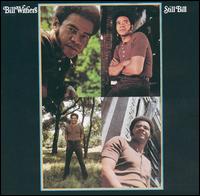
Lean on Me, by Bill Withers (1972), encountered 1972

Buy it here | See it here | Lyrics here | Sheet music here

 Certain conversations change your life.  Let me start with one that did, but in exactly the wrong way.

It is a grey and damp March Saturday in 1971.  A gentleman with close-cropped gray hair named Earl Wasserman and I are walking the streets of West Philadelphia.  It is an open-air interview for a spot in next year’s Graduate English Program at Baltimore’s Johns Hopkins University, which Wasserman runs.

There’s History Here

This is a man who should be on my side, almost no questions asked.  Without him, my life to this point would have been completely different, and he must know this.  Back when he and my father were young faculty members together at the University of Illinois, they and their spouses formed a foursome.  Wasserman, an enthusiastic proselytizer for the academic program he came from, Hopkins Graduate English, had persuaded my mother to matriculate in that very program should she return East, as she eventually did.  And it was there, on or around the steps of Gilman Hall, my mother met the man who, about a decade later, would become my stepdad.  Ernie Gohn, the stepfather who did far more than his share of the heavy lifting in raising me, would earn his doctorate in that program a couple of years after he and Mother met.  Wasserman knows all this history.

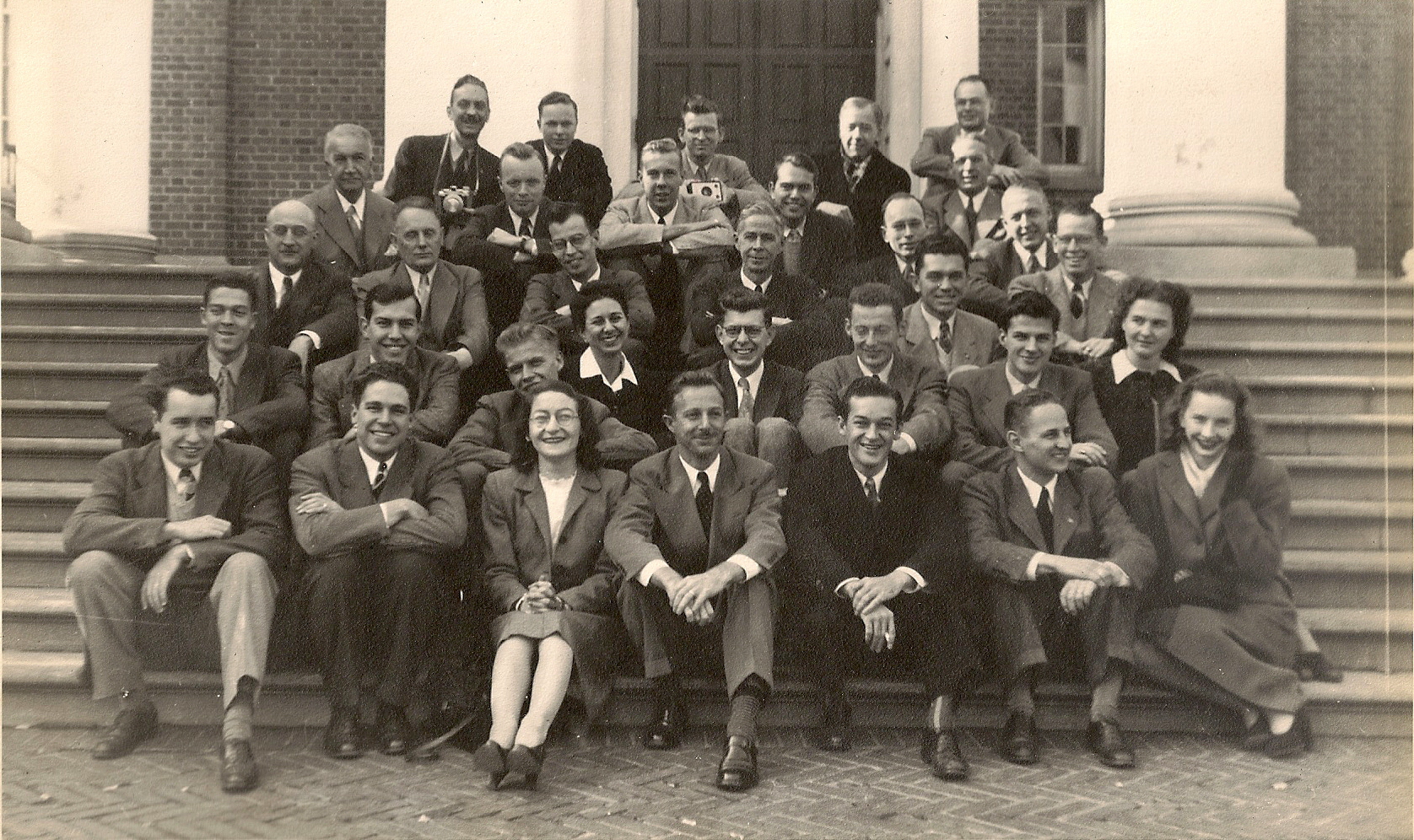
And incidentally, here you can see, on those Gilman steps (from the Fall of 1946), the students my mom joined, including my mom herself, in the middle of the front row, with my stepdad right behind her.  This was three years before my mom and father even produced me.[1]  In the gossipy world of scholars connected almost umbilically with this program, whatever unconventional goings-on lay behind that photo are history any faithful alum like Wasserman, especially an alum who pushed my mother into the program to begin with, must have heard.  And he should be helping to write the next chapter of that history, right?

And I am the kind of student any graduate English program should welcome.  Great grades, working familiarity with Old English, Middle English, and the contemporary stuff and everything in between.  Earning bachelor’s and master’s degree simultaneously.

Not On My Side?

Yet for the moment it doesn’t appear he is on my side.  What do I think I’m up to, applying to a department where there are twenty trying to get in for every slot?  And what is this business in my application where I say I’d like to do some creative writing in after life, along with scholarship?  Am I aware that I can’t possibly do both?  OK, so C.S. Lewis did it; I don’t think I can, do I?  Am I really unaware that scholarship consumes all a real scholar’s time and loyalty?  Johns Hopkins only wants real scholars who will produce great scholarly works.  Am I going to commit myself to that goal, or will I skulk in, pretending that I am going to produce these works, while actually planning to go off and fritter myself away being creative, when there are so many worthy people in the world who would make better use of the opportunity?

Now, if I agreed with Wasserman’s premise, I’d feel worse about trying to placate him.  But I don’t agree; oh, maybe I can sense the experience that lies behind his pronouncements and the faint traces of benevolence in his effort to send creative writers elsewhere.  But I think I’m more capable than Wasserman allows.  I think that, with focus and drive, I really can do both the creating and the scholarship.  But he won’t let me say that, so I kind of lie and downplay parts of my ambition.

Perhaps I succeed; I am admitted two weeks later.

Have I really fooled Wasserman?  I don’t know, but I doubt it.  My best guess, looking back, is that he let me in on account of auld lang syne, because of the connections with my mom and my stepdad — and my father.  And he was probably hoping for the best, the best being that he could eventually ease me into his ascetic scholarly mold.  As for me, on the strength of that conversation alone, I should have run like hell in the other direction, because even if I didn’t know yet exactly what he wanted, I had sufficient warning that it would be something I could never provide.  Each of us thus said yes when we should have been saying no.  Call it fate.

As is always the case, it wasn’t sheer cussedness alone that led me to make that choice; there were also various sensible considerations. The pattern of acceptances and financial offers I and my fiancee received made it clear we were either headed to my home town of Ann Arbor, or to Baltimore, from whence she came. And slightly better money seemed to be coming from Baltimore.

Deconstructed

But it proved to be nothing like what I had expected.  Partly this stemmed from me unwarrantedly extrapolating from what I knew. I’d assumed that all graduate English departments were like Penn’s: lecture format (where the professor did much of the heavy lifting) with the occasional seminar.  Hopkins was all seminars, all the time.  We were expected to do multiple papers in each course, read them to each other, and comment (and if you think that brought out some unhealthy competitiveness, you’re right).  But those were the superficial dissimilarities.  Wasserman had been less than candid too, it seems, about something even more important.  Hopkins, it emerged, was all about criticism, not scholarship.  And so, in our seminar papers and everywhere else, we were expected to spend more time talking about the published criticism than about the works being criticized.  This brought to my mind the picture of a man bent over, playing tic-tac-toe in the dust, ignoring a spectacular sunset going on behind him.

It wasn’t just the emphasis on the criticism; it was the kind of criticism. Unlike what my mom and stepdad had encountered with their band of brothers and sisters in the 1940s, the Hopkins Grad English program of the 1970s had dedicated itself heart and soul to turning out Deconstructionist critics. And what (you may ask, if you’re not in the know) is Deconstructionism? I’ll tell you: I can’t tell you. There is no there there, no definition by definition. There are certain tenets: texts have no fixed meaning; we interpret them according to our sense of reality, but that sense is just another text. Criticism is therefore the creation of texts about texts, and the most creative creations of texts about texts are those that subvert the apparent meaning of the texts under discussion. Hence critical creativity dwells most consistently and most laudably in destruction.  Or, as they preferred to call it, Deconstruction.

My interest in scholarship, then, was not merely different from the interests of the professors; it was an affront to the premises on which they were basing their careers. I sought to learn facts about literary works that would help us understand what they actually, objectively meant. That quest that presupposed a conviction that works had objective meaning, that their meanings were tied to their authors’ lives and intentions, and that lives, intentions, and meanings  in many cases would be knowable.  This was anathema to my professors, or something worse than anathema: belle-lettristic.

And even that wasn’t the whole problem.  I came to realize fairly quickly that a lot of the writers and books I cared about weren’t considered worthy to be on the syllabus. So-called minor genres that I’d been able to write about freely at Penn (mystery, science fiction, spy fiction, children’s literature, rock lyrics) were off-limits. A destructive radicalism in reading was thus put at the service of a conservative and snobbish selection of what to read.

Puff Puff

You might expect that with such radicalism would come at least some kind of excitement, no matter how ersatz.  Sorry to disappoint you.  I present a transcript of a moment chosen almost at random from the seminar table talk of one professor I had. Imagine him smoking his pipe.  “When…I…was…in…(puff)…(puff)…college… …(puff)…(puff)…I had… … a friend…(puff)…who wrote… …(puff)…I get tired… … (puff)…(puff puff)…Is that a sign…(puff)…of…(puff puff)…maturity?”  You could go mad waiting for the end of two sentences like those, and then mad again dealing with the attitude they conveyed. 

The acme of the Hopkins Grad English universe was the Tudor Stuart club, a paneled room on the third floor where monthly evening meetings took place.  I attach a 2011 photo of the room, not much changed from how I remember it then.  Attendance was de rigeur, though they softened the blow by laying out beer and the makings of cold cut sandwiches.  But then you’d have to sit through lectures by visiting Deconstructionist dignitaries.  If a lecture were graspable using ordinary logic and common sense, it was deemed a failure.  There were few failures.  Instead, there would be the most impenetrable prose you ever heard.  After an hour of that, the questions would start.  People, mostly faculty, would pose questions, many in the same diction as the lecture, and you’d have to sit through that for up to another half hour, until dismissed.

There were those who drank the Kool-Aid, who claimed to get it.  These were the ones the professors rewarded with continued stipends and bona fide job recommendations (more about that in a later entry).  I neither claimed to nor did.

And They Hated Me Right Back

I caught on quickly that this wasn’t a congenial place for me, writing my parents at the end of September that I hated it.  Evidently the feeling was mutual.  At the beginning of February, I received a letter from the department chair advising that “On the basis of the necessarily limited evidence available, we have some doubts about the quality of your work as of this moment.”  My wife got a similar letter.  In my case, the department ultimately relented, and allowed me to stay with a stipend (I was upgraded to “satisfactory” in May), but it would extend no stipend to my wife.  She stepped down (and went on to better things).

In light of these developments, I wrote to a friend who’d gone to Yale:

Words have not been coined to describe the awfulness of this place…. They don’t have any money and they’re doing people dirt, right and left.[2]  Since there are no grades, we have no objective standards to point to in our own defense: all they have are subjective analyses of us on file with the chairman which we aren’t even allowed to see…. Classwork counts for nothing, and so the phenomenal string of papers we have to turn out like sausages is the essential means the student has of establishing his worth.  But around here you’re expected to become somebody’s disciple … and your papers had not only better be done well, but they had better coincide in their findings with the professor’s own opinions.

So I arrived at year’s end battered and bruised.  My value as a literary man had been impugned, my earlier-described vision of my wife and me as soaring through the clouds together sharing an academic career had crashed to earth, and I was in need of ready cash.  At least there was a partial and temporary solution for that last one: My father-in-law called in some favors and landed me and my brother-in-law a job to split: driving a Mister Softee truck in Anne Arundel County, a marshy enclave west of the Chesapeake and south of Baltimore.

It was certainly a different experience, I’ll say that.

The Power of Positive Ice Cream

[3]

Different, but not much of an improvement.  In those days you could fairly call that area (Glen Burnie and Severna Park) a redneck suburbia.  I drove up and down neatly-platted streets trying to sell soft ice cream, listening to a maddening jingle played over and over again on the speaker mounted above my cab.  The ice cream may have been cold, but the cab was hot, and I sweated off over a dozen pounds.  I was being paid a small base plus commission, incentivizing me to sell, sell, sell. But redneck or not, these were neighborhoods to which freezers had come, dampening demand, and the trucks were old and prone to breakdowns, frequently killing outright my ability to meet what demand there was.

You would not have guessed the existence of either of the problems listening to the franchisee, a man named Marshall.  In Marshall’s imagination the sky was the limit, and mechanical troubles were to be overcome with a positive attitude, not expensive repairs.  Yet ice cream trucks contained two complete mechanical systems (truck and kitchen), each with a plethora of moving parts.  Old systems are apt to go on the fritz; that’s just the way of it.  Your product was perishable, and if you couldn’t turn that mix into ice cream and those bananas into splits, they had to be written off.  If you had a flat tire, or the ice cream machine went down, you were out of business until further notice.  Marshall thought (or at least pretended to) that if we were really committed on a deep spiritual level to sales, we could magically move ice cream irrespective of whether the trucks could budge or the ice cream could dispense.

Marshall had a trophy younger girlfriend, Roxanne, who had been a beauty queen.  Marshall had made her vice president of his company.  It was painfully obvious to the rest of us that Marshall had mistaken whatever he saw in her for business acumen, but that she possessed neither more nor less of that than the rest of us, and her beauty and certain degree of spunk could not change the overall direction of an undercapitalized business dependent on a badly depreciated truck fleet.  We wanted Marshall to spend less time looking communing with Roxanne and more time looking at the fleet.  Marshall’s starry-eyed embrace of motivational nostrums could not substitute for an outlay of cash, and somehow he couldn’t see it.  And he probably couldn’t have afforded it even if he had seen it.

The Power of Nature

I obviously did not share Marshall’s rosy vision of the transformative powers of pure sales karma, but I did believe in getting to work on time (an improvement over my views working at Ford three summers before, written of in an earlier entry), and so, on Thursday, June 22, 1972, even though the weather was bad, I was trying to fight my way in.  I’d heard that there was a hurricane around but not exactly in Maryland.  Heading out to the car, I felt a lot of rain, but nothing like hurricane winds.  So I optimistically set out for Glen Burnie and the Mister Softee compound.  Bill Withers’ annoying April hit, Lean on Me, was playing on the radio as I cruised downhill on the Baltimore-Washington Parkway toward the wetlands that constitute the banks of the Patapsco River.  It was when I got close to those wetlands that I realized things might be a little different today.  There were no wetlands to be seen at all, just water that came up disconcertingly close to the highway — where there ought to have been at least 10 feet of grade separation.  And traffic had almost stopped.  As I got close to the next interchange, where I was supposed to exit the Parkway and get on the ramp for the Beltway southbound, there were police cars with flashing red lights, waving us off.

I guessed that there was something wrong with the Beltway, but I assumed I could find an alternate route.  So I not only kept on going (I had no choice about that), but also kept trying to get to work.  And that was the beginning of what (in memory at least) was a three-hour ordeal, in which, through increasingly powerful rain, I was seeking a way to Glen Burnie on back roads, roads I did not know, roads I was sharing with far too many drivers, roads that kept ending in roadblocks.  I don’t know how long it took me to figure out that Hurricane Agnes (they were calling it that even though it was no longer at hurricane strength) was simply going to keep me out of Glen Burnie altogether that day, and that, however great a sales opportunity might be presented with power out all over the peninsula and people’s freezers out of commission and their dark houses driving them into the street, I was never going to get there to capitalize on it.

[4]

When I did realize it, though, I also realized that it had been my choice to put myself out here, against advice, that I was in parts of the back of beyond I did not know, getting lashed by rain, and that, by this time, the paths back to what was comfortable and familiar might be closed.

Stuck Here

Even after two semesters at semiotically insane Johns Hopkins, I recognized a metaphor when one was rapping me on the knuckles.  And I also recognized that Lean on Me, which was played at least once again on the radio (it would become a Number 1 hit in July) as, against all odds, I gradually worked my way back into Baltimore, was a perfect metaphor for the metaphor.

Was there ever a more ugly or simple-minded song?  Starting with that opening piano cadence, an inverted C chord, followed by the hands simply moving up and down on the white keys without changing their position, and just seeing what happens.  The verses doggerel, poorly scanned.  A bass line that at one point is sketching out a different chord from the one being played by the piano, and not because the bass player is being inventive, but because he apparently isn’t listening.  And lyrics that relate two notions, though they do not explain the relationship, because they can’t.  One notion is that we need to help each other out, and the other is “there’s always tomorrow.”  Tell that second one to the three children in Maryland whose car overturned in the floodwaters of Hurricane Agnes and drowned.  They didn’t get even one tomorrow.  And if there were always tomorrow, then how important would it really be for people to help each other out?  Wouldn’t they all be assured of a tomorrow regardless of whether others lent a hand or not?

I could beat this horse for a long while, but it’s dead and I’m done.  The point is, that song just made it perfect.  I knew from having my ear well trained over the preceding decade what a good song sounded like.  I knew what the proper approach to literature looked like.  I knew that mysticism didn’t sell ice cream.  And now I was in a world where no one who ran the show cared what I knew; they thought they knew better and were going to do it their way.  And I was going to have to be a part of that world for a while.

I just had no idea on that wet June day how long I would be stuck there.  But stuck I was.


[1].  In answer to the obvious questions, my mom and father were in the midst of an extended separation at the time the photo was shot.  They were back together later, from 1948 to 1953, during which period I turned up.  A story to tell at greater length somewhere else.

[2].  The underlying problem seems to have been the end of a Cold War program that had funded humanities as a defense expenditure.  Why anyone had ever thought the study of literature constituted national defense in the first place is beyond me.

[3].  Image source here.

[4].  This is a screen capture; the interactive map from which it’s taken  is on the National Oceanographic and Atmospheric Administration’s website here.  On the source map, you can follow (at whatever scale you like) how Agnes moved up the coast, and make out why the storm was initially thought not likely to cause problems on June 22 at the top of the Chesapeake Bay.

Copyright (c) Jack L. B. Gohn

Theme Songs Page | Previous Theme Song | Next Theme Song


POTUS v. SCOTUS: There Are No Rules

The Big Picture Home Page | Previous Big Picture Column | Next Big Picture Column

POTUS v. SCOTUS: There Are No Rules

Published in the Maryland Daily Record May 7, 2012

When President Obama stated on April 2 that for the Supreme Court to strike down all or part of the Patient Protection and Affordable Care Act would be “an unprecedented, extraordinary step,” he was doing more than laying down the gauntlet to the Supreme Court. He was also grappling with a problem that is central to our constitutional scheme. Obama protested that invalidating the Act would be “unprecedented” and “extraordinary” because it would “overturn… a law that was passed by a strong majority of a democratically elected Congress.”

Like Scripture

Welcome to life under our Constitution. There have been those who have tended to view that document as a sort of infallible scripture; the late Sen. Sam Ervin comes to mind (if you remember Watergate, you’ll remember him). But one’s enthusiasm for that document is directly proportional to one’s tolerance for living with uncertainty. Like most scriptures, the Constitution is full of ambiguity, not to mention principles that are in ultimately unresolvable tension.

The Affordable Care Act, or ObamaCare if you will, plays directly into these ambiguities and unresolvable tensions. The biggest issue is the individual mandate, the requirement that many Americans purchase health insurance. Congress asserted the authority to impose the requirement under the Commerce Clause, which on its face simply authorizes Congress to regulate commerce among the states. Of course, it is near-impossible to say in a vacuum what it means to regulate interstate commerce; the phrase is like so many in the Constitution and its amendments which bear no fixed and reliable meaning. Think of equal protection, due process, cruel and unusual punishment, or the right of the people to bear arms. Clear as mud, the lot of them. You cannot know what those phrases mean until judges have interpreted and applied them – and even then you may not be certain.

Too Many Strike Zones

Whether forcing people to buy health insurance falls under Congress’ Commerce Clause power thus cannot be resolved by looking at the Clause itself; the words will tell you nothing. The determinant is not the text of the Clause but – at least ostensibly – whether the mandate is sanctioned by Supreme Court precedent. Yet even if that entire body of precedent could be reduced to precise rules, that would probably not answer the question where the individual mandate will ultimately survive. There are bodies of precedent pulling in both directions; either one could plausibly control the outcome. When, at his confirmation hearings, Chief Justice Roberts claimed his job was just calling balls and strikes, he was being disingenuous. The very concept of balls and strikes presupposes a strike zone, and constitutional interpretation is full of competing strike zones.

In fact, there aren’t even reliable rules for choosing among these strike zones. There are lots of different judicial approaches to constitutional interpretation that might arguably assist in choosing between bodies of precedent. The Oxford Companion to the Supreme Court lists six: historical, textual, structural, doctrinal, ethical, and prudential.[1] So if, let us imagine, a justice were consistently to follow one mode of interpretation, you might be able to figure out where that justice would land on a given issue.

However, experience shows that, whatever they claim, justices tend to play the field with these approaches, and, worse, seem to apply methodologies that lead them to reach outcomes that are politically to their liking. In other words, if you want to guess how the Court will rule on an issue, look at the individual Justices’ politics, not at their stated principles, and count noses.

Our Inevitably Political Bench

It would be naive to expostulate that the justices are somehow not “doing justice” when they play this game. Constitutional interpretation is not usually about justice, since constitutional interpretation seldom goes to matters of equity. But there is common feeling it should not be about politics. Almost everyone claims to want judges to be apolitical, but what most people who say that typically mean is that they don’t want judges playing the other side’s politics; playing the politics of one’s own side is just viewed as hewing to appropriate methodologies of constitutional interpretation.

The fact is, we don’t really know from our national experience what truly apolitical judicial construction of the Constitution would look like. We have seldom if ever had it.

Because They Can

Obama knew this, so his remark really was an appeal to political norms, not jurisprudential ones. No doubt what he truly meant was that: a) the crisis in health care funding has the power to destroy the economy over time; b) an enormous expenditure of political courage and capital had been required to pass a law to avert that catastrophe; c) there is little prospect that we as a nation can summon the will for a second try; and d) in the absence of any norms, there is nothing forcing the Court to invalidate the Act and precipitate the catastrophe. Simply put, if the Court sinks the lifeboats, we’ll probably drown, and the Founding Fathers never put a gun to the Justices’ heads and ordered them to sink the lifeboats.

But the language Obama used was redolent of the normal saws, found in thousands of judicial opinions, that one branch should respect the others. Only Obama’s phrase about the “strong majority of a democratically elected Congress” betrays the real dynamics of his appeal. This law, he seemed to be saying, was “super-legitimate,” it was the overwhelming expression of the overwhelming majority. Routine garden-variety political partisanship so often evident on the Supreme Court should yield to it, he was intimating.

There were at least three problems with this approach.

First, the premise happens not to be true: the Act was passed almost exclusively by Democrats, and barely cleared the cloture threshold in the Senate, after which the voters, largely in indignation over that law, destroyed the Democratic super-majority in the Senate and the Democratic power in the house: nothing like a “strong majority.”

Second, the President does not always respect the will of Congress either. Exhibit A: an anti-same-sex marriage law, the Defense of Marriage Act, passed by far greater Congressional majorities than were afforded the Affordable Care Act.[2] Obama’s administration now refuses to defend DOMA against court challenges. (A refusal I happen to applaud, but one Obama should own while talking about ObamaCare.)

Third, there is no existing norm of judicial deference when it comes to Constitutional interpretation. As of 2002, the Supreme Court had struck 158 federal laws as unconstitutional. The tradition started with Marbury v. Madison (1803). Where the Court, according to its own approaches to constitutional interpretation (however politically animated) and its own reading of the Constitution in light thereof, has found all or part of a federal statute unconstitutional, it has stricken it.

And Maybe They Will

None of this is to say that the president was wrong to suggest that striking the Affordable Care Act would put the country in a terrible jam. He was only wrong to imply that there are any existing norms to keep the Supreme Court from doing it.[3] The Court is going to do what it pleases, and we all are going to have to live with that. Or maybe die with it.


[1]. Id. at 184 (1992).

[3]. The obvious parallel is to President Franklin Roosevelt’s confrontation with the Supreme Court in two other Commerce Clause cases, Schechter Poultry Corp. v. United States (1935) and NLRB v. Jones & Laughlin Steel Corp. (1937), widely seen as instances where the politics ruled the jurisprudence. In the first, the Supreme Court blocked important New Deal legislation; in the second, under the threat of Court-packing, the Supreme Court backed down and upheld constitutionally indistinguishable legislation. The thing to remember is that the Court decided that issue both ways, and the fact that it happened in the order it did cannot readily be viewed as some kind of immutable political/constitutional order asserting itself. It was sheer power politics; Roosevelt’s threat to pack the Court was credible. Obama has not made, and could not credibly make, a similar threat. So results may vary.

Copyright (c) Jack L. B. Gohn

The Big Picture Home Page | Previous Big Picture Column | Next Big Picture Column

Off- and Off-Off-

 Theater Reviews Page | Previous Theater Review | Next Theater Review       

Off- and Off-Off-

Published in The Hopkins Review, New Series 5.2, Spring 2012 Issue

            New York is the hub of America’s theatrical creativity, the preeminent place for new playwrights giving us new shows.  But the innovation does not primarily come from Broadway. As I pointed out last time, Broadway is seldom in the originality business.  Almost everything found on the Great White Way is recycled somehow from works of art that have gone before.  Completely original projects abound in New York, but not in the 40 houses that give us the really big shows.  Instead the thrill of the truly new must be pursued in Off-Broadway and Off-Off-Broadway houses.

The label of Off-Broadway is technically restricted to New York houses from 100 to 499 seats that honor certain Actors’ Equity rules.  Many are found in the Theater District, so Off-Broadway does not necessarily mean literally off Broadway.  Off-Off-Broadway denotes houses that are smaller than that and (though here the nomenclature gets tricky and inconsistent) follow so-called Showcase rules when employing Equity personnel.  Some use the label Independent for small houses that don’t follow the rules, though I cannot see why a larger house that failed to do so would not also qualify as Independent.  As I’m here neither as lawyer, lexicographer, nor land surveyor, I shall leave the exact boundaries to those who care.

My point, instead, is simply that the truly new is almost always found in the truly small.

On a recent November weekend devoted to these smaller venues I was able to supply experimental validation of this thesis.  The new works were here, and they were excellent. I was not looking for a particular theme, but of course one emerged.  Each play waded into some big issues, in the popular modern mode of mixing a lot of humor in with the seriousness.

What You Can Remember, And What You Can Say

I’ll acknowledge that not everyone would agree that the issues in The Atmosphere of Memory, by David Bar Katz, which played at the Bank Street Theater for a “showcase” limited run, are big ones.  Bar Katz’s play examines the role of the artist mining family memories.  Jon, the protagonist, a playwright, has crafted a “memory play” a la Tennessee Williams (except that the characters frequently speak like refugees from Woody Allen).  The play-within-the-play is in rehearsal as the play-without-the-play begins.  Jon has arranged to cast his real mother (Ellen Burstyn) as the character based on his mother, his girlfriend in the role based on his sister, and ringers for himself and his father for the roles based on himself and his father.  This highly inopportune mingling of real and fictional worlds goes off the hook completely when Murray, his estranged father (the uproarious John Glover), crashes the rehearsals and then the family circle.  Murray holds to the thesis that Jon has got the critical facts wrong, and that Jon’s dramatized whining about his childhood is completely off-base.  A pile of notebooks and tapes then emerge to referee the clash of Jon’s memories and Murray’s debunking.

This setup gives us a jumping-off point for explorations of the unreliability of memory, as well as the moral responsibility (if any) of the memoirist or the fictionalizer of memoirs to the real people depicted in his/her writing.  Despite a somewhat comic treatment, Bar Katz is trying to make a serious point.

Jon is convinced that his mom loved him and his dad rejected him, and that there was some hideous dark secret in his family which led him to cut the somewhat nebbishy figure he does.  Eventually we get to the bottom of it, which is essentially that there’s no bottom there.  We find out, in fact, that his family suffered from no more than the ordinary amount of disharmony, and it was his mom who didn’t love him all that much, not his dad.  But even his mom made a reasonable effort to get on with the business of parenting.  Jon’s angst, it is suggested, is a predictable outcome of his need as an artist to have some raw material, little more.

It also emerges that he has been misrepresenting his sister all his life, and in rather cruel ways.  His depiction of her in his play-within-a-play is both uncomplimentary and inaccurate, and yet he cannot, will not, amend the play, because it helps make the play work.  In the end, his stance seems to be that this is what he as memoirist/dramatist does, and the others will have to live with it.

These are neither trivial issues nor unacceptable conclusions.  When most writers start out, they’re advised: Write About What You Know.  Followed even a little, that guidance leads almost immediately to the land of the frank or the disguised memoir, for the self is the subject every writer knows best.  And the memoir is instantly susceptible to the well-known unreliability of memory, and to the quite reliable reality that telling the most important aspects of one’s story is apt to be hurtful to someone.  If one decides to tell the story nevertheless, one chooses not only for oneself but also for others, a responsibility few writers do or should enjoy assuming.  But that is far from saying that a writer should not make that choice.

What’s Important

In calling the issues in Atmosphere of Memory serious ones, I do not mean in the grand scheme of things.  It may make no difference there whether a memoirist is kind or hurtful, spot-on with the facts or artistically manipulative.  No; this is of consequence only in the artistic sphere and in that of human relationships.  But in the world of art, these are issues of consequence.  And the world of art matters, at least to those engaged with it.

The play did not do very well with other critics, who rightly called out some of the silly efforts to be shocking (the playwright’s protagonist in the play-within-a-play confesses to his psychiatrist that he makes his living in a way that, even in a world filled with highly perverse people, could never locate a paying customer base), the obsessive literary and dramatic allusions, and an unevenness in tone.  I could see all this, and agree the play needs some shaping up, and yet Bar Katz’s piece spoke to me.

Suicide, by contrast, is a big issue in anyone’s book.  Camus called it the only important question, though I doubt that Andrew Hinderaker, author of Suicide, Incorporated, featured during November and December at the Black Box Theater as part of the Roundabout Underground’s New Play Initiative, would go quite that far.  The conflict in Hinderaker’s play lies between the view from inside the potential suicide’s mind and the view from outside, neither one of which is conceded unquestioned sway.  Two things stand out in Hinderacker’s presentation: suicide is generally a somewhat rational response to pain and failure, and the choices for suicide – and also against it – are contagious.  We are all familiar with suicide clusters, where one person’s exit encourages similar behavior from those close to him or her.  We also know that suicide prevention hotlines have some success, because one person’s resistance to suicide in general can persuade others not to do it.  Both sorts of contagion are on display in this play.

The framework is partly satirical.  Hinderacker has said that his dual inspirations were the suicide of someone close to him and his work (for the two weeks he could stomach it) at a company that “edited” college application essays.  Mashing these two notions in his head, he came up with the concept of a company devoted to buffing up or outright writing suicide notes.  The smooth, sadistic young man who runs it aims to justify the motto: “96% of our clients would recommend our service to a friend.”  Into this send-up of cutthroat corporate mores stumbles Jason, the new trainee.

Clusters In Conflict

It becomes apparent rapidly that Jason has also stumbled into a potential suicide cluster, in which all of the five principal characters are tempted by the thought of suicide, and one has already succumbed to that temptation (as will another in the course of the play).  It emerges too that Jason himself has a conflict of interest, which is drawn into focus by his new client, Norm (James McMenamin).  A failed romance drives Norm’s suicide plan, a story of tragicomic loserdom.  McMenamin has a slightly stoned-sounding delivery when he recounts his marriage that would probably make a reading of the Yellow Pages sound droll.  But underlying that amusing tale of haplessness is a mortal dispute, not resolved until the ending: whether Jason will get drawn into Norm’s suicidality or Norm will be dragged back from the brink by Jason.

I’m not sure to what extent suicide is explicable.  The standard explanation today does not pay much obeisance to the view of suicides as philosophers who respond rationally to arriving at a conviction like the one Camus rejected, i.e. that the absurdity of the universe in some sense argues for self-extinction.  Instead, suicide is generally seen as a kind of pain avoidance, an anesthetic if you will, whether the pain is caused by objective circumstances or irrational depression.  To the extent the play looks at explanations, that is where it too comes down.

Yet Suicide, Incorporated seldom goes close to philosophy or even explanations; it wisely stays mostly in the realm of experience.  A dramatist need not sell an audience on the philosophical soundness or moral correctness of a position most of its members will instinctively adhere to.  The unfolding lives of the characters tend to succeed dramatically, or not, according to principles of symmetry that reside far deeper in the mind than abstract thinking, though they are close to our experiences.  Suicides affect us, they horrify us, they engross us, and stimulate us to try to explain them.  And to the extent we have a position, most of us would say we are against it most of the time – based on our reaction to suicides in our social vicinities or in the media to which we are exposed.

The resolution of the play, therefore, is dramatically satisfactory, in the kind of provisional fashion that the ever-present importunities of suicide (to those who feel them) will permit: provisional victories of indefinite duration.  That is all any of us can achieve against death, even when it is not of the self-inflicted variety.

World Views In Conflict

There are no victories and no losses in the fascinating imagined encounter between Sigmund Freud and C.S. Lewis in Freud’s Last Session, in a long run at New World Stages.  We have no strong reasons to think that Freud (Martin Rayner) and Lewis (Mark H. Dold) ever met, far less that they met three weeks or so before Freud’s own assisted suicide to escape the misery of cancer and, perhaps, the unfolding horror of world war, both of which are ever-present in Mark St. Germain’s play.  But it seems likely that if they had had an encounter, and we could have watched it, we would have seen something like this.  I speak as one who knows more about Lewis than Freud – but that’s probably a common circumstance these days.  Freud is still revered, but the psychoanalysis he pioneered is in desuetude to a far greater extent than Lewis’ Christianity.  We revere Freud more for his willingness to ask difficult questions than for the answers, much less the techniques, he came up with in response.  I think it is legitimate to say that Lewis, by contrast, has followers fifty years after his death.

It may be objected that Lewis himself was a follower, of Christianity, which had a well-developed theory and praxis centuries before Lewis came along.  He had a ready-made doctrine, unlike Freud, who needed to improvise.  If one is to compare their statures from the standpoint of originality, Freud would surely deserve the palm.  But if, from a philosophical standpoint, Lewis was working with existing elements, it must be acknowledged that what he did with them was indeed innovative.  Starting with his earliest apologetics, he wedded considerable learning and philosophical rigor to the exploration and explication of human longings for the divine – what in Lewis’ view was the drama of the dialogue of divine and human.  He both dramatized human longing for God and seriously explored its logical and philosophical consequences in ways that may fairly be called original.

In his first major apologetic work, an allegory called Pilgrim’s Regress (1933), as the play correctly reports, Lewis had lampooned Freud as a character called Sigismund Enlightenment.  And the conflict between John, Lewis’ alter ego, and Enlightenment in that work exactly prefigured the conflict between Lewis and Freud in St. Germain’s play.  John is pursuing a divine vision of a perfect Island, and Sigismund Enlightenment says John believes it exists simply because John wants it so badly to exist, and that the vision is sexual in origin – roughly speaking, the argument of Freud’s The Future of an Illusion (1927).  In the play, in Freud’s London consulting-room, Lewis the character responds to this debunkery of his hunger for and belief in the divine with many of the arguments he would pursue thereafter: the problem that a materialist approach which argues that all viewpoints are predetermined by social conditioning and the like must logically admit to the same disqualification as attends the viewpoints it attacks ((The Abolition of Man) (1947)), the circularity of inductive reasoning behind many critiques of a belief in miracles ((Miracles) (1947)), and most of all the well-recounted experience of the entire arc of Lewis’ own life and spiritual development (Surprised by Joy (1955)).

No Winner

The polite struggle between Lewis and Freud is not the dramatically common war of hero and villain, nor even the kind of contest between religious rectitude and materialistic cynicism on display in many history plays, for instance A Man for All Seasons or The Crucible.  This is a dispute between two admirable people who are living difficult lives in keeping with the diametrically-opposed convictions they expound.

Freud maintains his courtesy and consideration without yielding an inch in his view that the universe is without comfort or meaning to the enlightened, whether the temptation be Lewis’ kind and optimistic blandishments or the horrors of Freud’s cancer, which are graphically portrayed at one moment that may cause members of the audience to look the other way.  We know he is about to choose death and will not turn to the reassurances of religion even in that comfortless place.

Lewis, by contrast, cheerfully acknowledges the irregularities of his life with a dead friend’s mother (suggesting some emotional deficits in him that might confirm Freud’s notions of the origins of religious desire); he owns the shaky evidentiary basis for his somewhat unfashionable creed (reaching a belief in Jesus while sitting in a sidecar on his brother’s motorcycle en route to the zoo).  But he does not surrender that creed in the slightest, even knowing it is about to be tested in another world war.

At least one critic commented of this play – and I think the criticism could to some extent be leveled at the treatment of serious issues in The Atmosphere of Memory and Suicide, Incorporated – that there is no winner, that the play consists in essence of two points of view being aired out.  A prizefight should have a winner, this approach suggests, and not just a few rounds of Lewis being Lewis and Freud being Freud.  But there is no such requirement.

The Versatility of the Drama of Ideas

Of course there does exist a drama of ideas that establishes one viewpoint and conclusively debunks another.  At its best it brings us plays like the aforementioned Man for All Seasons and Crucible, and at its worst, it gives us pedantic agitprop.  (I leave it to the reader to determine where Brecht falls on this spectrum.)  But that is not the only kind of theater of ideas.  There are some disputes where no honest conclusive victory is possible.  And I would argue this particularly of the kinds of ideas up for debate in the three plays considered here.

Is it more important for an artist whose metier is the memoir to avoid inflicting pain on those close to him or to tell the truth as he remembers it?  Is the allure of suicide to be taken on its own terms or treated with the taboo our society generally imposes upon it?  Which should sway the thinking person: the less than conclusive evidence for God’s existence and meaning in the universe or the less than conclusive evidence against God and meaning?  There is not going to be an objectively final resolution to these problems.  Should drama therefore not “go there”?  And if it does “go there,” must the dramatist furnish a right answer?

Not in my book.  A dramatist may, but is under no obligation to, take sides in the ideological or philosophical or religious contests that animate his or her plays.  And the more sophisticated generally will not.  For example, it could well be argued that the worst and weakest moments in John Patrick Shanley’s Doubt (2006), that drama built around the Vatican Two opening of the Church and the pedophile priest scandals, are when Shanley nearly tips his hand as to what “really” happened.  Call these plays prizefights without undisputed champions if you like, but the same canard could then be leveled at Waiting for Godot or Tiny Alice.  What “really” happened and what the “real” state of affairs is and what the “real” correct ethical choice is may all be indeterminate.  Are we as audiences so needy for a well-crafted and conclusive ending that we cannot accept dramatic indeterminacy?

For those who answer yes, it may be best to stick with Broadway.  Not too many dramatic and philosophical loose ends there, which are about as unacceptable as dropped lines, fluffed notes, and dramatic structures undigestible by the visiting dentist from Orange County and spouse.  (They, after all, can afford those tickets.)

Nor is the failure to resolve these big questions a cop-out.  The big questions usually don’t resolve that way anywhere else; why should we insist on seeing them resolved whenever there happens to be a proscenium arch in the room?

Seductive Levity?

There is also a legitimate question about the tone of these shows, specifically about the way that jokes keep pushing up like weeds through the pavement of seriousness.  And I am not talking about infrequent, isolated lightening of the mood, like the irruptions of a clown once or twice in a Shakespeare tragedy.  I’m talking about something more continuous.

Is this a distraction?  Worse, is it a way of maintaining an inappropriate sense of reassurance, a laugh track at a sentencing hearing, drinking songs at a funeral – only more seductive?  Such objections, I would maintain, may not be entirely misplaced.  Modern audiences do like a very large spoonful of sugar with any kind of medicine.  Yet I cannot help thinking that this accurately reflects the way most of us, most of the time, encounter big issues, even serious ones.  It takes severe and continuous pain to keep humans from joking, from seeing the ironies, from word-play and funny analogies.

Moreover, there are few serious arguments that do not have humor naturally embedded within them: what Lewis called “the bloom on the argument.”  One ignores them at the peril of missing something important.  For example, one of the antagonists in Freud’s Last Session remarks: “One of us is a fool.”  It draws a laugh, naturally.  But it summarizes at once both the pathos and the absurdity of the situation.  Two of the most rational and cultivated debaters, neither able to score a knockout punch precisely because there are no conclusive proofs of the ultimate realities.  They can slug at each other forever and never retire the other from the ring.  If the ultimate truths were knowable, there would indeed be a victor – and a fool.  Given the huge stakes in their debate, the indeterminacy that prevents a definitive outcome is both a tragic circumstance for us all – and a somewhat laughable incongruity.

So I do not think it devalues the enterprise much to see this level of levity, any more than I found the unresolved dialectic a demerit.

Credit Where It’s Due

Instead, I am grateful for the programs (Labyrinth Theater Company for Atmosphere of Memory, Roundabout New Leaders for New Works for Suicide, Incorporated), and for the regional theater farm systems (Suicide Incorporated was produced first in Chicago, Freud’s Last Session in Massachusetts) that gestated these serious plays, and the network of New York theaters – let’s call it Non-Broadway, to be completely inclusive – that can serve as the ultimate mecca for works of this class.

Copyright (c) Jack L. B. Gohn

 Theater Reviews Page | Previous Theater Review | Next Theater Review  

Retooling Makes REP’s LAS MENINAS Strong and Tragic

Theater Reviews Page | Previous Theater Review | Next Theater Review

Retooling Makes REP’s LAS MENINAS Strong and Tragic

Keilyn Durrel Jones and Katie Hileman

Posted on BroadwayWorld.com April 21, 2012

REP Stage, the Equity troupe in Columbia, is presenting the redoubtable Lynn Nottage’s Las Meninas (2002) directed by Eve Muson. This is at least Muson’s second local stab at it, Muson having directed the play at University of Maryland Baltimore County in 2010. (The production was revived to great acclaim at the Kennedy Center American College Theatre Festival in 2011.) This new production is actually a continuation of the old one, featuring the same two leads, three other members of the original ensemble, and, critically, the very important costumes and set designs of Elena Zlotescu from the 2010 production. I reviewed the show then approvingly but also cautioned that there were some unstable variations in the tone of the play, and that the student actors did not always possess the gravitas to realize Nottage’s and Muson’s vision. I also said that the play needed repeated productions to iron out some of its internal conflicts.

A Better Product on the Same Platform

I was therefore intrigued as soon as I heard that Muson was bringing the show to a professional company. My sense was that Muson felt she could build a better product on the same platform of stars, costume and set. If that’s what she was thinking, she was right. I could go down a checklist of my criticisms from the earlier production and see where every issue I raised was well addressed.

To crib somewhat from the earlier review (and why not?), the play has some puzzles associated with it. One is the title, also the name of a famous Velasquez painting at the Prado in Madrid. True, both the play and the painting shine a light on dwarves (or more correctly little people) and on Marie-Thérèse, bride of Louis XIV and hence Queen of France. But the name of the painting, which roughly means “Ladies in Waiting,” tells us that the painting is about something more. In the painting, the ladies in waiting matter. In the play, the ladies in waiting are essentially extras. Unless of course the playwright is telling us that the little person and the Queen are themselves “in waiting.” I think that is indeed the point, but I have not heard that Nottage herself has said this.

As I’ve noted, I commented on the tone in 2010. Nottage herself has said she thinks the play is “very funny.” I can see where there are laugh lines here and there, but the play struck me, then and now, as fundamentally a tragedy. In Muson’s second try, that’s what it less ambiguously is. And I think it’s stronger for losing the split personality.

Keeping It Tragic


That is not to say that a grim humor does not continue to hang over the enterprise, especially reinforced by designer Elena Zlotescu’s costumes, which are based on 17th Century French court patterns, no doubt, but deliberately exaggerated, all in diaphanous white, with wigs made of ribbons rather than hair. The back of the set is a panel of semi-transparent mirrors that arches forward towards the audience, so as characters come downstage, their images, seen from above, simultaneously rise over our heads – except when there is an illuminated scene perceptible behind the mirrors. In other words, the funhouse mirrors aren’t even reliable as funhouse mirrors. The French courtiers look and move like French courtiers – except when they are engaged in African tribal dance. And in the action, little seems comforting, familiar, or real.

Such staging works well, because this is a play centered on three characters who can never find their way to comfort or reality. Each has been rendered an outsider by the demands of a world he/she never made. Marie-Thérèse, no longer Velasquez’ slim infanta but now a hefty woman with unmet carnal needs and a faithless husband, is a Spaniard in a French world. Nabo, the little person from Dahomey (now Benin), essentially enslaved to her as a jester, is pitifully longing for his home, and well aware that intimacy with the Queen is likely to prove fatal to him. And their unacknowledged daughter, locked for life in a convent where the truth about her origins is hidden and her curiosity about it chastised, is longing for parents she will never see and sunlight she will never experience, an outsider to the entire world.

I wrote in 2010 that Marie-Thérèse not only exemplifies outsiderdom but also the privilege attaching to regal status and white skin, which she hides behind to survive the catastrophe while Nabo (black, baseborn, a little person, and a foreigner, with no sheltering privilege whatever) pays for it with his life. I don’t know if the lines have been cut, the actors have grown, or the direction has changed, but something has made that discontinuity less obvious. Somehow, Marie-Thérèse now seems far more purely a victim, far less an oppressor than in her previous incarnation. This change seems to strengthen the play.

What’s Old, What’s New

It is interesting seeing especially the two leads, KeiLyn Durrel Jones as Nabo and Katie Hileman as Marie-Thérèse, a year and a half on from their initial encounter with these roles. Jones reprises his amazing feat of playing the entire show on his haunches to give us a memorably credible little person, while Hileman again un-self-consciously abandons herself to the role of a large one at a court where all the other women are slim and trim, and make fun of her. Jones seems a hair more subdued and tentative, which I think is a loss, but Hileman seems to have grown subtly. Her grief seems deeper and more profound, her anger more clear-sighted. Less melodrama, more tragedy.

For the child of these star-crossed lovers, Louise Marie-Thérèse, the new production gives us Fatima Quander, an actress with a few extra years on her resumé over the student who took the role in 2010, and the clear, even piercing pathos of her delivery is a big improvement, as is the sanctimonious authoritarianism of Susan Rome as the Mother Superior and, in a doubled role, Rome’s delivery of the worldly sophistication of the former courtesan turned Queen Mother. (The student actress who took these roles before was good, but just a little too young to put them across properly.) I was also impressed by the improvement wrought by putting the seasoned local professional Tony Tsendeas in the doubled roles of a portrait painter and a court physician. He could impart both the cynicism of the one and the humbug of the other without lapsing into broad comedy, a skill that challenges student actors.

In short, Muson has taken what was best about the earlier production and tuned up the rest. The end product is a modern historical tragedy that obviously speaks directly to contemporary racial and gender issues but also past them to the human condition, as all great tragedy does. Nottage seems to be shaping up as one of the great playwrights of our age, and this retooled production shows us why.

Copyright (c) Jack L. B. Gohn except for graphic content 

Theater Reviews Page | Previous Theater Review | Next Theater Review