Sanctified Skullduggery: INCORRUPTIBLE at UMBC

Theater Reviews Page | Previous Theater Review | Next Theater Review

 Sanctified Skullduggery: INCORRUPTIBLE at UMBC


 Posted on BroadwayWorld.com April 19, 2012

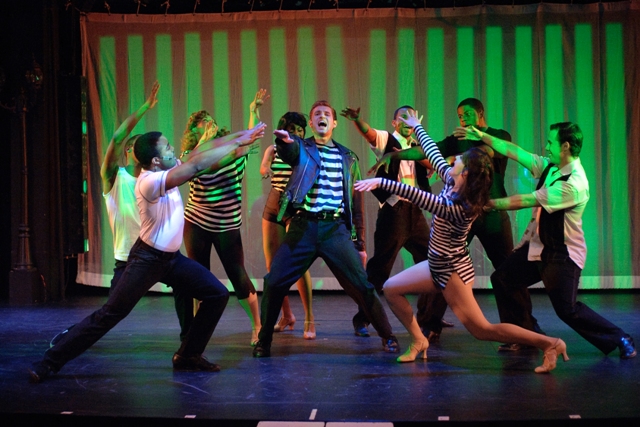
I had not heard of Michael Hollinger’s 1996 farce, Incorruptible, until the University of Maryland Baltimore County Theater Program’s new production. I’m grateful to UMBC for bringing it to my attention.

The veneration of deceased saints’ corpses and belongings and the attribution of miracles to them were practices wide open to fraud and abuse, a perception that goes back to Luther and Chaucer. The cult of relics, which reached its height during the Middle Ages, now seems creepy and risible to all but the most steadfast modern Catholic believers – and hence grist for the comic mill. Incorruptible is loosely based on a celebrated fight between two medieval churches over one saint’s remains. 

In brief, the premise is that the relics at one French monastery have “given out” and are failing to produce new miracles. Those miracles being the monastery’s only profit center, something must be done, and quickly. The weaselly Brother Martin (Brad Widener) hits on a scheme to force Jack, a third-rate minstrel and even lower-tier grave robber (David Brasington), to revive the monastery’s economy by turning the monastery’s graveyard into a kind of saint junkyard, purveying skulls, fingers and other bones to any European cathedral with the need and the ready cash for them. 

In classic farcical style, no sooner does this osseous juggling act come under control than the ante is upped: the monastery must now meet the demand for an “incorruptible,” a corpse that never decomposes, the Rolls-Royce of relics. Jack’s girlfriend Marie (Sydney Kleinberg) (or is she the girlfriend of Brother Felix (Christopher Dews)?) seems ready to be pressed into service over what may be her dead body. Or maybe she will fly the coop, leaving the monastery with nothing to show the Pope when he inauspiciously calls. The monks, torn between greed, fear, sibling rivalry, and conscience, will have to find a way to meet all eventualities. And only a bona fide miracle will save them. 

We in the audience, we of little faith, must still cling to our belief that in a farce, all will work eventually for the good. And seeing how these apparently unreconcilable elements coalesce in the inevitable happy ending is the fun Hollinger’s play completely delivers. One might wish that, in keeping with all proper costume dramas, farce included, he’d written his lines with British-sounding actors in mind, but the wisecracks are all written full of modern American phrases like “attitude problem.” So it doesn’t matter much that none of the home-fried young actors could be mistaken as a refugee from Masterpiece Theatre. Medieval people didn’t sound like this, but then, medieval Frenchmen didn’t even speak English for some reason. So it’s silly to carp. 

Regrettably, owing to my schedule, I had to see this piece at previews, where a blown cue led to the do-over of a few minutes, but I am confident that this student troupe, which I have seen and written of approvingly more than once, will do just fine in the “for real” performances. I particularly enjoyed the performances of Ms. Kleinberg, game whether the role called for her to dance or play dead, and Jessica Ruth Baker as the intimidating abbess Agatha, CEO of the competing ecclesiastical enterprise down the road. 

Incorruptible is a hoot. You should go.

Copyright (c) Jack L. B. Gohn except for graphic content

Theater Reviews Page | Previous Theater Review | Next Theater Review 

Imagining A Lot(tery)

 Theme Songs Page | Previous Theme Song | Next Theme Song

Imagining a Lot(tery)

Imagine, by John Lennon (1971), encountered 1971

Buy it here | See it here | Lyrics here | Sheet music here

Imagine: The lucky guy has just been given his life back, and mine has been taken.

365

Imagine: A college quad at night with someone running across it screaming “365!  365!”  It is December 1, 1969, the date of the first draft lotteries.  The lucky screamer, born February 26, has just been given his life back.  Whatever plans he’s made for his future are secure, at least from the threat of being called away to take part in that bigger lottery called the Vietnam War.  There’s no chance that Number 365 will be inducted.  Not only will he be spared the certain sacrifice of two years of his life, but he is immune to the risk of the even shorter straws: killing, dying or being wounded.

Imagine: A crowd of us sitting together a few moments earlier in Houston Hall, the student union building, listening to the draft lottery being broadcast.[1]  Afterwards, I wander despondently out onto College Hall Green, where the shouter sprints by.  I am filled with envy and terror.  Since I was born on a July 13, my number is 42.  My prognosis is the exact opposite of Number 365’s.  While I remain an undergraduate, I will be protected by a student deferment.  But when I graduate, as inevitably I shall in only three semesters’ time, they will reach me.  If the War goes on, as I know it will, and I do not find another deferment, as I doubt I shall, it is a certainty.[2]

42

Imagine me speaking to my parents by phone later that night.  I curse at my mother, and, with rare restraint, she takes in both my anger and its untoward expression without an angry reply.  Much later, after I have children, it will be obvious why.  A threat to me is a threat to her.  Still, little in her experience could lead her to accept my outlook.

It’s no problem imagining what has formed her views.  She has been through the Second World War.  She is no flag-waver, but she remembers her pride in the young GIs she met in the trains in those days.  Nor has anyone had to sell her on the evils of Communism – and Vietnam, they tell us, is a war against Communists.  No doubt she and millions of mothers like her feel instinctively that Horace was right when he wrote: “Dulce et decorum est, pro patria mori” (It is sweet and fitting to die for one’s country).  You support your church, your political party, your nation, and your nation’s wars: that is her outlook.  And these loyalties might call upon you to surrender up your only son.  Bring on the sweetness and the fittingness!  Up to this moment, I think, that conclusion has also been part of her outlook.

But now she has to imagine a contradiction to all that.

Imagine me seeing nothing sweet or fitting about dying, fighting, or putting myself at risk for Richard Nixon or his evil war.  From the moment in February of the previous year, during a poetry reading by Allen Ginsberg, when I had realized that I now opposed a war I had once supported, I am growing more and more horrified at the holocaust of young men, American and Vietnamese, the War is creating.  That type of sacrifice might be justified to bring about a world without Hitler, but hardly a world without Ho Chi Minh.

Holding Off Catastrophe

And now it becomes up to me to imagine ways to avoid this catastrophe bearing down on me.  I try.  I borrow books from my parish priest about Catholic views of war.  I thus become knowledgeable about Just War Theory.  I apply for conscientious objector status, but my Draft Board turns me down, unconvinced that I am against all possible wars, and concluding that my convictions are firm only about the current one.  I blush, because they have seen right through me.   I apply for a medical deferment on the basis of back pains I’ve been having.  I learn that I’m the third generation of my family with wretched backs, that my mother has often been in traction.  I get the doctor mother of Carol, the friend who lives in our house, to write a letter supporting my deferment claim.  I undergo a couple of draft physicals, one in a big tall building off Broad Street in Philly.  My medical deferment claim is rejected.  This time the call is wrong; I’m not malingering.  (In later life my back will be operated on three times.)  But the maw of Moloch must be fed, and questionable deferment claims must be rejected.

Imagine the inner dialogues, about the reality that, if I make good my escape from military service, someone else will have to take my place.  Imagine me deciding that if the worst comes to the worst, I will flee to Canada, because I will not accept either service or imprisonment.  Easy to say, but flight would mean disruption of my graduate studies and those of my young wife, and, so far as I know, I would never be able to come back to the United States to visit parents or in-laws or friends.  Imagine the misery drawn out, as my deferment fights defer the moment when I am required to report for induction.

Reprieve

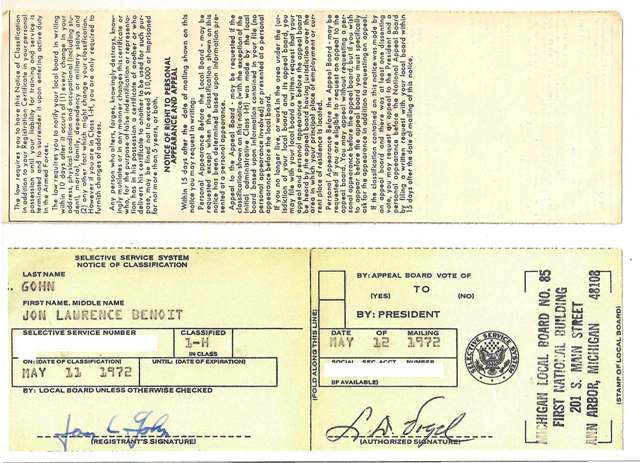
Imagine May 11, 1972, the date my Draft Board, for reasons that elude me entirely, reclassifies me 1-H.  I open the envelope and see the card, and realize I’ve never heard of 1-H.  It turns out that 1-H means not available for induction.  The card looks like, and in fact turns out to be a reprieve, one I had not even sought.  In later years I will hear rumors that it was issued to people suspected of being gay, but also that it simply meant that for whatever reason, you had not been inducted in your “year,” and so the Board was moving on to the next year’s candidates.  (The timing would pretty much work, since when the card arrives, I have been out of college and undeferred for about a year.  In which case, my sheer persistence in seeking a deferment has paid off after all, unimaginably well.)  In any case, no one ever tells me why, then or ever.

Imagine how I feel after it sinks in.  While I also understand that a 1-H is subject to reclassification as 1-A at any time, I never hear from the draft board again.  And now it is my turn to feel that my life has been given back to me.

A Song on the Radio

Later, I can remember myself very shortly after I know I’m probably saved, driving down Light Street in Baltimore, when John Lennon’s Imagine comes on the radio.  I dissolve in emotion.  It’s not simply that Lennon is asking us to imagine a world without war; he sees war as part of a complex of bad things:

Imagine there’s no countries
It isn’t hard to do
Nothing to kill or die for
And no religion too

At this point in my life, I’m a very serious Catholic, but I understand the role religion has played in so many wars, so I’m not blaming Lennon for his point of view.  I think it a perversion of religion to go to war for it, so I can agree with his diagnosis without signing on to his prescription.

But the way I respond goes to something far deeper than that: it’s the heartbroken melody, those langorous piano chords.  To be sure, there’s a hopeful note in there.  But mostly Lennon’s voice comes across as exhausted by sadness.  And it speaks to me because that’s how I feel after this close encounter.  I could have been a war casualty; I’m not, thank God.  But I tell myself I must never forget what it felt like nearly to have been one.  I must not forget the months of dread, of helplessness and anger.  I must not forget the way the good and patriotic motives of my countrymen were put in service of bloodthirsty insanity that threatened my life and my life’s plans.  And I never do.

Closing Vision

But beyond even that, I resolve never to forget Lennon’s closing vision:

Imagine all the people sharing all the world
You, you may say
I’m a dreamer, but I’m not the only one
I hope some day you’ll join us
And the world will live as one
 

And I never forget that, either.[3]  If you can imagine.


[1]  Just possibly watching it on TV: my memory is vague on this, but I know where we were sitting, and I cannot picture a TV set there in that era.

[2]  I had been trying to find words to convey what it felt like to be told that, by the random operation of a lottery, your country had slated you to (possibly) be killed.  And then I saw the 2012 movie of Hunger Games, and it was there on the screen, in the reaping scene at the beginning, in the breathless look on the face of the heroine’s sister when her name is drawn in the lottery to participate in a fight to the death.  I don’t mean to suggest the situation is a perfect parallel, but it captures the feelings perfectly.

[3]  Not that Lennon was passive benevolence personified.  If you listen to the Imagine album, the one the song came from – and you should – you’ll find it’s chock-a-block with violent emotions, including a savage attack on Paul McCartney (How Do You Sleep?) and the obvious remnants of a fight Lennon must have had with Yoko Ono (Jealous Guy).   And this album is a step down from the primal scream that was John Lennon/Plastic Ono Band (1970), maybe the angriest album I’ve ever heard – and also one of the greatest.  Nor is it possible to catch that line “Imagine no possessions” in the official video without smirking; as he lip-synchs that line, John is seated at a grand piano in a huge room, looking out over privately-owned gardens.  He was maybe imagining no possessions but wasn’t exactly letting go of them himself.

Copyright (c) Jack L. B. Gohn, except for artwork

 Theme Songs Page | Previous Theme Song | Next Theme Song


We First By Ourselves

Theme Songs Page | Previous Theme Song | Next Theme Song

We First By Ourselves

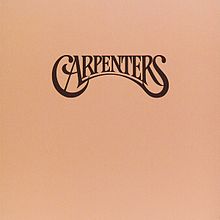
For All We Know, Music by Fred Karlin, Lyrics by Robb Royer and Jimmy Griffin, Performed by Larry Meredith (1970) and The Carpenters (1971), Encountered 1970 and 1971

Buy it here |  See it here | Sheet Music here | Lyrics here

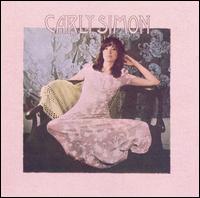
That’s the Way I’ve Always Heard It Should Be, by Carly Simon and Jacob Brackman, Performed by Carly Simon (1971), Encountered 1971

Buy it here |  See it here | Sheet Music here | Lyrics here

           When I write about deciding to get married, a decision I was confronting in 1970, there is a choice: either a wealth of detail or great simplicity.  The subject lends itself to either approach.  In my case, however, discretion mandates the latter.  As I’ve written before, this is my story, no one else’s.

The hardest fact, then, is the easiest to tell: I suffered agonies of indecision.  And this should have told me all I needed to know about whether to proceed, especially in view of how young I was, and in view of the fact my girlfriend S. was even younger.  We were both good people and very nearly right for each other for the long term.  But nearly only counts in horseshoes and hand-grenades, as S. herself would say in other contexts.

Indecision: Greatest Gen Versus Boomer Style

Harder to tell is the way the air of the times flavored the experience of going through that indecision.  Marriage is such an old institution and humanity has had such extensive experience of marriage that in one sense there can be no new wisdom about it, no new thinking. Everything that could possibly be said must surely have been said.  Still, every generation confronts the old questions and tries out the old answers in its own way.  And certainly this was extraordinarily true of my own generation.

Consider how it had appeared to our parents, the ones who had Weathered the Depression and Won the War.  Their identity was as a generation overcoming uncertainty and yearning to establish solid, lasting things.  Marriage, the way most of them wanted to believe in it, was one of those solid, lasting things.[1]  They could flock to its strictures and protections because they knew and were sick of the contingency of economic upheaval and world conflict.  From my perspective, they didn’t handle what their vows created any better or any worse than any other generation did, but I’m convinced they decided more decisively whether to take the vows in the first place.  At least more decisively than my generation did.

As for us Boomers, raised amid comparative peace and prosperity, we had been encouraged to make lifelong enterprises out of exploration of ourselves and our potential.  And it would be hard to be continually exploring after one had made certain commitments.  Marriage could only be reconciled with this aspiration if marriage itself became part of the adventure, if, instead of becoming the embrace of certainty with a person one knew intimately, it were to be made somehow the very vehicle in which the exciting journey of life could be taken.

The trouble was, if both of you were growing in unpredictable ways, were busy exploring, what would happen when each of you had grown into someone new?  After all, that you would each continue to grow, to metamorphose even, was absolutely a part of the program.  Could a marriage sustain such developments?  One could not know for certain in advance.  The only thing known for certain up front was the commitment; how much the cherished exploration could persist in its wake could only be known later.

Time Alone Will Tell

For All We Know, which appeared first in a movie all about deciding to get married, Lovers and Other Strangers (August 1970) (it won the Best Original Song Oscar), and then came out as a hit for The Carpenters early in 1971, was a perfect expression of that dilemma:

 Love, look at the two of us
 Strangers in many ways
 We’ve got a lifetime to share
 So much to say and as we go from day to day
 I’ll feel you close to me
 But time alone will tell
 Let’s take a lifetime to say
 I knew you well
 For only time will tell us so
 And love may grow for all we know.

           In other words, finding out whether (or not) you get to know the other person well – presumably if you don’t, it’s because the marriage failed – is part of the great exploration of life.  The “great exploration” part notwithstanding, this is hardly a ringing endorsement of marriage.

The staging of that moment in the movie, with Larry Meredith singing the song in (it must be said) an unmemorable rendition, just underlines the equivocation in the feelings.  You can see the scene here.  Bonnie Bedelia and Michael Brandon, the young couple whose indecision was the linchpin of the plot, finally take hands, ascend to the altar, and stand before the priest.  As they say their vows and exchange rings, and Meredith sings, the camera peeks around the church, lighting on various couples, their relationships in various states of array and disarray, including a hilarious three-shot of Gig Young, Anne Jackson, and Cloris Leachman, as respectively the adulterous father of the bride, his paramour, and his unsuspecting wife.  You can read the lyrics as hopeful, but they don’t have to be.  And as I watched that scene at the time, I understood exactly the ambiguity the moviemakers intended; I was feeling it.  And then The Carpenters came out with their own version and made the flavor last.

Two Birds Through The Clouds

Likewise with Carly Simon’s first hit, That’s the Way I’ve Always Heard It Should Be, which came out only about a month before S. and I graduated and, two days later, tied the knot.  Simon nailed the paradox of trying to make of marriage a liberation and commitment.

 You say we’ll soar like two birds through the clouds,
 But soon you’ll cage me on your shelf–
 I’ll never learn to be just me first
 By myself.

           That record stayed on the charts a long time, 17 weeks, so basically it was there whenever I turned on the radio during our first summer as a married couple.  I can remember stumbling out of the house at dawn and getting behind the wheel headed for my summer job (driving a lunch truck from North Philly to industrial locations in South Jersey) and hearing it as if it had been directed personally to me.  I drew consolation from the fact that the singer concludes she should marry, doubts notwithstanding.  I also drew consolation from an inability to imagine S. and me suffering in staid misery like the older generation pictured in the song.  And shortly thereafter Carly Simon herself got married to James Taylor, no less, and sang glowingly about it – for a while.

So I wrongheadedly ended up taking these basically dark and doubtful songs as omens of hope.  A crystal ball would have put matters in a different perspective. Simon, who must have been writing about herself, would see her marriage collapse at the same time as mine did.  And Karen Carpenter, who wasn’t actually marrying anyone in those days, married unhappily when she finally did, and, of course, had an untimely death from her struggles with anorexia.  I suspect she was too damaged from an early age to make any marriage work, but certainly the one she entered didn’t make anything better; it was not a great adventure.

Weekend In Brigantine

I believe the moment I finally made up my mind was during a brilliantly sunny weekend getaway, in late winter or earliest spring of 1971.  Some of my friends and I, not including S., went off to the seaside cottage of one of our parents in Brigantine, New Jersey.  I kept to myself, walking or sitting on the shore, staring at the ocean.  I think everyone else was paired off, so no one minded when I opted for solitude.

As I stared out at the water, it actually was not the Carpenters’ song in my head; if memory serves, it was Jethro Tull’s Reasons for Waiting again (I wrote of it in my previous Theme Song piece).  Some songs have “legs” in your subconscious.  You can take that song as a paean to male attentiveness and fidelity, and I think that quality of it helped me make up my mind.  In any case, coming away from that weekend, I had decided I could see enough odds of success to undertake the adventure with S.

I cannot call my exact thought process to mind now. I do remember, however, the picture I had for myself and S.  We would find our adventure in the study and teaching of literature; our metamorphoses would arise from the encounter with books.  If it might seem to you that vowing to shut oneself up in the academic cloister was rather thin gruel, I have to tell you you probably weren’t around in the liberal arts world of 1971.  To the stimulus an elite academic setting always provides, the era imparted a special explosive quality.  People were demonstrating, acting out, taking drugs, espousing politically radical new critical theories.  Anything and everything could happen.

And one thing S. and I knew was we were talented enough to succeed at the challenge.  It was a marriage of true minds.  And for a good long time, we did not admit impediments.


[1]. My touchstone for this is the song the sailors and their sweethearts sing at the end of On the Town: Some Other Time.  That little piece, and particularly the heartbreaking madrigal at its ending, captures all the longing, the frustration with not being able to build anything yet, that I believe typified that era.

Copyright (c) Jack L. B. Gohn, except for album art

Theme Songs Page | Previous Theme Song | Next Theme Song

Hunger Games: The Politics Is Ever Balanced

 The Big Picture Home Page | Previous Big Picture Column | Next Big Picture Column

Hunger Games: The Politics Is Ever Balanced

Published in the Maryland Daily Record April 2, 2012

Come on, admit it. You’ve read, or you’re going to read, the Hunger Games trilogy. Especially in light of the just-released movie, the world knows Suzanne Collins’ Hunger Games as a phenomenally potent brew of action, romance and dramatized game theory. But I would also add politics and statecraft to the list. Along with their other attributes, the books are an extended meditation on some potent political and governmental themes.

Works for Both the Left and the Right

The first installment, Hunger Games, plays it safest, riffing equally on narratives of both left and right in our country, in a way that gives everyone something to like and little to hate. It will resonate for you, whatever you believe.

We’ve heard a lot about political narratives recently, what with the publicity generated by Jonathan Haidt’s new book The Righteous Mind. Haidt has reminded us of the political narratives that bind right and left in our country. Collins uses both.

Narrative of the Right

The narrative on the right is that our country has been taken over by effete but tyrannical pleasure lovers who disrespect loyalty, fidelity, family and hard work, and that we, the righteous ones, must take the nation back. That is precisely the narrative arc of the trilogy.

In the story, which takes place after some unnamed catastrophe has reduced America to a smaller land made up of thirteen Districts and a Capitol, the Capitol-dwellers have enslaved the virtuous folks of the Districts. The Capitol-dwellers devote themselves to lavish feasts, outrageous consumption, and a spectator sport in which children from the Districts fight to the death on television. Meanwhile the virtuous denizens of the provinces scrape by on near-starvation rations, surrender up their children for the slaughter because they must, but otherwise treat each other with loyalty and respect and evince the strongest of family values. At least that is the case before a futuristic La Pasionara, Katniss Everdeen, rises up to become the symbol of a revolution that overthrows the government and – takes the nation back. And, in accordance with not only the PG values of some Young Adult Fiction but also the ideals of the right, she remains chaste though adored by two attractive and admirable young men, at least until she weds one of them at the end.

Narrative of the Left

Haidt also reminds us of the liberal narrative. Quoting sociologist Christian Smith, Haidt summarizes: “Once upon a time, the vast majority of people suffered in societies that were unjust … and oppressive…. But the noble human aspiration for autonomy, quality and prosperity struggled mightily against the forces of … oppression and eventually succeeded in establishing modern, liberal, democratic, capitalist, welfare societies. Despite our progress, there is much work to be done to dismantle the powerful vestiges of inequality, exploitation and repression.” And in fact today, liberalism focuses on dismantling what it sees as the resurgence of those vestiges, in the attention it draws to the 99% and the 1%.

This is also a way of encapsulating Katniss’ story, except that we are starting back in the “once upon a time” phase. The Capitol is that old stand-in for injustice and oppression, a colonial power, and the Districts are economically exploited colonies. Or one can say that the Capitol is the 1%, and all the people who are starved and slain and lied to are the 99.

Offensive Irrelevance

There is another liberal theme in the critique of reality TV and celebrity culture. Liberals are particularly offended by shows that line up contestants for one form or another of elimination competition, in which the participants, and by extension the audience, are encouraged to expend enormous emotional energy, even though these contests make no intrinsic political, economic, cultural, religious, or ecological difference (feel free to add your own categories too) regardless of who wins and who loses. To liberals, this focus on circuses distracts valuable attention from important matters (starvation, economic exploitation, eco-catastrophe, war, and politics – again, feel free to add your own categories) and emphasizes emotion rather over fact-gathering and logical habits. The Hunger Games (the fictional event, not the books) and the fictional media hoopla surrounding them are merely this kind of offensive irrelevance amped up and made far more vicious by the death of children.

I would also posit that the struggles of Katniss and of Peeta, one of her would-be lovers, to locate their own authenticity amid the celebrity hype imposed on them and among the challenges posed by the requirement of lying to stay alive, are political themes that both sides feel strongly about, although, unscientifically, I suspect liberals care more.

So, as of the end of the first installment, Collins has presented a tale that works well for readers at both ends of the spectrum. The second and third books, Catching Fire and Mockingjay, however, turn away from what we might call narratives of the political base, and focus instead on a question about government, a question that arises most urgently when revolutions erupt in the absence of an existing functioning civil society.

Robespierre or Washington?

This was the problem encountered by the French and the Russian revolutions. These were no mere palace coups but efforts to establish workable governments where older ones had comprehensively failed. Like Katniss’ Capitol, the anciens regimes in Paris and Moscow had bequeathed few functioning institutions that could even be reformed and then built upon. In the absence of durable institutions, however, revolutions are left to be shaped entirely by the people who lead them. And the question in Katniss’ rebellion is whether its leaders will go the murderous way of Robespierre and Lenin or the republic-building way of George Washington.

Katniss herself, because of the celebrity she has attained in the events of the first book, is deployed by the revolutionaries more as a symbol than a warrior, and certainly is not thought of by the leaders as one of them. And it is a genuine problem with any revolution requiring bloodshed that people trained in using bloodshed to achieve things have a hard time either choosing or learning to achieve things any other way when they win. As a result, humanity has seen far more new bosses that are the same, essentially, as the old boss, than it has seen humane leaders succeed tyrants. At the end of Mockingjay, the new leaders are actually ready to embrace a new round of Hunger Games, posing a final dilemma to Katniss. Will she throw in her lot with them?

As we readers reach that point, there is no real question in our minds which course Katniss will choose. But in real life I think conservatives and liberals tend to draw different practical answers. Conservatives fear the Robespierres more, and liberals are less patient with the anciens regimes. And once more, in the resolution, Suzanne Collins finds a way to please both, giving her readers a humane revolution freed from its would-be Robespierre, because Katniss has stricken her down.

Only at the Cineplex

The odds, it seems, would be ever in humanity’s favor were a certain YA heroine around to save the day. We can but hope they will remain in our favor when she joins us only at the cineplex and on the printed page.

Copyright (c) Jack L. B. Gohn

The Big Picture Home Page | Previous Big Picture Column | Next Big Picture Column


Sometimes the Path Strays from You: INTO THE WOODS at Center Stage

 Theater Reviews Page | Previous Theater Review | Next Theater Review

Sometimes the Path Strays from You: INTO THE WOODS at Center Stage

Posted on BroadwayWorld.com March 18, 2012


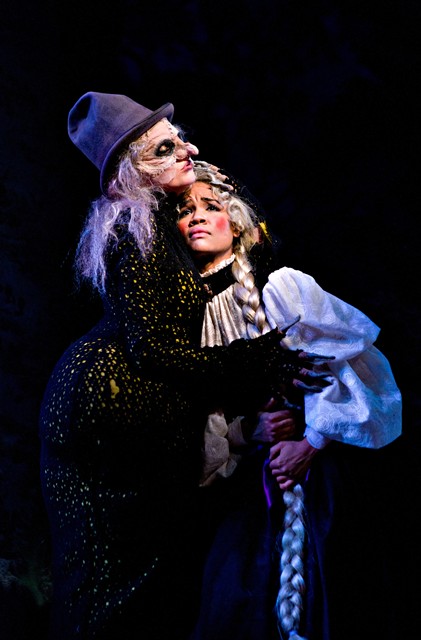
Lauren Kennedy & Britney Coleman

Into the Woods (in revival at Center Stage in a co-production with Connecticut’s Westport Country Playhouse) is one of that handful of musicals that can truly be called profound.  And small surprise, because its subject, the folklore passed on from parents to children under the deceptively superficial name of fairy tales, is equally profound.  Fairy tales are timeless because the kitchen drudge who yearns to become a princess, the little girl vanquishing a wolf encountered on the way to grandmother’s house, the simpleton who sells the family cow for a handful of magic beans, and their kindred, are archetypes of each of us, at various moments in the trajectories of our lives.  As such, there is actually nothing superficial about them.  By mashing up these stories, composer/lyricist Stephen Sondheim and book author James Lapine demonstrate the common dynamics in these tales that enable them to speak so powerfully to us.

I Wish

As most theatergoers know, the stories start with a common sense of longing.  As we discover Cinderella (Jenny Latimer), the Baker and his Wife (Erik Liberman and Danielle Ferland), Red Riding Hood (Dana Steingold), and Jack (of Beanstalk fame) (Justin Scott Brown), the common phrase in their song is “I wish.”  To pursue these wishes (to go to the festival, to have a child, to visit granny, to sell the cow), they are compelled to enter “The Woods,” which are far more than any mere geographical Black Forest.  These are simultaneously the place where anything can happen (like the dreamlike forest in A Midsummer Night’s Dream) and a metaphor for early encounters with risk and growth that come into each of our lives.  Mostly, things go well for the heroes and heroines, as befits their status in the tales about them.  They not only succeed, but they learn much about the world and themselves, leading to some degree of mixed emotions.  As Red Riding Hood summarizes her encounter with the wolf: “And he made me feel excited/-Well, excited and scared.”  Ditto Cinderella fleeing from her prince: in this version of the story, there is no short-lived pumpkin coach whose expiration forces her to leave the palace, but she simply finds herself unable to process immediately the erotic promise of the encounter and needs to break it off for the moment.

As we proceed, we also learn that these tales are not only about young people finding their mates or coming to terms with their sexuality or starting their families.  They are about age as well as youth, especially the familiar dance of closeness and separation between parent and child.  This is most poignantly true of the Witch (Lauren Kennedy) and Rapunzel (Britney Coleman).  What Rapunzel sees as the mother interfering with her independence and her relationship with her Prince (Robert Lenzi), the Witch sees as protecting her daughter from a terrifying and deadly world.  They are each wrong – and right.

Act I of course ends with all problems resolved, and all the heroes and heroines successful, as the ancient tales ordain.  But Act II is where the real genius of the show goes to work.  Like Act II of the Fantasticks, but far more richly, it takes as its premise the obvious truth that every happy ending is the beginning of another tale, and that when you have nowhere to go but down, down is where you have to go.  Lapine and Sondheim ask themselves and us what these same archetypal characters could tell us about ourselves if they were allowed to play out their strings further, beyond the happy endings.  The answers to that question are what make this musical one of the great evenings of theater.

Act II

The characters are all compelled by circumstances to go back into the woods, and this time they encounter there such things as infidelity, divorce, the death of parents, the death of children, abandonment, catastrophe – and overarching this the absence of a narration (the narrator, played by Jeffry Denman, becomes a casualty) or any other authoritative guidance as to the choices that need to be made.  As one of the characters observes: “The path has strayed from you.”  The unsettling conclusion: “You decide what’s right / You decide what’s good.”

This is all incredibly sad and confusing, not to mention frightening, and yet as the core of surviving characters gels, so does the indomitability of the human spirit they evince.  This story too, it is suggested by the moving final number, CHILDREN WILL LISTEN, should be told our children.

To me, this is Sondheim’s greatest musical.  As great as he is and abundant as are his gifts, he can and frequently does misfire.  But here, supported by Lapine’s flawless script, Sondheim (unlike the characters) never goes astray.  The music is stirring and intelligent, with motifs constantly recycling in ways that directly illuminate the action.  The lyrics are supple and studded with dazzling wordplay, whether it be one-liners (“If the end is right, it justifies the beans”) or tongue-twisters: (“If it were not for the thicket-“ “A thicket’s no trick.” “Is it thick?” “It’s the thickest.”)

Although the acting demands are not extreme, because of the frequent wide and unusual pitch intervals, it does not appear to be an easy musical to sing, and its frequent ensemble numbers call for razor-sharp timing.  Director Mark Lamos keeps everything running perfectly.  Indeed, this is an impeccable production which can stand comparison to the original 1987 cast version (streamable on Netflix, if you care to compare).  In fact, there is actually one member of that cast in this production: Danielle Ferland, now the Baker’s Wife, was the original Red Riding Hood.

I have been critical of Center Stage at times for being too staid and too safe.  And while I won’t say this production takes any notable risks, it goes full-bore, and no one would accuse it of being staid.  As Maryland’s State Theater, Center Stage is supposed to be the benchmark for Baltimore.  With the city’s vibrant theater scene, Center Stage cannot lead from behind, even if its mission surely calls for serving up a good proportion of classics.  This rendering of Into the Woods is exactly the way a classic should be done in this venue: with grace and style: Center Stage at its best.

Copyright (c) Jack L. B. Gohn, except for photograph

 Theater Reviews Page | Previous Theater Review | Next Theater Review

Contraception, an Unrepresentative Church, and Unresponsive Courts

The Big Picture Home Page | Previous Big Picture Column | Next Big Picture Column

Contraception, an Unrepresentative Church, and Unresponsive Courts

A shorter version of this piece was published in the Maryland Daily Record March 5, 2012

At this writing we still don’t have an outcome, either regulatory or political, in the fight between the President and the bishops over the proposed mandate that employers, including Catholic hospitals and universities, offer their employees health insurance plans with birth control coverage. But it is clear that the rhetorical battle line du jour is “religious freedom.”    The Catholic bishops call their rejection of the mandate “this effort to protect religious liberty and freedom of conscience for all.”  Their fellow-traveling politicans have sounded the same note.  Speaker John Boehner decried the regulation as “an unambiguous attack on religious freedom.”  Rick Santorum proclaimed that “it’s about freedom of religion” among other things.

The bishops may talk about “freedom of conscience for all,” but they do not mean all.  They’re actually quite selective about whose religious freedom is at stake. Clearly it is not the religious freedom of the 98% of sexually active American Catholic women have used so-called “artificial” birth control.  Nor is it that of the 57% of American Catholics who support the policy, including 59% of American Catholic women, per the Public Policy Polling Organization.  A just-published New York Times/CBS News poll turned up similar numbers.  Public Policy Polling summarized: “The Bishops really are not speaking for Catholics as a whole on this issue.”

Indeed not.  It does not take a great deal of cynicism to see this as an effort by the bishops to reassert a lost relevance, to point out to Catholic believers whom the bishops can no longer otherwise control that the hierarchy still rules the roost on Catholic turf.

If there seems to be something illegitimate here, though, it is this: that Catholic turf should not be the bishops’ to rule in the first place.  The hospitals and the universities were built with the funds and the blood, sweat and tears of generations of all Catholic believers, and should by all rights belong to all of their successors, the entire body of the faithful.  But legally speaking, that is not the case.  The deeds to every building, the title to every account, vest control in one constituency, the Catholic hierarchy.

Instead of acting like the in-title-only trustees of these institutions, accountable to those who built them and their successors, the hierarchy behave like the equitable owners.  And if you think these would-be owners are in favor of religious freedom for the rest of us in the Catholic fold, I have a bridge in Brooklyn I want to sell you.

Hitherto, the Catholic church has never claimed that its adherents and institutions should experience religious freedom vis-a-vis their own faith; that’s why all those heretics got burned at the stake, after all – why we had those Crusades and the Inquisition.  But a Church that for most of its history has been, internally, harshly authoritarian shouldn’t get to claim, in the midst of a national presidential campaign, that it is supporting religious freedom, of all things, especially for its female members, and, incidentally, for that of the men who love them.  Religious freedom is anathema, in the literal sense of the word, to my church.

Many of us who fill the pews (or, these days, sit in half empty ones) feel differently, however. We would like to see our faith acknowledge the views of those of us, evidently a majority, who see family planning as a good thing.  We would also like to see oral contraceptive medications also recognized as providing, and often being prescribed to provide, significant therapy for various medical conditions.[1]  We recognize employer-funded health insurance coverage of contraceptives as sound public health policy.  Our Church’s denial of any respect or accommodation for our views is antithetical to our religious freedom, and its use of institutions we and our predecessors built to reinforce that denial just compounds the insult.

This repeated disrespect for dissent and alienation of dissenters poses an existential challenge for the Church, however, in the decades ahead.  Everyone knows the Church has unsustainable problems, whatever metric one uses, whether it be the replacement rates of faithful,[2] of priests,[3] of nuns, or the survival of schools and churches,[4] or the state of church finances.[5]  I am certain that the largest cause for the Church’s decline is the authoritarianism of a hierarchy whose legitimacy is widely viewed as having disappeared.  The Church’s prospects for survival would be far more promising if there were some mechanism for turning out the current hierarchy and substituting one more responsive to what the majority consider to be God’s will.

And that problem is precisely highlighted by the birth control fight, which in part turns on whether the bishops on the one hand or the faithful on the other have the right to speak for the hospitals and universities.

In America, fights for control of institutions generally have a way of ending up in the courts.  I don’t see that happening with this one, however, because since 1872, the Supreme Court has been keeping courts and legislatures from second-guessing decisions about ecclesiastical control.  And the Court just did it again, unanimously, two months ago, in Hosanna-Tabor Evangelical Lutheran Church v. E.E.O.C.[6]

But not to choose is to choose.  Hands off doesn’t actually mean hands off.  It just means deferring to one side and one side only: the side controlling the hierarchical structures and tribunals, the deeds and the titles to the religious property.  That is the teaching of the precedents reaffirmed in Hosanna-Tabor.  It means going with the bishops even in the teeth of highly credible charges that by governing Catholic institutions in keeping with their doctrinal inflexibility they have abused their power and their trust.  It means choosing to let the bishops go on controlling what they “own.”

And that non-choice choice gives the bishops a huge and undeserved upper hand. It’s hard to have a faith anything like Catholicism without churches, schools, universities and hospitals.  This commons, once appropriated by a small entrenched and unrepresentative minority of the faithful, cannot be duplicated by the majority: the faithful have neither the means nor the energy to replicate them anew.

So, unchecked by the courts, the bishops will win.  But I predict their prize will be ashes.  There will always be religion and religions, but I’m gloomy about the future of my particular religion.  One in ten Americans has left the Catholic Church, making departed Catholics the second biggest “denomination” in the country.  Almost any Catholic can tell you about the good young men and women who leave and don’t come back, about the churches consolidating because there aren’t enough priests to say Mass on Sundays, about the closing parochial schools.  Anyone who thinks these stories are unrelated to the Church’s obduracy on the subject of birth control (and the usual list of related items: divorce, homosexuality, abortion, clerical celibacy, single-sex clergy, etc.) is deluded.  Disgust over that obduracy, together with the child abuse scandals, is the exact reason the Church is wasting away now and will continue to do so.

Will the last bishop to leave please turn out the lights of his church?  (It won’t be our church by then, thanks to courts that take sides by not taking sides.)


[1].    For these thoughts, I credit Max Romano, a medical student at the Johns Hopkins University School of Medicine, and various colleagues, in this piece.

[2].  Father John McCloskey had these observations in early 2006:

Before the Second Vatican Council, approximately 75% of Catholics attended Mass on Sundays. As of 2004, approximately 32% of American Catholics attend Mass every Sunday. On any given Sunday as many as 40% of American Catholics may be attending Mass even though some of them do not attend Mass regularly. Thus there are only more or less half as many Catholics attending Mass now as before the Council.

[3].  Father McCloskey said this on that score:

Let’s look at the numbers in the US first. In 1965, at the end of the Council, there were 58,000 priests. Now there are 41,000. By 2020, if present trends continue (and there is no sign of a dramatic upsurge in vocations), there will be only 31,000 priests, and half of those will be over 70. (To offer a personal example of the effect of these demographics, I was ordained in 1981 at the age of 27. Today, at the age of 52, I can still attend gatherings of priests and find myself one of the younger members present.) In 1965, 1,575 new priests were ordained. In 2005, the number was 454, a decrease of more than two-thirds — and remember that the Catholic population in the US increased during these years from 45.6 million in 1965 to the 64.8 million of 2005, a rise of almost 50%.

[4].  Father McCloskey said this in 2006 on that score: “Almost half the Catholic schools open in 1965 have closed; 4.5 million students attended Catholic schools in the mid-1960s, while today there are about half that many students.”

[5].  This is harder to get reasonable numbers on, because of the opacity of Church finances.  However, there is widespread anecdotal evidence that various dioceses are nearly bankrupt after paying settlements to abuse victims – and not receiving replacement donations from the outraged faithful.  See, e.g., this piece from National Catholic Reporter. Moreover, it is universally acknowledged that church finances at all levels lack adequate controls, internal or external, leading to endemic theft and embezzlement.  And what better way to ensure the autonomy of the priests and bishops in all matters spiritual and temporal within their fiefdoms than to assure that no one is allowed to look over their shoulders?

[6].  Justice Roberts summarized the decisional history – and I quote at length:

In Watson v. Jones, 13 Wall. 679, 20 L.Ed. 666 (1872), the Court considered a dispute between antislavery and proslavery factions over who controlled the property of the Walnut Street Presbyterian Church in Louisville, Kentucky. The General Assembly of the Presbyterian Church had recognized the antislavery faction, and this Court, applying not the Constitution but a “broad and sound view of the relations of church and state under our system of laws” declined to question that determination. Id., at 727. We explained that “whenever the questions of discipline, or of faith, or ecclesiastical rule, custom, or law have been decided by the highest of [the] church judicatories to which the matter has been carried, the legal tribunals must accept such decisions as final, and as binding on them.” Ibid. As we would put it later, our opinion in Watson “radiates … a spirit of freedom for religious organizations, an independence from secular control or manipulation” in short, power to decide for themselves, free from state interference, matters of church government as well as those of faith and doctrine.” Kedroff v. Saint Nicholas Cathedral of Russian Orthodox Church in North America, 344 U.S. 94, 116, 73 S.Ct. 143, 97 L.Ed. 120 (1952).

Confronting the issue under the Constitution for the first time in Kedroff, the Court recognized that the “[f]reedom to select the clergy, where no improper methods of choice are proven,” is “part of the free exercise of religion” protected by the First Amendment against government interference. Ibid. At issue in Kedroff was the right to use a Russian Orthodox cathedral in New York City. The Russian Orthodox churches in North America had split from the Supreme Church Authority in Moscow, out of concern that the Authority had become a tool of the Soviet Government. The North American churches claimed that the right to use the cathedral belonged to an archbishop elected by them; the Supreme Church Authority claimed that it belonged instead to an archbishop appointed by the patriarch in Moscow. New York’s highest court ruled in favor of the North American churches, based on a state law requiring every Russian Orthodox church in New York to recognize the determination of the governing body of the North American churches as authoritative. Id., at 96-97, 99, n. 3, 107, n. 10, 73 S.Ct. 143.

This Court reversed, concluding that the New York law violated the First Amendment. Id., at 107, 73 S.Ct. 143. We explained that the controversy over the right to use the cathedral was “strictly a matter of ecclesiastical government, the power of the Supreme Church Authority of the Russian Orthodox Church to appoint the ruling hierarch of the archdiocese of North America.” Id., at 115, 73 S.Ct. 143. By “pass[ing] the control of matters strictly ecclesiastical from one church authority to another,” the New York law intruded the “power of the state into the forbidden area of religious freedom contrary to the principles of the First Amendment.” Id., at 119, 73 S.Ct. 143. Accordingly, we declared the law unconstitutional because it “directly prohibit[ed] the free exercise of an ecclesiastical right, the Church’s choice of its hierarchy.” Ibid.

This Court reaffirmed these First Amendment principles in Serbian Eastern Orthodox Diocese for United States and Canada v. Milivojevich, 426 U.S. 696, 96 S.Ct. 2372, 49 L.Ed.2d 151 (1976), a case involving a dispute over control of the American-Canadian Diocese of the Serbian Orthodox Church, including its property and assets. The Church had removed Dionisije Milivojevich as bishop of the American-Canadian Diocese because of his defiance of the church hierarchy. Following his removal, Dionisije brought a civil action in state court challenging the Church’s decision, and the Illinois Supreme Court “purported in effect to reinstate Dionisije as Diocesan Bishop,” on the ground that the proceedings resulting in his removal failed to comply with church laws and regulations. Id., at 708, 96 S.Ct. 2372.

Reversing that judgment, this Court explained that the First Amendment “permit[s] hierarchical religious organizations to establish their own rules and regulations for internal discipline and government, and to create tribunals for adjudicating disputes over these matters.” Id., at 724, 96 S.Ct. 2372. When ecclesiastical tribunals decide such disputes, we further explained, “the Constitution requires that civil courts accept their decisions as binding upon them.” Id., at 725, 96 S.Ct. 2372. We thus held that by inquiring into whether the Church had followed its own procedures, the State Supreme Court had “unconstitutionally undertaken the resolution of quintessentially religious controversies whose resolution the First Amendment commits exclusively to the highest ecclesiastical tribunals” of the Church. Id., at 720, 96 S.Ct. 2372.

Hosanna-Tabor Evangelical Lutheran Church & Sch. v. E.E.O.C., 132 S. Ct. 694, 704-05 (2012).

Copyright (c) Jack L. B. Gohn

The Big Picture Home Page | Previous Big Picture Column | Next Big Picture Column

Strong Portia and Shylock Redeem Confused MERCHANT at CSC

Theater Reviews Page | Previous Theater Review | Next Theater Review

Strong Portia and Shylock Redeem Confused MERCHANT at CSC

Heather Howard and Greg Burgess in Merchant of Venice

Posted on BroadwayWorld.com February 20, 2012

At the Chesapeake Shakespeare Company’s revival of The Merchant of Venice, great efforts are made to render the performance “accessible.” Before the action starts, actors lounge around the hall, interacting with the audience. As the action starts, there is no dimming of house lights, and in fact there is very little house/stage distinction at all, given that the “stage” is simply a relatively small part of the room in which the audience sits on either side (augmented occasionally by a loft at one end of the room), and the actors are continually making exits and entrances not merely through the audience area but in between rows of patrons – again and again and again.  I was forced to wonder whether all this accessibility was really a service to the audience or the play.

An Inacessible World

I say this because The Merchant of Venice is not, despite its popularity, one of Shakespeare’s more approachable plays.  It is not a story of people somehow like us behaving in ways that can be totally explained using modern frames of reference. In order to respond as Shakespeare evidently intended, we would have to accept that there was some kind of rightness in the marginalization and persecution of Jews and the privileging of Christianity in a civilized society. In this play, Shakespeare has crafted what critic Harold Bloom rightly terms an “anti-Semitic masterpiece.” A modern audience should marvel at the mastery in this master-piece, but there is no acceptable way to get comfortable or cozy with it. A performance is not, and should not be presented as, a bunch of just-folks actors enacting a tale of just-folks having just-folks problems.

Instead, we are being plunged into a cauldron of contradictions that have their roots in a Renaissance world with violently different moral sensibilities from our own.  Antonio, the merchant of the title (Scott Alan Small), is admirable; we know this because of his bold mercantile enterprises, and even more because of his overwhelming generosity to Bassanio, his protégé, literally placing his life on the line to further Bassanio’s marital agenda. Antonio is also despicable, however, spitting on Shylock’s clothes, insulting his profession of money-lending, calling him a “misbeliever” and a “cutthroat dog,” muttering animadversions on Shylock’s “Jewish heart.” Bassanio (Matthew Sparacino) is admirable in his willingness to risk much to win the hand of Portia, in his love for Portia when he wins her, and in his loyalty to Antonio. Bassanio is also part of the gang that (without any excuse or sense that any excuse is needed) steals Shylock’s money along with his daughter. Portia (Heather Howard) is admirable in her conformity to her father’s mortmain control of her marital destiny, in her love for Bassanio, and for her miraculous judicial skills. But she is able to use those skills to turn Antonio’s defeat into victory only by gleefully relying on Venice’s xenophobic laws under which, so incidentally as not even to require comment, a Jew cannot attain the status of citizen. Shylock (Greg Burgess) is not admirable: he plots against Antonio’s life, and tries to subvert Venice’s rule of law by persuading a court to sanction killing as a mere incident of surety enforcement. Yet it is Shylock, and only he, who feelingly questions and suffers under a social and legal regime that promotes and fully accepts the dehumanization and degradation of a religious minority.

In stormy fictive seas like these, a modern audience ought not merely to feel as if it cannot find a firm bottom to stand upon; it should feel itself miles from land. It is therefore just wrong to surround a performance of the play with trappings of folksy accessibility. Instead, the audience should feel as if it is being inducted into something both wonderful and horrible – but in any case, into what Monty Python dubbed “something completely different.”

Two Towering Roles

Get past directorial choices, however, and this is a pretty good staging. This production one should go to for the acting. There are two towering roles in the play: Portia and Shylock (I have never been convinced that the Merchant of the title, Antonio, deserves to have the play named for him).  Howard’s portrayal of Portia is magnificent. She is passionate as both ingenue and jurist, conveying well her character’s love for Bassanio, while at the same time making credible the one moment she is really hard on him, even if only in sport (twitting him for losing a ring she gave him, knowing all the while the ring is not lost). My only quarrel with Howard’s performance (and again this goes back to directorial choices), is that no credible effort was expended in making her look masculine or different enough from her character’s ordinary self so that anyone in the court could have been deceived for a moment as to her gender, or that Bassanio and his colleague Graziano could have been successfully misled as to her identity. And yes, yes, I know that total verisimilitude could hardly have been required either way in Shakespeare’s time either. In fact then, because all the female parts were played by men, the gender problem would have gone the other way, i.e. rendering dramatically plausible the performance of femaleness, not maleness. But my point is that it’s hard to conceive of Bassanio, smitten as he is by Portia, being fooled for a moment by the imposture. And if you think that Shakespeare did not aim for any level of plausibility in this fantasy tale, think again: just think how believably close Shylock seems to come to realizing his aspiration to obtain judicial sanction for murder, at least an equally not-gonna-happen thing as a lay woman convincing a courtroom she is male and a judge. Just as Shylock’s plausible closeness to success matters dramatically, so too a semi-plausible drag would have helped here. And Howard, I believe, could have pulled it off.

Burgess is even more impressive as Shylock. He scales the heights and plumbs the depths with the character – and Shakespeare has provided him with plenty of both. Obviously the fact that Burgess is African American in an nearly all-white cast made for certain resonances. This is unconventional casting that works well. Because both Jews and blacks have been treated as Others in similar ways, we in the audience bring similar preconceptions to performances of blackness as to performances of Yiddishkeit. Burgess wisely does not attempt to load the character down with a Yiddish accent which in itself is naturally conducive to histrionics (as I have seen done), but otherwise gives full vent to histrionic highs and lows Shakespeare has given the character. Critics have commented that even at his most feverish, and even at the moment of his greatest humiliation when he is forced to convert to Christianity, Shylock maintains a weird dignity, and Burgess conveys this.

I cannot speak as approvingly of the unconventional casting of Launcelot Gobbo, played by a female actor, Kelsey Painter. But I acknowledge that the role is a mess in any actor or director’s hands. Exactly what kind of joke Shakespeare was making with this serving-man who deserts Shylock’s employ is hard to tell; the language is so obscure and wild it gives us few cues. Even harking back to the original staging tells us little.  The play was probably first produced at earliest in 1599, just after Will Kempe, Shakespeare’s original clown, who had premiered the role of Falstaff, for instance, left the Lord Chamberlain’s Men, and so far as I am aware, we do not even know the first Launcelot’s name, let alone his persona. In this production, Launcelot is portrayed as some kind of zany, with crazy hair and makeup, perpetually pulling up drooping short pants. Not for a moment could one conceive of Launcelot as a male character, let alone a coherent one.

A Night at Belmont

Having spoken at some length of directorial choices I would not praise, let me mention one area where I think director Teresa Castracane nailed it: the portrayal of the love of Lorenzo (Vince Eisenson) and Jessica (Molly Moores), and in particular the starlit night they spend basking in each other’s love at Portia’s home in Belmont, awaiting the happy return of the other lovers, at the beginning of Act V, Scene 1. Castracane finally kills the horrible house lights to achieve a modestly dazzling light effect, and for a moment we are in a place of sublime safety and happiness, thanks to these two passionate young lovers.

While I have gone on at some length on this production’s flaws, then, I do wish to hark back to my fundamental impression, which is that the strong Portia and strong Shylock outweigh the miscues in other areas. In a play in which morally acceptable and unacceptable stances are hopelessly intertwined and might turn an audience off, there are two things that will draw us to the play anyway: these two characters. If they are right, the play will succeed, despite all its difficulties. They are right as can be in this staging.

Copyright Jack L. B. Gohn except for photograph, by Teresa Castracane

Theater Reviews Page | Previous Theater Review | Next Theater Review

Revival Meetings: ANYTHING GOES, HAIR, and FOLLIES

 Theater Reviews Page | Previous Theater Review | Next Theater Review

Revival Meetings: Anything Goes, Hair, and Follies

A slightly shorter version of this piece appeared in the Winter 2012 issue of The Hopkins Review (New Series 5.1)

           Viewed as something of a genre unto itself, the Broadway stage, more than most art forms, persists through recycling, especially these days.  On a recent August weekend, I set out to sample the purest form of this recycling with what is arguably the purest product of the American stage: revivals of great American musicals, in this instance from three decades: Anything Goes, from the 1930s, Hair, from the 1960s, and Follies, from the 1970s.

The Recycling Bin

            On that recent August weekend, there were 24 shows on Broadway, and of those, only three were neither revivals nor jukebox musicals based on existing pop songbooks nor adaptations from other genres.  This represents a huge change from the way things used to be.  Although August once was much more fallow than it is today on Broadway, it bears note in that same August weekend in 1934, the year of Anything Goes, six of the seven Broadway shows playing were original productions.  In the same weekend in 1968, the year Hair came to Broadway, 8 of 16 shows were original.  And in August 1971, the year of Follies, 9 of 16 were original.  Based on these four datapoints, it would seem that the tide of derivativeness has been generally rising for at least the last 80 years.

            If Broadway is the pinnacle of American theater, and is a limited resource (40 stages), we are demonstrably devoting the bulk of our efforts at that pinnacle to works that started life in other genres and/or bygone times, and that we are largely crowding out new ones conceived (as my three exemplars once were) directly for the stage.

Issues for Revivals

            I come to anatomize this trend, not to praise it or dispraise it.  And in particular I come to consider issues unique to the quintessential form of recycling, viz. revivals.  They do, after all, pose a unique set of challenges to those who stage them, and a unique set of questions to be considered by a contemporary audience.  How does a show from one era fare in front of the audiences from a later one?  One has to assume that the work is viewed as having something to offer, or it would not be re-presented.  Yet audience sensibilities inevitably will have changed.  Does the contemporary production team tailor the work to those sensibilities, or does it count on the audience to make allowances and enjoy the work as more or less originally presented?

            These are difficult questions.  To confront the artifacts of another time can sometimes provoke shock and reflection, at others, ennui.  In any event, total anachronism is unachievable.  Even a producer who wishes to do so cannot actually provide the exact same experience an audience would have had 40, 50, or 70 years ago.  The performers will be different, the technicalities of stagecraft are not the same, and the business structure of Broadway has markedly changed over the years.

            Seeing these three revivals as I did, one on top of the other, emphasized the workings of all these dynamics.  Anything Goes took a highly revisionist approach.  The other two were far less willing to meddle.  They exemplified the strengths and weaknesses of each line of attack.

Anything Goes: Unsinkable

            Anything Goes can only be described as having started life as a rewrite, and then to have become more so over the years.  Songwriter Cole Porter began by collaborating with book-writers P.G. Wodehouse and Guy Bolton to do a musical about a shipwrecked ocean liner; then, just before rehearsals, came the Morro Castle disaster, leaving shipwreck no joking matter.  Wodehouse and Bolton having become unavailable to do the required salvage, Porter turned to the director Howard Lindsay and Russel Crouse to change the script to keep the ship afloat.  Their rewrite was in turn rewritten in two movies made of the show, with very different song lineups, characters given different names and different characteristics.  And then there was a 1962 off-Broadway revival, which largely nailed down the new list of songs evolved through the movie process and reduced the action to a single set (the original had reportedly ended with a couple of scenes off shipboard).  In 1987, Russel Crouse’s son Timothy and John Weidman were brought in to do yet another major rewrite.  Characters changed, the song lineup changed again, and songs were assigned to different characters once more.  The current production is based on the 1987 one.

            Given all this history, one can hardly grow indignant that we are not getting the “pure” 1934 production.  1934 was of mongrel breed itself.  Certainly it’s hard to image that Cole Porter would have cared.  He was given to doing the same thing when he enjoyed artistic control.  From his perspective, and probably that of the audiences of his era and ours, the show, like all Cole Porter shows, is fundamentally a delivery vehicle for his songs.  If they come across well, almost any flaw in the book, whether attributable to the revisers’’ hands or another’s, will be forgiven.

            We can add that the book was never flawed.  The Timothy Crouse/John Weidman adaptation is about as good a delivery vehicle as the Wodehouse/Bolton/Lindsay/Russel Crouse one.  We know that the plot, whoever scripts it, is a tissue, less significant or serious even than the plots in Gilbert & Sullivan, a nonsensical pastiche involving mistaken identities, an unsuitable marriage to be prevented, and two suitable ones to be achieved, some slapstick and some farce.  All that the script has to do is be funny.  The first version I saw in 1962[1] was funny.  The 1987-2011 one is funny.  Case closed.

Tap-Dance Explosion

            For 2011, the show has been “opened up” again, to use a phrase more associated with movies than the stage.  It has about 20 more performers than 1987, and conforms to modern big-Broadway expectations, making the song-and-dance last longer, giving the stars (when I saw it, Joel Grey and Sutton Foster were headlining) more opportunities to show off for the audience, even to give the technical marvels in the sets a fuller workout.  You can get a very clear illustration of the difference I’m talking about by comparing the 1962 Eileen Rodgers or the 1935 Jeanne Aubert London cast rendition of the title song, ANYTHING GOES (downloadable on Amazon or iTunes), with the video of the Sutton Foster tap dance explosion crafted from the same song and captured at the 2011 Tonys show (viewable on YouTube).  This seems to be about giving the theatergoer a thorough value for the $140 or so he or she will likely have plunked down for the experience. 

            This hypertrophy of razzmatazz does emphasize the original large scale of the show, but may detract from other Porter strengths.  There is something powerfully simple at the heart of Porter’s appeal.  He has a very complex musical sensibility, a fiendish facility with words, but a very uncomplicated outlook for all that.  Porter believes that sex is great fun, that love is a powerful, if not irresistible force, and that all else is humbug, including taking either sex or love too seriously.  For example, the character of Reno Sweeney, a revivalist/nightclub singer based on Aimee Semple McPherson could have been done “straight,” like the Salvation Army lass in Guys and Dolls, or done as an exposé (and by 1934 there was an air of scandal about McPherson).  But in Porter’s hands she comes across as neither seriously religious nor hypocritical.  Her revival meeting in the ship’s lounge is barely about good conduct, let alone religion, even though the religious trope of Gabriel blowing a horn of course is the title phrase in the song.  It’s simply a fun way of blowing off steam.

            Notwithstanding the great artistry of his music and lyrics, then, Porter’s songs deliberately cultivate an air of being trifles, facetious off-the-cuff improvisations sitting at a keyboard at a cocktail party.  1962 emphasized the small scale pleasures.  The economics of contemporary Broadway musicals dictate small orchestras but big singing and big dancing.  So that will be the emphasis for the moment, even if it undercuts that cocktail party dynamic.  If that’s what it takes to see Cole walk in our midst again, it is worth it.

No More Hair-y Guys

            In contrast, the reviser’s hands lie lightly on the current revival of Hair.  So far as I could tell, the intent was to recreate the experience of the original production, in a world to which in a strange way it seems less relevant than does Anything Goes.  We still have Cole Porter’s topics: love and sex, celebrity criminals and the thrill of travel, after all.  We do not have hippies, their hair, their fashions, the Draft, or the Vietnam War. 

Is This Trip Necessary?

            But let me ask a rude question: when the surrounding culture and politics have vanished, is it worthwhile to preserve and re-present Hair, either to a new generation, or to anyone?  

            The short answer might be that there must be something worth preserving in a show whose every lyric and every tune was so familiar to almost everyone I knew growing up.  If you weren’t there, you may find it hard to grasp how profoundly the show struck a chord with young theatergoers (and record-buyers) when it came out.  It was deliberately transgressive and provocative in its lyrics, which spoke of drugs in a completely positive way, put expletives in Broadway music in a then just-about-unheard-of way, and fiercely condemned the War and the Draft.  It limned the Generation Gap.  It glorified flowing locks on males, utterly anathema to the crew-cut generation of our parents who had won World War II.  And it was positive about sex — any sex.  The lyrics to SODOMY, for instance:

 Sodomy, fellatio, cunnilingus, pederasty:
Father, why do these words sound so nasty?
Masturbation can be fun.
Join the holy orgy Kama Sutra, everyone.

             Well, o-kay.  Today most of it lacks shock value.  But pederasty?  The generation that embraced Sexual Liberation is also the generation that brought a far more serious appreciation to the ravages of child sexual abuse.  It is not just another way of having fun, opposed only by fussy fools (as, arguably, are all the other things in the verse).  And the revivalists bringing it back to us must have known that.

            In short, if there was any effort going on to prettify Hair, I missed it.  What was already pretty stays that way, of course, like the curtain call where the audience is welcomed to throng the stage and help sing LET THE SUN SHINE IN.  The song is a deliberately uplifting and crowd-pleasing bit of power pop that would raise pulses anywhere.  But I think it seems less dramatically justified than it once did by its context, the tragic moment that has just preceded it: a vision of Claude, the young protagonist, inducted against his will into the armed services and slain in action.  One can interpret the song, whose lyrics are simply the phrase “let the sun shine in” repeated endlessly, as a prayer for the killing of the young Claudes of the nation to stop.  But in 1968 there was very little reason to think it would stop anytime soon, or to wax uplifting about the hope that it might.  The logic of the show gives us little to be upbeat about, even if we know that the Draft and the War both ultimately came to an end.

What Still Works

            And this, it seems to me, exactly typifies what still works and what does not.  The pop-iest songs, e.g. AQUARIUS, MANCHESTER, ENGLAND, HAIR, WHERE DO I GO, still pack a punch.  The politics, the characters, the plot and much of the lyrics do not.

            As to the politics, much of it seems now like an exercise in stating the obvious, and not very cogently.  Our parents mostly want us to go to war, and we don’t wanna; we’re repelled and we’re scared.  Long hair feels cool.  Why shouldn’t we have sex with whomever we feel like?  How are we (especially if we happen to be black) supposed to feel patriotic about a country that once held slaves?  Isn’t militarism just a form of insanity?  And the like — all lessons mostly learned (or thoughtfully rejected) by now.

            What’s was ugly seems uglier.  Hair was perhaps unintentionally frank about the shortcomings of the characters.  Progressive politics could coexist with sexism and personal cruelty; EASY TO BE HARD sums it up well: “Do you only care about the bleeding crowd?/ How about a needing friend?”  Sexual liberation leads to the impregnation of Sheila “by some crazy speed freak” with no prospect of providing parenthood for the child or love for Sheila, and Sheila barely has the tools to process or recognize the fix she and the child are in.  And the “off the grid” quality of the Tribe’s lives, without jobs or accountability, seems to modern eyes less liberated than parasitical.

What Were We Thinking?

            It begs the question: What exactly are we supposed to like or admire about these kids? In 1967, we would probably have admired how free they were.  Now we tend to ask what that freedom is in aid of.  The explanation provided: “In this dive we rediscover sensation.”  I suspect that that rediscovery is no longer so highly prized, and would not have made Hair a hit today, had it not been one already.

            The plot and the songs contain much incoherence, even for a show that is more a revue than a musical drama.  About those songs, it’s been commented that they often seem not to end so much as peter out.  INITIALS, for instance, consists in its entirety of playing around with the acronyms LBJ, IRT, CIA and LSD.  It’s mildly transgressive to juxtapose authority figures President Johnson and the Central Intelligence Agency with LSD, but pointless.  The Claude’s Nightmare sequence which takes up a good deal of Act Two is similarly incoherent.  To choose one example from many, it may be a piquant image to show a passel of Catholic nuns strangling Buddhist monks with rosaries, but so what?  What does it tell us other than that Claude is stoned?

            In short, Hair works now, to the extent it does, mostly because it worked once.  The songs are firmly lodged in the musical memory of everyone of a certain age.  But without updating, the show may leave many of that age wondering what we were all thinking.  And its original audience will not be around forever.

An Archival Follies

            The problem is far less pronounced with Follies, which is nearly as old.  Arguably Stephen Sondheim’s most ambitious work, it is to some degree inoculated against aging by taking as its central preoccupation the passing of time, and the verdict rendered on youth by age (and perhaps vice versa).

            As the world knows, Follies takes place in 1971 in an old theater about to be demolished, where during the Depression, a series of Ziegfeld-like follies were presented.  The occasion is a reunion of people associated with those productions, principally female dancers and their beaux and husbands.  The principal characters are shadowed by the ghosts of their younger selves.  So through a kind of mirror play we watch the men and women they have become describing the past (that description tellingly characterized as “ly[ing] about ourselves – a little”), and then, through the interplay of the ghosts, seeing what the truth was, and thence, by a roundabout path, getting to the truth of the present.

            The show is also a chance for actors and actresses of a certain age to show that they still have the stuff, and the audience will be “pulling for them” in the present, 2011, quite irrespective of how it would otherwise feel about the characters they portray either in 1971 or 1931 for that matter.  A show that demands consideration of the same story from so many temporal viewpoints is likely to draw audiences immune to what C.S. Lewis called “chronological snobbery,” i.e. the sense that because something no longer suits modern tastes, it must be unworthy of regard.  That being the case, the kinds of issues we have been considering that revivals provoke should be largely mooted out.

            Indeed, this is an audience likely to be approaching the piece with the anticipation of finally seeing it done at all.  It’s not that they necessarily either quarreled with or exalted the 1971 production (which only ran for 522 ill-attended performances) – I suspect that most of us sitting there, like me, hadn’t seen it before.  Worse, by common consent the original cast album was a butchered abomination, so, having missed the show itself, we had never were able to use the album as a chance to catch up.  The show is far too expensive for casual staging, unlike Company, its companion-piece from the previous year, so it is just not so well-known.  There was a great concert staging in 1985, which was recorded.  But that still does not add up to audience familiarity.  There was also a stripped-down Broadway revival in 2001.  Through the process of regional and West End revivals, the James Goldman script was quite significantly altered, and three songs dropped out and were replaced by three others.

            This production, which premiered at the Kennedy Center before moving to a limited Broadway run, is ponderous and visibly expensive (reportedly the most costly production ever premiered at Kennedy Center).  From a synopsis of the original and a synopsis of the changes Goldman later made, this seems to be the original script.  And the earlier song substitutions have been reversed. The word archival has been used to describe this production, and that seems right.

Too Much Superstructure?

            So what stands out?  There are a number of images out there in the publicity for this production of the ghostly showgirls with monstrous headpieces; that seems an apt icon for the musical.  The four intertwined personal stories at the heart of the enterprise have to support a similar superstructure: ghosts, a humungous three-level set, a 41-person cast, a full orchestra, and a ton of portentousness.  Critics have differed as to whether the burden crushes the stories or not.

            I think in part the answer one gravitates to depends on whether one buys Sondheim’s visions of marriage and of success.  There is a persistent theme in a number of his musicals, persistent enough so one must discount the hypothesis that it comes concurrently and independently from the various book authors with whom Sondheim has collaborated, the theme of marriage as at best a funhouse, at worst a house of horrors, from which, astonishingly, almost no resident actually chooses to escape.  Think of the married couples in Company (1970).  And he entertains a parallel vision of success as of something relatively easy to achieve, but very difficult to enjoy.  Consider quasi-autobiographical protagonist Franklin Shepard in Merrily We Roll Along (1981).  

            In short, Sondheim depicts people whose restlessness never gives them the ability to say of a career or a marriage: this is enough.  They may, and usually do, stay with the job and the marriage.  But this can only occur at the cost of constant wondering what might have been had those shackles never been laid on, and by dint of inflicting pain on those around them as they wonder.  Perhaps the reason Sondheim’s A Little Night Music (1973) seems such a dramatic success is that Ingmar Bergman’s Smiles of a Summer Night, Sondheim’s source, gave the unhappy characters an out: the miserable marriage actually ends and a presumably happy one ensues.  Where Bergman led, Sondheim had to follow.

Sondheim on Marriage

            So back to the two couples: Ben and Phyllis, and Buddy and Sally.  Their relationship goes back to the years of the Follies, when Ben and Buddy were young men at the bottom of the fire escape waiting to take showgirls Phyllis and Sally out on dates.  Ben has become a man of affairs, Buddy a salesman, and their two wives terminally bored and frustrated.  Sally, self-deluded, comes to the reunion believing she has a chance to rekindle a relationship with Ben.  Ben, Phyllis, and maybe Buddy have had affairs, and Sally has been fixated on memories of Ben.  So their marriages are hellish, as outlined in a couple of coruscating songs: COULD I LEAVE YOU? and BUDDY’S FOLLY, and especially Sally’s LOSING MY MIND (and it is a treat to hear Bernadette Peters’ treatment of this in the current version).

            Ben’s infidelity and coldness just seem to be givens, necessary to embody the Sondheim outlook on wedlock.  Phyllis’ coldness seems to be a response to Ben’s rebuffs.  And after the show-stopping COULD I LEAVE YOU? in which Phyllis tells off Ben, a volcanic eruption of hatred in which for three minutes she says unforgiveable, marriage-ending things, in response to him very emphatically asking for a divorce, the conclusion, which sees them still a couple, just does not follow.  The fight is over but not in any way walked back from.  Buddy, meanwhile, ought to be able to find a more desirable life companion than the sloppy, preoccupied Sally, and yet he is so conflicted that his staying with Sally is a foregone conclusion.

            The unveiling of this unhappiness proceeds concurrently with the reunion.  And despite the genuine piquancy of the notion of time’s passage at a gathering of superannuated showgirls and the men who surround them, it does not resemble the horror show of the two failed marriages.  Mostly the reunion is fun for the characters, the audience, and, presumably the cast.  This edition includes not only Bernadette Peters but Jan Maxwell and the grande dame of the British musical, Elaine Page.  They remain luminous and physically fit and it is a happy thing to see them.

A Gap Not Closed

            Apart from the four protagonists, the showgirls have had good lives, they are happy to see each other, and they retain the qualities that made them stars.  Even with notes of ruefulness injected, the song by Carlotta (Elaine Page), I’M STILL HERE, is about a kind of fulfillment and a great degree of honest, not to say triumphant insight. Is this depiction of private misery amidst rejoicing really a good fit?  It might be if the one compelled the other dramatically.  But the only causation I can see is that the reunion gives Sally a chance to find Ben and make a desperate attempt to win him back.  Everything else in their predicaments predates their arrival at the theater.  The setting does give the ghosts of their youthful selves a place to show how the two couples evolved out of a circle of friends, and perhaps how the seeds of their unhappiness were sown at the beginning.  And the Loveland sequence, a follies-style pastiche that degenerates into emotional grand guignol, which takes up much of the second act (the same way Claude’s nightmare does the second act of Hair, come to think of it), basically suspends depiction of the reunion.  It’s still got nothing to do with the reunion as a plot device.

            I would submit that Sondheim and his book author never quite closed this gap.  Follies remains more like two shows than one.  For comparison, think of how the happy romance and the tragic romance interplayed in South Pacific – a musical whose book was, incidentally, co-written by Oscar Hammerstein, well-known to have served as Sondheim’s mentor.  Because these romances were depicted in the same dramatic frame, and each had to do with cross-cultural romance, they cross-fertilized each other.

            James Goldman, the author of the book, kept tinkering with it up till his death in 1996.  But to my mind the show cannot be rewritten or updated to solve the problem

            That said, of course, Follies remains great art, slightly failed, but still richly deserving of this sumptuous re-creation.  We aren’t deterred from seeing revivals of Shakespeare’s “problem comedies” because they are imperfect; there’s far too much greatness there.  So it is with Follies.

What Will We Be Reviving In 2111?

            Looking forward, I would propose the following rules for predicting which shows will still be revived in 2111.  Great shows get invited back: Anything Goes will still be around – with, undoubtedly, fresh revisions. Great but flawed shows get invited back too: Follies will be back, and controversial then as now, with, probably, few revisions.  Shows that, taken out of their historical moment, are mediocre will probably disappear: Hair, I suspect, will suffer that fate, though some of the songs might persist.  And, whether my principles or my predictions based on them be right or wrong, I am confident about this: audiences a century hence will still be attending revivals.

___________

[1]  I’ve written about that revival elsewhere in this blog.

Copyright (c) Jack L. B. Gohn

Theater Reviews Page | Previous Theater Review | Next Theater Review
 

Where and Why Extraterritoriality Stops: iPads and Pirate Sites

  The Big Picture Home Page | Previous Big Picture Column | Next Big Picture Column

Where and Why Extraterritoriality Stops: iPads and Pirate Sites

A Shorter Version of This Piece Published in the Maryland Daily Record February 6, 2012

Sometimes it’s hard to believe how contrapuntal two current news stories can be. Such, for my money, are the tales of Apple’s Chinese factories and Hollywood’s at least temporarily failed effort to persuade Congress to pass anti-piracy legislation.

Can’t Live Without ‘Em

The Apple story is fascinating, if a little fuzzy around the edges. It’s no news to anyone paying attention that our consumer economy depends upon underpaid and endangered workers, whether we’re talking juvenile Uzbeki cotton-harvesters, conflict diamond miners, sewing-machine operators in maquiladoras along the Mexican border, migrant farm workers picking our fruit, or the toiling Asian hordes who handcraft our cheap consumer electronics. Without laborers working long hours in unsafe conditions for subsistence wages, we cannot stock our Wal-Marts or our Best Buys.

Apple just announced record profits, but the rumble about the Chinese factories where most of its hardware is made has been gradually increasing and threatens to drown out the rejoicing. The story largely got its start through the amateur reporting of monologuist Mike Daisey in his show The Agony and the Ecstasy of Steve Jobs, which as of this week is back from touring the country for an extended run in New York. Daisey claims to have penetrated the wall of secrecy surrounding the factories where iPods and iPads are made – and much of what he tells tends to puncture the Apple mystique.

Not Too Fuzzy

Daisey speaks of visiting the factory of Foxconn (Apple’s biggest supplier) in Shenzhen, which employs 430,000 workers, many of them as young as 12, working 12-to-16-hour shifts as the standard. The workers sleep in dorms with bedspace arranged in honeycombs. Bona fide unionization is criminalized.  Some of them work with neurotoxins that make their hands tremble.  And of course when the American companies they make things for come in to inspect working conditions, the factory always knows in advance and gets the underage workers and the dangerous chemicals out of sight.

At least, this is the story according to Daisey. Some have questioned whether he has his facts right.[1] But a long investigative report out last week in the New York Times confirms a lot of them.

Apple itself lent at least partial confirmation to Daisey and the NYT with the 2012 version of its annual “Supplier Responsibility Progress Report.”  Reading it, one wades through a fair amount of self-congratulation about Apple’s standards, its inspection program, and it remediation program; but there seems to be a lot, even by Apple’s admission, to remediate: only 38% of the factories stayed within acceptable working hours, only 69% (representing at least 90 factories) paid adequate wages, and there were a lot of other problems, like fatal and injurious explosions owing to improper ventilation, toxic chemicals dumped in wastewater, and unabated noise, at various plants. It’s harder to get a fix on how accurate or comprehensive all this is because almost no individual factories are named, and Apple has both a generalized culture of secrecy and a particularized PR need in this instance to deny leads to reporters who might be inspired to check Apple’s facts. The Progress Report is half mea culpa, half damage containment.

Live By the Sword …

And Apple, I strongly suspect, is one of the “good guys,” comparatively speaking. We are totally dependent on Asian electronic manufacturers, and they are totally dependent upon a workforce that can almost be characterized as slave labor. Manufacturers can’t easily or lawfully get away with that in the U.S. To their benefit and that of the American consuming public hooked on gizmos, that kind of behavior is either legal or the laws against it aren’t enforced elsewhere.

Live by the sword, die by the sword. American “content providers,” i.e. purveyors of movies, TV, music, and books (including Apple), recently relearned that adage. They have benefitted just as we American consumers have by having “content” disseminated and enjoyed on many of those cheap gizmos. However, they have discovered to their consternation over the last few weeks that consumers are adamant about preserving the option of getting the content for free, courtesy of that very same absence of law enforcement in foreign climes that makes the cheap gizmos possible.

Want Our MTV

Think of the Stop Online Piracy Act (SOPA) and the Protect Intellectual Property Act (PIPA), derailed this last month by a popular uproar, as attempts to subject to U.S. substantive law and U.S. court jurisdiction foreign pirate websites and the advertisers and payment intermediaries who service them. Both acts would have enabled courts to cut off consumer access to foreign pirate sites, order search engines to disable links to them, and force advertisers and payment agencies to stop dealing with them.

As gratifying as it might be to attribute the groundswell of popular resistance that has at least temporarily stopped SOPA and PIPA to concern about overweening extraterritoriality, freedom of speech (a search engine’s providing links is certainly speech), or the intellectual freedom of Web users, I suspect that this is less a matter of principle, and more a case of consumers “wanting their MTV” – and for free.

It’s not as if SOPA and PIPA aren’t part of something sinister; they are. The aggressive pursuit of extraterritoriality by all levels of the U.S. government, for instance bullying bankers around the globe, is a great untold story. And restrictions on Internet freedom are the kind of thing one expects from the Chinese government or the ancien regime in Egypt, not Uncle Sam. But the alliance between the Apples and the Foxconns of the world is pretty sinister, and American consumers aren’t rushing to remedy it. Nobody’s shutting down any websites over it.

And here consumers and government are as one. The U.S. government, for all its willingness to interfere with foreign sovereignty to enforce tax laws or fight Muslim fundamentalists, is doing nothing serious to better the working conditions in the factories of China, Inc.

What If We Tried Consistency?

The funny thing, of course, is that the average American consumer would be far better off if the priorities were different. Imagine if we tried tactics akin to those of SOPA and PIPA to force Asian electronic factories to adhere to U.S. standards of pay, safety, environmental responsibility and industrial hygiene. Supposing, for instance, we forbade Best Buy or Apple Stores to stock anything made at factories like Foxconn’s, denied manufacturers like Foxconn access to U.S. payment channels or banks, and made it impossible for retailers who dealt with such manufacturers to use the Web to advertise their wares. (Not saying all this would be consistent with our treaty obligations; just thinking out loud.)

That would deprive Asian sweatshops of the economic advantage, and make it profitable to move many of those factories to America, putting more Americans to work, and putting more money in American pockets. Yes, the price of the resulting goods would go up a lot. But with much more money in our pockets, we consumers could afford those prices.

We might even be less inclined to troll the Web in search of free content. Win-Win.


[1]  Ira Glass did some useful fact-checking in his profile of Daisey on This American Life.  The verdict seems to be that Daisey made some errors, but that his overall picture is roughly accurate.

Copyright (c) Jack L. B. Gohn

  The Big Picture Home Page | Previous Big Picture Column | Next Big Picture Column

Just the Songs (and Dance), Ma’am: SMOKEY JOE’S CAFE at Toby’s

Theater Reviews Page | Previous Theater Review | Next Theater Review
Just the Songs (and Dance), Ma’am: SMOKEY JOE’S CAFE at Toby’s

Posted on BroadwayWorld January 31, 2012

Once upon a time, musicals were collections of what the producers hoped would become hit songs, held together with a thin if sparkly integument of dance, plot and dialogue. Artists like Cole Porter and Dorothy Fields wrote shows like that. Then Rodgers and Hammerstein dragged the whole thing to a different level, the so-called “book show,” in which everything (music, song, and dance) was integrated into a dramatic whole.

There were those who felt this was not an unmixed blessing, both because (let’s face it) there aren’t enough Rodgers and Hammersteins and Stephen Sondheims to go around and because big hit songs may have something to offer the stage even when they aren’t transformative soliloquies. Finally, starting in the 1970s, came the counterrevolution, the “jukebox musical,” which would string together a bunch of preexisting hits, with or without plot or dialogue.

The Leiber & Stoller Oeuvre

The songbook of Jerry Leiber (1933-2011) and Mike Stoller (1933- ) is a natural for jukebox musical treatment, because it encompasses such variety that it requires little by way of setting to stay interesting. You don’t need a plot, you don’t need performers to talk or act, all you need is a band, some choreography and costumes, and some great singer/dancers, and you’re there. And that is the formula for Smokey Joe’s Café, holding forth for a while at Toby’s Baltimore.

This confection, which premiered on Broadway in 1995, showcases a good deal, though by no means all, of the Leiber-Stoller variety: torch songs, rock-n-roll, power pop, soul, novelty numbers, even touches of country. With a crew of ten talented performers whose only job is to put the songs across and dance, the concept is simple. Smokey Joe never was a big hit with critics, who tended to feel that the songs could have been served better by showing them in period context (something attempted for the girl group oeuvre, for instance, by Beehive, seen last year at Toby’s). Audiences begged to differ, though, giving the Broadway incarnation five years and over 2000 performances.

Neighborhood from Two Vantagepoints

Whether you agree with the critics or with the audiences is a matter of individual taste, but if you like it, you will do so despite the sketchy framing. For instance, sometimes two numbers will constitute a whole theme, e.g. TREAT ME NICE, where an importunate man (here Bryan Daniels) seeks acceptance from a hostile woman (Mary Searcy), and then she makes clear her continuing rejection of him by singing HOUND DOG. There’s a sort of cabaret going at the beginning of the second act, with the band’s platform thrust out from behind a scrim into the action, but it doesn’t affect the feel of the show much, for better or for worse. And there’s a song, NEIGHBORHOOD, that is sung at the beginning, middle and end, as a framing device, with a reference to snapshots of a bygone time – but as the show isn’t about bygone times or individual memories or even recognizable places, it lends no obvious structure to the show.

Then again, NEIGHBORHOOD is also a case in point on the other side of the argument. If you never heard of this 1974 number, join the crowd; you can’t even download the original on iTunes or Amazon, which tells you all you need to know about how much of a nonevent in the Leiber/Stoller canon it was – in the context the critics were crying out for. But forgetting context, NEIGHBORHOOD somehow turns out to be a flat-out gorgeous ballad that cries out for a choral setting, such as the show properly gives it. I was perfectly okay with hearing it three times, just as I was perfectly okay with most of the other things about the show.

Made of Rubber

I loved the dancing and clowning of Bryan Daniels, whose joints, to all appearances, are made of rubber (as is his face). Mary Searcy and Debra Bunoaccorsi were sultry throughout, but particularly in a quasi-burlesque rendition of an Elvis Presley number, TROUBLE. The tight choral singing of the men (e.g. RUBY BABY) and the women (WOMAN) was impressive. And the list of songs you know and would love to hear again (POISON IVY, ON BROADWAY, THERE GOES MY BABY, LOVE POTION #9, SPANISH HARLEM, STAND BY ME) and some worthwhile ones you’ve never heard of (like the aforementioned NEIGHBORHOOD) is long. The pit band led by Cedric Lyles, whether in front of or behind the scrim, is a pleasure. And you cannot fault the snappy choreography of Ashleigh King and Anwar Thomas.

In short, it’s all about the songs and the dance. If those things, standing unpretentiously by themselves, float your boat, then you’ll have a wonderful time. If you feel you need more (for example some insight into the state of popular culture in a bygone era when a small group of mostly Jewish composers and writers were writing most of the big crossover hits for black singers and bands – and that’s only one instance of all the possible areas the show doesn’t get into) then you won’t.

The audience I was watching with did.  And so did I. Sometimes all that drama stuff and all that highfallutin’ context just makes you think too hard, and you want just the song and the dance, ma’am.  At times like that, Smokey Joe’s Café, boasting 40 songs by two of the rock era’s finest tunesmiths, will do you.

Copyright (c) Jack L. B. Gohn except for image

Theater Reviews Page | Previous Theater Review | Next Theater Review