Poetic, Exotic, Amoral, and Fascinating: Oscar Wilde’s SALOME at SCENA

Theater Reviews Page | Previous Theater Review | Next Theater Review

Poetic, Exotic, Amoral, and Fascinating: Oscar Wilde’s SALOME at SCENA
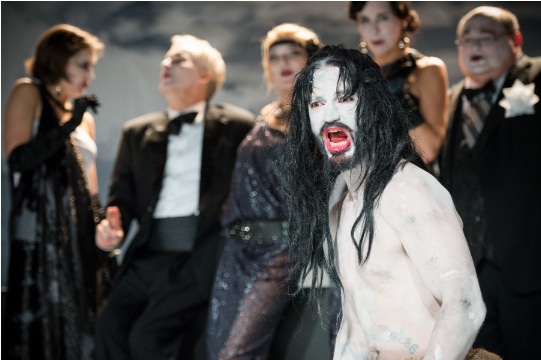
Joseph Carlson as Iokanaan

Posted on BroadwayWorld.com July 19, 2013

Oscar Wilde‘s Salomé (1892) epitomizes what it means for a play to have a reputation for recherché scandal. The very mention of the title conjures up memories of quasi-pornographic Aubrey Beardsley drawings in rare old book club editions. Though it concerns sorts of forbidden love other than the homosexuality that was overtaking its author’s life as it was being written, it clearly arises from the same place in Wilde’s psyche. The play was composed in French and the official credit for the translation into English (if not necessarily the actual translation) belongs to Lord Douglas, the male lover who was so instrumental in Wilde’s social downfall and imprisonment. And it was banned in Wilde’s own England for many years (albeit for its depiction of biblical figures, not its themes). Even now, it is not often produced, in part because of competition from Wilde’s four great comedies, which are approachable and delightful, while Salome is remote and offputting.

It is therefore greatly to the credit of Washington’s SCENA company (operating out of the Atlas Performing Arts Center in Northeast D.C., convenient to Baltimore audiences) that it has resisted both the aura of scandal and the blandishments of the comedies and tackled Wilde’s exotic tragedy (if that is the word for it) instead. Indeed, it is hard to pinpoint exactly the genre into which the play fits. It seems sui generis.

The play is built around accounts of the last days of John the Baptist found in Mark 6:17-29 and Matthew 14:3-11. Those accounts, essential identical, depict Herod’s capture of John because John had denounced Herod’s marriage to Herodias, his brother’s former wife (viewed as some kind of incest), Herod’s pleasure at a dance performed for him at a feast by Herodias’ unnamed daughter, his promise to her of anything she wanted as a reward, and her choice of John’s head as that reward. Wilde renders John’s name as Iokanaan (close to the Hebrew), and Shulamith (the name history gives Herod’s stepdaughter) as Salomé (the Greek version). This polyglot exoticism with the names signals that we are not exactly inhabiting any precise historical place anymore, that we have been transported to a strange world in which nothing will be quite recognizable.

That unrecognizability is beautifully conveyed in this production, where the characters except for Iokanaan (Joseph Carlson) are costumed in ornate black and white Roaring Twenties dress, and all except for Salomé (Irina Koval) are made up to be reminiscent of mimes. (A tip of the hat to Alisa Mandel, creator of the amazing costumes.) Much of the movement of the cast, under Robert McNamara‘s direction, is mime-like as well.

The thing least recognizable from the original biblical texts is the moral universe; this play lacks any center or sense of moral orientation. The scriptural John may have been domesticated for Christian purposes by two of the Evangelists and his utterances incorporated into that well-defined context; Wilde’s Iokanaan, on the other hand, seems close to mad, and his denunciations of the sexual mores of Herod and his party-goers seems appropriate grist for a comment of one of the characters early in the play, who comments of Jews debating the existence of angels: “I think it is ridiculous to dispute about such things.”

But if one cannot precisely admire Iokanaan, so one cannot either admire or condemn Salomé. She is both sexual prey (lusted after by Herod) and sexual predator (lusting after Iokanaan even unto his death). In a world of transgressiveness, she is single-minded about her own transgression (as Wilde reportedly was in his pursuit of rough young men). One cannot empathize much with Herod (Brian Hemmingsen), whose folly toward Salomé leads him to consent in the end, Pilate-like, to a killing he would much rather not order, even if he deserves some credit for strenuous efforts to avoid redeeming his pledge to do so. We may pity Herodias (Rena Cherry Brown) as she suffers from public humiliation at the loss of her husband’s sexual interest, but the savagery with which she signs onto Salomé’s plans for Iokanaan, once they are revealed, is appalling. And the chorus of revelers at the party, lost in effete consumption, mostly inspire contempt.

In short, this is a piece without much of a moral compass, akin to the atonality just about to begin to influence Western music when Salomé was written. But, like much of such music, it exerts a weird unexpected fascination. Like Salomé’s dance, stunningly choreographed (if I’m interpreting the program notes correctly) by Kim Curtis, the decapitation of Iokanaan and the process that leads to it, is sexual and disturbing, but not to be looked away from. Wilde asks us not to judge much, just to watch and feel, and to luxuriate.

The language is entirely at one with this process. Wilde was, among other things, a poet, and even though this is not formally speaking a verse play, the lines, whether in French or English, are heavy with it. For instance:

THE YOUNG SYRIAN: The Princess is getting up! She is leaving the table! She looks very troubled. Ah, she is coming this way. Yes, she is coming towards us. How pale she is! Never have I seen her so pale.

THE PAGE OF HERODIAS: Do not look at her. I pray you not to look at her.

THE YOUNG SYRIAN: She is like a dove that has strayed . . . . She is like a narcissus trembling in the wind . . . . She is like a silver flower.

Or Herod attempting to divert Salomé from her determination to have Iokanaan’s head by offering her jewels instead:

I have topazes yellow as are the eyes of tigers, and topazes that are pink as the eyes of a wood-pigeon, and green topazes that are as the eyes of cats. I have opals that burn always, with a flame that is cold as ice, opals that make sad men’s minds, and are afraid of the shadows. I have onyxes like the eyeballs of a dead woman. I have moonstones that change when the moon changes, and are wan when they see the sun. I have sapphires big like eggs, and as blue as blue flowers. The sea wanders within them, and the moon comes never to trouble the blue of their waves.

And so forth. This is poetry, poetry for the mind to sink into and be overwhelmed. To paraphrase Mae West, goodness has nothing to do with it. Nor does badness. It comes from some amoral place in Wilde’s psyche and appeals to that place in ours. Wilde may overdo it at points (I personally had heard enough of Salomé’s oft-repeated signature phrase, “I will kiss thy mouth, Iokanaan” and the catalogue of jewelry goes on too long to hold the interest) but these are small flaws.

And this production does Wilde’s fever dream proud: superb performances, great staging, even great incidental music (I think the creation of Chris Kurtz). It wouldn’t do for everyday, this kind of theater, but in small doses, like the 105 minutes audiences spend at the Atlas for this production, it is a wonderful thing.

Copyright (c) Jack L. B. Gohn except for production still

Theater Reviews Page | Previous Theater Review | Next Theater Review

Old Hat But Interesting: Shepard’s HEARTLESS at Shepherdstown’s CATF

Theater Reviews Page | Previous Theater Review | Next Theater Review

Old Hat But Interesting: Shepard’s HEARTLESS at Shepherdstown’s CATF

Posted on BroadwayWorld.com July 16, 2013

[Note: The Contemporary American Theater Festival each year produces five new American plays in Shepherdstown, WV (an hour and a half from Baltimore) Wednesdays through Sundays throughout July. This is a review of one of this year’s productions. Each will be separately reviewed in this space.]

I am not sure what Shepard is doing in Shepherdstown. The Contemporary American Theater Festival held there is dedicated to performing “new American plays.” There’s nothing new to me about Sam Shepard‘s play Heartless; it seems distinctly old hat. I went back to a review I wrote of one of his plays for my college newspaper in 1970, and a number of the things I wrote about that play (The Holy Ghostly) could be said about Heartless. I commented how characters migrate into each other, how they become composites of various characters, how there is no predictable logic to their interactions, and how the drama loses the sense of being story-telling about distinct persons. I compared what Shepard did to abstract painting. And, on the evidence of Heartless, it’s still true.

An author who is still writing essentially the same play in 2013 that he wrote in 1970 is not contemporary, as I use the term. Shepard is probably one of the two greatest surviving masters (Edward Albee being the other) of the Theater of the Absurd, but that was essentially a 20th, not 21st-Century phenomenon. Shepard’s peers include Beckett, Ionesco, Pirandello, and Pinter. Not bad company to be in, but their movement is about played out, and for cause. Theater is much better at telling stories about characters with fixed identities and recognizable personalities than at enacting rituals whose meaning, logic and grammar are obscure. “The fundamental things apply,” as we learned from Casablanca, and Absurdism was a rebellion against the fundamental things. It did not take over, did not replace what it rebelled against. It was contemporary once, but no more.

That said, if you don’t mind going back and witnessing DR. Shepard performing the same experiment again, you will see a handsome production. (So far as I can tell from attending two seasons of Shepherdstown, they don’t do unhandsome ones.) This one concerns Roscoe (Michael Cullen), a “not young anymore” professor, separated from his wife and adrift in a house full of women in the hills looking down on Los Angeles. The women are an invalided mother, Mable (Kathleen Butler), and two daughters Lucy (Cassie Beck) and Sally, plus Liz (Susannah Hoffman), who appears to be Mable’s nurse. But wait! Sally, we know from a spectacular moment in Act One when she turns to the audience with a big zipper scar from chest to navel, is using the heart of a person who died when she was little – except that Liz (we learn in Act Two) has the same scar and appears to have been the donor. But that would mean that …?? Well, while we’re puzzling through that, consider that Mable has given Roscoe (and the audience) two completely incompatible versions of Liz’s biography while Liz kept an inscrutable silence. Liz spends much of the first act polishing her hands and much of the second polishing her feet. Meanwhile big sister Lucy seems to have swapped places and personalities, and even clothes with Sally by the end. And all of this delivered with aplomb by a Sam Shepard who does not show his hand about how any of it works or what any of it means.

The reader may have twigged that I did not mention the actress who played Sally, and that is because I cannot predict who would be holding down the role when the reader might see the play. We in the media were told that before the final preview performance the actress who was to have played the part because suddenly unavailable for the moment, though she was expected to return. Rushed in to fill the part at least temporarily was Margot White, who had had one day of rehearsal and one performance before I saw her do the show. She was still, understandably, using a script for parts of Act Two. She seemed to fit the role perfectly. If I hadn’t been told about the substitution and seen one page of the script in her hand, I would never have known. Any theatrical troupe would be fortunate to recruit a ringer like White.

The juiciest part in the play, however, belongs to Butler. Casts at Shepherdstown tend to skew young, and Butler may have had an unfair advantage because she was the only actress of a certain age in any of the casts this year. There are things a mature performer can do, can get away with, that more youthful ones can’t, and Butler gives a little workshop on those things. Sitting in a wheelchair with immobile hands, with little but her voice and face as tools, Butler dominates every scene Shepard gives her. Of course, she’s meant to; Mable is fiercely, even abusively critical of everyone around her. Here, for instance, she first meets Roscoe in Sally’s company:

MABLE: (to ROSCOE) Who’re you?

ROSCOE: Uh-

SALLY: This is my friend-Roscoe.

MABLE: Let him speak for himself. He can speak for himself-(to ROSCOE) Can’t you?

ROSCOE: Yes, ma’am.

MABLE: Well then?

ROSCOE: I’m-

MABLE: What kind of ‘friend’ do you call yourself, Roscoe? A ‘friend/friend’; a ‘casual friend’ or a ‘friend to the death’. Are you any of those?

One soon recognizes that this Pinteresque bullying is all an act, a voice, an attitude, not the speech of a character conventionally realized. Still, an actress with a certain presence can make much of it. And Butler does.

I also liked, though I did not understand nor was meant to, Susannah Hoffman‘s performance as Liz. Shepard was aiming for a David Lynch-y weirdness with her character, an undead woman in an old-fashioned white nurse’s uniform (today’s nurses wear scrubs, of course) polishing her extremities nonstop, who bursts into song about how she wants to live. Hoffman does a great job of being a refugee from Twin Peaks.

And it would be hard to fault Ed Herendeen’s direction, which seems to have captured Shepard’s conception.

In short, it was an interesting production of a limited but interesting play. I just don’t know why I was seeing it where I was seeing it.

Copyright (c) Jack L. B. Gohn except for graphic

Theater Reviews Page | Previous Theater Review | Next Theater Review

Likeable Frenemies in St. Germain’s SCOTT AND HEM at CATF

Theater Reviews Page | Previous Theater Review | Next Theater Review

Likeable Frenemies in St. Germain’s SCOTT AND HEM at CATF

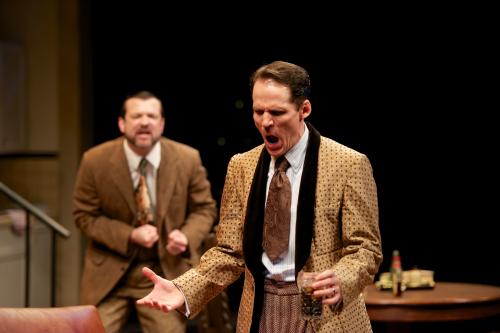
Rod Brogan as Hemingway and Joey Collins as Fitzgerald

Posted on BroadwayWorld July 12, 2013

“Every good story’s a war story,” says a character in Scott and Hem in the Garden of Allah, premiering at the Contemporary American Theater Festival. That certainly seems to be playwright Mark St. Germain‘s approach in imagining a 1937 encounter between writers F. Scott Fitzgerald and Ernest Hemingway.

Some history first. Such an encounter could have happened; Fitzgerald was in Hollywood living in an apartment complex called the Garden of Allah and writing for MGM in 1937. Hemingway did come through town that summer for screenings of Hemingway and John Dos Passos‘ documentary about the Spanish Civil War, The Spanish Earth. It appears Fitzgerald attended one screening, and sent a complimentary note to Hemingway afterwards. But the fact that he had to send a note suggests the distance between the writers. They had been much in each other’s company in 1925-26 and again in the spring of 1929, and then, after that, only on about seven more occasions over the rest of their lives. As Fitzgerald wrote toward the end of his life, he and Hemingway had “not [been] really friends since 1926.”

Perhaps the best label for what they had been since 1926 is “frenemies.” And hence the “war story” St. Germain constructs for them. In St. Germain‘s conception, they remain competitors, though their career trajectories are both heading downwards at this point. Fitzgerald’s last complete novel (and this is factual) is behind him, Hemingway (Rod Brogan) is too far into wives and bottles and losing his talent (a lot more of a stretch, considering that he would go on to write For Whom the Bell Tolls and The Old Man and the Sea yet), and Hemingway comes to Fitzgerald (Joey Collins) with a plan to rescue Fitzgerald from oblivion by giving him the movie rights to The Snows of Kilimanjaro to sell. But of course this offer may be a Trojan Horse of sorts, a way to make Fitzgerald less hungry and less of a competitor for literary glory.

And in a sense that’s it, that’s the play. The dramatic issues posed by the play are ones whose outcomes most viewers will know: whether Scott kicks his alcoholism, whether Hemingway kicks his, whether Scott accepts Hemingway’s Trojan Horse, whether Scott can ultimately succeed as a screenwriter. So the dramatic tension is not as high as it might be in a different kind of play.

I wrote in another publication concerning St. Germain‘s recent off-Broadway hit Freud’s Last Session that it wasn’t so much that anything happened in the play, but that it was C.S. Lewis being C.S. Lewis and Freud being Freud, and that that was enough to make the play worthwhile. And, given the lack of dramatic tension in the current play (even when the characters do take a couple of swings at each other to liven things up), the same basic proposition, Fitzgerald being Fitzgerald and Hemingway being Hemingway, is the ultimate value added of Scott and Hem. I’m not certain whether this time the formula works as well.

One of the things that bothers me is all the offstage cameos, smuggled in by, among other things, mentions of who was at the screening of Hemingway’s movie, and by the presence at a party below the apartment and interacting with Fitzgerald through an Open Window, of a great many Hollywood notables, Erroll Flynn, Robert BenchleyTallulah BankheadDorothy Parker, Frederick March, and Charles Laughton among them. They seem to have be brought in partly for verisimilitude (yes, we really are in Hollywood in 1937!) but also, I think, to impart a little thrill to the scene we are watching, to make us feel as if we are in the presence or at least the vicinity of many more interesting people than just the two right in front of us. It betrays a certain insecurity on St. Germain‘s part as to whether he’s got enough going on in this play with just the two right in front of us.

In the end, I think it’s barely enough. I repeat: we really don’t care too much about the action of the play, because if we have any biographical clue about the subjects we kind of know where it must go, and in any event St. Germain takes some nearly Shakespearean liberties with the facts. (For instance, Fitzgerald was let go by MGM in 1939, not 1937, and went on writing as a freelance screenwriter for the rest of his life, which gives the lie to the meaning, not just the facts, of an ending which suggests he is washed up in Hollywood.) But an evening just taking in the company of these two booze-afflicted geniuses left me feeling entertained if not thrilled.

And certainly the cast did its part to make the evening pass pleasantly. Collins and Brogan look and act close enough to my conceptions of Hemingway and Fitzgerald to pass muster, and their achievement is the more remarkable when one realizes that they are simultaneously holding down major and very different roles in A Discourse on the Wonders of the Invisible World, playing in repertory at the Contemporary American Theater Festival (reviewed here), and are often scheduled to do both plays on a single day. (For Collins, this reprises his feat of last season, when he alternated between roles as a ne’er-do-well U.S. college town handyman and an Israeli secret agent.) And I was tremendously impressed by Angela Pierce in a medium-sized role as “Miss Montaigne,” who seems to be some kind of amalgam of studio functionary and Sheilah Graham, a historical Fitzgerald girlfriend of this era. As Fitzgerald’s minder morphing into his lover, she combines steely determination, killer appearance (doing the 30s pencil skirt, stockings and tight sweater look), and an independence of spirit as a woman making her way in a men’s workplace; she could be Peggy Olson’s much older sister.

In a festival bristling with difficult and challenging plays, this is the easygoing exception, interesting and likeable. And that is fine. Not every surface has to be sandpaper.

Copyright (c) Jack L. B. Gohn except for production still

Theater Reviews Page | Previous Theater Review | Next Theater Review
Of Dual Citizenship and Pulled Rugs: MODERN TERRORISM at CATF

Theater Reviews Page | Previous Theater Review | Next Theater Review

Of Dual Citizenship and Pulled Rugs: MODERN TERRORISM at CATF

Mahira Kakkar as Yalda and Omar Maskati as Rahim

Mahira Kakkar as Yalda and Omar Maskati as Rahim

Posted on BroadwayWorld.com July 11, 2013

[Note: The Contemporary American Theater Festival each year produces five new American plays in Shepherdstown, WV (an hour and a half from Baltimore) Wednesdays through Sundays throughout July. This is a review of one of this year’s productions. Each will be separately reviewed in this space.]

Jon Kern‘s play Modern Terrorism, or They Who Would Kill Us and How We Learn to Love Them depicts a cell of terrorists dedicated to bombing the Empire State Building. There are three of them. Rahim, the designated bomb carrier (Omar Maskati) is a college-age Pakistani thoroughly acculturated from American movies and TV (the Star Wars theme is special to him). Yalda (Mahira Kakkar) a sort of general facilitator, Pakistani-American and a little older, was radicalized when a drone hit her destination wedding in Pakistan and killed her husband. The leader and intended publicist for when the group has exploits to publicize, Qalalaase (Royce Johnson), Somali, is the product of Western schools in Africa and Yemeni bomb-making seminars.

All of them, then, have one foot in Muslim culture and one in the Western culture Muslim terrorists affect to despise, and that is part of the point author Jon Kern is making about them. Whether they like it or not, they are dual citizens. What enrages them is also a part of them, and it means that in waging war on Americans, they are also waging war on themselves. Indeed, as Kern pictures them, they are shot through with contradictions.

Yalda is devoted to her iPod songs and irritated by her fellow-radicals’ doctrinaire avoidance of toilet paper. Though a woman, she refuses to back down easily when she disagrees with her male colleague Rahim, causing him to remark “This stubbornness. It’s because you’re American, right?” Qalalaase gets bomb parts delivered by FedEx, rejoices that they are covered by warranties, and tracks an errant shipment by computer. Rahim, motivated by the thought of “all the mothers without children and the men forced to kneel and cry,” participates in an effort to cause mothers to lose their children and men to be forced to kneel and cry.

Not surprisingly, a gang so inconsistently constituted is largely a “gang that couldn’t shoot straight,” to use Jimmy Breslin‘s phrase. They encounter mishap after mishap, especially when Jerome (Kohler McKenzie), a goofball neighbor from the apartment above theirs in their Brooklyn walkup, blunders into their midst. The jihadis veer constantly and comically between trying to benefit from his cooperation and trying to kill him. Their incoherence is never more on display than in dealing with Jerome:

Qualalasse: We need to know who he is and what he knows. Because unless we do, everyone will die.

Rahim: Don’t you mean no one will die?

Qalalaase: [blank] You’re right.

Obviously, however, a gang that can’t shoot straight is rather different from a gang that can’t shoot at all. And one truth about terrorists is that they play with very dangerous toys. The odds thus always favor death and dismemberment in the end; it is just a question of whose. And I suppose that by calling the play a tragicomedy, I am giving away the ending to some degree. But I do it because there is no way to evaluate the play without taking the ending into some kind of account.

Modern American “serious” theater seems to a great degree to be built on plays with a deliberately inconsistent tone. Here, from what I have been saying, it’s obvious that the play has a broad comic streak, including some comic dialogue (I just quoted a sample), some social satire and some outright slapstick and farce. No surprise; playwright Kern is on the writing staff of The Simpsons. And that comic touch imbues even one of the serious things the play seeks to do, which is exploring the psychology of the bombers; Kern reported that, as a very close neighbor to the World Trade Center site and a volunteer at Ground Zero, he was trying to understand the “severely flawed narratives” that had led to 9/11, which had so marked his own life. And we do get some apercus: the male bombers seem to have had bad relationships with their dads, for instance (although I”ll hardly call these profound insights). At the end, however, the comedy pretty much deserts the show.

In fact, I’d go so far as to say that Kern pulls the rug out from under the audience, emotionally speaking. Using comedy to seduce us into sympathy for these would-be killers (as the subtitle suggests), Kern takes us to a very bad place with them. And ultimately, how you feel about the show depends on how you feel about the rug-pulling. One of my companions thought it was great and true to life. Another thought it was facile. I’m somewhere in between.

Of course, a play about terrorists where everyone lived happily ever after would by definition be a play about terrorists who had forsworn terrorism, and would not be realistic. Terrorism waged in the West is generally asymmetrical warfare, meaning that the party under attack has most of the resources and most of the tools, and that, while the terrorists may take a certain number of innocent lives exploiting vulnerabilities, their days are usually numbered. They only get to be Butch Cassidy, not Tamerlane.

But realism is one thing, and dramatic genre another. Are there not limits to how successfully a play can violate the rules and mood of comedy? Again, reasonable minds may differ. But that is the challenge the play poses. It may be that a play that addresses the questions Kern wishes to address cannot be entirely successful with such a laugh track attached.

The viewer’s quarrel, if he/she has one, will be with the script, not the direction (by CATF founder Ed Herendeen) or the acting. The cast are a crew of appealing youngsters one hopes to see more of.

In any case, like everything else at CATF, this play will make you think.

Copyright (c) Jack L. B. Gohn except for production still

Theater Reviews Page | Previous Theater Review | Next Theater Review

Art, Life, and the Meaning of It All Up For Discussion – and Combat – in H2O at CATF

Theater Reviews Page | Previous Theater Review | Next Theater Review
Art, Life, and the Meaning of It All Up For Discussion – and Combat – in H2O at CATF

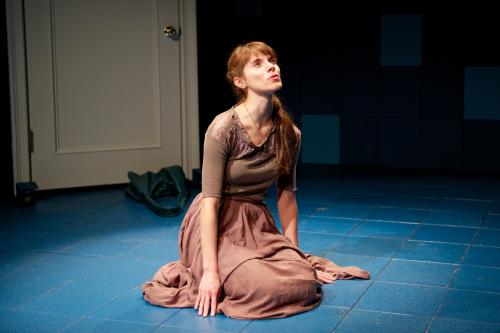
Diane Mair as Deborah

Posted July 10, 2013 on BroadwayWorld.com

There are plays, and Jane Martin’s H2O (a new play commissioned for the Contemporary American Theater Festival) is one, that the reviewer can hardly discuss objectively, because there is scarcely an objective viewpoint from which to examine it. In important part, it concerns the argument between faith and a view that would characterize itself as rationality. While there are philosophical justifications for each stance, neither of them can be fully proven using the tools of philosophy itself, and, in the absence of definitive demonstration, the proponents of each view tend to consider their opposite numbers emotionally and intellectually shallow. It is possible to write a play – say Freud’s Last Session – in which the standoff between these outlooks is marked by respect on both sides.

But that is not true to the dispute as it is generally lived. Culture War is more frequently the model. Generally modern rationalists think Evangelical Christians an emotionally stunted and irrational lot, and the Evangelicals regard rationalists as deficient in grace. Usually, the people at the extremes of these views tend to avoid each other, if only to keep the peace. But in this play, they (and hence we in the audience) are not given that space. Instead, their collision is profound and prolonged, and we have to watch and judge it at close hand, and cannot possibly avoid bringing our own points of view to bear. But I shall strive for neutrality in this discussion.

Jake (Alex Podulke), the rationalist here, is a rich celebrity actor who feels deeply what he considers the meaninglessness of life, perhaps from being traumatized (the script hints he was a soldier in our current wars). In the first scene, he tries, rather spectacularly, to kill himself and spends the rest of the play trying to wreck the life prolonged by the interruption of his attempt. It is one thing to despair in the face of what one thinks a meaningless universe, another thing to despair so excessively. In other words, if he is truly a rationalist, he is a rationalist at the mercy of irrational destructiveness.

Deborah, the Christian who disrupted the suicide attempt (Diane Mair), is an aspiring actress, trying to locate a way to accommodate her own very demanding and orderly principles with living and working in a theatrical ethos more accommodating to Jake’s principles and personality than to hers. And of course, just to make it more absorbing but unbearable for the audience, these two are deeply attracted to each other.

We know from the start that that attraction would have to overcome not only the eruptive kind of destructiveness Jake evinces almost as a matter of course, but the Deborah’s determination not to compromise in her allegiance to what she understands to be Christian principles. That allegiance would naturally be so threatened by a liaison with Jake that she would be almost obligated to nip it in the bud, i.e. destroy it. In short, their mutual attraction would have to navigate a minefield of destructiveness.

The play’s the thing – literally, specifically a production of Hamlet – in which their chances of coming together are tested. He is Hamlet, the H in H2O, and she is Ophelia, the O. Shakespeare’s Ophelia’s life runs out in H2O, water, and, as we learn, in Martin’s play, it is also water that finally threatens Jake/Hamlet’s life. And the final crisis is precipitated by a most Shakespearean device, a necklace, reminiscent of the fatal handkerchief in Othello.

Why Shakespeare? Well, Jake’s view is that, if there is any meaning in the universe at all, it is to be found in the Bard. He says: “But I recognize Shakespeare is a different deal. He knows something and out of this mysterious knowledge he makes poetry that kills. So I thought I would attach my meaningless self to his meaningful self and see if it worked like a transfusion.” And Deborah sees in Shakespeare a bit of the secular world that is somehow safe enough for her because he “transcends man while showing what man could be,” and even amounts to “an argument for the existence of God.”

Putting on Hamlet, then, is the characters’ joint quest for transcendence. Whether one agrees with either character’s assessment of the playwright as some kind of bridge to meaning, it is certainly believable dramatically that the characters think him so.

And incidentally, I have never, absolutely never, come across as trenchant an analysis of the dramatic problems with Hamlet as playwright Martin puts in Jake’s mouth.

I will not reveal how this combat of destructiveness with desire plays out, nor which of the characters seems to have the better of the metaphysical argument by the final fadeout. But I will say that H2O is a knockout. There is a richness to it that should leave you sorting it through long after the curtain calls.

And of course there is the acting. Mair’s portrayal of Deborah is magnetic. She is not dazzlingly pretty, but her eyes and her voice make you want to look at her all the time. The voice in particular, with its patient, thoughtful, and possibly mad tone of certainty, draws you in. You may not like or approve of this character, but you will be looking at her. Podulsky is a more than adequate foil for Mair, although the script gives him less original material to show us. (We’ve all seen nihilistic war veterans with explosive tempers before. But Poduslky does this stock character really well.)

And then there’s the tech side. I myself am not much versed in tech matters, but I debriefed about this show with a friend who teaches lighting design at the university level. He regarded the lighting as innovative and gutsy. He also said that it was forced to be, because this stage, known as CCA 112 and probably the least advanced of the three that Shepherd University makes available to the Festival, was built with inadequate amperage. Necessity, however, having proved the mother of invention, the solutions lighting designer John Abrosone came up with (involving, I think, unconventionally low-powered sources that required actors to hit their marks quite precisely) left my friend tremendously impressed. All I know is, the lighting looked good.

For my money, H2O is the standout of a very competitive field of plays in this season of the Contemporary American Theater Festival. If you’re only seeing one of the plays, this is the one to see. It will leave you dealing not only with your feelings about the characters, but also reconsidering art, life, and The Meaning of It All.

Copyright (c) Jack L. B. Gohn, except for production photo

Theater Reviews Page | Previous Theater Review | Next Theater Review
 

Satan from Within: A Discourse on the Wonders of the Invisible World at Contemporary American Theater Festival

Theater Reviews Page | Previous Theater Review | Next Theater Review
Satan from Within: A Discourse on the Wonders of the Invisible World at Contemporary American Theater Festival

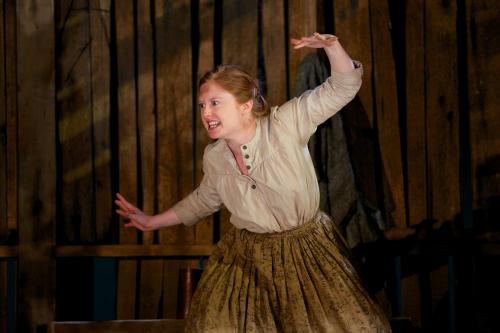
Becky Byers as Rebekkah

Posted July 8, 2013 on BroadwayWorld.com

Imagine if George Bernard Shaw had taken it into his head to write a sequel to Arthur Miller’s The Crucible, with an assist from Shakespeare, and you get a sense of what Liz Duffy Adams’s A Discourse on the Wonders of the Invisible World is like.

Discourse starts ten years after the Salem witch trials of which Miller’s play so powerfully reminded us. Discourse is not a direct take-off from The Crucible, however, in the way that Clybourne Park, for instance, takes off from A Raisin in the Sun. Though there are two characters, Abigail Williams and Mercy Lewis, with the same names and much the same history as characters in Miller’s play, they cannot be said to be exactly continuances of Miller’s characters. The historical Abigail, upon whom Miller based his character, was only 12 at the time she made hysterical accusations that led to the executions of neighbors. Miller imagined her as five years older, which made it more plausible that, as Miller pictures it, a failed affair between Abigail and farmer John Proctor had been at the root of Abigail’s behavior. Adams reverses Miller’s ahistorical aging of the character and makes it clear there had no hanky-panky between Abigail and Proctor. Whatever the cause was, from Adams’s perspective, sexual jealousy had no part in it. But what did? Adams has some theories.

Adams refashions Abigail (Susannah Hoffman) into the investigator out to answer that question. We see her a decade after the witch trials had been suppressed, traumatized by what she had done, by what she had been allowed to do, and searching for explanations.

This Abigail returns to confront her fellow-accuser, Mercy (Cassie Beck) now a widow and tavern-keeper, to ask for Mercy’s sense of what had occurred, which turns out to be a perilous thing. Mercy, unlike Abigail, still believes heart and soul in the validity of the accusations she had cast, resents having become a persona non grata in Salem after the witchcraft panic receded, and regards backsliding by Abigail as proof that Abigail herself has now cast her lot with the witches. Mercy cobbles together a rump court comprised of a local reverend (Joey Collins), an oafish neighbor (Rod Brogan), and Rebekkah, a 15-year-old servant girl (Becky Byers) to try Abigail for witchcraft on the spot.

And here is where the play turns first somewhat Shakespearean and then decidedly Shavian. The Reverend, who doubles as magistrate, comes across as a bit of a Dogberry, the confused and pompous law enforcer in Much Ado About Nothing, not so much by aping Dogberry’s mangled language as by a similar failing: laughably but lethally inconsequential logic. He proudly relies upon a sermon by Cotton Mather (itself called A Discourse on the Wonders of the Invisible World and the source for the title here), which lists a series of supposed signs that the accused is a witch. All in one way or another commit the fallacy of assuming as true what is to be proved, and when the tests are applied, they naturally prove Abigail a witch. That answers part of Abigail’s question as to how it happened: the Salem witch trials were enabled by legal and metaphysical doctrine that was absurd on its face.

But this part of the answer is trivial, and still leaves open the larger one: what possessed Abigail’s town to embrace, not merely the inanity of Cotton’s jurisprudential principles, but the judicial murder of so many innocents that those principles inspired? In other words, if the thinking was shoddy and stupid, and the results both inhumane and destructive, what allowed a community to let its guard down and act on it?

Paging Dr. Shaw! A most Shavian hero turns up, one John Fox (Gerardo Rodriguez), a man with a diabolical air, particularly (at least in the eyes of the tribunal) by virtue of mixed Native American and other non-white heritage. Suspected, tried and condemned for being the very devil with whom Abigail has putatively leagued herself, he makes incidental use of the credulity of the accusers to escape immediate danger along with Abigail. Shaw, who provided lavish sympathy for the devil in Man and Superman, also provided a fairly obvious model for Fox in Bluntschli, the “chocolate cream soldier” in Arms and the Man, a cynical but somewhat philosophical bounder who can speak with detached and comic mien of his own potentially mortal predicaments. That is the way Fox talks. As Fox and Abigail try to figure out how to revive an apparently blocked flight, they also discover a) how their histories have left each of them morally compromised and hence incidentally made soul-mates of them, and more importantly b) the answer to the larger question of why and how Salem happened.

This is the world premiere of the play, and it is, like all plays presented at this Festival, still a work in progress. Adams has made a wonderful start, although, to my way of thinking, some violence in Act II is discordant and unnecessary, and I hope Adams finds a way to plot around it. The Shavian surface of the second act, comedy of manners and philosophy given only a little dramatic frisson by a hint of danger, goes quickly to hell (so to speak) with the violence, and never quite returns thereafter. While the backdrop is the death of 20 falsely-accused people for which one of the characters was centrally responsible, and that is quite grave and horrifying, it is also ten years in the past by the time of the action of the play, and it is being discussed as a subject, not precisely relived. The horror should not be reanimated because to do so will (in the words of the Scottish Play) “displace the mirth,” which is worth not displacing. The mood of most of the Act II dialogue is too good to disrupt that way.

The cast, like all casts at the Contemporary American Theater Festival that I have seen, is simply perfect. I was particularly charmed by Becky Byers’ turn as Rebekkah, especially a monologue in which she recounts having seen a performance of “McDeath” (the “Scottish Play” adapted to the geography and ethnograpy of the New World), in a manner full of flourish and outgoingness that is deliberately at odds with her manner elsewhere (pictured above), and the Dogberry-ish delivery of Joey Collins as the Reverend, all too full of himself.

In the end, as Abigail and John discover, it is the invisible world within human characters like Rebekkah (who reprises, against Abigail, the very hysteria Abigail once deployed against others) and the Reverend (with his circular logic and his a priori approach toward what is unseen and unseeable), that contains the real menaces. We have met the enemy, as Pogo said, and he is us. Satan comes from within, not without.

Copyright (c) Jack L. B. Gohn except for production photo

Theater Reviews Page | Previous Theater Review | Next Theater Review
Thurgood, Perry, and the Long-Ago Thirties

The Big Picture Home Page | Previous Big Picture Column | Next Big Picture Column

Thurgood, Perry, and the Long-Ago Thirties

Published in the Maryland Daily Record, July 22, 2013

Last time I focused on two lawyers named Thomas; this time on lawyers Thurgood and Perry.

The careers of the Thomases in the 1530s, set against a legal culture shaped by unitary church and state, sanguinary punishments, the absence of any right of the accused to remain silent, etc., had tempted me to quote novelist Kingsley Amis’ hero Lucky Jim: “Had people ever been as nasty, as self-indulgent, as dull, as miserable … or as wrong as they’d been in the Middle Ages?”[1] But I didn’t, reasoning that snide condescension at such a remove is too easy, like shooting fish in a barrel. My recent reading has confirmed the wisdom of my hesitancy: turns out the legal environment even of the 1930s, definitely from the modern constitutional era, was plenty backward too, and in some ways feels just as odd as the nasty world of Henry VIII.

Separate Was The Point, Equal Aspirational

First, as to Thurgood, whose last name of course was Marshall, the future Justice’s early career has recently been chronicled in a fascinating book, Young Thurgood, by Professor Larry Gibson (who teaches at the University of Maryland School of Law). As Gibson explains in detail, Marshall, whose life’s paramount goal was bringing down “separate but equal,” began his career in the fall of 1933 in a Baltimore very much in the thrall to that doctrine. Separate but equal affected everything.

The dominant powers cared most about the separateness. Equal was aspirational at best. But the African American populus was determined to have its own way, and the result was a cat-and-mouse game in which the white powers were continuously trying to provide second-or-third-best, and the African American power structure was striving for excellence. Thus, as Gibson recounts, for instance, Baltimore’s Colored High School when Marshall was growing up lacked a cafeteria, auditorium, or gymnasium. But the High School had an impressive faculty, graduates of schools such as Wellesley, Columbia, Smith, Amherst and Brown. This concentration of talent was undoubtedly itself a reflection of the limited opportunities local apartheid afforded talented teachers of color, but it was still a powerhouse for talented youngsters. At least Baltimore City had a public high school African Americans could attend; there was no such amenity in Baltimore County, which surrounds Baltimore City (a state of affairs Marshall litigated against in 1936-37).

But what a difference in the world before Brown v. Board of Education! Lynchings were common in the country, and took place in Marshall’s Maryland. The very law school where Gibson now teaches was closed to African Americans, and President Harry Byrd (yes, sports fans, the Byrd of Byrd Stadium) was petrified at the prospect of integration. He wrote Maryland’s Attorney General after Marshall had won a round in the fight: “[I]f the order of the lower court is carried out, and negro students are admitted in the University, I should not like to be held responsible for what may happen …. With five hundred girls on the campus at College Park, and with girls entering the Baltimore schools in constantly increasing numbers, the seriousness of the situation for the University … cannot be overestimated.” Nuff said.

If you were black, and you wanted to practice law, you had quite a search for reputable quarters in Baltimore’s downtown. You had tight geographical restrictions as to where you could live. If you wanted to join a local bar association, you could join the separate-but-equal Monumental Bar Association, but not the Bar Association of Baltimore City. You could join the National Bar Association but not the American Bar Association. Such a world bred enormous inventiveness and self-reliance within the black legal community, and, on Gibson’s showing, made possible impressive sorts of networking. What has replaced it after the end of de jure segregation is by no means entirely an improvement, but it certainly is different. And as one reads page after page of Gibson’s book, the sense of strangeness – and outrage – never wears off.

Ethics Aspirational Too

Baltimore’s Thurgood Marshall was not the only lawyer to begin his career in 1933. Off in Los Angeles, fictional lawyer Perry Mason made also his first appearance that year, in The Case of the Velvet Claws. I recently read Velvet Claws, along with the third Perry Mason installment, published in 1934 (author Erle Stanley Gardner wrote quickly), The Case of the Lucky Legs. Here the weirdly different element is legal ethics. Not to say that California did not have a code of legal ethics in 1933-34. Like most American states, California had effectively adopted a code worked out by the American Bar Association in 1908, and enforced and republished by a new mandatory state bar that got started in 1927. But you’d never know it from the way Perry carried on.

In Velvet Claws, Perry has a client tailed without telling her, tries to bribe the editor of a scandal sheet, pays a hotel telephone operator to eavesdrop on a call, bribes a policeman to get identifying information on a telephone number (who advises him to “forget where you got it”), assaults a butler and a news reporter, counsels a client to lie to the police, registers at a hotel under a false name, and intercepts service of process by telling the server he is the defendant. And in Lucky Legs, Perry withholds information from a client, takes on two clients with a clear and unwaived conflict of interest, breaks into a crime scene and rearranges it with the help of a skeleton key, lies to the police to cover up the break-in, tells two young women to swap clothes and identities to deceive the police further, etc.

Obviously, no modern lawyer could carry on like that for long without getting disbarred. At least I hope not. It raises the question whether Mason’s creator Gardner, himself a California lawyer, thought Mason could really have got away with it then. The answer seems to be yes. Gardner’s introduction for a reprint of Lucky Legs in 1961 said the early Mason’s cases came “in what now seems almost a different world,” in which a “criminal lawyer can get into a series of most attractive escapades with … an impulsive disregard for the finer points of legal ethics.” This was characteristic of what Gardner calls “the days of the speakeasy and individual initiative.” This is by contrast with “nowadays,” when the youthful Mason’s conduct would make “bar associations shiver with anticipation.”

Now, Gardner may have been a little disingenuous writing these words. But I suspect not much. Readers of the Thirties were supposed to like, even idealize, Mason, not be horrified by him. He was presented as a hero, not an antihero. Which suggests a public not turned off by egregious ethical lapses. And if codes of ethics played no big role in setting public expectations, they probably didn’t do much yet to affect attorney behavior either.

Makes the Thirties seem like a long time ago. Culturally it was, but not by the calendar.

And again, if lawyers not that long ago practiced in racially separate worlds, in a profession where both the equality and the ethics were merely aspirational, what will they be saying about our world, eighty years from now? You know what they say about people who live in glass houses.

____________

[1] One can argue about whether Henry VIII ruled in the Middle Ages or the Renaissance. (I think the Renaissance.) But Henry VIII, whose reign was the focus of the previous piece, was definitely associated with “Merrie England,” which was actually the trigger of Jim Dixon’s quoted rant. See, e.g., a travel package that advertises: “Feast with your host Henry VIII and other colorful characters from Merrie England at a medieval banquet straight from the pages of history!”

Copyright (c) Jack L. B. Gohn

The Big Picture Home Page | Previous Big Picture Column | Next Big Picture Column


Something I Was Good At

Theme Songs Page | Previous Theme Song | Next Theme Song

Something I Was Good At

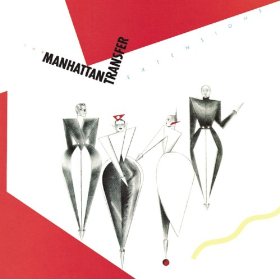
Birdland, Music by Joe Zawinul, Words by Jon Hendricks, Sung by The Manhattan Transfer (1979), Encountered 1979

Buy it here | See it here | Lyrics here | Sheet music here

The Manhattan Transfer’s rendering of Birdland, a tribute to a long-gone 52nd Street jazz venue,[1] was like no song I had heard before.[2] The moment I first encountered it (listening to WEAA, the Morgan State University radio station one winter morning in late 1979), I sensed I was in for layers of unpacking.

Pantheon-by-Nickname

It was a picture of a jazz club where everyone that mattered played, and I didn’t really know who any of them were:

Bird would cook, Max would look – where?
Down in Birdland
Miles came through, ‘Trane came too – there
Down in Birdland
Basie blew, Blakey too – where?
Down in Birdland
Cannonball played that hall – there
Down in Birdland
Yeah

 This pantheon-by-nickname evocation of black jazz stars, most of whose names, let alone nicknames, were unknown to me, was a challenge and a signpost. A white guy raised mainly on rock (as these postings attest), I could hear these words and realize I how far I still had to go in my musical basic training.[3]

Vocalese and Space Cadets

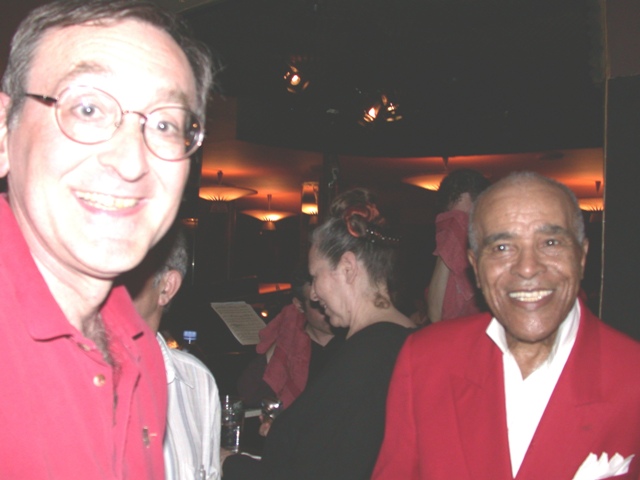
With Hendricks 2004

And then there was the vocalese aspect of the song: the lyrics written to follow the scattered notes of a jazz instrument. That was a new one on me too. (Later I would come to know of Jon Hendricks, the lyricist, vocalese wordsmith par excellence, and, in 2004, I would actually watch him sing and shake hands with him in a Paris nightclub.) But I had to start learning about this.

I knew also that the music came from Weather Report, a jazz-rock fusion band at least as white as it was black, and that the song was not itself the kind of jazz it praised.[4] Much, then, to learn about fusion.

And then, it wasn’t being performed by Weather Report, either, but by this quartet called The Manhattan Transfer,[5] who had had themselves drawn on the album cover as a series of angular tops, and photographed on the back of the sleeve as some kind of space cadets from the future. I was going to have to learn about them too, because they clearly were dedicated to reviving and expanding various musical styles I didn’t even know the names for, but wanted to hear more of.

Worth Working For

To be sure, all that homework would be fine by me. By then I was doing plenty of homework, anyhow, and none of it fazed me. I had found something I was really good at and really liked: the law. It was worth working for, just as great music was.

I had been through graduate school, and my feelings about that experience, mostly bad, have already been discussed here. Law school was the un-grad school. It wasn’t pretentious, it followed more or less rational rules, and the work I did was every bit as challenging to the mind as that I’d done in graduate school, but it paid off in mastery of usable concepts, concepts that worked together. The accepted metaphor for this coordination of the various branches of the law is “the seamless web.”[6] But the tight four-part harmony of the Manhattan Transfer would have been closer to the mark.

Harmony also characterized the friendships I was making. My small section was full of interesting people; the study group many of us in that section formed were like brothers and sisters, and stayed close for many years after law school.

Worthy Work

Best of all, this exercise was heading me toward employment. I’ve written in these pieces of the frustration of being an out-of-work Ph.D.; this story was obviously going to end differently. They told us in the orientation session that we should avoid paid work during our first year, and I ignored them. I needed the money, and I needed the feeling of being hands-on.

My first job was reading and commenting on criminal trial transcripts for a poverty lawyer with a distinguished background as a Communist who had been disbarred in McCarthy time, and then rehabilitated as the hysteria receded. Then, sometime during or right after the second semester, I started working as a law clerk for a couple of downtown litigators, and began to learn the mechanics of a litigation practice: drafting papers, going to court, serving process, billing, office procedures. And by the time I heard Birdland, I had received two semesters’ worth of grades, knew I was near the top of the class, and had written my way onto the law review. Best of all, I had received an offer of employment over the summer of 1980 from what most members of the Baltimore legal community regarded as the classiest firm in town, then known as Piper & Marbury.[7]

Cup Running Over

Nor was even that all the good news. I had assembled pieces of my father’s last book and just had it accepted by Praeger Publishers, and was continuing to place bits of writing in published locations, like my college alumni magazine. I was still a writer.

Not to mention father of two, husband of a woman about to enter law practice herself, and homeowner.

It would have been impossible and inhuman to avoid some degree of hubris at this juncture, and I was never very good at the impossible. I was feeling I could beat the world at long last, that I had found the key. And the Transfer’s exhilarating tight, jazzy harmony which had bored its way into my brain almost on first hearing was the background music for that buzzy hubristic high.

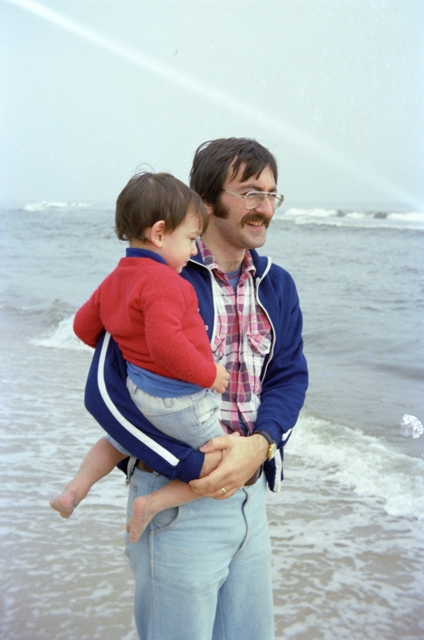
To the right, a photo of me and my son the summer I was beating the world, shortly before I heard that song. The posture says it all.


[1]  There still is a Birdland, and it certainly has some kind of legitimate successorship to the 52nd Street club, but it is actually the third venue to bear the name. Read about it here.

[2]  Although I suppose that The Animals’ Monterey was a little similar, if you substitute rock for jazz and the Sixties for the Forties and Fifties.

[3]  I can talk knowledgably about all of them now, but it took me another two decades to reach that point.

[4]  See the Weather Report version of the song and read the history of it here.

[5]  A John dos Passos title, as I knew from my English Literature days. Not that I could see either in the album or in the group any echoes of dos Passos. I don’t know what the group name means.

[6]  Truth to tell, I have since come to feel that the seamless web metaphor is less than apt. In my maturity, I see the law as being a series of compromises between warring principles, compromises that do not stick for long. Yes, every piece has to fit somehow with every other piece, but the relationships between any two pieces will be affected by all other relationship, in a never-ending evolution. When I grasp for a metaphor today, I come up with the way a galaxy holds together, with the physical forces binding all the stars together constantly in flux as they move relative to each other. Or, if one is relying on solid structures, a tensegrity.

[7]  Since then – and well since my brief time there — it has become one of the germs of the behemoth known as DLA Piper.

Copyright (c) Jack L. B. Gohn

Theme Songs Page | Previous Theme Song | Next Theme Song

Two Lawyers Named Thomas

The Big Picture Home Page | Previous Big Picture Column | Next Big Picture Column

Two Lawyers Named Thomas

Published in the Maryland Daily Record June 14, 2013

King Henry VIII of England and his intimates have recently been brought to televised life in The Tudors, and revivified in Hilary Mantel’s trilogy of historical novels, now two-thirds complete, about Lord Chamberlain Thomas Cromwell. The books and the television show run us through all the same events, and from a surprisingly similar perspective. A picture emerges.

In that picture, two lawyers seize the imagination: the aforesaid Thomas Cromwell (1485?-1540), and Thomas More (1478-1535), Lord Chancellor. Probably England’s two ablest men, each served for a time as Henry right hand, and in the end each was beheaded by Henry. Their career trajectories, then, were quite similar. Each sought to use the tools of government to make the British state do what, from his viewpoint, governments were supposed to do, and somehow each ended up being ground up in the gears of that very government. Both their deeds and their sanguinary ends provide food for contemporary thought.

No Constitutional Protections

Imagine, if you can, a world  in which there is a dominant monarchy to which only the current monarch’s firstborn legitimate male child could ordinarily succeed. Imagine a problem with that succession. And then imagine trying to resolve that problem without the aid and protections of the First, Fifth, and Eighth Amendments, without legal divorce (though the church had annulment power), with treason broadly defined (including adultery with the king’s wife and imagining the king’s death), and no right to counsel for those charged with it. It is a nightmare, and it was a nightmare for those who had to live through it, or, as the case may have been, die because of it.

First Amendment first: the absence of any clear separation of Church and State was a recipe for dysfunction. Under prevailing theory, the State, as well as the Church, had the right and responsibility to enforce religious orthodoxy. (Police power, if you will, extended to the souls as well as the bodies of the subjects.) But though the Church relied on the State for this, the Church claimed superiority over the State. And the Church denial of annulment could be an inconvenient thing when a queen could not provide a legitimate male heir, and the king felt the need to replace her with a queen who might. Henry’s solution was not to decree Church/State separation, but rather to proclaim himself the head of both, and thus to obtain from the unified Church and State the annulment he sought.

Meaning, however, that to disagree that Henry could be head of both Church and State courted charges of both treason and heresy. Another feature of the First Amendment, freedom of speech, would have helped, not to mention a limited definition of treason like that in Article III, Section 3 in the American constitution (only levying war, adhering to enemies, or giving enemies aid and comfort). With a more circumscribed definition of treason, to disagree with Henry’s arrogation of church powers, or speak in a theoretical way about Henry’s demise, would be harmless. In the legal culture of the 1530s, however, such things constituted treason, and sufficed to get you burned alive, beheaded, or hanged, drawn and quartered. Reasonable minds were not permitted to differ.

No Fifth or Eighth Amendment

In fact, because there was no Fifth Amendment, differing minds were not even permitted to be silent. After divorcing his first wife, Catherine of Aragon, and installing Anne Boleyn in her place, Henry required every Briton to swear support for the legitimacy of what he had done. This was what finally did in Thomas More, who disagreed and attempted to take refuge in silence, but was eventually deprived of that refuge by (depending on whom you believe), the skillful questioning or the perjury of the attorney general. Had More enjoyed a right to silence, matters might have been different for him, and for many unfortunates.

The difference is spelled out in the sanguinary punishments I have already mentioned. Both the television series and the novels give us sickening closeups of what these judicial killings were like. I need not and will not repeat these in any detail here. But it is worthy of note that More himself burned heretics. There was a definite poetic justice that there was no Eighth Amendment there for him either at the end. And, for that matter, for Cromwell, who superintended the undoing and execution of More as well as that of Anne Boleyn, Henry’s second wife.

Stalinism Is What You Get

This combination of missing rights and total control of both Church and State by an unchecked monarch led in the end to a polity historian and judge Jonathan Sumption has suggested was “Stalinist,” and I concur. So, the question posed by the examples of More and Cromwell is how a conscientious lawyer functions within a Stalinist system. My take: such a system may not prevent all aspirations to pursue justice, but it does provide its subjects, including lawyers, a most confusing frame of reference, in which barbaric things may appear proper.

The characterization of Cromwell as conscientious may strike some as strange, given how ruthlessly he ran More and Anne Boleyn to ground, given that More was just trying to keep his views to himself and Anne’s alleged treason consisted of the aforementioned entertaining the thought of Henry’s death (not her alleged adulteries). Not to mention that Cromwell engineered the expropriation of the monasteries a bit like Stalin going to work on the kulaks. Still, as Hilary Mantel has imaginatively and persuasively recreated him, Cromwell’s actions seemed to be consistent with an eye to the greater good, as Henry’s securing a legitimate male heir was a matter of urgent public importance, and the desirability of the monasteries sitting on an estimated 25% share of the national landed wealth was legitimately debatable, to say the least.

More’s Preference

More, similarly, died because he opposed Henry’s Stalinist consolidation of power, an opposition I think we can fairly deem conscientious. But it was conscientiousness in the service of a vision in which the Church was superior to the State, not separate from it. More, then, is no First Amendment hero. Plus, there were More’s incinerated heretics. And yet, even as to that, some perspective is demanded. More probably burned six; later on Queen Mary and then Queen Elizabeth killed hundreds. And, like Cromwell,[1] More seems not to have tortured people, in an era when that was an available tool of investigation.

In a Barbaric Legal Culture

The takeaway, I think, is this: In a barbaric legal culture, even conscientious lawyers are likely to find themselves acting a lot like barbarians. Take that Church and State issue: everyone saw the problem with each institution claiming priority. More’s solution was to become a Church partisan, Cromwell’s to become a State one. But either way, innocent blood flowed. Neither Thomas could envision, apparently, that the correct solution was the sovereignty of neither over either.

How much better things might have if these influential lawyers, best and brightest of their generation, could have imagined things like freedom of speech, civil divorce, narrowly-defined treason, freedom from self-incrimination, and separation of Church and State. But they couldn’t.

The Uncomfortable Question

Which begs the uncomfortable question: Is that the kind of thing our successors will be saying about us five hundred years from now?

__________

[1] No one who has seen The Tudors can fail to remember how Anne’s musician Mark Smeaton was racked there, purportedly as part of Cromwell’s investigation of Anne’s adulteries. Though there are historical rumors to that effect, it is all but certainly untrue; indeed Mantel makes a plot point of Smeaton confessing almost spontaneously.

Copyright (c) Jack L. B. Gohn

The Big Picture Home Page | Previous Big Picture Column | Next Big Picture Column

A Half Day

Theme Songs Page | Previous Theme Song | Next Theme Song

A Half Day

The Seven Tin Soldiers, by Papa Dee Allen, Harold Brown, B.B. Dickerson, Lonnie Jordan, Charles Miller, Lee Oskar, and Howard Scott, performed by WAR (1977), encountered 1978

Buy it here | See it here

You Better Come Home

I still possess carbons of the green daily report sheets I used to turn in to record my engagements as a court reporter. The sheet for Thursday, May 4, 1978 reflects a “Half day” in the Superior Court grand jury down below Washington’s Judiciary Square. About mid-day, someone had reported there was a call for me (a rare thing), and when I got on the phone, it was my wife. “Honey, you better come home,” she said. The way people say things like that, you immediately know someone has died. “What’s happened?” I asked, wondering who among our vast network of family and our narrower network of friends might have left us. S. did not want to say, but eventually she let me know: it was my father. And so home I came.

I was astounded. At 28, I didn’t know anyone who had lost a father, and I’d seen mine in February. In fact, I’d spoken with him in the past week. And when I thought about that call, my heart sank, not because of what had been said, but because of what hadn’t.

The Short Straw

Some background: I had not lived with my father since I was five, and along the way, as must happen when parents go their separate ways, someone got shortchanged on the intimacies and joys of parenthood. My father had been the one to draw that short straw. But as I grew up and especially as I married and became a parent in my own right, my dad had begun to regain some ground. I was proud of my father, a Harvard-educated former diplomat and professor of economics at Columbia. I was trying to be more like him, which obviously wasn’t going to happen while I was working as a court reporter. So I was putting in motion various plans to move on. (Applying to law school, buying a new house, putting a novel I’d written into the hands of a typist so I could try to publish it.)

But when I’d seen him in February, those plans were still in fairly rudimentary shape. The disparities were on display, when we’d met up at Union Station in Washington on a Friday as I was coming off work in the grand jury (taking down other people’s words) and he was coming from a conference of government policy-makers at which he’d been a speaker (having people listen to his words). The two of us had ridden up to Baltimore on the last car of a train, right at the back, watching as the right-of-way receded behind us and the sun sank low in the west. It had been a moment of quiet intimacy, flavored by the half-and-half nature of my achievements thus far. I knew he sympathized greatly with me for my becalmed career, and shared my hope that I would move on. On the plus side, I had two lovely children to present to him, and a house purchase under contract. But I had not yet completed the law school application, and was still not clear in my own mind that law school was what I wanted to do, or indeed what I wanted to do.

Maybe You Had to Know Him

I know he was warmly appreciative of what I did have to offer. He’d written me and my wife in early January: “Every time I am with you I am surprised how much I enjoy the parental role. It is one I’ve rarely exercised, and one I did not suppose was particularly congenial. Yet I seem to get increased pleasure from it.” Well, maybe you had to know him to recognize that this was effusive praise; trust me on this.

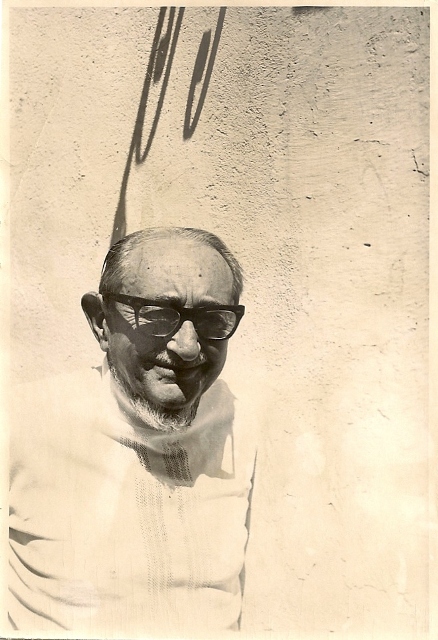
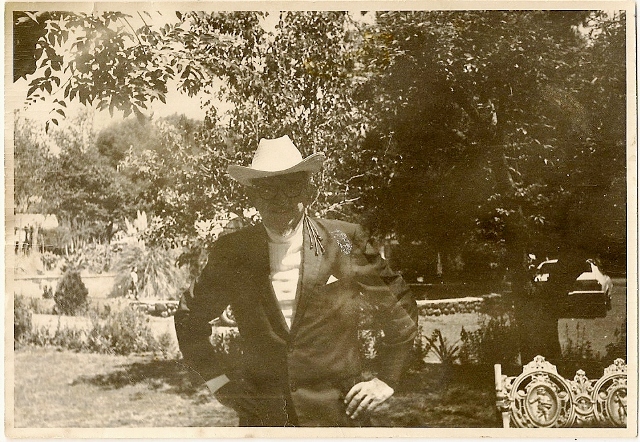
To all appearances he had been still bursting with life. After that February encounter (and it kills me that I have not the slightest recollection of our final goodbye on the Sunday after that train trip), he had gone back with my stepmother Etta down to San Miguel de Allende, Mexico, where the two of them maintained a winter home. In a late letter, he’d enclosed a trio of photos, two of which I copy here, both taken, I believe, at the Instituto Allende, the art college, where I think he was taking a class. On the back of the photo of him in the sombrero, beaming in the garden in the bright sunlight, he had written “Lush, eh?” Clearly this was a man still instinct with curiosity and excitement.

Yet he was also a diabetic with a related heart condition, and in the end, that was what won. On the morning of May 4, less than two weeks after his seasonal return from Mexico, he suffered a heart attack, and died in the hospital shortly thereafter. Gone before I knew there was a problem. Oh, I knew he suffered from diabetes, but I didn’t really know what that was, I was so young and ignorant.

The Too-Late Machine

I’d spoken with him the last time, I think, the Saturday or Sunday before. To this day, I feel terrible about that call. My offer of a place in the University of Maryland School of Law had been in hand about two weeks at that point; I had just made up my mind to accept. (I think I mailed out my intent to attend the day after the call.) But when Dad phoned in, I had been working feverishly to finish typing the transcript of an extended hearing about unionization of a company that made fire alarms and security equipment. I’d been called up to answer the phone from my typewriter in the basement and was eager to get back. I fielded it in the wall phone in the kitchen without sitting down. I did not volunteer any information about this momentous change I was about to go through, and my dad did not ask, though he knew I had an application in. I would very much have wanted him to know about all this, but I was too caught up in my preoccupations of the instant to share it, be it ever so important. And then suddenly it was too late.

That is what death is: the too-late machine; it stamps out a point beyond which nothing can be made right.

How We Mourned

We coped medium-well with our losses. Quakerdom and academia did their unimpressive best to memorialize the man, at a memorial service attended mostly by members of my parents’ Friends meeting and my dad’s Columbia department. No one said anything much; I vividly recall the chair of the department, a man named Boris, trying to think of something piquant to say, making some idiotic remark about the exotic airline bag my dad would carry.[1]  My stepmother and I nearly quarreled about my inheritance – friction I swear to this day I did nothing to create or exacerbate, though I did feel I was due something. She acknowledged her moodiness in a note, but of course we were all moody then. (And almost immediately that inheritance had a major influence on my life, making it possible for me to transfer before the school year started from night school to day school; I’ll talk more about that in a subsequent piece.)

So I was left to mourn in my own way, in the midst of a house move and in the midst of a huge change in my life. By now the reader knows me well enough to know music would have something to do with it.

How I Mourned

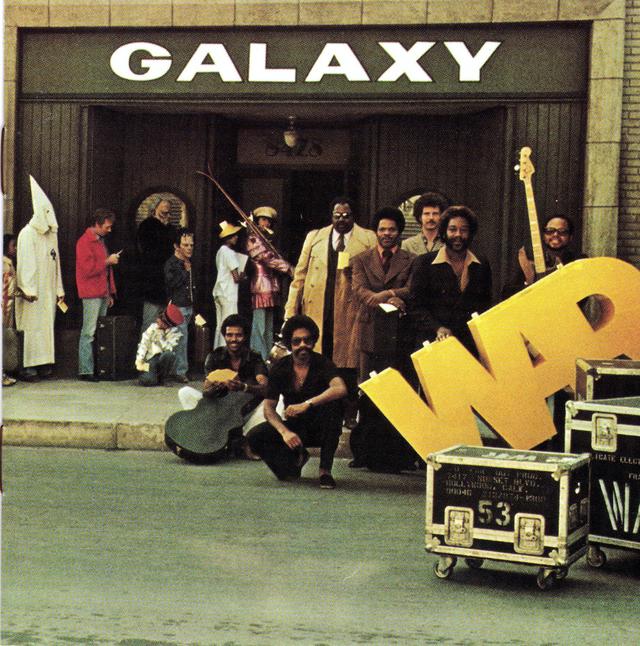
A record I had on loan from the Towson Library when all this struck was WAR’s Galaxy (1977). WAR was a crew of mostly black Angeleno musicians who had been assembled originally to back up a white Brit, Eric Burdon, late of The Animals. But Burdon had split from the group, which had gone on to forge several hits of its own, relying on such things as a weird combination of funk and Latino sound, as well as the unique combination of sax and harmonica playing together as a brass section. And this would prove to be the last album made under the WAR name by that core group. The last song of the last album by this group was a powerful 14-minute tour-de-force which for my money always seemed elegiac in the extreme.

The title is The Seven Tin Soldiers, and there is something a little march-y about it, and I’d assume that the Soldiers are the seven members of WAR marching along, so this seems to be a musical group portrait of them at the very end of their time together.[2] But despite the egalitarian name, the song belongs to the harmonica player, Lee Oskar, who wrote the melodies that hold the song together, and whose solos dominate the song. The principal melody is funky and mournful – and increasingly virtuosic as the piece proceeds.

And I found I could sort of play along with it. I was using a chromatic harmonica and Oskar was using diatonics (which I did not then know how to play),[3] but still I could chime in with most of it. Our new house had a sunroom with a western exposure, and there I stood, one afternoon shortly after my father had died and we had moved in and my life was all jumbled up beyond recall, with the light of the dying day filtering in through the tree outside, tears welling up as I honked through a requiem for my father with the instrument I knew best how to play. And in the last three minutes, the chorus of Scott and Dickerson and Allen and Miller would rise in the background and propel the song to a height of emotion that nothing else could express.


[1] At least the chair got the name right; my father’s name was Emile, but the New York Times obituary rendered it as Emil. I inadvertently got the chair back and in a fashion quite similar to that of the Times; in the acknowledgments of my father’s last book, which I edited and saw through the press, my proofreading let slip a typo identifying the poor chair as “Doris.”

[2] In the Barry Alonso liner notes of the 1992 CD rerelease, Oskar is quoted as saying he wrote it “thinking about all the band had survived and done together. I’d always been a Hans Christian Andersen fan, so I thought of us as being like the seven tin soldiers coming back from the war, with the clock ticking.”

[3]  I don’t know if he was also using a variation of diatonic harmonicas Oskar brands under the name “Melody Maker,” which I’ve never tried to play. But while I believe most of the song was played on a standard G diatonic harmonica, there are notes in the song that did not come from such an instrument.

Copyright (c) Jack L. B. Gohn, except for album graphics

Theme Songs Page | Previous Theme Song | Next Theme Song