The Class Life and the Sex Life of the Collegian

Theme Songs Page | Previous Theme Song | Next Theme Song

The Class Life and the Sex Life of the Collegian
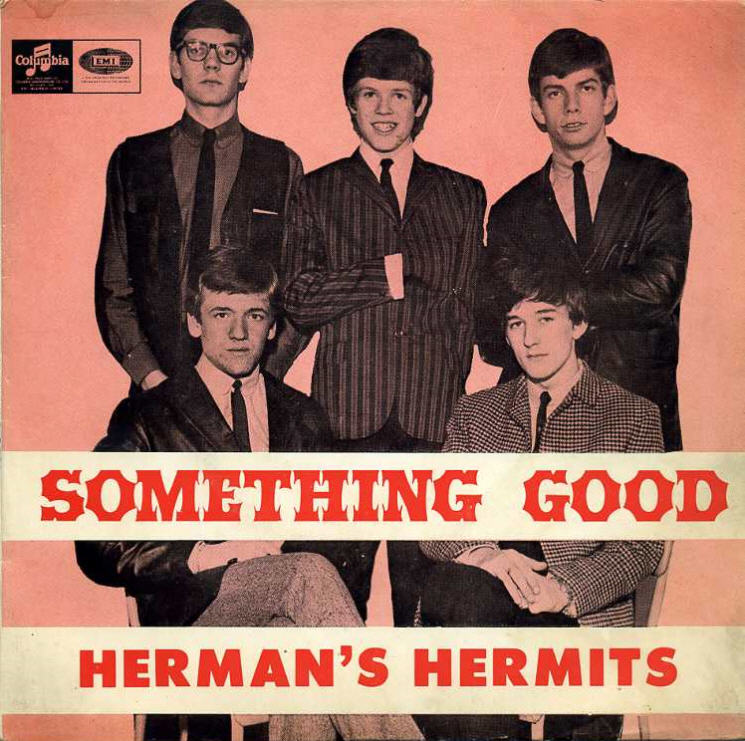
I’m Into Something Good, by Carole King and Gerry Goffin, sung by Herman’s Hermits (1964), encountered 1968

Buy it here | See it here | Lyrics here

I received a very early tutorial in social hierarchy and sexual privilege among college students in the late 1960s.  Philadelphia was (and is) very much the college town.  So, setting aside the under-aged high school girls who congregated along Locust Walk, Penn’s fraternity row, on weekend nights who were a special case, and the coeds at our own university who might be less impressed by us because they were our peers, there were lots of places where more chronologically appropriate and perhaps more impressionable young women were to be found.  My first or second Sunday at Penn, our dorm counselor[1] took us to visit a couple of such places.

Harcum from a Rambler

Including the counselor, there were nine of us in his little green 1957 Rambler station wagon.  After a brief tour of historic downtown Philly and breakfast, we went off to see Bryn Mawr College, but the place hadn’t opened yet, so we dropped in on its nearby neighbor, Harcum College, a two-year institution, then single-sex.  Its reputation[2] I described this way in a letter: “a veddy posh … college…. The atmosphere of the place is plush and palatial, but very, very protective.”

Something like this ...

Something like this …

I think it was move-in day there.  We rolled up next to an authority figure talking with some parents, and asked him, probably a shade too boisterously, if we knew the way to Penn Dorm.  (This dorm – no relative of the University of Pennsylvania — was supposedly where a friend of someone in the car was going to be living.)  The fellow didn’t like the look of us and warned us to stay away from the campus that day, or he’d have us arrested.  “We only want gentlemen visiting this campus.”

We drove away, laughing as soon as it was safe to (our dorm counselor included), and found Penn Dorm on our own.  Things didn’t immediately improve there.  We walked in the front door, all nine of us, probably coming on as a bunch of storm troopers.  I actually saw a parent’s jaw drop as we passed.  The young lady we were seeking turned out to be elsewhere, at a meeting with the dean, but her friends were very friendly, and very helpful.  But eventually we came up against a den mother, accompanied by a campus cop.  And the cop was not simpatico.

“Hey, are you guys the ones in the blue Studebaker?”

We weren’t about to get pedantic over nameplates, but we did intend to stand our ground if we could.  The one who knew the girl protested that we had an invitation.

“What did the man tell yah?” the cop interrupted.

“I was trying to say, sir,” began our friend again.

“What did the man tell yah?  He told yah to stay out, dint he?”  And he poked one of the guys with his stick to emphasize the point.

Clearly, it was no time to stand our ground after all.  We let him herd us in the direction of the door.  But as we neared the door, someone got through to him that we were Penn men.  The change in his demeanor was instantaneous; no more toughness.

And just in time, as we were met at the door by the first gent we’d been talking to.  “Gentlemen,” he said, “I’m the head of the Harcum physical plant, and I told you to stay out.  We could throw you guys in jail.”

The cop protested.  “Oh, they’re all right, Mr. Wilson.  They just didn’t know.”  Here he actually threw his arm around me.  “They’re just guys out to have a good time.”  He addressed me: “I know.  I was a boy, too, once.  I wasn’t born like this, you know.”  Referring to his girth.

Mr. Wilson wasn’t placated.  “Now I want you gentlemen to get out of here right now, and we won’t press charges.”

The cop intervened.  “But they’re just Penn boys.”

Wilson didn’t bat an eyelash, but he did change his tack.  “Well, you can come back tomorrow, but we don’t allow boys on the campus when the girls are moving in.  If you act like gentlemen, you’re welcome here.  If not, don’t bother coming back.”

Groupie Status

So we learned that being a Penn guy gave us preferential access to women.  In a town filled with colleges and universities, many of them dedicated to the education of women,[3] this was welcome information.  And later experience only confirmed it. In that town, apart from Princeton University, safely sequestered over an hour away, Penn, my school, had the most – the only word that comes to mind is what Frank Zappa called “groupie status.”  Not a perfect analogy, but it will do.[4]

During my freshman year, I took full advantage of this advantage.  In practice this meant that I went to mixer dances[5] at schools all over and met young women there, or they came to mixers at Penn.  And then I’d date them, but always briefly or superficially.  Lots of us were dating lots of people.  I had a couple of real heart-flutters, but they weren’t returned.[6]

In the midst of all this I met Cindy, a black-haired lass (or at least that was the color of what I discovered was her fall) at one of the dances.  I want to say it was at the Palestra, the great basketball floor at Penn, but I could be wrong about this.  This would have been around the end of the first semester, or the very beginning of the second.  Cindy went to Rosemont, a Catholic school, then single-sex, though since that time, like Harcum, it has gone co-ed.  Cindy glommed hard onto me after our first dance together.

Cashing In On Cachet

I wish I could remember her more clearly, but the fact that I can’t exactly underlines the problem.  The tone of what I do remember about her is all class markers, from her smoking to her accent.  Think of the bridge-and-tunnel strivers in Saturday Night Fever and I think you’ll have the picture of what I saw.  At that point though, I was mainly thinking about sex.

And I fear it was class that she saw as well.  Everywhere I’d ever been, everything I’d ever done, was equipping me for life in the professional classes.  It was who all my parents were, it was where I was going to school, it was in my aspirations and my accent.  I was, in sum, a Penn man.  And I don’t think for a minute she was blind to that.  If I’d looked exactly the same but gone to St. Joe’s, I doubt I would have held nearly the allure.  After all, women of my own social class found me perfectly resistible, in droves.

And now we get to the Theme Song piece.  We parted, I’m pretty sure somewhere in downtown Philadelphia, most likely the Suburban Station, and I know we had made a promise to get together at a date both certain and soon.  I believe it had been raining, and I had my umbrella (furled), as I was walking across a wet square.  That’s when I’m Into Something Good came unbidden to my mind.  And why not?  The lyrics fit my situation pretty closely.

She’s the kind of girl who’s not too shy : Check!

She danced close to me like I hoped she would: Check!

We only danced for a minute or two / But then she stuck close to me the whole night through: Check!

I walked her home and she held my hand / I knew it couldn’t be just a one-night stand / So I asked to see her next week and she told me I could: Also check!

There had been something about the way she kissed goodnight that had made it clear to me I could probably go anywhere on the proverbial basepath with her.  And then her tongue had been in my ear at some point as well.  I started singing the song to myself.  I went through it several times, clicking the point of the umbrella on the Philadelphia sidewalks as I made my way back.

Sounds as if I was all set to cash in on my cachet.

The prospect became more explicit on my next date with her.  Again, I wish my memories were clearer, but that exactly illustrates the problem.  Putting together little clues in my memory, I believe we started the evening at my dorm room, where there was some making out, then dinner and a movie downtown.  Only two things vividly stand out in my mind about that date.  One was that when I first caught sight of her, the long black hair was gone.  What I’d seen was a fall, not her real hair.  With it shorter, she wasn’t nearly as attractive; I was taken aback.  In retrospect, I believe she was posing me some kind of test: was I sufficiently attracted to her without the help from the fall that she could trust her body and her heart to me?  And beneath that test, a bigger one: was I okay with the class difference?

The other is a picture of the two of us, at the end of the date, making out hot and heavy in some underground corner of the catacombs under Center City, not far from the Suburban Station, before I took her to her train.  My hands were all over her, and she was moaning.  I seemed to be passing her test.  But I was failing the bigger test of my own character.  Droit de seigneur is as corrupting for the lord as it is degrading to the serf.

But in the end I passed that test.  After agonizing over it for a few days, I sent Cindy a letter telling as much of the truth as I could bear to tell.  Which was a lot.  We weren’t right for each other, I wrote.  And that much was true.  I didn’t spell out the reasons for the mismatch, and the hints I gave were deliberately wrong.  But the rest of what I wrote was also true.  I said it was obvious we were going to be having sex if we went on, and while I wasn’t sure where I stood on the official Catholic line on this, I knew sex was serious, and if it wasn’t kept for marriage, at least it should be kept for something committed.  Strange, now, to note that I was speaking my mind about sex, but not about class.  My Catholic upbringing had given me a vocabulary and a straightforwardness for one but not the other.

Cindy, bless her, wrote back, saying that it was a great compliment to her that I would look at the relationship so squarely.  She acknowledged that the impending sex would have put her in conflict.  (Catholic kids had that burden.)  And she ended by addressing, somewhat more squarely than I had dared to, the class issue.  She was sorry she had “disappointed” me in that regard, she said.

She could have spared herself that apology.  None of us has anything to apologize for about where one comes from, Cindy least of all.

Classist at Heart

In a strange way, then, I guess the promise of that song was fulfilled.  I was in for something good when I met Cindy.  It was brief, it was abortive, but it was good, especially in how it ended.  And it left me confronting, if not remotely solving, my own classism.  If one’s early affairs are about learning, this was a great success, something good.


[1] That’s right, the same gentleman I mentioned in my earlier Theater Days piece.

[2] I can’t speak to the reality.  To the best of my recollection this was the only time I was there.

[3] I used to call them girls’ schools, but my wife assures me there is no way to say this without sounding sexist.  We don’t say boys’ schools, and we never did.  So I guess that’s fair.

[4] My guess is that if you went back today, you might find Penn absolutely paramount in the “groupie status” contest.  But this was a slew of U.S. News & World Report rankings ago.  (In fact, those rankings didn’t even start until 12 years after I graduated.)

[5] Though it astonishes me, I see no trace of this former staple of campus social life when I visit academia today.  People just don’t go to dances, or they don’t do it much.  Of course men and women still find each other, but to all appearances they do it in other ways.

[6] There was Lucy, for instance, whose steadfast look and voice swept me off my feet, and who kissed me back, but who did not share my love of jazz and made me take her home early from the Quaker City Jazz Festival and wouldn’t go out with me again.  There was Ellie, who flirted hard, but wouldn’t go out with me because I was a gentile.  There was Cathy, who would go out with me but not very happily – because I was a gentile.  There was Laurie, a late-model beatnik, who had no problems with me being a gentile, but did have problems with my not being my friend Bill; she and Bill managed to make each other miserable for some time after I lost interest.

Source for Rambler image here

Copyright (c) Jack L. B. Gohn, except for photographs
Theme Songs Page | Previous Theme Song | Next Theme Song

Candidate Jack versus the Doubting Thomases

The Big Picture Home Page | Previous Big Picture Column | Next Big Picture Column

Candidate Jack versus the Doubting Thomases

Published in the Maryland Daily Record June 6, 2011

I recently put myself through the following mental exercise: Supposing I were running for president, what would the likes of Donald Trump make of my own documentary history?  That is, how would I fare if people took a skeptical attitude toward my own particular subset of the pool of public and semi-public documents that most of us rely upon to demonstrate who we are and what we have done?  To my surprise, I concluded that the docu-skeptics would probably have a field day.  I would really need to rethink whether I wanted to run.

Ms. Batchelor’s Handiwork

Start with the birth certificate.  I have one, but it is British, as my dad was Economic Attaché at the London Embassy at the time of my birth.  Supposing someone questioned whether I’d even been born when and where I claimed.  The Hammersmith Deputy Registrar of Births and Deaths, Freda Annie Gwendoline Batchelor (only in England!), who executed it in July 1949, is not likely among the living, and if she is, still probably wasn’t in the room when I was born, and wouldn’t remember a birth that far back.  My mother and father are dead.  I would be hard-pressed to summon a single percipient witness.

Unless one is prepared to cede a certain degree of faith to Ms. Batchelor’s handiwork simply because it is obviously official, there’s really no basis for concluding that I was born when and where I claim.  Let’s face it, even I have no substantiating memories of my own.

Then too, I’d have to show that I was an American citizen.  For that you’d need my State Department Form 240, Report of Birth: Child Born Abroad of American Parent or Parents, created after a birth certificate is shown to consular personnel.  But when doubters stopped and thought about the process that created that form, they’d realize how shot through with possibilities of fraud that was.  To receive it, my dad didn’t have to exhibit me, just the piece of paper Ms. Batchelor signed.  And apparently James C. Powell, Jr., the American Consul, simply took Ms. Batchelor’s say-so on faith.  If someone were trying to manufacture a bogus American identity for a child, this would have been an ideal moment.  And of course Mr. Powell is no more likely to be among the living than Ms. Batchelor.

With the birth certificate and the Form 240, it’s not even necessary to show that the documents are forgeries to sow the seeds of doubt.  All you have to do is raise a question whether the people who created them knew what they were doing.  Genuine document, but not necessarily genuine me.

Keeping It Unreal With Photoshop

What about my subsequent history?  Well, of course there are still people who remember me from my school days.  But what about my grades?  (You may recall that there have been suggestions that our President lacked the grades to get into the elite institutions of higher learning from which he graduated.)  I don’t know whether my grade school, which still exists, maintains its own records going back to the 1950s.  But I’m quite skeptical that anyone could locate grade records from my non-public high school, which closed its doors forever the year after I graduated.  I could probably scrounge up some old report cards and a transcript from my family’s files, but they could be forgeries.

As we get closer to my present, authentication of both the documents and their contents grows progressively easier – but only, I think, because computer records start to exist side-by-side with paper records.  That is, I have a contemporaneous law school transcript and the law school computers would probably confirm its contents.

Oddly, though, as we get further into the computer era, such double-confirmation becomes less available.  As records increasingly become nothing but computer entries, as we leave paper behind, our records can command no greater faith than do the underlying computers.  And we know or fear that computers can be hacked or gamed, or simply fail.  That is, for instance, one reason computer voting machines inspire such discomfort.  And this was apparently the problem with Obama’s short-form birth certificate: that it was essentially a computer printout.

And even when there is a satisfactory-looking paper document, we all know that amazing things can be done with Photoshop.  So there’s some basis for anxiety even if the documents seem to confirm what the computers say.

Fromage Vert

The end result, as this little experiment with my own history demonstrates, is that there is some basis to distrust just about anything.  Skepticism about public records and their non-public near-equivalents (private-school transcripts, baptismal records, newspaper announcements and the like), these records we live by, is not entirely irrational.

What is irrational is losing all sense of perspective, and not resigning oneself to treating public documents with some quantum of trust.  True, utter certainty is not attainable now, any more than it ever was.  (Surely it happened from time to time in the Middle Ages that someone faked the king’s seal.)  And maybe Ms. Batchelor and my parents really were in on a plot to pass off a British child as American.  And maybe the moon really is made of green cheese.

On the other hand, if you truly believe the moon is a mere morceau de fromage vert, I’m sorry to have to tell you you have a screw loose.  You lack the judgment to perceive when the theoretically possible is overwhelmingly unlikely.  The recent flap over the President’s back story is of that order.  Of course the theoretical possibility exists, and can never be eliminated, that Obama’s entire identity and history is a fabrication.  But acting as if it were remotely likely is the sign of some kind of willed lack of judgment.

Right in the Eye

It is no doubt tempting to lose oneself in such a game of make-believe, all the more so because we are all lied to so regularly.  But lies of that sort don’t usually infect multiple ancient public records.  These are actually among the more reliable guideposts.  And obviously the more lies those records are supposed to conceal, like the slew of them that would have had to be involved in the President’s supposed alternative history (born in Kenya, dual citizen, academic underachiever who was somehow smuggled into Columbia and Harvard), the crazier it is to entertain such a notion.

Worse, a determined skepticism about public records hurts us all.  Aggressively pushing the view that all documents are forgeries, all history is made up, and anyone who says otherwise is a patsy or a traitor, damages a part of the commons, the social infrastructure.  Public records are a legacy from each generation to its successors.  Our parents and our ancestors went to a lot of effort to bequeath us tangible evidence of who we are and where we came from.  Birther madness spits right in the eye of the old archivists, insults them for their trouble, and devalues their contributions.

It is hard enough to know who we are, as individuals and as a people.  Hence, unless there are strong reasons for not doing so, we should greet the help we’ve received with some gratitude, not the third degree.


Copyright (c) Jack L. B. Gohn

The Big Picture Home Page | Previous Big Picture Column | Next Big Picture Column

Sharing: Comin’ Home, Baby and The Hill (O Morro)

Theme Songs Page |Previous Theme Song | Next Theme Song

Sharing

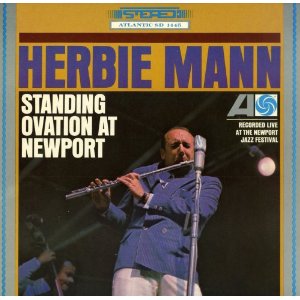
Comin’ Home Baby, by Ben Tucker, performed by Herbie Mann (1966), encountered 1967

Buy it here |View it here (earlier performance)

The Hill (O Morro), by Antonio Carlos Jobim and Vinicius deMoraes, performed by The Tamba 4 (1968), encountered 1968

Buy it here | View it here

One of the great things about the coming-together of college classes is simply this: The records get shared. Now I know I’m dating myself by saying it that way.  And these days it’s equally dating to say “the tapes get shared” or “the CDs get shared.”  But isn’t this slightly anachronistic phrase the simplest, most generic way to say it?  Would you prefer “the music files get shared” or “the playlists get shared” or “the downloads get shared”?  Each phrase has something unhelpfully limiting about it.  Choose your own phrasing, then, but then move on and think about my point, which has probably been valid one way or another since collegians first started rooming together in the Middle Ages and teaching each other ditties on the lute and the recorder.

No one, particularly in the space of the 18 years they’ve taken to ready themselves for college, gets to experience or learn to treasure all that the vast trove of music has to offer.  As the ancients put it, Ars longa, vita brevis.  But pool a bunch of brief 18-year stretches of musical experience and you’ve got something collective, ready to pool.  Put a bunch of 18 year-olds in one space and the pooling begins.

What I Was Hearing

All over my dorm I was hearing new things, or hearing old things in a new way.  Take my roommate Billy.  He was the one who first made me aware of Burt Bacharach as an auteur and performer in his own right.[1]  I first heard Wives and Lovers on Billy’s Reach Out LP (1967).[2]  Billy also focused me on the Mamas and the Papas, who had simply been part of the Top 40 wallpaper to me before that.  A bright and earnest young man from down the hall made me listen to the Byrds beyond their big hits.  And I would hang in the record stores, especially a place called Jerry’s, on Walnut Street,[3] and just note what the sophisticated kids were buying: Jimi Hendrix, Jethro Tull, Cream, Dylan, Big Brother, the A Man and a Woman soundtrack.

One of the most dramatic discoveries for me was courtesy of a guy a dorm block or two over named Steve Morris. I don’t remember how we met, but I can guess. Steve played the flute really, really well. I’m guessing I heard the sound of his instrument coming from his window, then traced it to the dorm room it came from, and, if memory serves, invited myself into his room.   I not only heard him play, but listened while he put on one of his records, Herbie Mann’s incendiary performance of Comin’ Home, Baby at the 1965 Newport Jazz Festival.  This would have been close to my introduction to jazz flute.  My one previous experience had been two or three years before listening to the college-age son of my parents’ friends, playing Swingin’ Shepherd Blues.[4]  I’d liked that a lot.  And here, with Herbie Mann’s record, I was suddenly happening upon the Mother Lode.

Though Steve was not destined to be a great friend, he was palpably marked to be a musician of some consequence,[5] and if he was excited about Comin’ Home, Baby, it was an endorsement of my own instant rapture.

I can describe it, but you really have to hear it to believe it.  This was the nearly 11-minute capstone of Mann’s July 3, 1965 set at that edition of the Festival.  Mann rocks out backed by vibes, two trombones, Chick Corea on piano, drums and conga drums, and the composer, Ben Tucker, on bass.  First Mann solos, zooming around like a mosquito, making this simple blues pattern sparkle with all kinds of colors, with just Tucker giving rhythm and the hint of a chord pattern for about three minutes, followed by a couple of minutes of solos from the sidemen, followed by more of Mann.  The crowd goes wild, and Mann leaves the stage.  Per the George T. Simon liner notes: “Herbie had already left the stage, with no idea of returning, when producer George Wein grabbed him and yelled, ‘Get up there again! Hit ‘em again!’”  I’m not sure that this story isn’t a bit of showbiz hokum (what star leaves the stage after a set that kills without planning to provide an encore?), but it captures the intensity of the moment.

What I Was Sharing

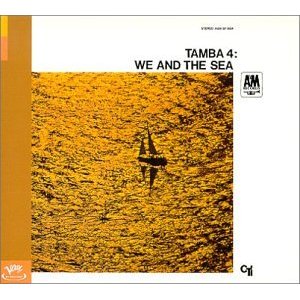
People shared with me, I shared with them.  I can remember proselytizing for my own discovery, the Tamba 4, whose album We and the Sea was, so far as I can recall, something I just picked up in the campus bookstore.  Probably what attracted me was the cover, a gorgeous thing in what I subsequently discovered was the trade dress of the CTI “imprint” within A&M Records: big photos wrapping around from front to back covers, leaving room for only one commensurately-sized photo of the performer(s) on the back.  I’m not sure what this particular cover photo, a sailboat captured from above, adrift on a golden sea,[6] had to do with the music, but of course when I got the shrink wrap off and could listen to the record itself, it stood on its own merits.

And believe me, it was meritorious. The big number is Jobim and deMoraes’ The Hill (O Morro), in the original Portuguese (I am told) an evocation of Rio’s hillside favela slums (though you barely get a hint of that in the standard English translation).  I don’t think there was any intention on Tamba 4’s part to use the jazz setting of this song to convey any particular message.  Instead, it is to blend some distinctly highbrow, north-of-the-border piano styling with Jobim’s plaintive southern hemisphere melody.  The liner notes mention Ravel, Debussy, and Gershwin; I think those are very apt comparisons.  Luiz Eça, the keyboard man, builds an astonishing set of classically-inflected variations on Jobim’s line.  The most astonishing moment of all comes at about 4:45 into this nearly 8-minute song, when Eça, slowly ditching the accompaniment of the other three musicians, sneaks his way up to a pianissimo E three octaves above middle C, and then slides down with a sudden vertiginous drop, as if going down a roller coaster, with a driving beat in the left hand and a silky tour up and down and up and down the treble clef with the right.  You think a little bit of Art Tatum, it’s so ornate, but as with Tatum at his best, the show-offiness is all in support of real thematic variations.

I had never heard anything like this at all.  I knew (though I wouldn’t have used this vocabulary for it at the time) that it was at once sophisticated and of the vernacular.  And it was a bit of my own unique taste that I brought to the great record sampling.  I remember guys standing in the door of my dorm room chatting while I was playing these songs.  Sometimes they would pay attention, sometimes not.  But my dorm room had a certain flavor, of which this was a part (along with a picture of David Hemmings in Blow-Up and a poster some friend at the Daily Pennsylvanian copied for me in the photo lab: a hippie-ish young man holding a burning piece of paper (evidently meant to be a draft card), with the legend at the bottom: FUCK THE DRAFT).[7]  I was adding my little bits to the cultural stew, and taking my little bits out.


[1]   Having previously been familiar with his tunes in the hands of others, like Walk on By, discussed in an earlier posting, but not so much that he was the common thread.

[2]   Yes, I know full well that the Hal David lyrics are jaw-droppingly old-fashioned where it comes to gender roles within a marriage.  No one would write that song today.  But it’s still beautiful and wistful within its own frame of reference.  Definitely Don Draper music.

[3]   Don’t think this was a relative of the Jerry’s vinyl emporium in Pittsburgh, which has, per its website, only been in business for “33-1/3 years,” which wouldn’t make it reach back far enough – although that number is obviously a joke.

[4]   So far as I can determine, Swingin’ Shepherd was originated by Moe Koffman, one of its composers, in a 1958 hit record.  It was covered by a lot of other people, including Ella Fitzgerald, before my new idol Herbie Mann got to it in a 1967 LP, The Beat Goes On.

[5]   He was one of the founding members of Wax, a Philadelphia band that was a name to conjure with for a while.

[6]   For some reason in more recent reissues, the gold has been turned orange.  I don’t know what that’s all about.

[7]   A sentiment I’ve revisited and explored more respectfully, but to the same conclusion, elsewhere in this blog.  At the end of the year, in a pale and simultaneously intentionally and unintentionally ironic imitation of the draft card burnings which were going on around the country, I and my friends burned our Freshman Commons cards.

Copyright (c) Jack L. B. Gohn

Theme Songs Page |Previous Theme Song | Next Theme Song

Reunion

The Closeup Page | About Life Page

Reunion

            Just back from my 40th college reunion.  If such occasions don’t drag out the deepest feelings in a person, nothing will.  In my case, there was a thin veneer of enjoyment, but a much thicker layer of gloom just beneath it.  The enjoyment came from the party, from seeing a few old familiar faces, and from drawing in a few breaths of the vitality of the place.  

            It was the reminder of how old I’d become – and how quickly – that sucked so. 

            I don’t wish to minimize the fun of the party and the old faces.  But there were, at least for me, a couple of reasons why I wasn’t delirious from what the party and my fellow-alums contributed to the experience.  I attended one of the great research universities, and, inevitably, I’d drawn my circle of friends from a small group, many of whom were not even in my class.  So my intimate friends weren’t there; obviously some of the others were luckier in that respect than I was.  But I think what I have to say might hold for them as well as me. 

         The Open House Visa

            When a great university holds a campus-wide party, the returning alum will almost certainly be exposed to parts of it he or she never experienced when young.  In my case, over two days, I: a) attended a marvelous photo exhibition in an art gallery, b) watched a panel discussion at the business school in which weighty issues of business ethics were debated, c) got a chance to play along with a student jazz ensemble, d) heard the university president present the institution’s recent staggering successes, e) listened to a glee ensemble sing and a marching band play, f) sat in and gossiped at a writers’ house, g) likewise gossiped at the student newspaper, and h) looked in on the university press and chatted with the staff about the future of scholarly publishing.  

            How much of this was revisiting old haunts?  Almost none of it.  I’d written a bit for the student newspaper.  Other than that, I was visiting little worlds within the vast universe of a great university that in four years there I had never been to before.  Some had certainly formed since my time.  But the fact was that for me, and probably for most of my fellow-undergrads, there had been an unreflective choice of but one world or two at a time when it might have been possible to become a citizen of many.  And now we could only cross those borders under the temporary visa of an open house. 

            Doors we had never even thought were open had closed behind us, years ago.  And now we could see them, quite clearly. 

           Naming the Wound

            The university president, in her early-morning talk, had diagnosed very precisely the discontent engendered by visiting all of this magnificence.  We would love to come back and be young here again, she said.  But, she added, that was not possible, so we would have to content ourselves with other things, like, of course, staying identified with and contributing financially to, the institution. 

            I shall do those things, naturally, and I’m sure they will help.  But they will not eradicate the really burning frustration at having squandered all those riches of experience when there was a chance to enjoy them more fully.  It is, after all, our 40th reunion, and we cannot truly go back.

            In fact, we are truly growing old.  This fact kept peeping out from the faces of my fellow-alums.  Age has differentiated us from each other much more than youth did.  If you look at our freshman facebook, which I still keep, we look so similar!  Almost all the girls with long straight dark hair, all the boys well-kempt and with miraculously unlined faces.  As we get bald, and our hair makes various compromises with grey and with white, as the spots and the wrinkles visit us, we are a more varied lot; we differ from each other as our parents and grandparents did. 

            And I catch us sounding like parents and grandparents as well.  Many of us are retired, and many of those who are retired seem content to be so.  And the calendar says this accession to done-with-ness is justified.  Twice 40 is 80, and few of us will attend our 80th; we are, most of us, more than halfway from the cap-and-gown to the grave.  So here we are, becoming the done-with-it generation, in the very place where youth and possibility are most celebrated and fostered. 

            It is hard, given that juxtaposition, not to be mournful.  

          Ankles Be Damned

            What did lift the spirits was the dance on the second night.  We partied for a little while like it was 1969.  And we still could, still had the capacity to do so.  Let this be reported: we truly could still dance the night away.  I’m sure there were some sore ankles the next morning.  I know mine were sore, but I can recall ankles like that at much earlier ages.  We had the youth and vitality left to party hearty.  For that I am truly thankful, and I intend to hang onto that capacity for as long as I humanly can. 

             Indeed, I’d make so bold as to wonder if some of this widespread resignation to the dying of the career light may be only a breather.  Modern medicine is apt to keep us here, if not quite to our 80th reunions, still through a substantial number of intervening ones.  I continue to hope against hope that the world can reconcile itself to finding ways other than manufacturing party-times for us, to accommodate our continuing curiosities, energies, and need for the validation that only the workplace provides, through the many anniversaries that we incipiently old alums are likely to enjoy. 

            Until we each are felled by whatever nastiness fate has stored up for us, I anticipate that each of us will say with Tennyson’s Ulysses: 

Though much is taken, much abides; and though
We are not now that strength which in the old days
Moved earth and heaven; that which we are, we are,
One equal-temper of heroic hearts,
Made weak by time and fate, but strong in will
To strive, to seek, to find, and not to yield.

Copyright (c) Jack L. B. Gohn

The Closeup Page | About Life Page

Theater Days

Theme Songs Page |Previous Theme Song | Next Theme Song

Theater Days


In and Out, by Brian Auger & The Trinity (1968), encountered 1968

Buy it here | See video with original piece here

Gates of Eden, by Bob Dylan (1965), encountered 1968

Buy it here | Video with original piece here | Lyrics here

I was theater-smitten before I ever got to college.  By my high school years, I’d accumulated over a hundred programs from shows I’d seen, and I could quote you a lot of Shakespeare.  In high school, I’d appeared in three plays.  Coming to Penn, then, I simply assumed that I’d get involved with the student theater company, and I did.  That turned out to be the Pennsylvania Players.  My resulting involvement with them ended up being tougher, shorter, and more interesting than I would have predicted.  In the end, I took part in only three shows.

Armless in Philly

The first show was a big original musical about GIs and nurses during the Korean War.  The hero: a concert pianist who gets his arm blown off in combat, but then discovers meaning in life taking care of a little girl with leukemia – a little too upbeat and square for a show being produced during Vietnam.  I served as assistant stage manager.[1] Doing that, I bumped up against some truths that were somehow new to me, I’m not sure why, but which I found offputting.  I learned that the theater is full of temperamental and cliquish people, for instance.  I learned that kids with aristocratic pedigrees from Philadelphia’s Main Line and similar spots further up the Eastern Seaboard had a sense of entitlement, not to mention quaint names.[2]  I learned that some of the people in theater were highly flirtatious, and that in an organization drawn from four college classes, a lot of the romantic histories and/or rivalries among the older members were important, extensive and not readily learned by newcomers.  Knock me over with a feather!  The effect was sort of Rosencrantz and Guildenstern-y, with me stuck occupying a corner of a scene that other people were barging into and out of with little heed to me.

Despite these shocks, I managed to do all right with that show, and suddenly started “feeling the love,” in the modern phrase.  (I burbled on to my parents “The first thing I discovered is that they are sort of a closed organization…. The next discovery I made is that they love me and look upon me as some sort of a whiz kid.”)

The Bottom Rung of the Farm System

In recognition of my success, I was now placed in line to direct a show somewhere further up the line.  My next step, in the spring, was being given a stage manager position on one of an evening of short plays (see the program here) that had won an undergraduate playwriting competition.  Unlike the very limited assistant stage manager role on the big musical, this was effectively an assistant directorship, and looked on as readying me to direct.

I surely don’t want to exaggerate how much of a step up this was for me.  Looking back, I can see this was  the bottom rung of the Penn Players’ farm system.  The play we were given, called Blues Man, by a senior we’ll call Chaim, was described by him in a handwritten note on the script as: “… the story of the necessary self-destruction of an emasculated white liberalism and the subsequent emancipation of the Negro Psyche.”  This two-character piece concerned the fracturing of a friendship and working relationship of a pair of jazz players, as the black one rejects the well-meaning but ultimately blind and patronizing support of the white one. As the (white) author pointed out to me recently, this was sort of an attempt to follow in the footsteps of black playwright Leroi Jones (these days known as Amiri Baraka).  Actually, for juvenilia, the play’s not all that bad.  But with the strained resources of talent Penn Players devoted to it, we made a hash of it.

Beyond the fact that we wrote the play a new ending and destroyed the playwright’s vision, we had no cast.  For the angry black man we had a whimsical and utterly unmenacing guy I’ll call Charles.  (He later married a white girlfriend.)  For the white guy we had a foreign grad student with a significant accent I’ll call Dieter.  Now, the white liberalism being dissed in the play was specifically American white liberalism.  Foreign jazz enthusiasts, of that era especially, were just different from American ones; they liked and were reacting against different things.  Dieter could effortlessly have come across as some kind of clueless foreigner, rendered insensible to the values of truth, justice and the American Way by too much food with garlic, powerful tobacco and reflexive Marxism.  But he couldn’t be a convincing U.S. honky trying to sidestep white guilt.  Also, he looked far more conventionally masculine than Charles.  Acted that way, too.  I remember him at parties, absolutely relentless in the pursuit of American women, which Charles never was, despite his quoting me the saw about “once you go black, you never come back.”  In Chaim’s and Leroi Jones’ imaginations, this would have been wrong; the black guy should be the studly one, not the – to use Chaim’s word – “emasculated” white liberal.

We Couldn’t Do The Music

So, okay, we couldn’t do typecasting.  Worse yet, we couldn’t do music, and that was on me.  For our play, the choice of cue music for some reason was mine.  Now you’d think that I’d have been sophisticated enough to realize that in a play about two blues-oriented American jazzmen, one of whom is black and plays the sax – the white guy tickles the ivories – we would lead in and out with small-group jazz that might remind one a bit of (but probably without actually being by) people like Coltrane, Parker or Rollins.  But the sad truth was that I knew nothing about those guys in 1968.  As I’ve said in another one of these pieces, rock was shouting pretty loudly in my ear right then.

I did have a jazz album, though: Open, by the Brian Auger Trinity, a bunch of Brits who had obviously heard rock once or twice.  The rock intonations were probably what I liked about it – well, that and the cover photo of spacy but sexy Julie Driscoll, who, however, only sang on one side of the record.[3]  So, making use of my limited repertoire of jazz records, what we hit upon to play for the cue-in music was In and Out from Open.  So, yes, technically I got the small group aspect right: as the name implies, the Trinity were Brian Auger and two other musicians, a bassist and drummer.  But the keyboard Auger was playing on this number was an organ, a Hammond B-3.  There’s no better way I know to describe the performance than to call it jaunty, a Hammond tour-de-force.  (You can listen to it by following the link above.)  It was swinging more than soulful, funky without the spirituality of the Coltrane types.  Kind of a strut with a sporadically walking bass line.  Call it Carnaby Street Jazz.

Whatever I was thinking, and I swear I don’t know, the result was that my little musical contribution to the theatrical end product was to strip out any musical context for a racial argument largely couched in musical terms.  And whatever I was thinking then, whenever I play that number or that album these days I think of my experience helping put on a little play in a strange and somewhat hostile environment – a sort of microcosm of how I felt about freshman year at a strange school in a strange city.

Glorious Rambling Nonsense

It’s not the only song that makes me think of the experience.  You also have to take Gates of Eden into account.  It was, as I have said, a three-play evening.  The first play, called Necropolis, has vanished from my memory (and the author hasn’t answered my e-mails to remind me).  But the music that accompanied it has not: Bob Dylan’s haunting, mystical, not-to-be-understood slice of what?  Gnosticism?  Apocalyptics? It was at about this point in the second semester of my freshman year that I was came to the realization that an English major would be a far safer course of study for me than a lot of other things.  I was starting to think and listen like one.  And my ear, increasingly sensitized by what I was getting in my courses, recognized both music and poetry amid the ramblings.

No mistake; the song did ramble.  I defy anyone to make cold sense out of lines like:

The lamppost stands with folded arms.
Its iron claws attach to curbs ‘neath holes
Where babies wail though it shadows metal badge

So one mistake would be to take every word as if it were seriously meant to denote something.  Another would be to take the whole as if there weren’t something meaningful going on.  There are two clear poles of meaning in the song.  It starts and ends with wonderment at the elusive meaning of war, and it contrasts the bafflement and confusion the speaker experiences with the certainty of Eden.  We know a few things about Eden; among them:

No sound ever comes from the Gates of Eden.
 
You will not hear a laugh
 
All except inside the Gates of Eden  [which seems to contradict the previous point]
 
There are no kings inside the Gates of Eden.

And there are no sins inside the Gates of Eden.

… what’s real and what is not.
It doesn’t matter inside the Gates of Eden.

And there are no trials inside the Gates of Eden.

And there are no truths outside the Gates of Eden.

Was the land beyond the Gates of Eden real in the universe of the song?  Unclear.  And was the peacefulness of Eden anything more than that of the grave?  Ditto.  There was something uncompromising and bleak about this music, though, which made Eden seem forbidding, even with all these basically positive attributes Dylan posited.  But I craved that bleakness for some reason.

Of course, like everyone in my generation, I’d been somewhat familiar with Dylan for at least three years.  But I knew him as a protest singer (Blowin’ in the Wind), who also wrote grouchy love songs (Don’t Think Twice, It’s All Right), and grouchy songs in general (Like a Rolling Stone).  The phase he was entering now, half Lewis Carroll nonsense versifier, half mad prophet, appealed to me much more.[4]  It was around this time, as I recall, I spent a good part of a skiing trip at my dad’s Catskill cottage, with the two of us playing Blonde On Blonde[5] speechless with laughter.  How can you not laugh at lyrics like:

The fiddler, he now steps to the road.
He writes “Everything’s been returned that was owed”
On the back of the fish truck that loads
While my conscience explodes.

This is so preposterous, so inconsequential, so syntactically wrong, the mind just goes into overload.  And Dylan was churning this stuff out by the acre at this phase.   But amidst the cheerful syntactical chaos, you could sense someone whose least utterance was powerful, whether for laughter, bleakness, or anger.  Dylan was important.

So Necropolis was, in the final analysis, my real introduction to one of the great artists.

The Origins Story of an Ink-Stained Wretch

To jump ahead just a little in the story, there was, as I’ve stated, one more one-act play, the following academic year.  This time I directed.  I rubbed shoulders with some interesting people on this one.  A future housemate of mine, a guy who went on to write for the New Yorker, and also ghosted the memoirs of a well-known madam was in my little cast.  And in another play, the well-known musical theater critic Ethan Mordden (not the name he started at Penn with and not the spelling he used at that point of his apparently self-chosen name).  The music was in the hands of a man who became a well-known Baltimore DJ during the album rock years.  So there were interesting folk about.

But over that year, which was the first I had a real girlfriend, I made two discoveries.  I found out that romance was a more interesting endeavor than the exercise in herding cats that theater was turning out to be – and that I liked reviewing theater for the Daily Pennsylvanian more than I liked producing it for Penn Players.  Reviewing plays and musicals is a pursuit that has, off and on, lasted to this day.  I remain a theater-struck ink-stained wretch, but with a face that has stayed innocent of greasepaint.


[1]   See excerpts from the program here.  (The rest had to be jettisoned for reasons of bandwidth.)

[2]   The star was my dorm counselor, Bancroft Littlefield, Jr.  (Or, from an etymologist’s perspective, Beanfield Littlefield.)  Consider this comment bemusement at his name, not a suggestion one way or another as to whether he had what we moderns call a sense of entitlement, or any other kind of disrespect.  He has apparently. and doubtless deservedly, become a name to reckon with in New England legal and political circles.

[3]   The story here is a bit complicated.  The album was a double album.  The A-side was called Jools, and had the above-pictured cover of Julie Driscoll (known then by the nickname Jools, nowadays, 2011, performing under her married name Julie Tippetts).  Reviewer Greg Boraman aptly summarizes her performance this way: “the seminal 60s hippy chick, sings with a stoned, disjointed charm to great effect.” (There are good videos of Jools performing cuts from the album with the Trinity here and here.) The B-side was just the Trinity.  It had a matching cover photo of an overexposed (a word that happens to be apt as a matter both of photography and of decency) Brian Auger, frontally nude, but with his privates covered by a medallion that depicted the other two members of his band.  This side was called Auge.  That’s where In and Out came from.

[4]   For a good quick chronological Dylan guide, look here.

[5]   I didn’t own it; it came into our world courtesy of one of my stepsister Hilary’s friends or boyfriends, who had the admirable habit of leaving a lot of interesting vinyl up at the cottage.

Copyright (c) Jack L. B. Gohn

Theme Songs Page | Previous Theme Song | Next Theme Song

Signing Statements Done Wrong, and Done Right

The Big Picture Home Page | Previous Big Picture Column | Next Big Picture Column

 Signing Statements Done Wrong, and Done Right

 Published in the Maryland Daily Record May 2, 2011   

       James Risen of the New York Times recently attempted to add an exhibit to the growing “Obama is a lot like Bush” meme by pointing out that President Obama had recently issued a signing statement on the budget bill, asserting that two sections of the bill were improper encroachments on presidential power.  Risen commented that “[d]uring his campaign for president, Mr. Obama criticized President George W. Bush for what he portrayed as abusive use of signing statements… But since taking office, Mr. Obama has seemed less reticent to employ signing statements than his campaign statement may have suggested.”

          I have a great deal of admiration for Risen, and have expressed it more than once in this column, but this time he’s implying nonsense.  In this area, Obama is not Bush Lite, he’s just Not Bush.  Here is the real story.

          Signing statements are statements a president makes when he signs a bill into law.  They become controversial when they suggest that the Executive may decline to implement or follow parts of the bill being signed, usually on the theory that there is something unconstitutional about the law.  They are not reliably posted on the White House website, but you can find them in various places, including www.presidency.ucsb.edu.  And you’ll see, if you compare George W. Bush’s with just about any other president’s, that he took to making controversial signing statements in a different way and in bulk (1200 bill provisions challenged[1] vs. around 600 total in all earlier presidencies).[2]  Bush was routinely spoiling for a fight with Congress, but it wasn’t just his pugnacity that was the problem.

          For one thing, he was routinely deliberately opaque.  He used repetitive boilerplate objections that did not signal what he found objectionable or what he might do about it.  Here’s a standard one, part of his comment on the Trafficking Victims Protection Reauthorization Act of 2005:

Section 104(e)(2) purports to require the Secretary of State, prior to voting for a new or reauthorized peacekeeping mission under the auspices of a multilateral organization…, to submit to the Congress a specific report. The executive branch shall construe this reporting requirement in a manner consistent with the President’s constitutional authority as Commander in Chief and the President’s constitutional authority to conduct the Nation’s foreign affairs.

Did this signal a determination that in certain circumstances he would defy Congress about whether to submit the report?  Did Bush himself have any idea?[3]

          Frequently Bush would signal an intent to interpret a law in a way that could not be squared with the text of the law.  Here’s part of his comment on the Deficit Reduction Act of 2005:

The executive branch shall construe … section 6034 of the Act, which purports to make consultation with a legislative agent a precondition to execution of the law, to call for but not mandate such consultation …

Yet when you read the language of the law, there’s nothing optional about it.  It reads in relevant part: “Each 5-fiscal year plan … shall be developed by the Secretary in consultation with the Comptroller General of the United States …”  (The Comptroller General is a Congressional officer.)

          Endlessly repeated (reportedly 363 times)[4] in the Bush comments[5] is a commitment to the notion of the “unitary executive,” which means an executive in which no part is independent of the president and his policy-making, even those administrative bodies established by Congress to effectuate Congressional policy.  Since Congress cannot implement policy except through the courts and the executive branch, a thoroughgoing adherence to unitary executive theory would leave Congress almost powerless to formulate national policy.

          It was excesses like these that led the ABA to issue a blue-ribbon panel report in 2006 calling for legislation to curb signing statements (responsive legislation did not pass),[6] and led also to President Obama’s early Federal Register notice about signing statements.  There he advised that he would attempt to advise Congress in advance when constitutional problems were threatened by upcoming legislation, and that “I will ensure that signing statement identify my constitutional concerns about a statutory provision with sufficient specificity to make clear the nature and basis of the constitutional objection.”

          With this background, then, let us turn to the specific signing statement Risen singled out.  And let’s note as we do that this is by my count the ninth statement from Obama to raise constitutional objections to any act he has signed.  He is not remotely comparable to Bush in that way.

          The statement challenged two provisions of the interim budget, Department of Defense and Full-Year Continuing Appropriations Act, 2011.  One pair of challenged sections barred the use of funds to transfer Guantanamo detainees to the United States for trial or move them to other countries, another barred paying for White House advisory positions colloquially known as the health care, auto and climate czars.  In measured and precise terms, Obama explained exactly why he considered these strictures objectionable.  With respect to the detainees, Obama merely criticized the Congressional policy choices;[7] he did not signal defiance.  As to the czar positions, he claimed a    

 … well-established authority to supervise and oversee the executive branch, and to obtain advice in furtherance of this supervisory authority…. Legislative efforts that significantly impede the President’s ability to exercise his supervisory and coordinating authorities or to obtain the views of the appropriate senior advisers violate the separation of powers by undermining the President’s ability to exercise his constitutional responsibilities and take care that the laws be faithfully executed.

          Risen commented that “the battle over czars has little effect on White House operations” because the positions are currently vacant.  But the same objection could be leveled at Congress.  Clearly this is a substantive fight.  “Czars” are not generally subject to Senatorial confirmation, and centralize much authority in the White House and take it from other Executive branch agencies that may be more accountable to and manipulable by Congress.  Even if the fight is being carried on via the proxy of unfilled positions, it is a real one, and Obama has made it clear he intends to defy Congress if it defunds any future czar he chooses to appoint.

          So if we are to have signing statements, Bush exemplified how not to do them, and Obama is doing them right.  Should we have them at all?  The ABA’s report staked out the position that if a President thinks a law contains unconstitutional language, he shouldn’t sign it.[8]  To me, that is Ivory Tower impracticality. 

          Take the 2011 Appropriations Act; if Obama hadn’t signed it, the government would have shut down.  Would it have been remotely responsible for Obama to have done that merely because he thought a couple of provisions among the thousands in that massive bill were constitutionally deficient?  Such purity would make government impossible.

          Signing statements are actually a good alternative to such chaos.  The President asserts non-aquiescence, government moves on, and the courts can sort the matter out if they need to.  A better system all around.


[1].  Laura McDonald, THE INTERPRETIVE WORTH OF PRESIDENTIAL SIGNING STATEMENTS: A NEW FORM OF LEGISLATIVE HISTORY, 38 Fla.St.L.Rev. 179, 185 (2010), citing a piece by Charlie Savage in the New York Times.

[2].  See here, at Page 14.

[4].  Per this article by Dawn Johnsen, at Page 417, citing Neil Kinkopf, Signing Statements and Statutory Interpretation in the Bush Administration, 16 WM. & MARY BILL RTS. J. 307, 312 (2008).

[5].  For instance, in the comment on the Deficit Reduction Act of 2005.

[6].  An analysis of one, H.R. 5993, the Presidential Signing Statements Act of 2008, can be found in Faith Joseph Jackson, THE CONSTITUTIONALITY OF PRESIDENTIAL SIGNING STATEMENTS: A NOTE ON H.R. 5993, 35 J. Legis. 1 (2009).

[7].  At least with respect to trying detainees in U.S. mainland courts, this column is on record as agreeing with the position the President at least does not want to foreclose.

[8].  See here, at Page 5.

Copyright (c) Jack L. B. Gohn

The Big Picture Home Page | Previous Big Picture Column | Next Big Picture Column

Earworms, Musical and Otherwise

Theme Songs Page | Previous Theme Song | Next Theme Song

Earworms, Musical and Otherwise

Blue Jay Way, by George Harrison, sung by the Beatles (1967), encountered 1967

Buy it here | See it here | Lyrics here | Sheet music here

I had expected that my freshman experience at college would full of good things, and it did not disappoint.  But I started to find out quickly that it was also full of things that were difficult, frustrating, and sometimes downright horrifying.

Settling Into a Harder Place

For instance, within a week of my arrival, a young man who had just matriculated with me, and whose face was on the same page as mine in the face book,[1] was tied up and beaten to death by a campus tobacconist whose shop stood just a block away from the dorm where I slept.  Although I was not quite unfamiliar with violent death occurring in my immediate vicinity,[2] it had never before happened to someone of whom I could plausibly say “that could have been me.”[3] More mundanely, my courses proved harder than I could have guessed (I pulled a first-semester GPA of only 2.8), and I wrote a friend, and meant it, that “everybody here’s smarter than I.”  My study habits clearly needed upgrading, but I didn’t have a clue how.  There was also chronic homesickness, and not doing spectacularly well with the girls, although I wasn’t really complaining too much about that: every near-miss at a relationship (and there were a lot of different ones) truly was a learning experience, and I felt it as such, whatever I may have said.[4]

The city itself was challenging, too.  I wanted to explore.  Philadelphia yielded itself up, but not easily.  There was lots of dirt, neighborhoods where it wasn’t safe to go, unpredictable train schedules,[5] distances that were a little uncomfortable to walk (and this was before backpacks, wheeled briefcases, or any technology for miniaturizing the information you needed to have available for your studies).  The air was full of soot that would collect on your record grooves (and you’d best believe I noticed something like that.)  Frequently there were sulfur dioxide and other smells from the nearby oil refineries.  People were harder than in my hometown.  The barber at the student union practically cursed me out when I didn’t tip him (not knowing better).  I got into a fight with the petty tyrant who checked to assure we were wearing ties for dinner at Freshman Commons, as required.[6] There was even a certain kind of pressure I had to come to terms with, being Catholic in a predominantly Jewish environment.[7]

George Harrison’s Earworm

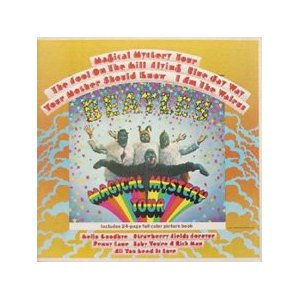
So as exciting as it all was, there was a queasy underside to it that kept me off balance.  I came up against the quintessential episode of that the day I bought the Beatles’ next album, Magical Mystery Tour.  Per the experts at AllMusic, the release date was Monday, November 27th.  By then I had completely absorbed the complexities of Sgt. Pepper, which I’ve already discussed, and I was more than ready for whatever the Beatles were about to dish up next.  The first few people I’d heard talking about the follow-up album were disappointed, but I just had to have it.  I bought the album on Saturday, December 9.[8] I was finished with all my courses then, and studying for finals.  (Complaining to my parents the previous day that “I should be out wenching and getting topped, but I’m going to be reading Kierkegaard.”)  Magical Mystery Tour was probably a present to myself for getting through the semester and an encouragement to myself to study hard.

I think on my first couple of listens, I found a lot to like about the album, but there was one totally creepy song, George Harrison’s Blue Jay Way.  My Beatles vade mecum, Ian MacDonald’s Revolution in the Head objectively describes the song:

Written in the fog-bound Hollywood Hills of Los Angeles on 1st August 1967, the blurred harmonic oscillation between C major and C diminished which is almost the entire musical matter of BLUE JAY WAY all too successfully conveys its author’s jet-lagged dislocation while waiting for publicist Derek Taylor to arrive.  A four-minute pedal-drone laden with ADT,[9] phasing, and backwards tapes, it numbingly fails to transcend the weary boredom that inspired it.

Subjectively, I found the song scary.  It seemed like a descent into some kind of languorous madness. (To be fair, probably not what Harrison intended.)  Not only was the song unattractive, but it wormed its way into my head and I couldn’t get it out.  It’s not just the songs you like that do that to you.  By the third play-through I deliberately lifted up the tone arm and skipped that song.

Here Be Dragons

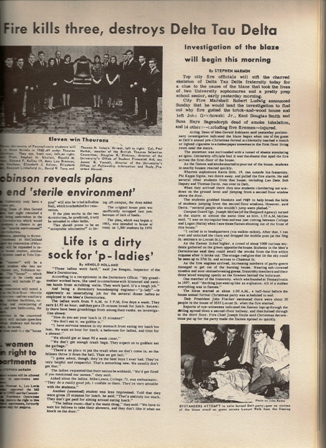
Predictably, I was far from the only person celebrating that day.  The fraternities and sororities were doing their end-of-semester thing.  I was no frat boy, and would not have been invited or welcome to their festivities.  But a block from me, at the Delta Tau Delta house, a dance was in progress.  Around 1:30 on the Sunday morning, someone mishandled a cigarette near some combustible Christmas decorations. The ground floor was promptly engulfed in flames, which then quickly spread up the one stairway to the second floor.  People on the second floor were trapped.  Many jumped from the window, some were pushed from the window by frantic partygoers behind them, and some injured themselves in the fall.  Three died, two frat brothers and a high school girl.  (Heavens only know what she was doing there at that hour.)

The word was all around campus, of course, when I awoke that Sunday morning.  I was dumbfounded.  That frat was, if memory serves correctly, at or near the east end of the fraternity row, on the main campus block.  I passed it every day.  And now people had died there!  I was scared.  I was horrified.  I tried but failed to get images of people on fire out of my head.

When I first walked on campus after that, I stole a glance at the charred entrance with the tape around it.  Then I looked away.  And for the next several days, I wouldn’t look that way.  Even though I didn’t attend frat bacchanals, I knew that what had happened was a sample of the random disasters that come along from time to time.  The next time might not be frat party, but something else I hadn’t even thought of.  People die in disasters, and there was no telling when one of them might involve me.  There but for the grace of God, I was feeling.

It’s obvious, then, why the song is the Theme Song for the experience.  I didn’t want either to look at the one thing or to listen to the other.  But I had to keep encountering them.  And I couldn’t get either one out of my head.

Growing up was, thank goodness, a process of becoming exposed to all kinds of things, only a few of them traumatic, but traumatic surely was part of it.  And I was growing up.

Denial to a New Level

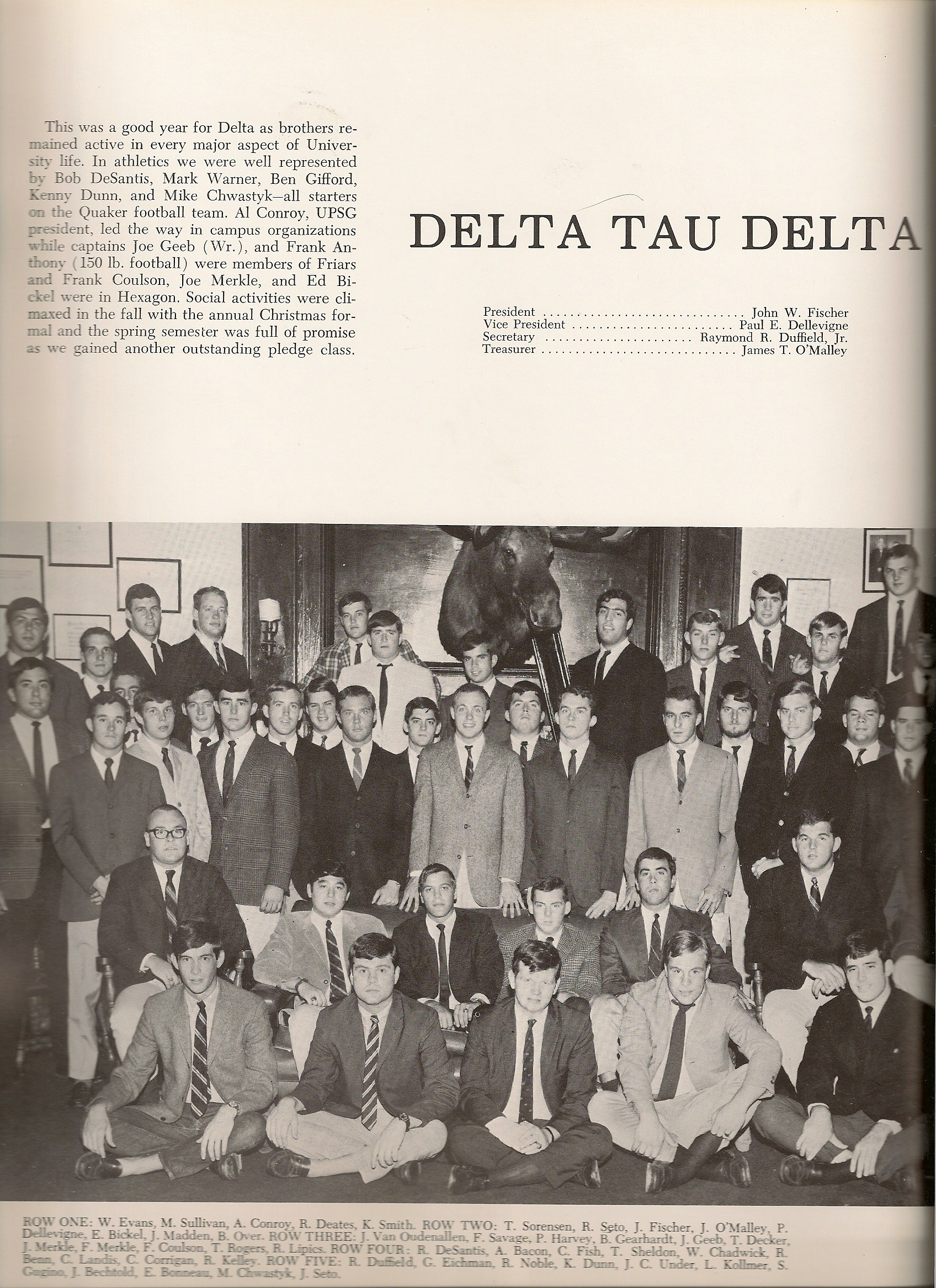
I had not been the only person celebrating, and then I was not the only person avoiding.  The following summer I received the yearbook (actually the only one I ever sprang for while I was a collegian).  On the Delta Tau Delta page, it’s as if the event had never occurred.  “This was a good year for Delta,” the page informs us, “as brothers remained active in every major aspect of University life.”  Football heroes are mentioned, and service clubs.  Toward the end, remarkably, this: “Social activities were climaxed in the fall with the annual Christmas formal and the spring semester was full of promise as we gained another outstanding pledge class.”  That’s it?  That’s all that’s worth mentioning about the “Christmas formal?”  Nothing about the three lives snuffed out and the desperate people being pushed out the window, and the charred entrance, and the trauma for the entire campus?

I kept hearing George Harrison’s refrain in my head, Please don’t be long/Please don’t you be very long, like a plea to the missing, as if George were invoking them to delay no further their return from the dead.  But George was too spaced-out for his voice to reach them, and so they wandered off further into the land of shades.


[1] I am now speaking of an actual face book, distributed by the University, with pretty much everyone’s photo and some identifying information in it.  I still have mine.  So successful has Facebook become in preempting the sense of these morphemes that this bit of etymology will probably soon be known only to philologists.

[2] In a fit of road rage, a next-door neighbor of mine had slain the father of someone I went to school with.

[3] In reality, it probably couldn’t have been me.  There were strong overtones of homosexuality about the whole incident, which would have ruled me out as a victim, but I hadn’t quite got a fix yet on what all that was about.

[4] For instance, one concrete lesson I learned was that after a bad date, even if the girl said she’d go out with you again, she wouldn’t.  I think I grasped that one quicker than some guys did.

[5] Although I talked with bravado about the transit system.  And it was a fact that I could enter the maw of the 37th Street underground trolley stop, and emerge near my father’s apartment at the 116th Street and Broadway IRT station in New York without going outside once, which was pretty cool.

[6] I wanted to wear a turtleneck sweater one night, and thought a tie under it would be silly.  He insisted on checking, found that I had no tie on, and refused me admittance until I went back to the dorm and secured a tie.  The following night I presented myself with a turtleneck again.  He again insisted on an inspection.  This time there was a tie, but taped to my collar above the tie was a sign that read “Fuck You.”  This needless confrontation with authority got me into some kind of trouble, although the details are hazy.

[7] Which Penn was at the time.  The resulting rules could get damned confusing.  For instance I’d been a stage manager of the Penn Players’ big musical which had played the weekend preceding the weekend I’m about to discuss.  There had been a pretty member of the crew who had kissed me several times amidst the scrum of sexual friction that always happens backstage.  After the production, I had asked her out, and was told she only dated Orthodox Jewish boys.  I found it strange – then – to be treated as a person in one context and as just a member of a category in another.  Acceptable to kiss but not to date was a new one on me.  Then.

[8] The incident I’m about to discuss occurred in the early hours of Sunday, December 10.  (See this newspaper account, dated the Monday, which supplies the date by implication.)

[9] Artificial double-tracking.  Says MacDonald: “It consists of taking the signal from the sync head of the multitrack, recording it to a variably-oscillated loop, and sending it back to the multitrack about a fifth of a second out of phase.”

Copyright (c) Jack L. B. Gohn

Theme Songs Page | Previous Theme Song | Next Theme Song

An Empty Room, Green Trolleys, and Brubeck

Theme Songs Page | Previous Theme Song | Next Theme Song

An Empty Room, Green Trolleys, and Brubeck

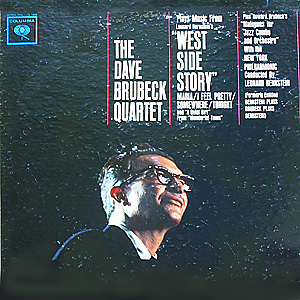
Dialogues for Jazz Combo and Orchestra: III – Adagio-Ballad, by Howard Brubeck, performed by the New York Philharmonic with the Dave Brubeck Quartet conducted by Leonard Bernstein (1961), encountered 1966(?), re-encountered 1967

Buy it here

In a nearly empty room, after perhaps weeks of silence, music begins.  A group of cellos is heard, meandering through a series of desolate chords without a clear direction, while above them a lonely French horn picks out a melody as if at random, as if trying to find a footing in the insecure and seemingly trackless chordal structure.  Then, after two minutes, the whole thing jells, and a jazz saxophone picks up where the French horn left off, and, confidently navigating the chord pattern, swings effortlessly where the French horn stumbled.  A piano picks up the stride, and struts through what now turns out to have been a 16-bar pattern, and then the saxophone comes back, and marches with the entire orchestra to a composed, if bluesy, and subdued, and melancholy conclusion.

This is the way I still picture to myself hearing part of the Dialogues for Jazz Combo and Orchestra: in my empty college dorm room on my very first night there, all alone.  It is a powerful recollection.

We are now entering the densest collection of songs for any time period I’ll be discussing in these pages.  Some years don’t rate a song; this one is worth several.  Freshman year was an explosion of new things, music among them, all discovered together.

Ending a Summer, and a Time of  Life

The preceding period had been the opposite of explosive.  In the previous piece, I wrote about how the summer after graduation was an exhausted, solitary, and introspective time, as, among other things, my stepdad recovered from a life-threatening illness and surgery and I tried to write a novel.  By the end of the summer, though, we were all pulling ourselves together.  I visited my father in New York, and my mom and stepdad vacationed in Bay City (while the Detroit riots raged).  And when I got back, and they got back, we were all refreshed and recovered, and it was time to get serious.

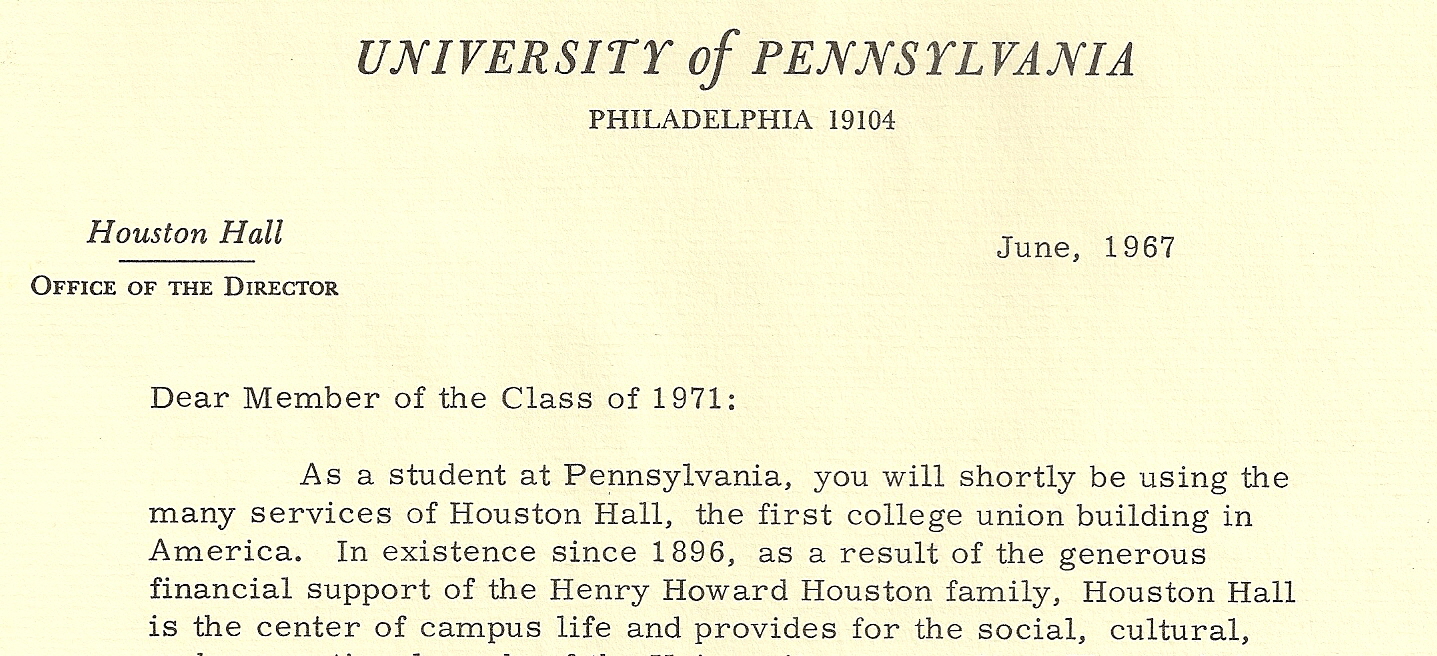
None of us knew much about what we were getting serious for, though.  In my case – and from talking to contemporaries, it seems that this was far more typical in those years than nowadays – I had literally never set foot on the campus of the university I would be attending and couldn’t even picture it in my head.  (I did like the cream-colored stationery with the interesting typeface but that was hardly something to start planning a future around.)

Not to Be Rushed

I really had no idea of what the place was like.  There were no websites to visit, very little in the way of counseling to advise me, and my parents were, for a set of academics, singularly clueless about where I might like to go, or why.[1] I had applied to six schools, all of them elite Eastern institutions.  I just assumed that I was good enough and would get through the screening process.  It was a near thing in the end, though;[2] only one ended up accepting me.[3]

My stepdad, now well enough, took me to Fiegel’s, an old-line men’s store on Main Street, to get some clothes for college.  I remember getting much that turned out to be too dressy, although that could have turned out to be more a sign of the changing times as we moved into the later 60s than of any norms at the University of Pennsylvania, my new school.  I had this picture in my mind of people attending football games dressed a bit like collegians from the 20s, which sort of was true for about one year.  (I ended up hanging onto those largely-unworn ties well into graduate school.)  Somehow we also acquired a huge green trunk with a removable shelf, and packed a lot of my stuff, including some records and stereo gear, into it.  Then we entrusted it to the care of the Railway Express Agency,[4] in the hope and expectation that it would be delivered to my dorm in time.

And then it was time to go.  But we did it my family’s own unique way.  My mom called her brother in Southern Maryland, her father in Boston, and an old high school friend of hers in Washington, and urged them all to be part of the sendoff in Philadelphia. All of them could and did make it.  Not only that, but we made a royal progress of what was at most a two-day journey (we’d got to Washington in one day on my high school junior trip), stopping in Pittsburgh and with old graduate school friends of my parents in Chambersburg as well.  We even toured the battlefields at Gettysburg.

So it was that not until about 5 p.m. on Friday, September 1, did we reach the point at Valley Forge where the Schuylkill Expressway diverged southwards from the Pennsylvania Turnpike.  And I knew from the maps (I’d become the family’s navigator on long car trips), that I was finally getting close to my new home.  And a sense of anticipation that had sort of been dammed up inside me until that point started to spring some leaks.  I just wanted to be at Penn, whatever that was like, and doing things my own way.  Instead I was still part of a family get-together.

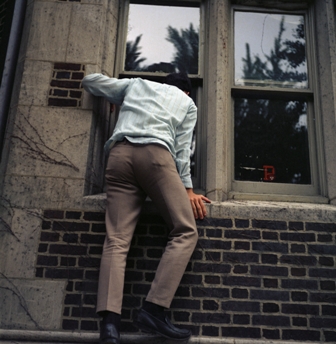
But of course my parents, being who they were, were not to be rushed.  We didn’t go past the campus then, but instead made for the Sheraton in Center City, on the John F. Kennedy Boulevard.  Then we had to go to one of the Bookbinder’ses[5] for dinner.  Finally, after dinner, my parents consented to take me over to the campus; a campus cop let us in.  We found my dorm room, in an ivy-covered quad.  It would have been a little too high off the ground for a Sebastian Flyte to have been likely to come and vomit in my window, a la Brideshead Revisited,[6] though this photo taken of the same window the following summer (with the ivy unfortunately stripped) demonstrates it might have been technically possible.  Still, I was going to be almost as immediately exposed to whatever would go down out there on the quad as Charles Ryder had been.  I thought about this as we drove back to the Sheraton.

The following day, all the other members of the family group gathered.  All I wanted was to get away.  We  retrieved the Railway Express trunk, and moved my things into the dorm.  I got to make my bed, and pulled my precious stereo components together from the green trunk and the boxes in the car, but I don’t think I had time to wire them. The six of us went out to dinner at the other Bookbinder’s.  And then, gloriously, I slipped away…

Trial by Trolley

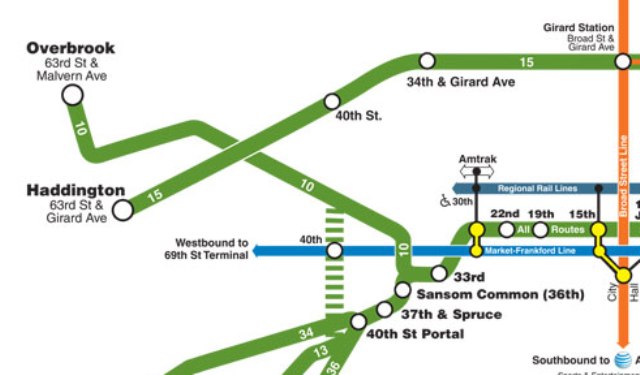
I was always the navigator, as I’ve said, and I could have walked it, and I’m sure for that matter my parents would have staked me to a cab.  But I really wanted to do it the way a Philadelphian would, by the underground trolley.  Somehow I’d researched it, and worked out that there were four lines that ran through a station a block from the hotel, and would deposit me right on campus outside the dorms.  (Just avoid the Number 10, I was warned.)  So, as soon as I’d made my leave, I went down into the portal of the 19th Street Station.

I was excited and nervous.  I remember being struck by what I would come to recognize as the peculiar smell of that tube, something reminiscent of steam and heated electrical copper.  There were four tracks, but only two were accessible from the platforms in this station; I saw bigger, faster trains traverse those tracks, and for some reason that made me nervous whether I was truly on the right line.  Eventually one of the correct trolleys came by, a shiny green thing, but needless to say, I was still nervous.

I was puzzled, too, when the trolley came to a switch in the tunnel, stopped, and waited for the track alignment to reset.  Again, I was concerned that somehow I might have things wrong, and that this new alignment would take me out to whatever place I shouldn’t go.  (You can know facts like the fact that you’re not on the Number 10, and then somehow still worry, especially when you’re just 18 and in the big city on your own for the first time.)  So at the first stop after the switch, I bolted.  I figured if I were not too far out, I could either go back, or work my way over to the campus and the dorm, whereas if I waited for the next stop, somehow it might turn out not to be 37th Street, but somewhere else entirely, and I might find I was further out in the wrong direction.[7]

So out I got at the Sansom Street stop.  If you go by there today, you’ll find it’s part of the gleaming, transformed Penn of the 21st Century, in a smart, retail-heavy neighborhood.  When I alit at the same stop on the evening of Saturday, September 2, 1967, the street was dark, empty, and a little bit sinister.  But I felt reassured somehow that I was in about the right place, and struck out in what I figured had to be the right direction.  I was correct on all assumptions.  My dorm room turned out to be only about three blocks off.  I got inside without trouble.

Lares and Penates

So I settled in, all by myself.  And that’s when I hooked up my lares and penates, the stereo components, and sat in the semidarkness.  I don’t know just what it was that made me pull out the album pictured above, with the too-long title, for the very first thing I would play, but I’m quite clear that that was the music.  I’d been turned on to the album by Bob, a high-school classmate, who like me used to sit in the small audio-visual section and play music through headphones.  I loved Brubeck’s crunchy piano chords, the searching, piercing sax of Paul Desmond, and Joe Morello and Gene Wright’s elegant drums and bass.  But most of all, I loved to hear them set against an orchestra.

The work I was listening to was a four-movement concert piece composed by Brubeck’s brother Howard, which gave the orchestra set things to do and periodically opened up windows for the quartet to jam in.  All of the movements were wonderful, but there’s no doubt that that night it was the third movement, the Adagio, that mattered.  I was lonely and a little frightened, and I embraced those feelings.  And that Adagio, described at the head of this piece, nailed that feeling.

My roommate was coming the next day, I knew.  But for that one night, I could revel in my aloneness, in a strange place, after a challenging first encounter with public transport, and a great adventure before me.

That would be a nice note on which to end this piece, but in truth there’s a little more to tell.

The next day, typically of my upbringing, started with my finding my mom at the Cathedral for mass.  Afterwards I had to play tourist courtesy of my mom’s old friend, who had been a lawyer in Philadelphia for some years before decamping for Washington (she’ll come into these stories again), and we toured, for instance the Main Line.  But I cut out when I could, got back and met and spent the night with my new roommate, with whom I hit it off pretty well (a friend to this very day).  So that was exciting.

That Guillotine Moment

The following day, though, was the one I’d really been anticipating and dreading.  I wrote earlier about how high school graduations mark the moment when the pulling apart of the ties between parents and children, so necessary and so scary, begins in earnest.  However, for sheer guillotine-like intensity and definitiveness of severance, nothing in our society, short of divorces and funerals, begins to compare to the moment when parents leave kids off at college for the first time.  I have now been through both sides of the experience, and I know.  Talk about necessary; talk about wrenching!

I rejoined my family for breakfast, and then everyone but my parents got going on their respective modes of transport out of town.  It was down to my parents and me.  My parents checked out of the hotel, and drove me over to the campus.  The new roomie, his parents, my parents and I all went to the Dean’s reception.  Then came the moment of goodbye.  I had this terrible hollow feeling.  I don’t remember the hugs and what was said, but I do remember, after my parents had left, being unable to talk to anyone.  I just needed to get out.

The campus block that includes what were then known as the Men’s Dorms, a sprawling polyhedron of connected quads, was quite large, encompassing also the University Hospital and the Arboretum, perhaps a mile around.  I went out walking, head down, crying softly.  Suddenly, someone honked at me.  I looked up, and there were my folks, one more time.  “Hey,” my stepdad yelled, “can you tell us the way to Penn?” and then they sped off.

I burst into tears.  I may have misted up and sobbed to myself before; now I was bawling.  My childhood, at this very moment, was completely gone, all used up.  A door had slammed behind me.

And After

I finished the long walk around the block, pulling myself together as I went.  I made it back to my room, and sat down and wrote Stefan and Walter, my two closest friends, that I had “a king-sized case of the blues.”  There was no one to tell me what to do anymore, I confided, and part of me wanted that back.

Still, I promptly went out and began my campus life.  They had something called Tradition Night that night.  I described it to my parents as “an orgy of chauvinism backed by the Glee Club.”  I also wrote: “One of the funniest things that happened last night was when this doddering old alumnus, representing the big alumni organization, stepped up to the microphone and said, ‘Welcome aboard.’  My first response … was ‘Who in the hell is he?’  It was obvious that anybody of his mental caliber couldn’t possibly make it into Penn today.”

I nearly choke when I read these words nearly half a century on.  The misplaced negative is the least of it.  I probably am now no younger than that “doddering old alumnus,” and odds are I couldn’t make it past a 21st-Century admissions committee myself.   Still, I take that letter as overall a good thing.  Surely the return of the insufferable arrogance of youth meant that some kind of equilibrium was being restored.

I was launched, thanks to a million and one things, including that unfairly-maligned alumnus, a small victory over the green underground trolley cars, and Brubeck’s Dialogues.


[1] I’m the product of a Harvard-Radcliffe union, and my stepdad was a Hopkins product.  I think my mom and dad couldn’t image me not at Harvard, but to the extent they entertained the notion, they pictured the other schools as being more or less like Harvard.  I’m not clear on what my stepdad was thinking.

[2] I shudder now to think how near.  I nearly didn’t get into Penn because the application process required me to have a Social Security Number, which I didn’t have, and I delayed until the last minute acquiring one.

[3] Though it sounds peculiar today to say it, I did have one ace in the hole if all had gone wrong, the University of Michigan, which I was certain would accept me if I applied.  But I was holding off applying.

[4] Invoking the name of this company, which went out of business in 1975, dates me as much as anything in this blog.  But they were a great thing; unlike the air express to which I turned thereafter, they would pick up the trunk at home and deliver it at the other end.  This ad brags about it.  Source: http://www.american-rails.com/railway-express-agency.html .  (With air express, I was in charge of pickup and dropoff.)

[5] There were two seafood-oriented restaurants of that name in Philadelphia in those days, relating to different offshoots of the same family.  I understand that only one survives.

[6] If this reference escapes you, see Page 29 of the original American edition (1945).

[7] I had not too long before had an unsettling experience trying to take the New York subway from lower Manhattan to my father’s appointment, and getting off at 116th Street – only to  find that it was not 116th Street and Broadway on Morningside Heights, where I meant to go, but 116th Street far to the east, in Harlem.  For a white boy from the Midwest in that era, it was not the desired result.  It may have given me a sense that subway tunnels were not to be trusted always to lead to the same points.

Copyright (c) Jack L. B. Gohn

Theme Songs Page | Previous Theme Song | Next Theme Song

Speak Inaudibly and Carry a Stick of Indeterminate Size

The Big Picture Home Page | Previous Big Picture Column | Next Big Picture Column

Speak Inaudibly, And Carry A Stick of Indeterminate Size:

Finessing Legality in Libya

Published in the Maryland Daily Record April 4, 2011 

           What, legally speaking, did the Obama Administration do when it committed U.S. forces to the military effort to rein in Colonel Kadafi?  If you had to scratch your head over that one, you’re not alone.  The Administration has chosen not to provide a legal analysis.

            On one, very superficial level, we know.  That is, the U.S. lent itself to the enforcement of U.N. Security Council Resolutions 1970 and 1973, which together authorized the creation and enforcement of a no-fly zone, and also authorized member states to “take all necessary measures…  to protect civilians and civilian populated areas under threat of attack.”  These enactments and their implementation were accompanied, both at the U.N. and the White House, by assertions that these steps do not and will not involve ground forces (and hence have gone forward to date without U.S. “boots on the ground”).  After the President’s March 28 address, it seems we have a “no-boots” pledge.

          Will the Other Boot Fall?

            As of this writing (March 28), it seems reasonably possible that “boots” may not be required, even to achieve the only resolution that has a chance of protecting civilians long-term, i.e., one that removes Kadafi.  But that Resolution language about “all necessary measures” is an open door, and one that it seems possible someone may have to walk through.  The “nightmare scenario” leading to that necessity is easy to imagine: Kadafi is not dethroned, and continues, despite no-fly, to attack citizenry, and enjoys some degree of success.  It then becomes necessary, if other powers wish “to protect civilians … [from] attack,” to finish the job of dethroning Kadafi; these may prove to be the only viable alternatives.

            The confusion Speaker of the House John Boehner expressed in his March 23 letter to Obama is a direct and legitimate consequence.  He phrased it this way: “You have stated that Libyan leader Muammar Qadhafi must go, consistent with U.S. policy goals.  But the U.N. resolution the U.S. helped develop and signed onto makes clear that regime change is not part of this mission.”  I would rephrase it: “You commit to a mission that may require regime change, but foreswear pursuing it.  How do you reconcile these positions?”

            History may save Obama from having to answer the question.  He is not eager to answer: instead his stance on March 28 has been that we have only been involved in a limited operation, and that our major commitment to it is just about over.  If something bigger is required for Kadafi to fall, perhaps it will be up to others to provide it.

            From the standpoint of the laws, then, his implicit argument is that he wasn’t involved in a war, or just a teeny little one.  That will not wash, though, when laid next to the laws on the books.

          Out of Compliance

            Two documents theoretically constrain a president’s freedom to do what Obama has done.  One is the Constitution, which allows only Congress, not the President to initiate wars, and then only by declaration.  The other is the War Powers Resolution.  That law requires quick “consultation” with Congress when U.S. military forces are deployed, and requires the president to withdraw deployed forces within 60 days unless Congress approves their continued deployment. 

            If sending warplanes and Tomahawk missiles to blast Libyan tanks, anti-aircraft batteries, runways, and aircraft to smithereens is not an act of war, then Obama did not constitutionally need a declaration.  But act of that nature are warfare.  Obama has yet to exceed his 60 days under the WPR, and he claimed on March 28 to have acted after  “consulting the bipartisan leadership of Congress.”  If the second half of this were true, Obama would be compliant with the WPR for the moment.  It appears that by this phrase Obama means a March 18 briefing of certain members of Congress.  But, as was pointed out immediately, this was a briefing at which congressional input was not sought.  That is not what is ordinarily meant by consultation.

            So basically Obama is out of compliance.  He has made a calculation to ignore what the written rules say, because history is on his side.  Unfortunately, as far as the law goes, that bet is almost certainly right. 

          Once More With Imperfect War

            As I explained in a series of articles in these pages between 2005 and 2007, the congressional monopoly on committing U.S. forces to combat was quickly breached by Supreme Court rulings that countenanced something called “imperfect war,” meaning, essentially, commitment of U.S. armed forces unpreceded by a congressional war declaration.  This approach greatly appealed to the Executive, because it allowed the president to claim the deference due his war powers, while freeing him from his dependency upon Congress to authorize their exercise.  Thereafter, declared wars – and congressional say in the matter – almost vanished from the scene, but we have been “at war” from the standpoint of the presidential prerogative dozens of times.

            After Vietnam, Congress tried to recapture some of its authority with the WPR.  While running for office, Obama had claimed to endorse the view that “The president does not have power under the Constitution to unilaterally authorize a military attack in a situation that does not involve stopping an actual or imminent threat to the nation.”  I warned in this space that I did not see clear signs he was really committed to that view.  I said just before the last election: “ we do not yet have a clear picture of what would happen next if a President Obama were to tell congressional leaders he planned to … invade some country … and they were to express opposition.”  Libya seems to bear out those misgivings.

            Not that I wish to minimize the short-term considerations that guided Obama’s course.  In the rapidly emerging bloodbath that Kadafi had explicitly promised, Obama seemed to face a much more genuine crisis than the threat of phony weapons of mass destruction Bush used to justify Iraq.  True consultation might have delayed the intervention too long.

          A New Obama Doctrine Under Wraps?

            And now, says Obama, it’s already nearly over.  That may save Obama from ever having to articulate the legal justification for what he did.  We never saw any Office of Legal Counsel memos.[1]  But I’d be willing to bet that somewhere in some Department of Justice office, a group of lawyers has put together an Opinion that runs something like this: a) Treaties can lawfully delegate certain otherwise congressional powers to international entities; b) We have by treaty delegated to the Security Council and organizations like NATO power to authorize member states to use force; c) We are a member state; d) Ergo we have delegated to the Security Council or NATO part of congressional powers of approval for us to enter “imperfect” wars, and e) The president can lawfully treat a Security Council or NATO Resolution as sufficient authorization for him to employ military force without further congressional approval.

             If that is the way things are tending, candidly, we could do worse.  The community of nations might function as a bit more of a check and balance on Executive military adventurism than Congress.  Still, we saw George Bush game the international system in Iraq.  And like most Americans, I’m sure, I’d rather keep the checks and balances stateside.


[1]   A search March 27, 2011 at the OLC site revealed nothing.

Copyright (c) Jack L. B. Gohn

The Big Picture Home Page | Previous Big Picture Column | Next Big Picture Column

Summertime, Betwixt and Between

Theme Songs Page | Previous Theme Song | Next Theme Song

Summertime Betwixt and Between

Didn’t Want to Have to Do It, by The Lovin’ Spoonful (1966), encountered 1967

Buy it here | See it here[1] | Lyrics here

No Fair At All, by The Association (1967), encountered 1967

Buy it in a different mix here | See it in a different mix here | Lyrics here | Guitar tabs here

As I wrote in the last piece, we were leaving home.  Only not just yet.  College started in September.  There was all that time between graduation in June and matriculation in September to get through first.  This one is about getting through that summer.  It was, I think by my own choice, a rather solitary time for me, both busy and languid.

Sitting by Myself Writing

All three of us in the Gohn household withdrew into ourselves, under the shadow of the coming separation that college would bring (I was headed for the University of Pennsylvania in Philadelphia, hundreds of miles away) – and my stepdad’s illness, mentioned in the previous entry.  Though to modern ears, conditioned by the way health care is delivered and paid for these days, it may sound incredible, it appears from the evidence that he was in the hospital for most of two months, and seriously convalescent for another month.

My mother, worn out with nursing him, changing dressings, etc., hardly wrote an entry in her diary, which was highly uncharacteristic of her.  And I nearly stopped journaling myself.  I also stopped writing to a confidante/pen pal in Rome.  I was too focused on other things.  But as a side effect, all of a sudden there isn’t much of a documentary record for a while, and I have to rely on my dangerously unreliable memories.

And what do those memories tell me?  They pretty much confirm what one little scrap of evidence tells me, a letter I wrote to my step-grandmother exactly a month after my graduation.  “My summer is perfect.  I’m not working: couldn’t find any.  So I keep my own hours – noon to 3 a.m.  I work on writing a book between 11 and 3.  Nobody calls up and there’s nothing else to do, and so there are no interruptions.  I go to every single movie I want to.  I share a fairly regular date with this other guy, and have enough friends to pass the time.  I do chores around the house, read … occasionally play tennis or billiards or canoe.  I imagine this is the last chance I’ll get in my life for this kind of existence.”

So I was keeping to myself, and writing.

The Wrong Models

My writing project: the Great American High School Novel – based, of course, on my own recent past, despite the fact that, on the evidence, I really had nothing to say about high school.  I lacked any theme.

I also was working from the wrong models.  There was Middlemarch and War and Peace and Tai Pan (which had just come out the previous year) and Kristin Lavransdatter.  And Advise and Consent (though as literature it doesn’t measure up to any of these other models, not even Tai Pan, a potboiler if there ever was one).[2]  Epics, one and all.

Now you can write about high school, or you can write epics, but you cannot do both at once.  High school is for sensitive novels about the shaping of the artist, about first love, about sports, and, now that we have YA fiction, about kids confronting various big life problems and social issues.  But, in the phraseology of this blog, it’s closeup work, not big picture material.

And even if I’d employed a reasonable focus, I had no idea about what tone to adopt, and no idea how to shape a story.

The result, of course, was that the 200 or so pages I completed that summer[3] are about as unreadable as anything I ever wrote.  I don’t think I ever supposed they were all that good, but I kept thinking I could fix it all in “post,”[4] that I could take this shapeless, toneless, theme-less mass and make something of it.

What I Was Really Getting At

And, as near as I can tell in retrospect, there was a kind of unarticulated (even to myself) design there.  The real plan was to write a story in which I got the girl.  If you’ve been reading these pieces, you know what had really happened.  Whatever else I might have accomplished in high school, I would still have had to acknowledge that I didn’t get the girl.  As Don McLean so riotously put it (“All the victories I’ve led/ Still haven’t brought you to my bed.”)[5]  But I think my inchoate hope was that by making sense of it all through a fictional reinterpretation, I could still get the real-life girl to love me.  She would read the story and see how foolish she’d been.  And she’d come to that realization by reading a story in which a character like her sees how foolish she’s been.

Glancing at this huge unfinished typescript (I can’t really bring myself to read it), I think I can see how that reinterpretation was expected to work.  The character who stood in for me would achieve a kind of moral grandeur through dealing compassionately with other characters’ difficulties and avoiding their shortcomings, persuading one or two girls (I think I hadn’t worked out the number) to fall in love with him.  Maybe, if there were two, he would break the heart of one of them because he had grown too lofty for her.

That might have been doable, in a jejune kind of way, if I’d had any idea how to plot a story, but I didn’t.  I wanted to afford the interactions of a bunch of high schoolers the kind of treatment Tolstoy gave to Russia’s Napoleonic wars or Allen Drury gave to the machinations by which the U.S. Congress came to vote on a presidential appointment.  I grasped from these sources that everything that happens is a consequence of a vast number of other events, and that providing a truly contextual understanding of anything requires the recreation of an entire web of human interactions.  What eluded me, apparently, was that no one wants a truly contextual understanding of young love.

Undeterred, I was listening to music that constituted Theme Songs to my one or two ultimate story lines.  (This time the term is actually employed more specifically; I was dreaming of having a movie made of the book, and was thinking along the lines of actually having these numbers played in it.)

The Songs

The Lovin’ Spoonful’s Didn’t Want to Have to Do It was the music for the story line having to do with the girl who didn’t quite measure up.  The singer has had to disappoint a woman who “keeps on a-tryin’/ And I knew that you’d end up a-cryin’.”  Actually, this was pretty much what had happened to me, not to the girls in my life, and I’m sure that’s the real reason it resonated so much with me.  It is an extraordinarily beautiful song, with heavy, heavy vibrato on John Sebastian’s guitar (or is it autoharp?), while in the lyrics, Sebastian is continually if reluctantly drawn to the two words “the end.”  But I’ll leave it to a pseudonymous YouTube poster to summarize in slightly technical terms what happens when Sebastian gets to “the end”:

“Absolute genius songwriting and performance. It’s not just John Sebastian’s beautiful “…the end” vocal… After he hits that beautiful Db note over the Gmaj7 chord, we have to endure Joe Butler’s gorgeous vibrato echoing “…the end” with an equally devastating A note (which makes the chord an intolerably emotional Gmaj7/9/add Db!!). But then it gets worse (better)…”[6]

Yes, it does.[7]

Meanwhile The Association’s No Fair At All was the song for the happier love story.  Jim Yester’s lyric is a scales-falling-from-the-eyes tale:

I’ve never seen the sight of you before
‘Till now.
I’ve never knew that you could feel this way
‘Till now.
After all this time we’ve spent together
Just doesn’t seem fair
At all.

“No fair at all” gets sung at the end by several voices, in something like a round, while a recorder weaves in and out.  It’s devastatingly beautiful.[8]  That scales-from-the-eyes experience conjured up by the song, of course, is what I wanted to happen to the girl in my life.  I wanted to be seen in all my magnificence.  And since in real life I was a little deficient in the magnificence department, and she seemed quite content to keep the scales on her eyes, fiction was the only route to that experience.

I know that The Association never gained much respect, as their music was too pretty, and too closely orchestrated.  With around six male voices it could call on, and some slick arrangers, it could be called ear candy.  (Although I challenge anyone to say that about their anti-war song Requiem for the Masses.)[9]  I’ve never liked putdowns like “ear candy.”  If it’s moving, say I, it’s good.  So I wear my heart on my sleeve unapologetically for the Association.

Still, I’ll grant you that it was no summer for profundity.  As exemplified by the book I was trying to write, I lacked enough depth, perception, experience to do anything except wait for the seasoning that college was about to bring me.


[1]   This video is someone’s very personal collection of the images he/she associates with the song, interspersed with some stills of the Lovin’ Spoonful.  But the sound is crystal clear and gorgeous.

[2]   To be fair, Advise and Consent (1959), a Pulitzer Prize-winner, still has page-turning qualities; most of its sequels are unreadable rubbish marred by an utterly loony right-wing world-view.  The steep decline in the quality of Drury’s fiction has led to him being almost utterly forgotten.  But he did move youngsters to embrace politics.  Peggy Noonan, Reagan’s speechwriter, has been quoted as saying that all the baby boomers in the Reagan White House “had read Advise and Consent and at least one other of Allen Drury’s wonderful old novels about Washington. We had read them in the Sixties, when we were young, and they were part of the reason we were here.”  I think what Drury managed to do was animate the process, the procedural rules of political bodies, and legislative life, and make it seem not only overwhelmingly important but enormously interesting.

[3]   There are over 400 pages in my incomplete typescript, but I think half of them may have been written the following summer.

[4]   A bit of film-maker slang my older son taught me when he was being a film-maker, short, of course, for post-production.  It’s such a handy phrase I find myself mentally using it all the time.

[5]   Everybody Loves Me, Baby from American Pie (1971)

[6]  Quoting a poster called blackmore4 at http://www.youtube.com/watch?v=dfqwx7pMsqs .

[7]   It wouldn’t be accurate to suggest that that was the only Lovin’ Spoonful song I was playing over and over again that summer.  I was actually going through the entire Best of the Lovin’ Spoonful album (released in March) again and again.  I’d dubbed a tape of it on reel-to-reel from my friend Walter’s copy.

[8]   It should be strenuously noted here that the version I listened to all that summer is not the one widely commercially available today.  For some reason, when the song was remastered somewhere along the line, the mix in which the lead was sung by Jim Yester was wiped out, and the ensemble carries the melody in harmony.  I prefer it with Yester front and center.

[9]   Bruce Eder claims in his entry on The Association at Allmusic that Requiem for the Masses was “a searing social indictment, originally dealing with the death of boxer Davy [sic] Moore.”  I can find no evidence in the text of the song, admittedly somewhat abstract, that it has anything to do with Davey Moore.  Perhaps Terry Kirkman, who wrote it, has said so.  Absent such information, anyone hearing the song when it came out in 1967 would have thought it was talking about soldiers and war.  I did and do.

Copyright (c) Jack L. B. Gohn, except for commercial images

Theme Songs Page | Previous Theme Song | Next Theme Song