Time To Rationalize Back?

The Big Picture Home Page | Previous Big Picture Column | Next Big Picture Column

Time to Rationalize Back?

A Shorter Version Was Published In The Maryland Daily Record November 7, 2011

Union Trust.  Signet.  First Union.  Wachovia.  Wells Fargo.  These are the banks that have held the stakes to the same trio of banking, checking, and charge accounts I’ve used since 1983.  It’s been up and away for my little accounts.  When Union Trust was acquired by Signet in 1985, my accounts were moved from a smaller local bank to a bigger bank from out of town.  And when First Union acquired Signet in 1997, my accounts went to an even bigger one, but, needless to say, did not come home.  And so on.

I have been watching the procession for nearly 30 years.  Over the changes, I’ve never experienced diminished service.  But I’ve never felt happy about the change, either when it came or in retrospect.  I’ve known too many out-of-work bankers.

In Baltimore, where I live, there were once many large and strong local banks and savings-and-loan associations.  Each one had its own executive corps, its own lending operations and trust departments, its own branches, its own back offices.  Each fell victim to consolidation, just as Union Trust did.  And when banks (inevitably from out-of-town) acquired the local ones, it was dicey for the people who worked there.  Suddenly strong earners had to worry about where their next paycheck was coming from.  Suddenly local charities had to scour harder to find qualified board members, and corporate contributions steered to them by the local, and locally-answerable bankers who served as board members and contributors.  What justified this loss of local banking employment?

One approving name business writers and economists gave this process was “rationalization.”  From an economist’s standpoint, it is not necessary to the working of the banking industry, for example, for there to be dozens of back-room operations in one medium-sized metropolitan area, when the same processing could be done by a relative handful of such operations in much larger areas.  The smaller number of people and smaller number of operations was more “rational” than what had been the norm when I became a customer.[1]

And if it were objected that there was a certain irrational lack of utility in depriving so many bank workers of their jobs and so many local cities of a corps of locally-answerable bank officers, the answer these economists would provide would be that customers would benefit, in terms of lower-cost services and better services, and that the market would eventually find newer places for the displaced.  I would agree that not every displaced banker I knew who was “shaken out” was unable to get back in, but not infrequently they retired or left the industry.  And the ones who stayed suffered career delays and losses of status that would never have occurred had the business remained as it was.  I cannot see that services to me as a customer have become any cheaper.  Or better.  Surely I cannot be alone.

Well, let’s see.  If neither the customers nor the employees benefited, who was left to reap the benefits of these “rationalities”?  The obvious suspect would be the investors.  All those profits theoretically belonged to them, after all.  Well, we all know how badly bank investors made out in the most recent crisis.  But they have historically fared abysmally in bull markets as well.  So, while I’m no investment analyst, I do not see much evidence that investors have historically been the ones to profit from “rationalization.”  That leaves, uh, well, the few bankers at the top of the banks, right?  Ah, now we’re onto something!

This you can look up.  Historically, i.e. up to the 2008 crisis, top bankers were doing quite well out of stripping out our banking infrastructure.[2]  For instance Ken Lewis, who drove Bank of America off a cliff, received $24.8 million in total compensation in 2007, the year before the crisis, when all those “rationalizations” were supposedly working at full tilt.  (Think how many local bankers you could hire for that!)  Lewis’ successor Brian Moynihan received $10 million for 2010 – and this, as the New York Times pointed out, while “presiding over a $3.6 billion loss and a significantly negative total return for shareholders.”  Less than Lewis, to be sure, but of the same order of magnitude.  So that’s who benefited and still benefits from the “rationalizations.”

And as we all know full well, when BofA got in trouble, all those “rationalizations” notwithstanding, we the taxpayers had to come to the rescue ($45 billion of TARP money).  These are the same taxpayers who watched as BofA and its ilk gobbled up almost all the local and regional banks, putting those same taxpayers in their roles as banking customers at the mercy of states that allow usurious lending rates like South Dakota and Delaware, to which all the big banks nominally relegated all their consumer lending relationships.  And by the way, the temporary stability that taxpayer support brought BofA hasn’t brought jobs back.  In August BofA announced it planned to cut at least 3,500 jobs, maybe 10,000.

So it got me to thinking: What about trying to rationalize back?

Once upon a time, corporations were chartered individually by state legislatures to achieve specific policy ends of those legislatures; that’s the historical root of the declarations of corporate purpose that are still required in charters.  The purpose and the means of doing business were not totally private concerns; instead they were something in which the public was understood to have an interest and a voice.

What’s to prevent, for instance, a legislature chartering a bank one of whose very purposes is to be locally owned and controlled, with charter provisions that prevent out-of-state takeovers or incorporation into bigger banks?  And charter provisions that protect its borrowers from usurious out-of-state lending rates?  I can hear Tea Partiers complaining that all that local regulation would drive investors screaming to the exits – but as we have noted, bank investors have historically done poorly with the existing setup.  Could this be worse?

As John Lennon sang, you may say I’m a dreamer, but I’m not the only one.  After entertaining these thoughts, I learned there’s actually a national movement impelled by the same dynamic: the model is the Bank of North Dakota, which the state fosters by placing all its deposits there.  It does not take consumer deposits but it does do small business lending.  The legislatures of five other states have entertained bills that would do the same thing.

The North Dakota government lends some constitutional cover.  Trying to duplicate this old-timey kind of incorporation in the private sector would probably run into opposition from Big Banking, which would cite in opposition the Dormant Commerce Clause, that invisible piece of the Commerce Clause which says that states can’t discriminate against interstate commerce.  But I’m not convinced they would prevail.  I can’t do the scholarship in the space I’m allotted for this column, but it’s my belief there would be a way through that thicket.  The trick is to show “a legitimate local purpose.”  Is the protection of local businesses, jobs, and borrowers from utter devastation really illegitimate?

If so, who’s being irrational?


[1].  An example from an Irish working paper that shows how the term is used: “A strong motive – though not the only one – for mergers and takeovers in retail banking is to achieve more cost-effective operations. Mergers and acquisitions are often seen as an effective response to a requirement for cost rationalization because economies of scale and scope at head-office and, sometimes, rationalization of branches can be used in order to eliminate perceived surplus capacity.”

[2].  See here and here.

Copyright (c) Jack L. B. Gohn

The Big Picture Home Page | Previous Big Picture Column | Next Big Picture Column

House of Song and Laughter

Theme Songs Page | Previous Theme Song | Next Theme Song

House of Song and Laughter

Come Together, by John Lennon & Paul McCartney, performed by the Beatles (1969), encountered 1969

Buy it here | See it here[1] | Lyrics here | Sheet music here

Beginnings, by Robert Lamm, performed by Chicago Transit Authority (1969), encountered 1969

Buy it here | See it here | Lyrics here | Sheet music here

How Can You Be In Two Places At Once When You’re Not Anywhere At All by The Firesign Theatre (1969), encountered 1969

Buy it here | See it here

“Time passes much too quickly, when we’re together laughing…” Robert Lamm, Beginnings (1969)

2209 Rittenhouse Square in Philadelphia, where I lived during my junior and senior years of college, occupied a deceptively grand-sounding address (it isn’t actually on Philly’s famed Rittenhouse Square), but it certainly proved grand enough for me and my housemates.  There were officially three of us – no, wait, there were officially two of us, one of whom wasn’t actually one of us at all unofficially – but in reality there were four of us if there weren’t five – unofficially.  It was that confusing (as college housemate arrangements so often are).

Perfect for Us

Somehow it had been agreed toward the end of my sophomore year that I and my girlfriend S. and two of her freshman friends from Baltimore, Otts and Chuckie, would all figure out a way to room together.  We had all done the campus thing, and were eager for the excitement of downtown.  But where?  We were wandering around a side street downtown with eyes peeled for “For Rent” signs when a door opened and a hippie-ish art student type came out, and we accosted her, as someone who looked a likely bet to share both our outlook and our limited finances.  She chatted with us for a while, then offered to show us her house, shared with some other art students, as an example of what we might find.

It was perfectly sized: three bedrooms, two with bath, two with studies.  And it had atmosphere to burn: erratic but carefully drawn stripes running along floors up walls and on the ceiling, a highly unconventional color scheme, and, in one room, a mural of a harpy-like monster to which the residents had added a sculpted torso that came out of the wall at you.  Naturally, we didn’t want to live in a place like 2209; we wanted to live at 2209.  Was there any chance this place would be coming available? we asked.  Why, yes, as it turned out, there was.  The caravan of artists was about to pull out.  We formed an instant determination to succeed them.

A Little Fraud Among Friends

We were warned that the rental agent, a man with the unlikely name of George Wallace, was devoted to enforcing the mandate of the landlord, a man with the unlikely name of John L. Sullivan, not to rent to groups of college kids.  We needed a married couple as a front.  S. was the only young woman in our circle, so she had to be the fiancée — and she was going to be in Philly the summer of ’69 to spearhead the negotiations, but all of the guys destined to be the actual rent-payers were going to be out of town for the summer.  A Philly-dwelling fiancé had to be located.  By dint of extraordinary luck, we prevailed upon an otherwise sensible pre-med colleague of mine named Tom who was willing to complete the charade and put his name on the lease.  Of course Tom insisted (as did George Wallace) that a bona fide responsible adult put his name on the lease, and so my poor father stepped up with a guarantee; I think he was supposed to be Tom’s step-dad.  Could George and John possibly not have seen through this?  If they didn’t, they were idiots.  And if they did, why bother and not just rent out in the open to the college boys who after all were going to be the rent-paying tenants?  Not our problem: Tom (who never set foot in the house, so far as I know) and S., who barely knew Tom, were the happy engaged couple, and my father, who never met Tom, was Tom’s father – and the proprieties were preserved.

I’m glad to say that neither my dad nor Tom ever lost a penny by this rickety arrangement.  But it was a harbinger of the generally lawless lifestyle we were to pursue at 2209.  We started with that fraud (though we meant and did no harm to anyone by it), and went on from there.  It wasn’t just that we were drinking underage or having sex without benefit of clergy.  Kids, don’t try this in your home: LSD was literally kept in the fridge for consumption by – one or more of us – but let me hasten to say it wasn’t me.[2]  I was one year older than pretty much everyone else who passed through our door, and held down the role of the grownup persona, and that abstemiousness was in keeping with the role.  But I had no problems with anyone else’s bliss.  It was the Sixties still, even if Nixon had won.  And I may have been the designated grownup, but I was a Sixties grownup.

The four or five of us grew quite close, even vacationing together.  I can remember borrowing my dad’s Saab station wagon in New York and taking the whole crew together with someone’s girlfriend from Barnard up to the mountains.

Domesticity

We may not have been art students like our predecessors in phony leasehold, but we did expand on their period style.  We found some red carpet and some green carpet, and covered the stairs in alternating colors.  S., who was handy with a sewing machine, ran off curtains with fabric of the era, paisleys and wild hot floral prints and such.  You can see some of the tamer curtains behind me in this photo of the house from the front.  They were hung by simple rings from wooden dowels, but they covered the windows and gave us the atmosphere we were looking for.  The material came from Otts’ dad, who wholesaled paper products, especially psychedelic-style writing pads, many of which were covered with these fabrics.  In his line of pads, the fabrics were laminated in plastic squares and held in place with spiral binding.  In our windows, the fabrics hung free.

I’m sure we pained the neighbors.  Rittenhouse Square, even the street bearing that name three blocks from the actual grand Square, was for grownup achievers, not for the likes of us.  We knew that full well, and felt looked down on.  I recall a moment of pushback, when Chuckie grabbed a ball (I think it was on a sedate Sunday morning) and led us all out onto the street, yelling “Everybody out for volleyball, rich people!”  (No one came out to play.)

Which is not to say that the neighbors didn’t actually deal with us pretty well.  The couple next door, a dentist who sang opera, and his wife, had a cute French au pair we were close to (though the wife told us firmly no one was to seduce the au pair).[3]  Behind us across the alley was a gay alcoholic landscape architect or interior decorator (I can’t remember which) who spent most of the time over my nearly two years in the house arranging and rearranging the bricks in his driveway to some fantastic degree of perfection, but spoiled the effect somewhat by driving home plastered lots of nights in a big station wagon, terror of the narrow alley’s garbage cans.  He was truculent when drunk, friendly enough when sober.  A New Yorker cartoonist, a reserved family man, had the big house to our east.

The Folks That Come With The House

We attracted an interesting crew.  There was Carol, a sweet young lady so in love with us and the house she moved from bedroom to bedroom as time progressed.  There was a guy we knew only as The Freak, a true drug casualty, who had had some kind of connection to the departed art students but never figured out they were not in residence any more, and turned up from time to time.  He’d come in, harangue whoever was home with tales of how he was playing now in the Rolling Stones (once it was The Doors), serenade us with an air guitar solo while singing tunelessly, and end up pulling various illegal substances out of his bloodstained socks and dosing and/or injecting himself with them.  Thus fortified, he’d wander back out on the street.  There was our summer substitute roommate, Jodie, who used dill in everything she cooked (I grew to despise dill and her other favored ingredient, internal organs), and who was proud of her mom who had reentered the workforce as “a professional astrologer.”

The Freak wasn’t the only music fan in our environment.  You could encounter music all over the house, coming out of the stereo in every bedroom, and sometimes the basement.  Probably the first specific memory I have of us all together in the house was of the four of us sitting in my and S.’s bedroom listening to Abbey Road which I had purchased the day or the day after it came out.[4]  Someone, I think it may have been Carol, then Otts’ girlfriend who became Chuckie’s girlfriend in due course, and reportedly (after my time in the house), Larry’s girlfriend,[5] came in and tried to say something, and Otts shushed her, saying we were having a religious experience.  And he was right.  (In honor of which I’ve picked the lead-off number from the album, Come Together, as a Theme Song for this piece.)

Opposite Trajectories

I was first and foremost a Beatles man.  As readers of these pages know, my loyalties had been fired in the forges of 1964.  Otts may have been more open to the very newest stuff, being a year younger and music editor for 34th Street, the new arts-and-commentary supplement to the Daily Pennsylvanian, our campus newspaper, meaning that he received all the hot new albums as they came out.  But even for him this was a religious experience.

At that point, though, it would be fair to say, Otts was a Chicago man.  Their awe-inspiring first album, Chicago Transit Authority, had just been issued in April: two big LPs of jazz rock.  While I and probably most fans were taken with the brass section, what got Otts was the drumming of Danny Seraphine.  And if you listen to just the first number, Introduction, and if you know anything about what rock drumming sounded like back then, you can tell that the tempo changes, the polyrhythms, the very un-rock-like tempos, were all remarkable: disciplined, erudite, mostly from a world more sophisticated than rock.  Otts hankered to reproduce that feel.  So in short order we had Otts’ drum set assembled in the basement, and frequently the house, and no doubt the neighborhood, would resound with Otts attempting to make like Danny Seraphine.  So there was never a question I would also be enthusiastic about Chicago.

Abbey Road was, though we couldn’t know it yet, the end of something, the last artistically successful Beatles album. Let It Be, the chronicle of and testament to their breakdown and breakup, would not be released until the end of the academic year.  But Abbey Road itself, evan as one of the Beatles’ successes, was rather labored going.  Come Together, for instance, came together mostly on the basis of John’s nonsense poetry, delivered in a distortion of his now heroin-addicted voice.  (“Hold you in his armchair, you can feel his disease.”)  It feels exhausted; a man as great as Lennon should be doing more than second-hand Dylan, however great a man Dylan is, and however apt the hommage.[6]  Meanwhile, Chicago Transit Authority both was and felt like a bolt of new and promising lightning.  (Check out the video hyperlinked at the head of this piece to see what I’m talking about.)  The Robert Lamm song Beginnings makes that quite explicitly, repeating the phrase “only the beginning” time and again.

It would be a mistake to make too much of this.  Every age, every year, every moment, is a transition between something and something.  There are so many things out there to wax and wane, that you can always pair up a couple of them headed in opposite directions.  Still, this exemplied the kind of transition to which the house on Rittenhouse Square bore witness.  The early 60s, the high 60s, if you will, led by the Beatles, full of a certain kind of youth and fun, were giving way to something powerful and worthwhile, but without the careless rapture.

Tuning In To Ralph Spoilsport

There was plenty of fun left, of course.  There’s always plenty of fun.  One of the things that made for fun was the unique comedy of Firesign Theatre, four amazing Angelenos.  They were so sui generis, I am almost at a loss to describe them.  Though they had their roots in radio, their real medium was the LP.  They created densely-layered experiences in which, for instance, a character might be listening to the radio and then find himself inside the program he was listening to, and grow old or young during the experiences inside the program.  You would quickly lose track of which experience was the frame and which the “real” world.  The whole would be accompanied by outrageous wordplay, references to Joyce or Shakespeare or Conan Doyle.  I’m dropping a small sample in an endnote.[7]

Firesign had just come out with its second album, How Can You Be In Two Places At Once When You’re Not Anywhere At All.  We rapidly committed the entire first two albums to memory, doing the voices, capturing the rhythms.  Firesign turned out to be as full of phrases applicable to any occasion as were Shakespeare and the Bible.  We competed to see who could find the most applicable Firesign phrase for any given situation, leavening it with the occasional Dylan or Beatles quote.  Otts recently reported to me that he had seen them in concert in recent years, and for some of their routines there were, in effect, “singalongs,” where everyone in the audience knew the words, just as we’d known the words.

So this was what life at 2209 sounded like.

It wasn’t perfect (too far off campus, for one thing).[8]  But it was our first toehold in urban living.  Not one of us came from a big downtown.  Not one of us had lived away from both home and campus before.  Not one of us regretted it.  With all its imperfections, it was a house of song and laughter, a great first experiment in the independent lives we were getting ready to lead.


[1]   As the YouTube comments point out, this is an artful mashup of the sound from the album, video from the Concert for Bangladesh, and little bits of Paul from other videos.

[2]   It had just been made illegal the previous year.  Considering that the Congress which had come up with that decision was the one funding the War, considering the the delegitimizing effect of the Draft then going on (about which this blog will shortly have more to say), considering that the use of the substance was observably doing no serious harm to any of us, is it any wonder we thumbed our noses?  For some reason, marijuana wasn’t part of the package in our establishment; I think there were some other hallucinogens from time to time.  There was all kinds of stuff going around.  But since I never sampled it, I just never got au courant either.

[3]   Fat chance.  She was older than we, and I’m quite certain far more sexually experienced as well.  She flirted, but we were not on her radar screen.

[4]   Per Ian MacDonald, as ever my source on all things Beatles, the U.S. release was Wednesday, October 1, 1969.  So this would have been Wednesday, Thursday, or just possibly Friday of that week.  Revolution in the Head at 461 (3rd ed. 2007).

[5]   Larry was a friend of Otts and Chuckie’s, and played in a band with Otts, and I think may have lived there after S. and I moved out in 1971.  Plus Larry and Otts lived together in New York later.  The point is, we were definitely keeping Carol in the family.

[6]   Ian MacDonald makes some grandiose claims about this song, which makes it one of the relatively rare places we part company.  “Nothing else on Abbey Road matches the Zeitgeist-catching impact of Lennon’s cover-breaking announcement, after two verses of faintly menacing semi-nonsense: ‘One thing I can tell you is you got to be free.’  The freedom invoked here differs from previous revolutionary freedom in being a liberation from all forms and all norms, including left-wing ones.”  And he adds: “Enthusiastically received in campus and underground circles, COME TOGETHER is the key song of the turn of the decade, isolating a pivotal moment when the free world’s coming generation rejected established wisdom, knowledge, ethics, and behaviour for a drug-inspired relativism which has since undermined the intellectual foundations of Western culture.”  Revolution in the Head at 359-60 (3rd ed. 2007).  I’m sorry, I don’t think any of us who were busy rejecting some of the established wisdom, knowledge, ethics and behavior took this as a marching song.

[7]   The title piece in the album discussed further above, How Can You Be In Two Places At Once When You’re Not Anywhere At All, begins with a parody of the TV ads of a Los Angeles auto dealer named Ralph Williams, here rechristened Ralph Spoilsport:

Hiya, friends!  Ralph Spoilsport, Ralph Spoilsport Motors, the world’s largest new used and used new automobile dealership, Ralph Spoilsport Motors, here in the City of Emphysema.  Let’s just look at the extras on this fabulous car!  Wire-wheel spoke fenders, two-way sneezethrough windvent, star-studded mudguards, sponge-coated edible steering column, chrome fender dents, and factory air-conditioned air from our fully factory-equipped factory.  It’s a beautiful car, friends, with doors to match!  Birch’s Blacklist says this automobile was stolen, but for you, friends, the complete price, only two thousand five hundred dollars, in easy monthly payments of twenty-five dollars a week, twice a week, and never on Sundays.

At this point, Ralph is interrupted by Babe, the persona whom we follow through the hall of sonic mirrors, who wants to buy the car, and suddenly we’re inside the ad, on a weird odyssey that will not end until 27 minutes later with Ralph reciting an adaptation of Molly Bloom’s soliloquy from the end of Ulysses.  If you want to hear what I just quoted, click on the link at the head of this piece.  For commentary and the text just quoted, go to The Firesign Theatre’s Big Book of Plays, 37-39 (1972).

[8]   I can remember lugging my so-called “portable” typewriter to campus on foot across the Walnut Street bridge in the heat, or waiting for the buses in freezing snow.  S. nominally lived in a dorm at the far end of campus (even though it was obvious we weren’t doing a very successful job of fooling her parents, but proprieties had to be observed on both sides), and sometimes I’d have to stay at her place, in her tiny cramped bed.  And it often seemed as if we were really living, at least on the weekends, on the Penn Central Railroad, going up to my dad’s in New York or down to S.’s parents in Baltimore.  Though it consequently sometimes felt more like a pied-à-terre than a home, it beat everything else hollow.

Copyright (c) Jack L. B. Gohn, except for commercial images

Theme Songs Page | Previous Theme Song | Next Theme Song

Nonversations

The Big Picture Home Page | Previous Big Picture Column | Next Big Picture Column

Nonversations

 A shorter version of this piece was published in the Maryland Daily Record October 3, 2011

It used to be said that the great difference between family and friends was that you could pick your friends.  Technology, that great changer of realities on the ground, has subtly undercut the joke.  You may not be enjoying quite the autonomy in picking your friends you once enjoyed.  And that may be a good thing from a First Amendment standpoint.  But the jury’s still out.

I refer, of course, to the world of social media, in which we ostensibly pick, link up with or otherwise inaugurate connections with “friends.”  Sounds like an act of great autonomy.  But various kinds of linkage are likely to assure that our friends’ friends come unbidden with the package.  And once we enter that strange, strange world, before we know it, we are reading discussions partly or even wholly among people we have never met.  Or we are participating in dialogues with people we knew once and have suddenly become reacquainted with.

This system looks as if it were designed to counteract the siloing effect much remarked upon among the punditry, i.e. the tendency listen to radio stations and watch TV news slanted towards whatever your slant may be, visit only websites that stoke your own viewpoint, chat with neighbors selected to be just like you, and go to your house of worship to encounter the deity only with fellow-believers, and never encounter points of view that differ from your own.

You have it in your power to create a comprehensive comfort zone.  Given siloing, you can persist on a steady diet of Christian fundamentalism, or Tea Party-ism, or Islamic radicalism, or conservatism or liberalism whatever ism tickles your fancy, and seldom have to come up for air.  But arguably the social media make it harder to stay in the silo the whole time.

Once you log onto Facebook and check your Recent Stories, you are going to at least have to scroll past what your friends’ friends say, and what your old friends say.  You will enter a universe where everyone sounds off, and some of them will say one thing, and others say the opposite.  Your radical lesbian feminist friend will be reposting something very different from your old classmate who moved to Arizona and is patrolling the border with the Minutemen.  You will stroll down a veritable bazaar of discourse, with links and videos and screeds and rants and arguments.  Arguments especially.  Disagreements between those who mostly agree and disagreements between those who mostly never agree.

The undisputed policy of the First Amendment (at least since the Warren Court[1] and certainly persisting in the Roberts Court era)[2] is to encourage expression of ideas with underlying hope that there will be not just an expression of ideas (critical to human dignity), but also an exchange of ideas (thought to be critical to the formation of a wise political consensus).  Siloing is the enemy of this desired exchange.  This is paradoxical, because siloing is only made possible by the very freedom of media sources to proliferate.  But proliferation does have the side effect of enabling the balkanizing of public discourse.  When the “lamestream media” can be totally ignored, there is little common currency in the marketplace of ideas.

This is where at least potentially the social media could offer some relief.  You at least have to take notice of your feminist friend and of the Minuteman, whichever one you might initially be inclined to disagree with.  You may see longs strings of stridency where the feminist and the Minuteman tangle with each other, rag on each other, belittle each other’s logic.  It can be quite amusing, and indeed I spent much of my first year in this world watching with a grin as just such matches played out.

But increasingly I have come to wonder if what I am witnessing is a series of nonversations.  (If you’re behind the curve, “nonversation” is a neologism that denotes any of several different kinds of interchanges that look like conversations but aren’t.)  Even given the commonly-experienced difficulty anyone has changing anyone else’s mind, it has come to seem that the spectacle before us is simply a gladiatorial combat between viewpoints, not a dialogue in which people are seeking to influence anyone’s thinking.

At a gladiatorial combat – all right, maybe that’s a bit old-fashioned, however apropos; try the NFL – at a football game on any given Sunday, the partisans of both teams come in to cheer their favorites.  Each team does its best to put on a good show.  But whoever wins, when the fans troop out they still root for whomever they were rooting for as they trooped in.  No allegiances were harmed in the making of that movie.

I recently tried a small experiment to see if the clashes in social media were similarly unproductive.

There was a dialogue involving someone I’d gone to school with back in my golden youth.  This guy, call him Babulus, has become a Tea Party activist.  Daily my old friend Babulus foams at the mouth about President Obama.  The President has become what the decapitated head of King Charles was to Mr. Dick in David Copperfield: a subject that intrudes into every conversation.  No matter what problem is under discussion, it’s President Obama’s fault.  He’s the president and it happened on his watch, so it’s his fault.  QED.  And the world must be told.  Like a fan on a football Sunday, Babulus cheers when Republicans triumph and jeers as Obama sinks in the polls.

Trading jibes with him is another old friend, Catus, who, amidst what from my view is some pretty shrewd liberal analysis, adds his own jibes at Republican pratfalls and personal insults for Tea Party figures.

I interjected in one exchange that I was finding the tone of Babulus’ remarks increasingly grating, that his crowing at Obama’s misfortunes could be interpreted as gloating directed personally at those who had elected and agreed with the man, and that this was a turn-off.  And I added that the syllogism which resulted in everything that happened on Obama’s watch being Obama’s fault left a little to be desired.  I suggested, gently as I could, that if Babulus really wanted to convince anyone, he should lose the raillery and the inconsequential logic.

Babulus’ only substantive response was that he was exercising his First Amendment rights.  As if that excused boorishness and bad logic.  I could not draw so much as a pro forma expression of regret.  My comment had had literally zero effect on Babulus.

I’m not going to bother again with trying to change Babulus.  He and Catus and some other people in our Facebook debating society are obviously committed to slugging it out for the duration.  Babulus is right that he’s exercising his First Amendment rights, but he’s not contributing to the First Amendment’s purpose.  Jointly he and friends like Catus (with whom I mostly agree on the substance) have turned the encounter of disparate speakers into a sparring match whose sole end is the spectacle it produces.  No one is seeking to convince anyone else or to be convinced.

New social media should not be about nonversation.  We have too much of that everywhere else, and too few outlets for a true exchange of ideas, which is a big part of the reason we have a First Amendment.


[1]. “It is the purpose of the First Amendment to preserve an uninhibited marketplace of ideas in which truth will ultimately prevail, rather than to countenance monopolization of that market, whether it be by the Government itself or a private licensee.” Red Lion Broadcasting Co., Inc. v. FCC (1969).

[2].  “Factions should be checked by permitting them all to speak, … and by entrusting the people to judge what is true and what is false.”  Citizens United v. Fed. Election Comm’n (2010).

Copyright (c) Jack L. B. Gohn

The Big Picture Home Page | Previous Big Picture Column | Next Big Picture Column

Lovesick on the Shop Floor

Theme Songs Page | Previous Theme Song | Next Theme Song

Lovesick on the Shop Floor


Sweet Caroline, by Neil Diamond (1969), encountered 1969

Buy it here | See it here | Lyrics here | Sheet music here

Crystal Blue Persuasion, by Tommy James and the Shondells (1969), encountered 1969

Buy it here | See it here | Lyrics here | Sheet music here

What Does It Take (To Win Your Love For Me)?, by Johnny Bristol, Harvey Fuqua and Vernon Bullock, performed by Jr. Walker & the All Stars (1969), encountered 1969

Buy it here | See it here | Lyrics here | Sheet music here

The first car may frequently be more important in a young man’s life than the first sex.  This is the obvious truth.  Sometime in the first two weeks of May 1969, my dad bought me mine, a well-used blue Chevrolet Nova.[1]  And it was important.

How You Could Tell

You could tell in my case just how important it was because I got into a fight with my father over that car, the very day we took delivery.  One of the only two big fights I ever recall with my father, I may add.  He, I, and my girlfriend had been slated to drive up together that evening to the family cottage in the Catskills, for one farewell weekend before I would take the car on to my summer back in Michigan.  And, since I wasn’t really familiar from my learner’s permit experience with negotiating New York City traffic or the mountains at night, he insisted on being the one to drive the car up to the cottage.  I was equally insistent that I do the driving.  Voices got raised. I stormed out, till my girlfriend (who’d walked out with me) prevailed on me to call him from a phone booth.  And of course he talked me back in, and I think we ended up starting for the mountains that night, just as planned, and with him at the wheel.  My independence behind the wheel would just have to wait another couple of days.  And it did come.

As I have indicated, my father and I almost never fought.  He was the parent I always got along with.  The huge blow-ups were for my mom.  And this fight too should have been with my mom, as the Nova represented a victory over her protectiveness.  She had been so fearful I’d kill myself behind the wheel that she had actively sabotaged my efforts to win a driver’s license even after I took driver’s ed, and made it so that I did not have a license when I went to college.  As I quickly found out, it’s damned hard to obtain a license as a nonresident college student in a strange state – and you don’t even have a car to practice or take the road test in.  Hence, though I cannot call to mind exactly how I finally pulled it off, I remember some of the hard times I went through to land that damn piece of plastic, including flunking the New York driver’s test at least once in Albany, courtesy of the very dad I was having the fight with, the one who had parlayed his New York City residence into a phony claim of New York citizenship for me so that I could be licensed there.

Tough to Go Home

But it wasn’t about the slightly deferred independence alone, that fight.  It also happened because I was emotionally overwhelmed at that point, not only by the gift of the car, by also by the prospect of leaving my girlfriend behind, and by the thought of spending another summer in Michigan.  I loved Michigan, then and always.  But going back was going to be tough.

Let me count the ways.  There was interrupting the studies I was starting to love with a new intensity.  There was leaving the dyad my girlfriend and I had become, knowing we were free to date others, and feeling nonplussed about it. [2]  And there was going back to living with my parents after the freedom of college.  Worse, I knew that, apart from any difficulties inherent in simply living at home, it was likely going to be a period of great depression for my parents; my mom had lost her college teaching job, and she accurately foresaw that there would never be another job for her again that was as meaningful.  She was no longer very adaptable (though she had been so once), and I was expecting her to obsess about it, which would be no fun to be around.

I was relying on the car to help with all of that, and let me count the ways on that one too.

If I couldn’t be a college student at study, maybe I could be a college student at play; maybe I could live like the Beach Boys on the album covers, make like the college kids I read about partying on spring break.  Cars were good for getting to beaches and parties and places where young people congregated.  If I was going on dates with unknown women, cars would be immensely helpful, especially five hundred miles away from the public transportation grid of Philly I had so come to rely on.  And if I had to be with my parents, at least I could use the car to get away by going to work, because I – because the car finally necessitated that I get a job, in order to pay for insurance.

Well, that was the theory, anyway.  Things worked out a little differently.

When my mom finally contemplated her defeat in the form of the blue Nova sitting in the driveway, her joy at my return took the sting out of it for her.  I have a recollection of a frantic hug and her blurting out “You’re home, you’re home,” and being taken aback because I wasn’t so glad to be home, or, candidly, to see her, but having no words for what I felt, and knowing I would have had no right to say the words if I’d had them.    And all she recorded in her diary was “[Jack] returns – in his car.”  The dash said it all if you knew her.

Auto Worker

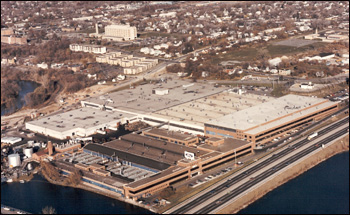
That was on a Wednesday.  The following Monday I was at the gate of the Grove Street plant of the Ford Motor Company in Ypsilanti, the next town over from Ann Arbor.[3]  Ford’s need for assembly line workers was immediate.  I took a physical in the morning, and received an offer.  I went home and wrote the girlfriend.

This is the hang-up: Ford will probably want me to work the second shift, which is 4:30 pm to 12:30 am.  But it would phht! my recreational and social plans, let along virtually cut me off from my family.  So for once my parents were rational and indicated that the idea didn’t send them into paroxysms of joy.  Job-hunting isn’t as difficult as I feared.  For one thing all the auto plants are hiring right now, because people are going off for summer vacation, and the auto makers expect the business to hold up well all summer.

It all sounds so like science fiction now, with manufacturing jobs as scarce as hen’s teeth.  Yet in those times it was true.

It turned out Ford wanted me to work a shift that started at 7:00 a.m., not 4:30 p.m. as feared, so I took the job the next day.

That Friday, I wrote S., my girlfriend:

My wild summer plans have come to nought so far: my job eats up all my time.  Tomorrow, for example, is a Saturday: Ford Motor Company, however, needs 165,000 shock absorbers pronto, 1/16th of which, approximately, pass through my hands.  So tomorrow I work from 5:00 a.m. to 1:30 p.m.  Time-and-a-half the whole time, so it comes to forty dollars for one day.  Not bad for a day’s work.  But it’s hard,… very hard.

I described having seen a performance of She Stoops to Conquer one evening, but feeling out-of-place amongst the cultured audience.

My hands … are getting covered with dirt that is too deep to get out with mere soap.  I am beginning to feel like an hourly laborer… [Last night] I … found myself telling myself once or twice “You’re an auto worker from over at the Ypsi Ford Plant.”  Not a student… An auto worker at General Parts.

And this, mind you, was after only four days on the job.  I described it this way:

[It’s] so simple it took me about ten minutes to learn it: Take a washer, slap it down on the block, reach down to the conveyor belt simultaneously and pick up a shock absorber (weighs anywhere from ten to twenty-five lbs.), slap the absorber on the block, pick up mallet and pound the washer onto the shock screw, put the shock back on the belt, facing the other way, and start again.  I am one of four people doing this job.  I’ve got to know one of [the others] a little bit.  He has been doing this same wretched job for seven years, and he still doesn’t have enough seniority to work one of the four hydraulic machines up the line.  What kind of a future is that?  Yet most of the thousands of automaton-men who work in the same room with me are spending their lives doing something quite similar.  And most of them are quite happy to be doing it.

I topped off the letter by describing my night on the town after this day “down the works.”  I went to a coffee house and saw no less a personage than the legendary Sun Ra, but I wasn’t ready for his kind of jazz, which at the time I dismissed as “pure noise.”[4]  Then I went to another coffee house, where a folkie soloist was playing guitar and singing, and saw a couple of guys from my old high school trying to pick up a pair of lost-looking teeny-boppers and failing.  So much for high times!

Then, during my second week, my job got harder.

Today I was elevated to operation of a steam-powered dingus known, I think, as a bushing ram.  Never mind the specifics: it is hell on earth.  I have to perform an incredible number of operations with sticky and uncooperative equipment at the rate of about five times a minute or more.  Furthermore, if I don’t complete them, I can screw up … a quarter of the shock operations in the plant.  Three times today I inadvertently shut the whole line down!  And it looks as if I’m going to be doing this awful job for ten hours both tomorrow and Thursday!… You should have seen me swearing and cursing, while I was fighting that monster.  Nobody seemed to do anything except criticize, except at one point at which I was getting a bit faint … and this guy I didn’t even like much came up and relieved me for a bit…. Whatever else he does, he’s my friend now.  I always thought it looked pretty vulgar, all those workers chewing gum.  I found out why today: your mouth gets incredibly dry.

Making the Best of Doomed

Clearly, this match of job and employee was doomed.  The qualities that made for a successful auto worker had passed me by.  Worse, I had yet to acquire basic skills even for holding down a job; my mom came home one day in the third week and found that I had not reported to work as scheduled, nor had I called in sick.  The truth was, I was exhausted, and did not know how to deal with it.

I had gone to the shop steward and complained about the overtime, saying I had agreed to work on regular shifts, not the OT.  To my outrage, I had met no sympathy.  I asked my Congressman if the employer could force me to work more than 40 hours a week, and was crestfallen when I found out it could.  I may have had a fair amount of book-learning by that point, but I didn’t understand the basics of assembly-line industrial relations, like the fact that allowing each worker to pick and choose hours would precipitate chaos, and the fact that almost everyone on that line welcomed the extra hours and the extra pay.  If I was going to be a revolutionary, I would have to do it without followers.  When I realized this, absenteeism and sullen silence had proved my only recourse, and my only response.

I have written elsewhere in this blog some disparaging things about Ford and the old Detroit auto industry; I take back nothing, but would be less than honest if I failed to add that I brought plenty of my own failings to that brief relationship – and it’s me I’m writing about here and now.  If I had come to that workplace a more mature person, I still don’t know if my body or my mind would have stood up to the challenges of the job for much longer than they did,[5] but at least I would have handled myself better.

As it was, my mom and stepdad had an out to offer me, and I took it most gratefully.  After years of trying to find a way to move to a better house, they finally closed the deal on a much nicer home in the Burns Park neighborhood of Ann Arbor.  This move was obviously going to be a huge project, and they actually did need me to stay home and help them do it.  There was no make-work about it.  I guess they must have picked up the cost of the car insurance at some point.[6]

I believe I worked another three weeks, and I listened to all my parents and did give the proper notice before quitting.  I was now freer, if not absolutely free, to try to have something like the kind of summer I had been hoping for.

Things Look Up A Little

Right out of the gate, I was able to host S., my girlfriend, over the July 4 weekend.  I had been conjuring up images of her and feasting on the frequent letters she sent as a way of coping with the rigors of the shop floor.  Longing was not as good as having, but it gave me some kind of motivation.  The song that had kept going through my head while I thought of her was Neil Diamond’s Sweet Caroline, which came out toward the end of June.  “Sweet Caroline” sort of scanned along with S.’s name.  It kept me going.  When Sweet S. actually came, it was a wonderful visit.

Then too, I was able to be of substantial help to my parents in a grown-up way.  I was pretty certain (not to mention determined) that this would be my last summer at home.  With a car, and, frankly, more mechanical skills than either of them possessed, I would give them something real to earn their respect and my exit visa.  My memory is full of things like hauling boxes of books, digging post holes and pouring concrete for clotheslines, buying a lawnmower and cutting grass, helping assemble and stock bookshelves.  My new wheels enabled me to go to the hardware store, and run out for carryout on those nights before the kitchen was assembled.  Once there was a kitchen, I did some cooking.  In short, I functioned as mostly an adult.

But that was it in terms of accomplishments.  I wrote my freshman-year roommate that “I’ve been making shockingly bad use of my time, getting no writing done and very little reading read.”  But even that admission was only in terms of my formal business of being a student.  In terms of the largely inchoate, unspoken agenda I have hinted at, I truly made little progress.

Trying to Touch the Zeitgeist

The only way to describe that agenda is to remember what the world promised young people my age at that moment.  There was an exciting, authentic, fulfilled way to live, so the media told us.  We could hang out at the beach and party all summer long, as the Beach Boys promised.  We could dress up fabulously, so we heard from Carnaby Street.  We could bring peace to the world and stop the War.  We could have constant sex and touch the infinite: just ask Jim Morrison.  I wanted to be part of all of that.

I may have managed a little bit of the beach thing.  I got away to Silver Lake with friends for an afternoon or two.  I vividly remember Crystal Blue Persuasion playing on someone’s transistor radio, which to my mind is the absolutely perfect beach song.  Yes, when you look at the lyrics and examine the history, you find it’s a song about God’s beneficence from a Christian viewpoint, but beaches and the relaxation one experiences there are indeed God’s gift (at least if you happen to believe in a beneficent God as I did), so there’s nothing really inconsistent there.  The biblical imagery is quite dispensable.  The echo-chambered guitar riff[7] and the throbbing Hammond organ are not.

I missed out on the great Ann Arbor riots, which were sort of about the War and everything else that might have been on students’ minds, and which went down less than a mile from my house.  I caught a momentary sight of the turmoil down one street as I was driving home from a hard day at the factory.  I did not stop either to participate or to gawk, and in fact was hardly aware of them.  Worse yet, I missed out on Woodstock.

And the closest I came to the free love and infinitude part was hanging out with my friend Walter and his roommates in an apartment, watching the Moon Landing, while Walter’s randy girlfriend made jokes about transorbital insertions.[8]

Partly my being in the wrong place at the wrong time was just a quick lesson in the reality of what it’s like to experience a Zeitgeist: there may not be that much of a there there.  (People I’ve talked to who were at Woodstock, for example, report feeling that they were in the wrong place to see or experience things properly.)  But part of it was just my karma; I was not destined for that kind of summer cool.  1969 was as close as I would come.  The adulthood I was rapidly reaching would have its own thrills.  But not that kind.

Echt Southern Michigan, Ex-Southern Michigan

The song that summarizes the summer for me is What Does It Take (To Win Your Love For Me)? as performed by Jr. Walker & the All Stars, which was a great hit during that stretch.  It is echt southern Michigan, gutbucket soul by a tenor saxophonist from Battle Creek playing on a Detroit label.  It is infused with longing, perhaps one of the longingest songs ever recorded.  It is harmonious to a fault; if you only know the song from that recording, I challenge you to hum it.  You really can’t, and not just because of the baroque sax break line, but because of the two human voices you hear singing at places, in thirds, there is no lead.  (When co-composer Johnny Bristol performed this in 1990 in Bristol, the harmony from an unbilled accompanist is, if anything, even tighter and more inscrutable.  Do not, on any account, miss, however, Walker’s 1985 performance of the song on David Letterman, where he sings without vocal accompaniment; the melody is utterly clear there, for my money much stronger, and the playing is simply out of this world.)  That song exactly chimed with my mood through much of that summer.  I was lovesick, and bored, and frustrated with my family, and excited about growing up and having a car.  And this is the song.

On Sunday, August 24, I got up at 5:00 a.m., got dressed, ate the breakfast my mom made, packed up the car, went with my mom to church (there turned out not to be a Mass at the anticipated hour), drove her home, and, by 6:45 a.m., motored away.  Ahead lay a house where S. and I could live together, along with friends, and the college life I had been building for myself.  Behind lay everything I had ever known.

When I came back next, I would be a visitor.  I would never live in Michigan again.[9]

___________________________________

[1]   Bought from a UN colleague of my stepmom’s, a Mr. Shezad Sadiq.  It was a car that had already been around the block, so to speak; it bore a Kansas City dealer’s markings, and I don’t think people with names and accents like Mr. Sadiq’s spent much time in Kansas City in those days.   General Motors had discontinued my model in 1965.  Putting these clues together, I conclude I had to be at least the third owner.  Source for the photo: http://wikicars.org/en/Image:1962_Chevrolet_II.jpg.

[2]  Not entirely voluntary on either of our parts.  I believe the girlfriend’s parents had extracted a promise from her that she would date around during the summer, and so of course it was only fair that I do so.  And, to go on being fair, I think I kind of wanted it; the record is somewhat ambiguous on that score, and my memory is a little hazy as well.  And rather than being evasive with each other about what we were up to as sensible kids would have done, we were fairly explicit, which was calculated to inflict jealousy and depression upon each other.  Since we had already been bandying about the “m word,” I think we regarded this freedom to seek the embrace of others as sort of a test to see if we were really serious about making a lifelong commitment.  But of course if you’re confiding in each other, you’re not really letting go enough to test separateness, and you’re also not engaging in the kind of confidentiality with anyone else that might give a relationship with that other person a fair shake.

[3]   Source for photo: http://www.ypsilantihistoricalsociety.org/history/page999995.html.

[4]   And to be honest, I still feel that way about much of Sun Ra’s music.  Check out the clips Amazon sets out on this 1971 album, and see if you don’t agree.

[5]   One legacy of that job is my perpetual respect for assembly line workers, especially the ones who make heavy machinery.  What they do is amazing, and any white collar condescension based simply on what they do is, to be polite about it, misinformed.  I continue to take a dim view of the ubiquitous foul language and some of the other things I saw; these are not all misplaced noblemen who, in Gilbert and Sullivan’s words, have gone wrong.  But the work itself, and the fortitude required to make it happen, merit only admiration.

[6]   At least, with my help.  I have a very unhappy letter from my father, urging me to stay on the job, and lamenting what it will cost him if I don’t.  Apparently I had also been ungrateful about my stepmom’s loan of the license plates.  Clearly this was not my finest moment.  But I know I sent some money which I earned.

[7]   Sampled, to my delight, by De|Phazz in their song Sabbatical (2001).

[8]   If you don’t remember the catchphrase, which you could hear on newscasts at the time, here’s a technical explanation.  Of course the girlfriend had a rather different kind of insertion in mind.

[9]  Well, the declaration that I never lived in Michigan again makes for a good ending, anyway.  A few weeks after writing it, however, I came across clear evidence that I was back in Michigan from the beginning of July to early September of 1970, taking a History course (on the British Empire) at the University of Michigan and helping my folks in some of the ways attributed above to the summer of 1969.  It certainly goes to show how unreliable memory is.  I guess you could argue that if it made so small an impression, it stands as proof that I had mentally checked out at the end of the summer of 1969, and hence that there was some “poetic” accuracy to my statements that I was no longer living at home thereafter.  But I’m not a poet.  So all I can say is I was wrong.

Copyright (c) Jack L. B. Gohn, except for images

Theme Songs Page | Previous Theme Song | Next Theme Song

Of Love and Caffeine

Theme Songs Page | Previous Theme Song | Next Theme Song

Of Love and Caffeine

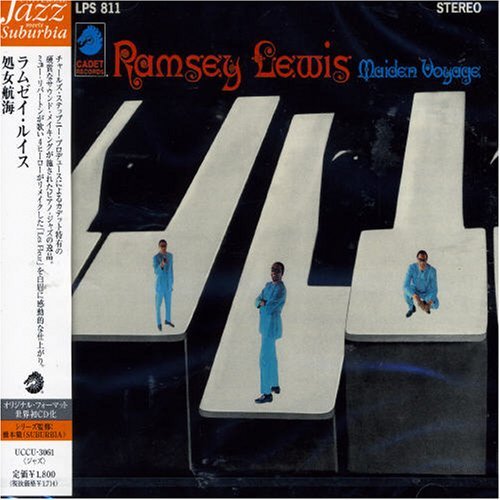
Maiden Voyage, by Herbie Hancock, performed by Ramsey Lewis (1968), encountered 1968

Buy it here | See it here | Sheet music here

In late September 1968, I was writing home from college to my mom and stepdad about the breadth of the things I was studying.  In Philosophy, people like Russell, Ayer, and Wittgenstein.[1] In Psychology, all about ganglia, and stimuli and responses (I wasn’t wild about the way this approach made us all resemble machines).[2] In one English course, Beowulf, Gawaine and Mallory in translation.[3] In another, Chaucer’s Canterbury Tales in the original, which I acknowledged to them was “one of the greatest books in the world.”

This was the relatively safe discussion to have with my parents. I knew that at least the literary part of my news would please my folks, as English literature was still my stepdad’s field, and had once been my mom’s.[4]

There were two other discussions I could have had with them that weren’t so safe.  One I did have, one I didn’t, or not then.

The one I had, though with some difficulty, was about my new girlfriend.  Naturally, there was some reticence about that, and in any event words were lacking.  For all that poets and pornographers and everyone in between have tried their best to describe it, there is something about the sweetness of a first serious love affair that exceeds and eludes description.  It was all-absorbing, though.  More prosaically, and more to the point here, my girlfriend S. and I were “seeing each other almost just about every day,” as I wrote my friend Walter.

Overload

Tough as it might have been to put words to it, no doubt my parents were ready for that.  I was of the age where that sort of thing was to be expected.[5] What I didn’t feel I could write about at all was something that should have been and maybe was obvious, which was the way that my theater commitment combined with my budding love life and my studies to overwhelm me.  And as September turned into October, the theater part became the most overwhelming part of all.

I have already written that I had been given a one-acter to direct.  I was learning, as had generations of student thespians before me, that as you get closer to that first performance, the available study time approaches the vanishing point.  For the duration, I wasn’t studying, I was directing.[6] My little play came off the weekend of October 17.   My postmortem to my friend Walter: “The play went over, at least in a small way.  It suffers from almost total incomprehensibility, which mars its audience appeal.”[7]

But then I added these grim and true words: “[T]he play … took all my time, and I’m now two weeks behind in everything, with bleak prospects for the grades if I don’t shape up fast.”

I was clearly in overload.  I had so much to process (throw in the disastrous Nixon election along with everything else) that by the end I had failed to communicate with my mom and stepdad for about three weeks, which provoked the predictable unhappiness.

Subterranean

So where do you go to catch up and sort out, if it’s the fall of 1968, and you’re a student at Penn, and you live in an overcrowded apartment with inadequate study space and your girlfriend is living in a dorm from which men are rigorously excluded overnight?  But of course: the underground study hall in the Men’s Dorms!

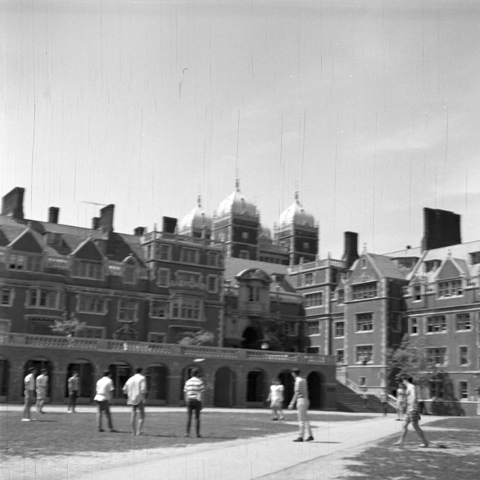
Here’s a photo I took of the exterior in the spring of 1968.  This looks from the Lower Quad toward the Upper.  And the sort of arcade[8] behind the young men at play is the outside of what was in those days a kind of lounge.  The lounge itself was very important.  Pretty much no one had his own TV, and that was where you could go if, for example, you wanted to stay current with Star Trek in the company of several dozen friends.  (The real Star Trek, that is, with William Shatner and Leonard Nimoy as smooth, slim young men,[9] women in miniskirts, and cheesy sets that cost $1.95 to build.)  I watched the 1968 election returns there too.  But what I’m speaking of now is the room beneath that lounge.

Talk about your basic study hall!  This was a glorified corridor walled with cinder block and illuminated day and night with fluorescent lighting running the length of the lounge above, and probably of equal width with that lounge.  In my memory, carrels are lined up three or four abreast the length of the room, like airline seating for the intellectually dogged.  There was a more sociable study hall at the library, known informally as the Rosengarten Mixer, and not without cause.  But that was for study as a social event, and in any case it kept library hours and was useless for that serious late-night swotting  There was a far more plushly-furnished study hall in one of the picturesque dorm turrets nearby (visible in the middle of the photo above), but that, as I promptly discovered the wrong way, was for stretching out on something soft and falling asleep when you should be staying up and cramming some more.

A lot like this …

Because, yes, endurance was the name of the game.  And this anonymous study area, basic though it was, had one amenity critical to endurance: a coffee vending machine from the Macke Vending Company.[10] Incredibly basic: Coffee black or with heavy or light cream, with or without sugar, plus hot chocolate.  No cappuccino.  (If you’d mentioned cappuccino to me in 1968, I’d have stared blankly.)  An incredibly basic machine with the Macke Vending label.  Yet it was the fons et origo of great things. How to sing its praises?

I’d been around coffee all my life, but for whatever reason I’d never had much interest in it before.  I’m not one much for drugs.  Lifetime tobacco score: one cigarette, one cigar.  Moderate drinker.  Marijuana experimentation only a few times and long, long ago.[11] But coffee was my addiction waiting to happen, and here’s where it did.

In a sense, it parallels the love affair with drugs every other addict describes.  Ecstasy those first few times, diminishing returns of bliss thereafter, lifelong servitude nevertheless.

Ecstasy

But this was my first, mad moment of infatuation.  I’d wander down to that stark subterranean corridor, park my books on a carrel, and stride back the way I came in lordly fashion, back up to the Macke machine.  I’d put in a quarter (I think that was the going rate), and out would come – well, I have a feeling that today I’d find it bland and unsatisfying at best, undrinkable at worst.  But to me then, it was a bolt of lightning that would infuse me with a raised pulse, a sense of ecstasy, and the certain knowledge that I would be equal to the rigors of the night ahead.  (All right, sometimes I had a chaser of No-Doz, but who’s counting?)

And this, I think, is the point to explain my choice of Ramsey Lewis’ version of Maiden Voyage as the Theme Song for this memory.  I heard it courtesy of my girlfriend.  The theorem I posited earlier, that in college records get shared, of course applied, nay, applied to the nth degree, with boyfriends and girlfriends.  In the course of getting to know everything about each other, my new love and I ransacked each other’s LPs.  And a gem of hers I found at around this stage was her copy of Ramsey Lewis’s album Maiden Voyage.  The title song, a gentle reworking of Herbie Hancock’s 1965 masterpiece, was my ear’s full opening to the evocativeness of modal jazz.

Lewis, a consummate, powerful pianist, had all the jazz licks but he was a popularizer, not for the most part a composer like Hancock.  He was as apt to raid the pop charts for inspiration as the charts written by real jazz composers.  For instance, he’d had a Number 5 hit on the pop charts with a 1965 cover of The “In” Crowd, which Dobie Gray had made an R&B hit earlier that same year.[12] But in Maiden Voyage, he’d found the perfect material.  If you don’t know the song, click on the link in the preceding paragraph for Hancock’s original version.  It’s lyrical, yes, but it’s also got that hard ascetic bop edge.  Then compare it to Lewis’ version.  It’s close, but it has the lyricism amped up and the bop edge softened down.

Let me wax technical for a moment en route back to my point.  Lewis has taken his basic trio (Cleveland Eaton on bass, Maurice White – yes, later the Earth, Wind & Fire Maurice White – on drums), and embedded it in heavy but powerful Charles Stepney string and chorus arrangements, with Minnie Riperton (uncredited)[13] keening in the background.  This combination gives the feeling of new, unexplored horizons, a feeling that the song itself was cunningly written to evoke.  Why cunningly?  Well, when you listen to it in either version, you’re apt to wonder how Hancock/Lewis can wander through so many keys.  Every key change sounds as if it’s taking you somewhere new.  Actually, though the composition is modal and so not wedded to any key, it sticks to only four chords. Like the effect I wrote about earlier in Brian Wilson’s California Girls, it spins you around and lands you right back in the key you started with while making you feel you’ve gone somewhere else.  But you, the listener, are not going to know that, unless you have keener ears than mine, are blessed with perfect pitch, or have cheated by looking at the sheet music.  The secret, I think, is in the complexity of the chords; you can go anywhere with them and it still sounds like a maiden voyage rather than plying a trade route.

Well, seriously, can you think of better music for studying while high on caffeine?  You want to feel that you have transcended time and space, and that your reading and your writing is taking you somewhere new and exciting.  I can assure you that Ramsey Lewis’ expansive sound was very much in my head on those long, long nights, and helped me get through them, as did thoughts of my new lover, the bringer of good things who had blessed me with this celestial melody.  And, of course, I was also helped by desperation about my grades.

Marathon Man

So the marathons began.  On 16 November I report to my friend Walter that “I pulled four all-nighters in the last two weeks … I’m pulling a D in French at the moment.  The amount of reading I have to digest is enormous… I just wish I had thirty-six hours a day.”  On 5 December I write Walter: “The play did such damage to my studies that it has literally taken until the very end of classes to catch up.”  On 20 December, I report to my father: “I am now in the last and longest (36 hours) of my enforced waking periods of the semester… [I] studied nine and a half hours straight [today].”  That’s an awful lot of Macke coffee and Ramsey Lewis.  And mind you, I was not trailing clouds of glory through this whole ordeal.  To the contrary, I recall nights of sheer physical torment trying to stay awake and mentally absorbent as strange and challenging new information fought to enter my head.  Being at my carrel all night also did not mean that I might not pass out with my head in my hands, only to wake between ten minutes and an hour later with pins and needles in my arms, or a crick in my neck, or some other little indignity.

But it worked.  I failed nothing, escaped with only one D (as described in the notes below), and pivoted to a regimen of studies that led to a cum laude overall plus honors in my major.

There were two other effects, each of which was undoubtedly foundational to my subsequent success with the GPA.

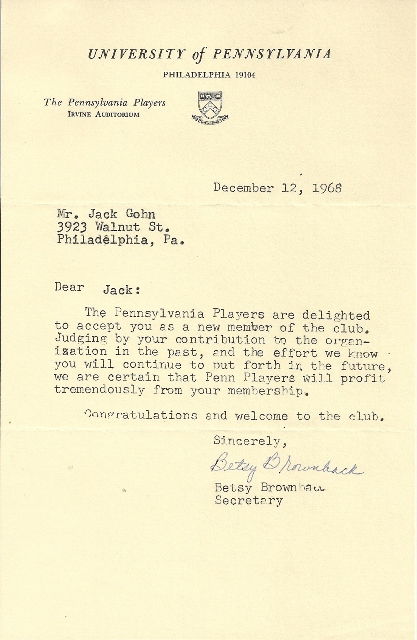
One had to do with Penn Players.  I wrote earlier that at around this point I ended my involvement with them.  In fact it was a little more dramatic, in a quiet way.  On December 9, in the midst of this torrent of studies, I walked into the Penn Players offices, after a class had been canceled and I had a little bit of time on my hands.  Someone congratulated me.  I asked why, and was told that I had just been admitted to the Club.  As I wrote my parents the next day, “I was a little astonished, inasmuch as I was not in the formal heeling program, and had not done the things you have to do to get into the Club, like selling tickets and painting sets… So apparently they’ve changed the rules – I don’t know.”  Weighing whether to accept, I considered whether I wanted to commit to the minimum 30 hours a semester, and whether it was worth it just to have a say about those who would have a say in choosing the Artistic Director (the very same professor who was giving me the D) (see Note 2 below).  But I knew ousting him wasn’t likely.  For that reason, and others, my conclusion, with regard to this unexpected and unsought honor: “I have bigger fish to fry.”  This was not meant to insult the organization; it was merely an assessment of where my priorities now lay.

The other effect of all this study was profound.  Force-feeding does fatten the goose, after all.  I was beginning to think of myself as a man who’d read Chaucer and Spenser and Milton and Corneille and Sartre.  It was hundreds of pages, to be sure.  But, as I wrote my parents (for now I could share the whole situation with them) “Most of the stuff has been of some genuine value.  In fact I discovered that, for the first time in my life, I was fighting to cope with a tide of reading that was … really significant and relevant to me.”

A Little Learned

The aha! moment came when I was consulting C.S. Lewis’ most important critical work, The Allegory of Love.  I’d been a fan of Lewis’ fictions and his Christian apologetics all my life.  But this was professional literary criticism.  In September, that book would have been utterly incomprehensible to me; by December, I had the tools to read and understand it.  As I wrote my parents, “For the first time in my life, I’ve really felt a little learned, as opposed to just well informed.”

Thanks in good measure to Herbie Hancock and Ramsey Lewis and Minnie Riperton and Macke Vending, the die was cast.  I was going to be an intellectual, and not just an aesthete.


[1] With Professor James Francis Ross.  I find I have absolutely no recollection of the man or his lectures, notwithstanding that I considered them “excellent” in the passage quoted above.  I vaguely remember the textbooks and the experience of reading these philosophers, though I believe I also covered them with another professor, so it all gets confused.

[2] With Professor Henry Gleitman, still, incredibly, as of 2011, associated with the Psychology Department at Penn.  He was already the Chair when I took that course 43 years earlier.  I ended up earning my only post grade-school D in this course, a grade which to this day I don’t think I deserved.  Unlike Professor Ross, Gleitman sticks in my memory, not only because of his lectures, which may have been dry but engaging, but also because he and his wife were a big deal with the Penn Players.  He was directing a mainstage play when I was helming my little one-acter.  In fact, I have an exchange of correspondence between us over his annoyance that I had moved a rehearsal of my little play two hours earlier, which rendered it impossible for him to see a rehearsal.  Apparently he held some kind of supervisory function with Penn Players, and I was frustrating his oversight.  I wonder if my D was an unconscious consequence of his annoyance?  Or to put it in his terms, if his ganglia had been stimulated by our little contretemps, and this was in some way his response?

[3] With Professor Edward B. Irving, Jr., memorialized toward the bottom of the column of obituaries here.  He was quite important in my undergraduate education, because of his involvement with the English Honors Program, which I shortly thereafter entered.  I think I eventually read Beowulf in the original with him, at least I studied it at length with him.  Somewhere I have my ms. translation of the entire poem, and if that contains clues as to the dates, showing whether the translation was done in undergraduate or graduate classes, perhaps I can update this endnote.

[4] At this point, my mother was teaching German at the college level.  But she was ABD in English from the Johns Hopkins University – a subject to which I’ll return later.

[5] There were massive complications because I was Catholic and my girlfriend Jewish.  The roots and branches of that will be dealt with elsewhere, but it goes without saying that that factor too complicated greatly the discussions between my mother and me.  Still, discussions did occur.

[6] I recorded that Penn Players kept track of your hours devoted to the cause, and that when I had been the stage manager for a play the preceding year, I’d logged 172 hours.  I’m sure I put in more as a director.  I suppose, though I couldn’t know it at the time, this was good training for the logging of billable hours I’d have to do as a lawyer later on.

[7] Jean-Claude van Itallie’s War (1963), which I had seen produced as a laboratory play at the University of Michigan sometime in the previous couple of years.  I felt then, and continue to feel, that the play is a ritual more than a story.  The summary in Doolee.com, the Playwrights’ Database: “Two actors, one young, one old, and a bizarre lady, engage in a series of fantasy-like improvisations, articulating the relentless war which humankind is doomed to wage against harsh reality and the inexorable passage of time.”

[8] Obviously remodeled in later years.

[9] There’s a photo of the 1968 cast here, if you don’t believe me.

[10] It would appear from this summary that Macke was acquired by Allegany Beverages sometime before 1985, that Allegany was merged into Service America Corp., whose parent, Servam Corp., disappeared into the mists of bankruptcy sometime in the 1990s.  This New York Times piece seems to be about as far forward as I can trace it.  I would have liked to entertain the notion of Macke still catering to young scholars somewhere, but it appears that this is nothing but a wishful fantasy.

[11] And, yes, I say legalize it.

[12] Gray did not actually write the song (the honor goes to Billy Page), but Gray was its first interpreter.

[13] My source for the Riperton attribution is a William G. Stout customer review of the album at Amazon.com.

Note: Source for the coffee vending machine photo here.

Copyright (c) Jack L. B. Gohn, except for commercial images

Theme Songs Page | Previous Theme Song | Next Theme Song

Music in the Dark

Theme Songs Page | Previous Theme Song | Next Theme Song

Music in the Dark

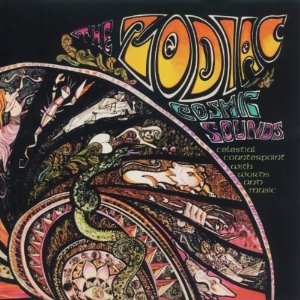
Capricorn: The Uncapricious Climber, by Zodiac (1967), encountered 1968

Buy it here | See it here

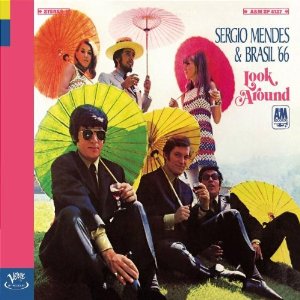
So Many Stars, by Alan and Marilyn Bergman and Sergio Mendes, performed by Sergio Mendes and Brasil ’66, sung by Lani Hall (1968), encountered 1968

Buy it here | See it here | Lyrics here | Sheet music here

Sometimes darkness makes the music more intense, especially music about things you can only see in the dark.  This one is about that experience.

But first a necessary preliminary.  I wrote once earlier on that there were going to be places in these memoirs where I would elect to be silent about things I remember.  Now we reach the principal one.  It was at this point that I met the woman I would marry – and divorce.  This is not her story, and I have too much esteem for her to invade her privacy even to tell my own tale.  I cannot simply give her a pseudonym as I have done with some of the other people I’ve been talking about in these pages; the world knows of our connection, and we have children and grandchildren in common.  Hence I shall call her only S., and tell those parts of my story that involve her in such a way as to leave most aspects of her history and personality respectfully to one side.  This constricts me a little, but there still remains plenty to tell within those boundaries. All you need to know to start with is that we met as fellow-students at the University of Pennsylvania.

Graudensville

A Not Terribly-Clean Rug

That said, I’ll hustle you, gentle reader, past the preliminaries, and dump you on the not terribly clean rug in the front room of an apartment on Walnut Street, in a building that no longer exists.[1] There are four of us either lying on the rug or sitting on the grungy couches: me, S., and my roommates Jim and Elliot.  It is my sophomore year.  We call the apartment house Graudensville in honor of our heavily-accented landlord Mr. Graudens.  Let me say this gently; Mr. Graudens does not run a first-class establishment; this is a student tenement.  The furniture and the rugs come with the apartment, and they look as if they have come with the apartment for a good long time. There are three guys living here in an apartment designed for two.

In my memory, it is daytime but the curtains are drawn (nothing to look at but an airspace between rowhouses anyhow).  The lights are low or out.  Music is playing.

In years to come I shall look up my roomies’ whereabouts on the Web, and find that Jim has become a lawyer in Youngstown, and Elliot a musician and political activist in suburban Philly.  You might think that as a future lawyer with a giant music obsession, I’d really hit it off with each of these guys.  But not so.  We haven’t bunked down together out of any great interest in each other; we were simply cast out of the men’s dorms by the University’s lottery and had to find flatmates quickly.  But being stuck together means it is to our mutual advantage to try to find things to do and enjoy together.  Clearly music is our best bet.

Elliot, the future musician, appropriately has the best equipment.  I myself am the proud owner of an Ampex tape deck by this time (I think another present from my father, who (as recorded in an earlier entry) gave me my core hi-fi components a few years before).[2] Elliot has either a better Ampex or a TEAC, which is coming to be known as the gold standard of reel-to-reel decks at this point.  We hook the two up in series and fell like the kings of audio.

Later no one will be likely quite to grasp the importance of a tape deck.  In this era before ripping of CDs and downloading of tracks from questionable sites, it is the only way to get music for free without actually shoplifting – which means it is the key technology in sharing music.[3] Elliot has a lot of cool stuff on reel-to-reel.  Elliot also has some pretty cool records.

Psychedelia for Straight Kids

We’re listening to someone else’s record at this moment, one that I’m almost certain belongs to Elliot: Cosmic Sounds by Zodiac.  It is a reflection of the time that the cover sleeve could also be read to enclose an album called Zodiac by Cosmic Sounds.  And there’s no reality-based context to settle the matter.  This is an album all about the Zodiac, and there is no real-life group or act called Cosmic Sounds.  So it’s just as plausible either way.

On the front of the cover is a trippy distorted zodiac, so we know this is true psychedelia.  On the back is written in hot pink “Must be played in the dark.”  And so, following the instructions and the ethos of the era, we close the curtains and douse the lights.  This is the time of psychedelia, and we obey.  Perhaps there will be revelations in the dark that light would interfere with.

How to describe the psychedelic years to an audience that was not there?  “Psychedelic,” initially a technical term for a class of recreational drugs, has come to mean as many things as “hip-hop” will later do.  It is a drug style, but also an art style, a music style, a set of social and political views, and two or three fashions in clothing.  It says something about the breadth of the label that of the four of us sprawling attentively in the dark, none of us is on drugs.  No, not even pot.  Yet this is a psychedelic moment for us anyhow.

The record is unique, and perfect of its sort.  I quote the Richie Unterberger reissue liner notes, reproduced in the informative Wikipedia article on the album:

Divided into 12 separate tracks, one for each astrological sign, it appeared just as both psychedelic rock and astrology itself were coming into vogue in the youthful counterculture. In some respects it was similar to other instrumental psychsploitation albums of the time, with a spacy yet tight groove that could have fit into the soundtrack of 1966 Sunset Strip documentaries, played in large measure by seasoned Los Angeles session musicians. In other respects, it was futuristic, embellished by some of the first Moog synthesizer ever heard on a commercial recording, an assortment of exotic percussive instruments, and sitar. The arrangements were further decorated by haunting harpsichord and organ, along with standard mid-1960s Los Angeles rock guitar licks. For those who took the astrology as seriously as the music, there was the dramatic reading of narrator Cyrus Faryar, musing upon aspects of each astrological sign in a rich, deep voice without a hint of irony.

Here, by way of example, is a part of the lowdown on Capricorn: The Uncapricious Climber:

Eight notes scale an octave.  Master the scale and you master the score.  Uncapricious Capricorn captures each note, holding it tight until it surrenders.  The mystery of music can meld into black and white, then dissolve into grey.  Capricorn, convinced, can make grey glisten like white onyx.

I don’t think any of us, in the language of those album cover notes, “took astrology as seriously as the music.”  But the tour of the varied personalities associated with the astrological signs was entertaining, the music was definitely trippy, and there was something cool about lying around as if we were drugged, even if we weren’t.  I think that little snapshot is quite indicative of the way that good middle-class kids of that era made their peace with the ethos of free love and drugs which fueled what was coming to be called the Counterculture.[4] We were all Ivy Leaguers, for heaven’s sake!  Three future lawyers and a musician/politician!  And yet we were all as sober as judges[5] (give or take a few swigs of Mateus),[6] giving a respectful listen to what was meant to be a drug experience-like trip based on a mythos none of us had the least belief in!

It was the fashion of the times.

Straightness for Psychedelic Kids

How firmly we had one foot planted in the world of Woodstock (set to happen in about ten months) and the other in that of our parents can be gleaned from another star-focused song on a different record I also recall us listening to in the dark.  This LP was a contribution from me: Look Around, by Sergio Mendes and Brasil ’66.  Now, despite the candy-colored scheme of the album cover, by the standards of the time, this was square music.

I’ve already written about my infatuation with Brazilian-inflected music, Jobim and the Tamba 4.  That stuff was pure and exotic enough to be cool.  Mendes was a different story, unique in the Brazilian Invasion, having immigrated to New York in 1964, and having started a quartet (a quintet on records) called Brasil ’65, which was really a jazz outfit with a strong Brazilian accent, then replaced it with a pop sextet he called Brasil ’66, in which half the personnel were U.S.-born.  By compromising his Brazilian-ness this way, he could never be exactly cool, but he certainly was popular.[7] Partly it was the great A&M Records covers, which looked almost good enough to eat, partly it was the equally glossy production inside.

Look Around, his third Brasil ’66 album and by far his most pop one to that time, excelled in both departments, and went to Number 5 on the charts.  But the songs were the main thing, including the two big hits from the album, the remake of Bacharach and David’s The Look of Love from the Casino Royale sendup movie[8] and the title song, Look Around.  These are finely-crafted pop-delivery devices, and we all appreciated them.

Steady Forecloses Possibilities

But the song that really got to me was So Many Stars, a lovely collaboration of Mendes with lyricists Marilyn and Alan Bergman,[9] who were probably twenty years older than the people who had put together The Zodiac, and had first broken big writing for Dean Martin and Frank Sinatra about a decade before.  And however swinging Sinatra appears to members of my generation now in posthumous refurbishment, he was suspiciously, well, old to those of us who were teenagers in 1968.  So this piece was right on the edge of what we would all have been comfortable listening to – together, anyway.

So Many Stars spoke to me.  Reflect: I had my first real girlfriend, after having dated a lot – admittedly, I had wanted a real girlfriend for the longest time – but I was comfortable dating, while I had no experience with being anyone’s steady.  So you can imagine the effect of lyrics like these (especially as served up on a lush bed of strings orchestrated by Dave Grusin):

The dawn is filled with dreams[10]
So many dreams which one is mine
One must be right for me
Which dream of all the dreams
When there’s a dream for every star
And there are oh so many stars
So many stars
The wind is filled with songs
So many songs which one is mine
One must be right for me
Which song of all the songs
When there’s a song for every star
And there are oh so many stars, so many stars

I was experiencing elation at having found someone so interesting who did me the great compliment of reacting to me the same way.  But at the same time, I was aware that I was foreclosing other possibilities in a world full of them.  And of course I had the recent history with Carolyn, described in the preceding piece, to just exemplify what I was surrendering.  This song spoke wistfully to those very misgivings.

What To Do About Misgivings

In retrospect, where everything is crystal clear, I can say that I should have paid more attention to those misgivings, that a person feeling that way was not ready to settle down, even to the extent that going steady was settling down, especially at such a young age, and even more especially if the person was afflicted with a Catholic moral seriousness that fails to recognize how often sex should not be cause for commitment.  But what I was telling myself at that stage was that life was full of tradeoffs, and that I’d be experiencing some kind of emotional confusion no matter what “star” I happened to be choosing.  In other words, I was feeding myself the wrong kind of adult wisdom.

I should have listened closer to the music in the dark.


[1]  3923 Walnut Street, an address which no longer exists; I believe the site has been incorporated into larger buildings not once but twice in the intervening years.  If memory serves correctly, the mesne structure sited a movie theater exactly where our house had been.

Ampex!

[2] Here’s a photo of me with the deck a year or two later.

[3] In retrospect, it was a very unsatisfactory one.  You either had to use fairly short tapes, on which one or two stereo albums might fit, or monstrous ones, that would accommodate typically five and a fraction LPs, leaving you with tough calls between economy (tape only part of the sixth album?) or completeness which created its own form of incompleteness (leave part of side two of the tape unoccupied).  The reels were all too bulky, so you were tempted to go with the larger ones, but then you had serious retrieval problems, figuring out where your music was on the reel.  You did have access to a sort of capstan odometer, and you could and if you were serious pretty much had to note down readings for starting and ending albums carefully, or you would condemn yourself to hunting around, starting and stopping over and over again, when you wanted to find anything but the first album on the tape.  Moreover, tape deteriorated with time.  It could stretch, warp, break, or flake.  But in those days, it was the best you had.  And if, as Elliot and I did when we set up our machines next to each other, you had two of them, you could make tapes of tapes, rearrange the sequence of tracks, and do interesting things with the echo effect.  You definitely had something.

[4] Per Wikipedia, the term Counterculture was coined by Theodore Roszak, given currency by his book The Making of a Counter Culture: Reflections on the Technocratic Society and Its Youthful Opposition, which was published right about the time I’m speaking of.

[5] As a lawyer, I’ve often wondered where that expression came from.

[6] Mateus Rose was a staple of college life in that era, at least in the circles in which I ran.  I find it almost undrinkable now.

[7] He’s not necessarily so popular in the second decade of the Twenty-First Century, but he has certainly regained his authenticity, at least periodically, and his cool.  There’s nothing you can say about his album of collaborations with younger musicians from his homeland, Brasileiro (1992), except “Wow!”

[8] James Bond fans know the story.  Casino Royale, the book (1954), didn’t end up in the hands of the Saltzman-Broccoli team which had bought up all the other James Bond movie rights (except for Thunderball, an even more complicated tale).  Casino Royale fell into the hands of Charles K. Feldman, who turned it over to much of the same creative team that had given the world the wonderful and more-than-slightly mad What’s New, Pussycat? (1965)Casino Royale, the 1967 movie, was not so wonderful, but, like Pussycat, boasted music by Burt Bacharach, including the indelible Dusty Springfield performance of The Look of Love, which has subsequently been recorded by every musician under the sun.  Sergio Mendes and Brasil ’66 performed their cover of that song at the 1968 Oscars.

[9] The Wikipedia pieces on Marilyn and Alan Bergman are helpful in getting a sense of their world, but a better evocation of their definitely pre-60s ethos (notwithstanding their continued, if not greater commercial success after the 60s) can be gleaned from this 2007 Terri Gross interview.

[10] Yes I know many of the published versions of the lyrics show the line as “The dark is filled with dreams” (which would actually fit better with the theme of this piece).  But my ears are not crazy; Lani Hall sang “dawn” on this album, as did Natalie Cole or Sara Vaughn in their respective versions of the song.  And the sheet music referenced above confirms what I hear.

Copyright (c) Jack L. B. Gohn

Theme Songs Page | Previous Theme Song | Next Theme Song

… Or The Kid Dies: The NCAA’s Little First Amendment Problem

The Big Picture Home Page | Previous Big Picture Column | Next Big Picture Column

… Or The Kid Dies: The NCAA’s Little First Amendment Problem

A shorter version of this column was published in the Maryland Daily Record August 1, 2011

My eyebrows rose in amazement as I read a message direct from Elizabeth Heinrich, Interim Chief of Compliance at the University of Michigan Athletic Department, to my law partner Mark, warning him of ten things he must not do.[1]  Mind you, Mark’s only Wolverine connection is that some years back he graduated from the Michigan Law School.  He is not a current student, staff or faculty member.  He is not a member of any athletic booster association.  In short, he is not someone you’d think Ms. Heinrich would assume she could boss around.

No Precatory Niceties

Yet the communication brushes aside any precatory niceties.  Mark is informed that: “You MAY NOT make recruiting contacts with prospects, their relatives or legal guardians.”  He is told: “You MAY NOT contact a prospect’s coach, principal, or counselor in an attempt to evaluate the prospect.”  Even when he’s allowed to do things, Ms. Heinrich would place curbs, as in: “You MAY attend high school or junior college competitions provided no contact occurs with the prospect or the prospect’s relatives.”  Well, it’s no doubt a relief to know that Mark may attend high school sporting events, though it may be a source of anxiety to him to know that the arena may teem with people he is forbidden to address.

At this point, you may be asking, as I did: Who the heck is Ms. Heinrich and what gives her the idea she can tell Mark what to say and whom to greet?[2]  Well, I can tell you one thing she clearly is, and that is, for First Amendment purposes, a state actor.[3]  Now I dare say that even Ms. Heinrich, even with all the authority of the State of Michigan behind her, would recognize that she does not actually have the legal power to regulate these things.  But she does issue a threat that may effectively substitute for that power: “Any infraction will jeopardize a prospect or student-athletes [sic] opportunity to attend and compete for UM no matter how minor it may seem.”

Of course, it’s not the State of Michigan itself establishing the threat, but rather the National Collegiate Athletic Association.  “The NCAA has strictly limited the role you, as a Michigan Fan, may take with regard to prospects and student-athletes.”  In other words, if Mark exercises his free-speech rights and tells a high schooler he/she should think about Ann Arbor, it’s not the state action of the University of Michigan penalizing the poor kid, but the NCAA.  And, at least in some decisions, the NCAA has been held not to be a state actor.[4]

No Calling The Cops

So the chill on Mark’s free speech works a bit like the scene we’ve all seen in the movies: the bad guy holds a gun to some terrified child’s head and says to a parent: “Keep your mouth shut or the kid dies.”  It makes the parent think twice about exercising free speech rights to call the cops.  The only variation here is that here the state actor issuing the warning isn’t the one holding the kid: the (supposedly private) NCAA is holding the kid.

The question, then, is whether the NCAA can chill Mark’s free speech by occasioning a threat by Michigan, a state actor, that it won’t field any student athlete Mark addresses.

The NCAA certainly thinks so.  Read NCAA Rule 13.02.14,[5] which dubs as a “representative of the institution’s athletics interests” [sic], among many other people, “an individual … who is known (or who should have been known) by a member of the institution’s … athletics administration to … have been involved … in promoting the institution’s athletics program.”  Ms. Heinrich is without doubt “a member of the institution’s athletic administration.”  And if you assume, as Ms. Heinrich does, and probably correctly, that most alums would do Michigan’s athletics program a good turn if they could, you probably reach the same conclusion she did, namely that she knows or should know that Mark is, unbeknownst to himself, a “representative of the institution’s athletics interests.”  And the prohibitions listed above have their roots in NCAA prohibitions that extend to all “representatives.”  So, yes, it looks as if the NCAA thinks it can chill Mark’s speech by occasioning Ms. Heinrich’s threats against athletes he’d like to talk to.

No Shutting Down Political Debate

So, is the NCAA right?  There’s not much law on the subject.  The closest cases seem to be Crue v. Aiken (7th Cir. 2004), and the lower court opinion affirmed there.[6]  But they’re not on all fours.  The would-be free speakers in Crue opposed the University of Illinois’ use of a generic Native American figure, Chief Illiniwek, as the school’s mascot.  They tried to embarrass Illinois by announcing plans to contact high school prospects, warning them about the mascot, and implicitly suggesting they might want not to be associated with a school that employed it.  The university chancellor pulled an Elizabeth Heinrich and sent an e-mail to all faculty, staff and students warning that “No contacts are permitted with prospective student athletes … without express authorization of the Director of Athletics or his designee.”  Again, NCAA rules were cited in justification.  The inevitable lawsuit pointed out the little First Amendment problem the e-mail had created.

The courts had no problem concluding that when Illinois tried to gag these communications, it was a state actor, and the gag order was unconstitutional.  And this was a painfully obvious penalty whistle.  There’s not much room for interpretation when a state school tries to shut down a political protest (the very thing the First Amendment most protects), irrespective of NCAA rules.

But what if the students had actually planned, on their own and without involvement of the “athletics administration,” to contact the same prospects to sell them on the joys of Champaign-Urbana?  We don’t have a First Amendment-based ruling yet covering that situation.

No Getting Past State Power

I’d assume that in such a case, the university and the NCAA would argue that these restrictions are required to preserve the amateur ideal, that if freelance boosters get into the act, students will start receiving who knows what solicitations, and unreported remuneration.[7]  I’d agree that there could be real challenges to amateurism if free speech reigned.  But are state actors allowed to favor only speech conducive to amateurism in the first place?  Does not commercialism, both advocacy therefor and speech which embodies it, have equal speech rights with amateurism and professionalism, whichever the state might prefer as a matter of policy?  Bates v. Arizona State Bar, anyone?[8]  The Supreme Court has recently supported free speech even over reasonable economic regulation and over efforts to keep politicians from being beholden to corporations. So I’d bet on the speakers every time.  I’d even bet on Mark if he sued to force Michigan to grant varsity status to students he’d awarded athletic scholarships through a freelance program of his own creation, notwithstanding some kind of private status for the NCAA.

And here’s why: The NCAA has no power separate from what its constituent schools endow it with.  When the NCAA tells the state not to suit up a young athlete, the NCAA is doing no more than exercising the state’s power delegated to it in the first place. If the University of Michigan, a state actor, has delegated to the NCAA the power to determine whether or not it should favor amateurism, surely the NCAA is, at least for that purpose, exercising the University’s power.  Call the NCAA private if you want, but recognize that it has no power over Michigan which Michigan did not give it, and as such, is exercising Michigan’s borrowed state power for at least that purpose.  If, then, the University does the NCAA’s bidding informed by that choice, and excludes a young athlete simply because Mark solicited him or paid him openly or secretly, that exclusion is state action, irrespective of the NCAA’s supposedly private status.  And, as I have just pointed out, enforcing a choice in favor of amateurism by forcing student athletes to abjure professionalism in order to enjoy the privilege of competing on a state-sponsored team probably would be held to violate the First Amendment.  At least it would if this were a principled, consistent, and predictable Supreme Court.  (But that’s a different column.)

No Tears For Amateurism

Anyhow, there are few things more inimical to First Amendment commercial freedom than NCAA “amateurism.”  And while I recognize that something would be lost if “amateurism” were dispatched by the courts, I think the world of college athletics would be better on balance  without it.  “Amateurism” destroys the market power of students to capitalize on what may well be their greatest assets, and all it provides, at least in immediate return, is a college education and some farm league experience, the fair market value of which may be vastly less than what the college receives in the bargain.[9]  College sports are often big business for the colleges – but never for the students who play by the rules.  Why should they be left out?  And why should Mark?


[1].  News coverage of the message here.

[2].  If the question were why she was doing it, the answer would be simple enough: Michigan is seeking to clean up its act after some widely publicized violations of NCAA rules.  See, e.g. here and here concerning recent problems with the football team that led to the removal of its head coach, and, herefor earlier scandals that cost the head basketball coach his job.

[3].  In National Collegiate Athletic Assn. v. Tarkanian (1988), the Supreme Court held the NCAA itself not to be a state actor, though that case may have been distinguished out of practical existence in Brentwood Academy v. Tennessee Secondary School Athletic Ass’n (2000), which held an NCAA equivalent for state high schools was a state actor.  The central rationale for the distinction, that there was one state sovereignty behind most of the high schools in the state association as opposed to the plethora of state sovereignties behind the NCAA, does not seem tenable, in that all of the state sovereignties are just that, state sovereignties, and the fact that there is more than one of them merely means that there are several state actors collaborating.  I predict that if that part of the Tarkanian holding is ever revisited, it will be overruled.  In any case, it is one thing for a private actor to chill the exercise of free speech, another thing for a state university, which is clearly a state actor, to do so, even in response to the dictates of a private actor.  That it is a state actor was an assumption that was so obvious as to require no explanation in Crue v. Aiken, the Illinois case discussed below.

[4].  See previous note.

[5].  For some reason the NCAA puts its “Legislation” on the web, but it is hard to find.  Getting access to the NCAA’s Legislative Services Database (without first applying for a password and necessarily identifying yourself as a student, faculty, member of the press, etc.) is not easy; copy-protection renders copying individual “Legislation” harder; and harder still is obtaining a usable hyperlink that will take one back to an individual article.  The best I can tell a reader who like me is unaccredited and wishes to see this “Legislation” for himself or herself is to start at www.ncaa.org, and drill down from the Resources page.  If you come across a document entitled Instructions for Online Manual (Bylaw) Search, ignore it.  The instructions there are inapplicable from top to bottom.  Happy hunting!  And in the meantime, you think maybe an organization that calls its rules “Legislation” looks a little bit like a state actor?

[6].  204 F.Supp.2d 1130 (C.D. Ill. 2002).

[7].  In Crue, the Seventh Circuit pointed out that in “prior restraint” cases involving political speech, like Crue itself, courts will apply a balancing test, the so-called NTEU test, under which the state will be required to identify an interest which outweighs the interests of a large number of potential speakers before they have even spoken.  The interest has to be quite significant to outweigh such widespread free speech rights.  I do not pretend that a frontal challenge to prior restraints on genuinely commercial solicitation of college athletes would fall precisely in this category, for two separate reasons.  First,as I state above, Crue involves clearly political speech.  Historically, commercial speech did not receive the same kind of protection as did political speech.  But the historical political/commercial distinction seems to carry less and less weight as the years go by.  So perhaps the subject-matter of the speech might not distinguish Mark’s hypothetical challenge to Michigan’s enforcement of the NCAA bans on commercial solicitation or over-solicitation of student athletes as much as one would have expected.  But for sure Mark’s challenge, in order to be truly effective, would have to involve post-hoc sanctions, not prior restraint.  (In lay terms, Mark would have had to have already exercised his free speech rights and paid a student athlete to attend and play for Michigan, and the case would have to be about whether the student could be constitutionally sanctioned for accepting such compensation.)  Either way, I’d expect that something like the NTEU test would still have to be relied upon in the end; there is no obvious other way to sort the matter out.  And since the NCAA’s notion of amateurism is the undisputed interest and justification for the rules the athlete and/or Mark would be challenging on First Amendment grounds, I would expect it to be raised as the consideration to balance against the free speech rights being penalized.

[8].  This was not a case about “amateurism” but rather its apparent opposite, “professionalism.”  The rationale on both sides was, however, quite similar.  The State Bar felt that it was unprofessional and unseemly for lawyers to advertise and tried to discipline two lawyers who did it.  The Arizona Bar’s ideal of professionalism, as the Supreme Court held, did not prevail over the free speech right of lawyers who wished to solicit clients.  The Court held that by allowing the advertising prices, the needs of legal consumers were served.  Clearly, more information about athletic programs, and more voices providing more competitive inducements to young athletes to enter these programs, would be of similar benefit to the latter.

[9].  The NCAA’s use of its market power obviously resembles and may in fact be an antitrust violation.  And it is significant that the one big case of which I know in which athletes complained on antitrust grounds of being shut out of big paydays by the NCAA’s rules was settled, with the NCAA ponying up a $10 million fund to keep the case from going to trial.  Read about it here.

Copyright (c) Jack L. B. Gohn

The Big Picture Home Page | Previous Big Picture Column | Next Big Picture Column

Slow-Dancing On The Sand: This Guy’s In Love With You

Theme Songs Page | Previous Theme Song | Next Theme Song

Slow-Dancing On the Sand
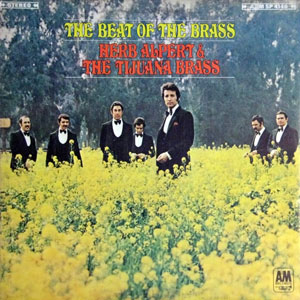
This Guy’s in Love with You, by Hal David and Burt Bacharach, performed by Herb Alpert and the Tijuana Brass (1968), encountered 1968

Buy it here |  Video here |  Lyrics here

When I originally planned this piece, I expected to call it “A Perfect Day.”  But then I went back and looked at the evidence.  I realized that, glorious as the day was, perfect was not the word for it.
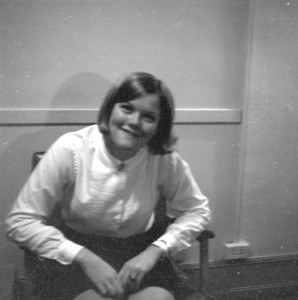
Call her Carolyn.  Here’s her photo.  I’ll tell you in a minute how it was taken.

I’ve written earlier in this series of my astonishment that mixer dances have more or less disappeared from the contemporary collegiate scene.  In fact, on the day after this story starts, I’d written it down that mixers “are quite necessary – if they didn’t exist, we’d have to invent them.”  Apparently time has proven me wrong; my collegian younger son’s never been to one, so far as I know.  Nonetheless, they were awfully important for me back in the day…

Well Mixed

The story starts on Friday, April 26, 1968, at the outset of Penn’s version of that perennial, the college spring festival.  Penn called it Skimmer.  In the idealized version of this idyll, we’d wear skimmer hats and sit with our dates watching rowing races on the Schuylkill.  I did not have a date, however.  Fortunately I had a mixer.  Well, to be technical about it, the next institution over, Drexel Institute of Technology, had a mixer.  And that was where I met Carolyn, good-looking, friendly, smart, a coed at Chestnut Hill College, another Catholic women’s school.  I invited her to do the riverbank thing with me the next day, followed by other Skimmer excitements.

I believe first she said yes, then on reconsideration she said no to the riverbank part.  And truthfully the weather looked iffy.  But she agreed to come in for the evening, which I’d planned to spend at my roommate’s new fraternity, “getting loaded,” as I dishonestly boasted to my parents in a letter I dashed off that day.[1] Come the evening, she turned up, we rode some carnival rides on the field outside the women’s dorm, and then we went back to the dorm room to wait until it was time for the party.

So we started kissing, but it didn’t go on long.  The next thing I knew we were arguing about kissing.  We were arguing about roaming hands.  But the argument was being waged while we were lying side-by-side on the narrow single lower bunk of a bunk bed, from which neither of us was actually getting up.  I was very politely calling her narrow-minded and she was very politely getting indignant, and then we were kissing some more, and then we were arguing some more.  Oddly, this combination was raising both the lust level and the respect level.

We didn’t bother with the frat party.  It was somehow incredibly romantic, just lying there arguing about what I wanted to do and she didn’t.

Incredibly Romantic

Since she wouldn’t allow me to undress her in any other way, she agreed to take off her makeup for me.  She told me: “When I was trying to figure how to make myself up, I didn’t know what you’d like, and honestly, I didn’t care.”  I asked: “And you care now?”  Her answer was to come over and throw her arms around me and give me a terrific kiss.  And allow me to take the photo above.

Finally, we had to end the evening with a mad rush to catch the 11:30 Suburban to Chestnut Hill at the 30th Street Station.  She fell down once, and even that was romantic.

We couldn’t get together again until Saturday, May 11, which I believe was my last night in the dorms before my freshman year tenancy expired.  I must have done most of my packing already, because I had time to take her to a matinee of Gone With the Wind, in revival in one of the big old movie houses downtown.  Hated the movie, but loved the rest of the evening: dinner at a favorite pizza joint, then watching as she finished packing my trunk, at which she was surprisingly efficient.  (The trunk later weighed in at 163 pounds.)  We also carried my boxed-up speakers over to Railway Express in the rain.  My description of the evening to my now-former roommate ended this way: “After we got back, she showed me some judo, and then some more necking and back to her sister’s dorm.”[2] What a woman!

You would not have expected that all this non-sex and judo and packing would have made us boyfriend and girlfriend, and it didn’t, but it left us intrigued with each other.  As witnessed by a letter she posted the following Saturday[3] which: a) told me she’d met another guy at another Drexel mixer (albeit he was what she called “this idiot Greek” who only wanted to “dance, dance, DANCE!” –  establishing there were no ties preventing her from dancing, dancing, DANCING with other guys) but b) invited me to visit her in her home town of Avon-by-the-Sea, New Jersey, if I could find a way there over the course of the summer (establishing a continuing interest).

Planning The Date

We wrote back and forth for the next few weeks, including a bit of jointly working through the Robert Kennedy assassination, which befell that June.  I made a stab at taking her up on her visit offer – with the notion that I might drop by on a scheduled stay with my father in New York.  Had that stay gone off according to schedule, Carolyn would not have been able to take time off from work (at the local phone company).[4] But my step-grandmother died,[5] and we all had to run to Chicago Heights to deal with the obsequies and the dispersement of her things.  In consequence, I did not get off to New York until July 8.  And, as it happened, right at the end of that stay, there was a one-day window for Carolyn: Sunday, July 22.

And that was the perfect-ish day.

On this stay with my Dad, I was fortunate to have my old grade-school friend Walter with me.  This gave me a chance to show off my East Coast world,[6] and I made the most of it.  We trained down to Philly and visited my university,[7] we chased girls down in the Village, and we spent a lot of days up at my dad’s country place in Tannersville, New York.  It wasn’t quite idyllic up there because there were no girls, or at least none for us.  My dad was in some kind of group therapy at that point, and he’d brought up a friend from therapy, a hospital orderly named Phil, and Phil had brought his girlfriend Karen.  They were in the bedroom next to the one I shared with Walter.  And the rooms were very small.  And yes, we could hear things that were probably Phil and Karen having sex; even if we were mistaken about that, we certainly knew it must be going on.  That knowledge got on our nerves, and I know we were, uncharacteristically, beginning to have had enough of each other.
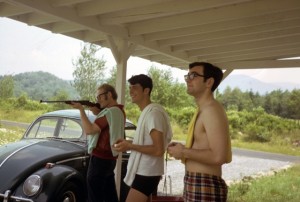
Here’s me and Walter and Phil, target shooting from our carport in the country:

Release and Relief

Visiting New Jersey was therefore a release to a different setting, and also, blissfully, to the company of the fairer sex for a while (as Carolyn reported she’d secured a date for Walter).  So at around 11 we boarded a bus at the Port Authority Terminal, bound for Asbury Park, a few blocks from her town.[8]

I believe I was supposed to phone ahead before we left, but the line was busy when I tried to place a call from the Terminal, so we were fretting all the way down that Carolyn might have thought we’d stood her up.  Worse still, the bus was over an hour late, as we seemed to be going round Robin Hood’s Barn making additional stops that didn’t appear on our schedule.  But when at last we alit in Asbury Park, I found a phone, called Carolyn, and she said she’d be there in a few minutes.  I walked back to Walter, shared the good news, and we both sort of collapsed.  There was hardly a cloud in the sky.

Then we heard a honk, and there was Carolyn’s freckled face beaming at us from behind steel-rimmed sunglasses out a car window.  She whisked us out of the touristy downtown and took us somewhere residential, where Walter’s date lived.  And at the front door was Jan, a girl-next-door with something mischievous in her eye.  Jan went to yet another Catholic women’s college somewhere in New York, which she described as a place where they didn’t do anything but drink legal beer and make out.  An auspicious introducing comment for Walter.

Better news yet: the girls had planned for us to spend most of the day at the beach, which meant, in the first place, that we got to spend most of the day at the beach, and secondly that we guys weren’t going to have to spend much money, a not inconsiderable thing.  Jan gave us one for the road (though I abstained).  We sat around chatting about the movie of Rosemary’s Baby, just out, which only Walter had seen, but everyone wanted to.

The Beautiful Beach

Then we all piled back in the car and drove to Avon (pronounced Ah-von).  Carolyn lived with her mom in a bungalow with a sort of stolid Irish interior: big solid chairs, family photos, a Blessed Virgin statuette.  We put something on the record player (Days of Future Passed, I think it was), and I helped Carolyn get lunch together.  Alone together in the kitchen, Carolyn embraced me suddenly and told me she was glad I’d come.  We took lunch out to the awning-covered front porch and sat and ate in the breeze.  I don’t remember what we ate, but shortly afterwards we all went upstairs and changed into beach stuff.  When the girls emerged from their room, Jan was wearing something in two pieces, yellow and sexy, and Carolyn was in something brown and demure.

“So [as I wrote], off to the beautiful beach.”  Walter and I then made our only cash outlay for the entire day, bar our bus fares: $1.75 each for day-badges which entitled us to use the beach for “22” only.  Then we were actually on the sand.  I took of my shoes and buried my toes.  Bliss!  Walter and Jan ran on ahead, threw down their stuff and dashed into the water.  They were as good-looking as models in a suntan lotion commercial.  Carolyn and I couldn’t compete on that kind of looks, but I felt no envy.

Shortly, the two of us joined Walter and Jan in the water.  We dove in the waves, and did the traditional water fights with the girls mounted on the boys’ shoulders.  Then we lolled in the sand, letting the sun and the wind dry us.  Now you, gentle reader, may have had tons of this in your past, and it may all seem quite standard-issue to you, but that would be one area in which we differ.  I had never before played in the surf with a date.  So you can imagine how sexy and exciting the whole thing felt to me.

Eventually Carolyn and I went off on our own, down as far as the beach went, and wandered out onto a fishing jetty protecting the outlet of a channel (the Shark River, I’ve since learned) that flowed under a drawbridge just behind us.  (There’s a great photo of the scene today here and a useful aerial view here.)  We talked seriously.

Meeting the Mom

In her letters to me she’d mentioned having awakened recently to certain what she called permanent aspects of her character.  I wanted to know what she meant.  Not surprisingly, it had to do with another guy she was seeing (this one from West Point) who had taken her out on this same jetty in the moonlight, and I guess had beguiled her with notions of sharing an urbane life; she said she had realized then that she was at heart a country girl.  I’m sure it will not surprise you to learn I couldn’t focus very well on the country girl aspect of the discussion; I was stuck being envious of Mr. West Point, whoever he was.  I was helped past this juncture by Walter and Jan, who joined us.  We talked about my writing, and about Anna Karenina, which Carolyn had just read.

Then Carolyn had to take a break and pick up her mom from work, as Carolyn had commandeered the family car for our excursion.  Walter and Jan stretched out on the sand, obviously ready to be alone for a while, and I decided to go for a walk.  I strolled north on the beach, then back south on the boardwalk, luxuriating in the feel of the grained wood beneath my feet.  When Carolyn came back, we all caught a ride back to the house.

When we got back there, we met Carolyn’s mom, a dentist’s receptionist.  She had a polite but disapproving look.   I sensed I was being sized up; well, I could size up back.  To my instincts I was looking at the source and pattern of the boundaries of what Carolyn would allow in our embraces.  As a parent nowadays, of course, I have more sympathy.  But I wasn’t thrilled right then.

We boys showered in an enclosure in the back yard; Carolyn had a laugh by popping open a window directly above and proffering Walter a towel when he was in the nude, which annoyed him.  I don’t think she actually glanced at him, but the joke was had.  Walter, as it happened, had just been musing about Jan’s swimsuit: “I could see her nipples and everything.”  So arguably Carolyn’s joke was a case of turnabout being fair play.

The girls came down and packed dinner, and Walter and I carried it out to the car.  Carolyn tried to sneak some beer into the cooler past her mom, but failed.

Transistor Radio

We drove back to the beach again, setting up camp near the base of the jetty.  A little later, I had some words with Carolyn about her mom.  I criticized what my journal dubbed “the parochialism of her mind.”  I cringe when I read these words; I was a teenager who had never earned a penny looking down my nose at a woman putting two daughters through college without a dad.  I feel a little better when I read the next thing I wrote: “Carolyn was quite right being upset with me.  I was just shooting off my mouth.”

It was a repast of chicken washed down with soda, since Carolyn’s mom had interdicted the beer.  We turned on Jan’s transistor radio and listened to WABC, and danced in the sand.  I remember the feeling of utter peacefulness holding Carolyn in my arms, as we moved to the sound of Herb Alpert singing This Guy’s In Love With You.  We played leapfrog.  And then we sat down and entwined toes in the sand.  When the game stopped, Carolyn’s toes and mine remained entwined, and then we held hands.  For a while the only sound was the radio.  We heard Alpert’s song again.  (Playlists were short in those days.)

Time to Wrangle

And then the sun sank behind us.  The holding hands turned to kissing, and the blood was pounding in my temples.  Walter and Jan realized it was a cue to absent themselves.  When they were gone, I wondered aloud, phrasing it delicately, what kind of liberties Walter might be getting away with.  Jan had been discussing French kissing before, and I mentioned it.  When Carolyn seemed deliberately to misunderstand me, I rephrased more explicitly.  She responded that I seemed never to pull my conversational punches.

Hoping that she thought this directness of mine was a good thing, I went on in the same vein.  I asked if we should go steady.  I wasn’t exactly requesting it; I was trying to make sense of where we were.  Indeed, the next thing I said was that I didn’t think we should.  I thought we were too different.  In my blundering, vainglorious way, I said something about me being an intellectual – with the other term of the equation implied.  I wasn’t trying to be offensive.  And this time I didn’t offend.  Her eyebrows had shot up when I said what I said, but her response was that she was surprised that I felt that way, and that she had come here to tell me the same thing.

Then it was my turn to surprise her, as I said that I’d known that that would be her attitude.  And I guess if I hadn’t known it in advance, I could not have spoken out, so I think I was telling the truth.

The two of us sort of danced around the reasons why we didn’t want to go steady.  Eventually, I more or less summed it up: “I could never see being married to you.”  She agreed, saying she’d thought about it, and all she could see was such a marriage falling apart.  I don’t know if her own family experience played into that remark.  (Mine certainly had played into mine.)

Of course that mutual revelation begged a question we naturally both turned to: what were we doing buzzing each other with all the kissing and the slow dancing?  She said that it might just be sex.  I said, thinking back to my recent near-miss with Cindy, that if I just wanted sex, I could have had that.  This pleased her, and led to some more kissing.

The conversation then went back to French kissing.  She said she’d tried it with someone else (not me), and she said that now she couldn’t oppose it on the grounds of morality, but just didn’t care for it.  (You have to understand, we were both Catholic school kids, or issue of the morality or not of the practice simply wouldn’t have arisen between us.)  And then, with this sexual issue and my jealousy as a trigger, we each said some stupid things which I won’t replay here.  It is apparent, rereading my journal after forty-plus years, that as honest and forthright as Carolyn generally was, we’d reached a place where she couldn’t be entirely honest even with herself.  I’d say that for someone who wasn’t twenty yet, she was doing pretty well in accounting for her actions and reactions, but that damn Catholic training was making her say things that could not be reconciled with each other.

And then too she lashed out at me — and took it back almost with the next breath.  I think I betrayed some pain at her remarks, and she was rueful about that.  She seemed to turn on a dime, and to be telling me things to make me feel better.  If that was the thinking, it worked.  And so eventually our upsets were smoothed down.

But we were still looking at the question of where we went from there.  And it soon became clear neither of us had moved on the not going steady issue.  But we wanted to keep up a special connection at the same time.

If You’re Ever In The Area Again

While we’d been wrangling, the lights had come on along the boardwalk, and clouds had rolled over the stars, and we were in the dark.  Through my sweaty glasses, everything was suffused with a soft glow.  Everything was lit like a love scene in a sophisticated movie.  Somehow the visual cues also made me happy, as if I were in a love scene, instead of – whatever I was in.  (It isn’t a very conventional love scene when you’re resolving to be friends after you’ve both married other people.)

Walter and Jan rejoined us at this point, walking along the boardwalk, hand-in-hand.  One of them sang out “Where have you two been?”

“We ain’t gone nowheres!” I replied cheerfully.  So we started picking up and carrying things back to the car.  Carolyn and I went ahead, and as we neared the boardwalk, she reproved me: “You said we hadn’t gone anywhere; I think we’ve come a long way.”

Things happened quickly then: back to the house, clean up, pack up, say goodnight to Carolyn’s mom, and then Carolyn and Jan took us sightseeing and showed us the bright lights of Asbury Park, what everyone would come to know in a few years as Bruce Springsteen territory.  We ended up in a park opposite the bus station; our bus was already there.  Carolyn and I crossed a little bridge over a pond , and we looked out at Asbury Park’s twinkling lights.  We allowed that we were anxious for college to begin again.

“It’s going to be good, having something real to go back to this fall,” she said dreamily.

“And what we have, if nothing else, is real,” I said.

And then it was time to board the bus.  I’d given Carolyn some money to hold for me, and she brought it out, saying in a loud voice so the other passengers could hear: “Here you are, Mr. Gohn, here’s your change, and if you’re ever in the area again, give us a call!”  The girls broke into hysterics.  Then, after a few moments they were gone.

Well, almost.  We parked ourselves on the street side of the bus, and it was very quiet.  Suddenly they drove past us, shouting out the window again: “If you ever come this way, give us a call!”  I smiled and waved goodbye.

Then sleep.  A little waking.  Lights.  Faces.  More sleep.  And then the Port Authority Terminal, and the walk back to the 7th Avenue IRT.  The next morning we were on a homeward-bound plane by 10:30, and by 1:00 we were back in Michigan.

So was I right?  Was it real?  Part of the answer will have to await other pieces in this series.

Not Perfect

But it would only have been a perfect day if we had shaken hands on going steady rather than on not going steady.  We should have resolved to try being together.  It was telling that the reason she didn’t want to, and the reason I didn’t want to, was that we couldn’t see being married to each other.  We should never have been thinking in those terms.  But for neither of us could serious dating be conceived except as a part of a process that led to marriage.

Blame our upbringing. Blame it for the contradictions in the things she was saying, for the endless alternation between embraces and pushing away.  Blame it, probably, for the string of young men Carolyn had assembled, me and the West Point boy and the “idiot Greek” and perhaps others.  Safety of a kind in numbers.

You look at that photo of Carolyn at the head of this piece, and you see someone who could develop in all kinds of ways.  She could have got fat, could have got thin, could have become a lady or a peasant.  Whatever was next for her, it was going to be interesting to watch.  That was clear enough.  And we had what it took to find out what was next together.  She was bright enough and honest enough and pretty enough to have kept me engaged, and I flatter myself I had much to offer her – at least for a while.  But having to think about each other as possible marriage partners made that kind of commitment too risky.  Thank you, Catholic Church!

And while the pledge of eternal friendship we carried out of that date looked real, our lives were about to demonstrate whether it was proof against one of us finding real sexual and emotional intimacy.  (Spoiler alert: it was not.)

In the meantime, taking the short, hedonistic view would have been so much better for both of us.  Billy Joel didn’t release Only the Good Die Young for another nine years.  But he hit the nail on the head.

Come out Virginia.  Don’t let me wait.
You Catholic girls start much too late
But sooner or later it comes down to fate
I might as well be the one

When all’s said and done, though, that’s not the song that makes me think of Carolyn.  Unquestionably it’s This Guy’s In Love With You, which we must have heard five times on the day we slow-danced in the sand (I bought my copy of the album as soon as I got back).  Perhaps I should have avoided that association.  Contrary to the title or the lyrics, I didn’t declare then that I was in love with her, nor did she, then or ever, declare love for me.[9] And I think over the years my associating that song with that date has pulled a filmy gauze over the experience, similar to that hazy view of the boardwalk lights through dirty glasses.  Deceived by that softened view, over the years I had allowed it to morph in my head into a perfect day.

It had many of the aspects of perfection.  Against odds, we found the time to get together, we had the double date, we played in the surf, we had two meals and lots of dancing and necking on the beach.  And yet, in the end, it should have been more.


[1] One thing I have never been good at is drinking.  But I was at least good at talking the talk.

[2] I’m pretty sure the sister in question must have been at Drexel.

[4] There were such things as local phone companies in those days.

[5] The one who had had the antiques store pictured in the footnote in the first of the memories.

[6] More fun than sharing it with “Patricia” as a kid, but the same impulse.

[7] That’s him looking in the dorm window in the photo here.

[8] There seem to be four little hamlets: (proceeding north to south) Asbury Park, Ocean Grove, Bradley Beach, and Avon-by-the-Sea, each separated from the next by a little lagoon, each a few blocks’ thickness, top to bottom.  Carolyn told me that each had been settled by a different denomination, and that Avon was where the Catholics lived.

[9] I did write her one making that declaration, but it went unsent.  The one that went out instead used the word love, but love, as we all know, has many meanings, and I was pulling my punches the way I used the word.

Copyright (c) Jack L. B. Gohn

Theme Songs Page | Previous Theme Song | Next Theme Song
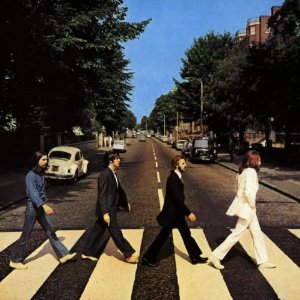
“Hostilities”

The Big Picture Home Page | Previous Big Picture Column | Next Big Picture Column

“Hostilities”

Published in the Maryland Daily Record July 5, 2011

There’s been a lot of intelligent comment[1] about Barack Obama and the War Powers Resolution (WPR) as we’ve neared and passed the 60-day deadline set by the WPR for the administration to ask Congress’s permission to continue with our military actions against Libya.  Original remarks may be hard to come by.  And I wrote about this myself three months back, shortly after the 60 days began.  But this column has made a point of commenting over the years on the saga of the presidency and the legalities of war, and recently there have been a couple of new developments.  So it seems best to stay on the story, even at the risk of a little repetition – of both myself and others.

If you’ve come in late, though, you should know that the one constant theme in the tale is: Heads I win, tails you lose.  This is the mantra chanted over the ages by the Executive to the Legislative whenever the subject is initiating military action. We started with a Constitution that generally left Congress with the power to decide when U.S. forces were committed.  We quickly found that presidents actually make these decisions.

Most of the early inter-branch struggles about this revolved around the definition of “war.”  If it was a war, Congress got to declare it.  But the president, acting under Commander-in-Chief powers, got to initiate any military action that was not declared, and the resulting combat operations were dubbed “imperfect war.” When it was an imperfect war, the president got to keep his Commander-in-Chief powers, while Congress got to keep nothing.  Not surprisingly, the vast preponderance of our dozens of military deployments have been imperfect wars.

The WPR was born of Congressional frustration with this state of affairs. Rep. Clement Zablocki and Sen. Jacob Javits, the lead sponsors, realized that if Congress were to reassert control, it had to take back power over the imperfect wars.  The mechanism they hit upon was the 60-day rule: If a president started an imperfect war, he had to get Congressional approval within 60 days or call the thing off.  Except the WPR doesn’t talk of “imperfect wars,” which admittedly has a 19th Century-ish ring to it.  The WPR speaks instead of “hostilities,” and thereby hangs this particular tale.

Presidents have generally tried to subvert the WPR.  Either they have not complied, or, if they have complied, have often done so with a studied bad grace, intimating that their reports to Congress and requests to authorize force were provided not because of the compulsion of the WPR, but on general principle.

Enter the Obama administration and its military involvement with Libya.  As I pointed out three months ago, there was some ambiguity surrounding whether the initial consultation required by the WPR before the beginning of hostilities had taken place.  There is no ambiguity surrounding the absence of authorization after 60 days – if the WPR applies at all.  But guess what?  Obama claims it doesn’t apply at all, because there are no “hostilities” at the moment.

The administration claim was advanced in at least two places: a 32-page White House briefing paper and a June 15 letter to Speaker of the House John Boehner.  The briefing paper acknowledged certain current activities. There have been 10,000 air sorties flown over Libya by NATO forces, it said.  However, today only a small number are flown by U.S. planes, and those “are limited to the suppression of enemy air defense and occasional strikes by unmanned Predator UAVs against a specific set of targets.”  (We know who those targets are.)  Further, “The United States provides nearly 70 percent of the coalition’s intelligence capabilities and a majority of its refueling assets.”  That is, intelligence and refueling for combat sorties.

And how is suppressing enemy air defense, launching Predator strikes, briefing and gassing up fighters that go out thousands of times a month to bomb Libya not “hostilities”?

Here is the key analysis, from the briefing paper:

U.S. military operations are distinct from the kind of “hostilities” contemplated by the Resolution’s 60 day termination provision. U.S. forces are playing a constrained and supporting role in a multinational coalition, whose operations are both legitimated by and limited to the terms of a United Nations Security Council Resolution that authorizes the use of force solely to protect civilians and civilian populated areas under attack or threat of attack and to enforce a no-fly zone and an arms embargo. U.S. operations do not involve sustained fighting or active exchanges of fire with hostile forces, nor do they involve the presence of U.S. ground troops, U.S. casualties or a serious threat thereof, or any significant chance of escalation into a conflict characterized by those factors.[2]

Fascinating stuff, to be sure, but I kind of missed the part which demonstrates the lack of “hostility” in the existence of a multinational coalition, in a Security Council resolution, in a supporting role, in a design to protect civilians, or in the absence of jeopardy to U.S. forces.  Doesn’t it make more sense to say that if our efforts aim at and help achieve things and people being blown up, they constitute hostilities?

Speaker Boehner certainly thought so, commenting that these explanations don’t pass the straight-face test. Note that the American Heritage Dictionary lists as the obviously applicable definition “acts of overt warfare.” And what could this be except warfare?  Not police work: I doubt there’s a single police force in the world that uses drones to take out bad guys or briefs the pilots of and refuels fighter jets.

Granted, the WPR doesn’t define “hostilities,” but apparently the Office of Legal Counsel thought it understood.  According to the New York Times, not only did OLC, whose word is generally law within the Executive, advise Obama that U.S. activities in Libya were WPR “hostilities,” but so did the top lawyer at the Pentagon.  We haven’t seen these opinions, nor the advice of the White House lawyers who reportedly argued to the contrary, so we can’t evaluate them.

But we can see what the word means to courts applying the word in contexts not fraught with national policy, like insurance, and with other statutes that use the word.  There the word denotes situations in which nations are shooting; it’s that simple.[3] Under that apolitical definition, we’re obviously engaged in hostilities.  Doesn’t matter that the Libyans can’t shoot back; our drones are shooting at them.  It shouldn’t matter that we’re only telling some French fighter jockey where to fly; if we’re handing out target assignments, we’re engaged in that sortie, irrespective of whose air force does the actual strafing.  And that bit about humanitarian motivations: if that matters, then the Civil War wasn’t hostilities either.

Even if you think it’s a good thing to be trying to unseat Kadafi, you ought to be discouraged by the thinly-veiled mutiny Obama is waging against the law.  Me, I had this naive notion that the president was supposed to take care that the laws be faithfully executed.  Silly moi!  Nothing faithful about this bit of execution.


[1].  See, e.g. Conor Friedersdorf’s column in The Atlantic here.

[2].  Briefing paper at 25.

[3].  See, e.g., United States v. Standard Oil of N.J. (2d Cir. 1949) (“hostilities” are “warlike” activities for purposes of marine insurance); Lord, Day & Lord v. Socialist Republic of Vietnam (S.D.N.Y. 2001) (“hostilities” as used in Foreign Sovereignties Immunities Act end when military action ends, irrespective of formal state of war or diplomatic estrangement); Samuels v. United Seamen’s Service, 352 F.Supp. 827 (9th Cir. 1948) (“hostilities” for purposes of construction of lease end when shooting stops, not date of surrender); International Dairy Engineering Co. of Asia, Inc. v. American Home Assur. Co., 352 F.Supp. 827 (N.D.Cal. 1970) (flare dropped by a belligerent’s warplane, even if by negligence, was part of “hostilities” for purposes of policy exclusion).

Copyright (c) Jack L. B. Gohn

The Big Picture Home Page | Previous Big Picture Column | Next Big Picture Column

School’s Out: Night in the City

Theme Songs Page |Previous Theme Song | Next Theme Song
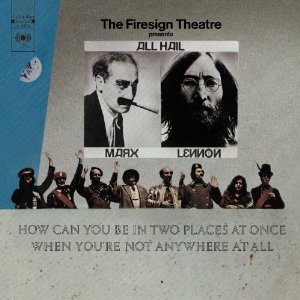
School’s Out

Night in the City, by Joni Mitchell (1968), encountered 1968

Buy it here | See it here | Lyrics here

And just like that, my exciting first year of college was over.  True, there’s always a relief in getting to the end of a semester.  But I don’t think I was particularly eager for it to end.  I was enjoying being a collegian, even enjoying my studies, challenging as they were.

I wish I could write more fully about my classes, the one topic from that year I haven’t touched on in these musical memoirs.  But my memory is selective, and my studies have largely been selected out.  And in any case, I don’t have music that specifically triggers memories of my studies, not that year anyway.  I think it’s safe to say, though, that I knew, coming out of that year, that I was going to be an English major.[1] And there was no doubt that, in my mind at least, I’d worked as hard as I’d played.  This equivalence would not have satisfied my demanding mom, but it suited me.

A Little Bit of Coping

Piecing together the few documentary clues that give me dates, I believe I finished up on or about Friday, May 10.  But being off duty required a little bit of coping.  My parents couldn’t come and pick me up until the following Friday.  There were two reasons for this: they had their own classes to teach during the intervening week (and indeed for a week or two thereafter), and they wanted to be in Baltimore that following Friday for the 25th reunion of the Johns Hopkins University Class of 1943, of which my stepdad was a member.  So obviously I had to stay East somehow for a week.[2] I actually had one reason of my own, which was a philosophy paper I needed to finish, a paper which, thankfully, my professor[3] let me hand in late.

The Penn dorms had closed, however.  That meant I had to find someone to put me up, or perhaps, better said, to put up with me.  I have no recollection of asking or being invited, but somehow I ended up staying with Steve, a classmate who lived in Northeast Philadelphia, son of a dentist (who, if the Web is to be believed, now practices dentistry himself).  At that time it was a love of poetry that drew us together.  We had talked about rooming together sophomore year, but for whatever reason, that didn’t happen.

I wrote a friend about that week: “Their place and food are lovely, not to mention [the family] … His mother urges food on me – ‘Force yourself!’ she says.  My beard put her off at first, but she’s figured out I don’t mean anything by it.”  (This in an era when beards signaled political dissent, and the dentist dad was of the generation forged in the patriotism of World War II – as a soldier he had been part of the liberation of the first concentration camp discovered.  I actually got rid of the beard while staying at their home.)

Joni Wasn’t Packed

Most of my stuff was packed away in the trunks for Railway Express, but I know there was one album that wasn’t: Joni Mitchell’s Song to a Seagull.  Well, at least that was the name at one time; it gets a bit fuzzy now.[4] Whatever it was called, it was stunning.  Of course there’s nothing original to be said about Joni Mitchell these days, but that stunning voice and those original chords and those poetic confessional lyrics were like nothing most of us had heard then.  I can picture sitting in Steve’s parents’ front room and playing it when I probably should have been finishing that Philosophy paper.[5] I must have played it enough so that two weeks later, writing Steve, the first thing I did is mention the album in a way I would only have done if I had known him to be as familiar with the order of the tracks as I was.  There’s a phrase in one letter that suggests we may have been listening to Steve’s copy.

My guess is that sensitive young women of that era responded more to the songs on the album about how tough it was to be female and sensitive in New York or about the liberating influence of the seaside.  My favorite, though, was the most masculine song on the record, Night in the City.  In the comments with which Joni prefaces her performance of the song the previous year (in the video hyperlinked above), she intimates that it was inspired by impatience with a roommate who was taking too long to get ready for a night on the town.  But the real subject of the song is simply how exciting the big city is at night.

Night in the city looks pretty to me
Night in the city looks fine
Music comes spilling out into the street
Colors go flashing in time

And what really made the song for me was Steve Stills’s slightly funky bass, which made that one song sound much more like rock and less like folk than anything else on the album.  Cities rocked, and the bass line confirmed it.

Well, my whole freshman year had confirmed it too.  I might have been a bit homesick for Ann Arbor, but downtown Philly, on one’s own, was an intoxicating place to me.  And now I was somewhere else.  For the moment, I was in a quiet, comfy home in suburbia, awaiting going back to a college town for the summer, stuck finishing a paper.  To be sure, I was going to find ways of having fun.  But it wasn’t going to be the same.

Encountering Baltimore

Come that Friday, I trained down to Baltimore, my first real visit to the town which, though I didn’t know it, was where I’d spend the biggest portion of my life later on.  My parents had flown into Philadelphia and were supposed to have caught a shuttle flight to Baltimore, but their flight was canceled, and they too had to take the train down, a later one.  In consequence of this delay, I checked into their Baltimore hotel room some hours before they did.  Talk about none of us knowing what we were getting into …

The Baltimore my parents thought they were visiting had just been given the coup de grace, though the dying would take years.  After the Martin Luther King assassination on April 4,[6] the town had been plunged into eight days of riots, which any Baltimorean can tell you changed everything.  The town was in for years of sliding downwards, losing corporate headquarters, heavy industry, white citizens, pro sports teams, and civic pride.  While my folks had been there in the 1940s, it had been a genteel Southern town (which was great if you happened to be white and genteel like them).  It was never going to be like that again.

By the time I turned up on the town’s doorstep on May 17, law and racial order had been restored, and I don’t think I saw any of the destroyed neighborhoods – of which I later discovered there were plenty.  But another source of civic chaos had just erupted which would stand in for it.  This was Preakness weekend.  And we were staying at what was then called the Sheraton Belvedere, a faded dowager of a Beaux Arts hotel that was being respected by the party-hearty race-goers in about the same way Blanche Dubois was respected by Stanley Kowalski.  There was constant yelling and running in the halls, raucous laughter everywhere – and a couple I’ll call Drew and Lacy.

I think Drew was a college pal of my stepdad’s.  In my recollection he was a southern-fried lout, and his wife made some nasty insinuating remarks about my status as stepson, not son – and insinuated accurately, but as if this did me some discredit, that I was partly of Jewish heritage.  I think there were also some arch comments about Mother being markedly older than my stepdad.  I don’t know what my stepdad was doing being friends with such lowlifes.  But they seemed to fit right in with the overall picture at the hotel that weekend.

I saw some of Hopkins too, but I really don’t remember it.  What really sticks in the mind was getting off the bus on North Charles Street at Hopkins, off the campus.  It was hot and dusty, and the street seemed too wide (I hadn’t yet learned to allow for the subtraction of the trolleys which had shaped so many urban thoroughfares and then disappeared from the scene.)  I remember thinking that this was a much less entertaining place than Spruce Street running by my dorm at Penn.  If only I’d remembered that perception later!  As dull as this stretch of Baltimore was, it got duller in Ann Arbor, to which I soon returned.

Shortly after my return, I wrote a friend that I’d visited a men’s clothing store, where I was told they’d had their slowest Thursday, Friday, and Saturday in the store’s history, seriatim.  Of course, this was the nadir, before the summer session started.  Things did improve a little as the summer went by.  And I had all the leisure I wanted to try for a second summer to finish my novel.

The Exciting City Night

But there was no doubt that I wanted to be back in that exciting city night that Joni had sung about:

Moon’s up, night’s up.
Taking the town by surprise.
Stairway, stairway,
Down to the crowds in the street.
They go their way
Looking for faces to greet …

Well, I’d be getting my shot soon.


[1] An excerpt from a letter to my mom and stepdad in April 1968: “But no matter what I do, I can’t digest French idioms, or petty details about the Baroque synthesis, or what species of brachiopod was dominant during the Permian.  I can’t even properly assimilate too much of what I moderately like.  And the frightening other side of the coin is that I can spend endless amounts of time doing things I really like, like English, like writing poems, like reading newsmagazines, like Penn Players.  This indicates that my control of my powers of concentration is just about nil.  And this results in lower grades.”

[2] Or at least it seemed obvious to them at the time.  Given that I ultimately flew back in to Michigan separately from them, and that my stuff went back by Railway Express, I’m not sure that there was any obvious necessity for me to stay on the East Coast for that week.  Maybe they really wanted to have me at their reunion, but I’m almost absent from my mom’s diary entries covering the event.  I think it was just the kind of thing parents of college kids do: not quite reckoning with how independent the kids have become.

[3] This was Robert Solomon, perhaps my favorite professor at Penn.  I ended up taking three courses from him.  And the day Allen Ginsberg came to talk and read at Penn, he sat in on Solomon’s class, two rows behind me.

[4] The name was spelled out in flying birds in Joni Mitchell’s hand-drawn cover art, pictured above.  AllMusic indexes the album under that name.  Yet the spine shows only Joni’s name.  And Jason Ankney’s biography of Mitchell on the same website calls the album “self-titled.”  Don’t ask me how to resolve the contradiction; I only work here.

[5] It still wasn’t done when I left Philadelphia, and I don’t think I finished it for another week.  Thankfully, this episode of procrastination was kind of a one-off, and was not going to be my way with school work generally.  As a student, a writer, and a lawyer, I generally get things in on time.  Call this more of the adjustment to the rhythms of college than a portent of things to come.

[6] From a letter to my parents on April 9: “Shortly after the news got around, the black students on campus gathered in front of the Library, huddled around a transistor radio.  I joined them for a while, but I had work to do.  Later the black students walked over to the ghetto, to be with their people.  The next day they held a really frightening vigil at noon.  After some gospel singing, the small crowd of blacks and much larger one of whites was treated to a series of Black Power harangues.  I got upset.  I don’t like being called ‘honky’ any more than a black likes being called [n-word].  One of my black friends got up and spoke, and I didn’t like the change in him at all.  Still the last two speakers addressed the larger crowd of whites, warning them not to take everything said literally.  They said that the Negro is a very emotional person, and that this anger is his natural response, but that militancy is just one approach and that nonviolence and moderation were still at leas as valid as militancy.”  A confusing time!  And no one realized that it’s insulting to talk of “the Negro” or for that matter “the white man.”  Not the speaker I quoted, and not me, at the time.

Copyright (c) Jack L. B. Gohn, except for artwork

Theme Songs Page |Previous Theme Song | Next Theme Song