Bat’s Squeak

Theme Songs Page | Previous Theme Song | Next Theme Song

Bat’s Squeak

Black Water,  by Patrick Simmons, Performed by The Doobie Brothers (1974), Encountered 1975

Buy it here | View it here | Lyrics here | Sheet music here

What was wrong with this picture?, I ask, as I contemplate the events I am about to discuss. If you had asked me at the time, I would have said, sincerely enough, that I was enjoying one of the happiest moments in the life of my new family, career difficulties notwithstanding. We had a darling daughter and a house, and I was working, at least a little, teaching one course of composition at Goucher College as adjunct faculty. I had a scholarly book coming out. Journals were publishing my articles. Surely my life was, if not a completely solved problem, at least a work in satisfactory progress.

Yet what happened happened. And it showed what it showed. And surely it showed, among other things, that the work of my life may not have been in such satisfactory progress.

Meat Market

I had to go to MLA, the annual meeting of the Modern Language Association, held each year in the week between Christmas and New Year’s. Though there was lots of reading of papers and laying down and sniffing of academic spoor, the significance for me was that it served as the the main marketplace for the employment of new English Ph.D.s. Once you knew when your doctorate would finish, you knew how to time your attendance. And I had known by the beginning of the 1974-75 academic year that I would receive mine at the end of it. That meant that my first MLA would be in 1974, and the second, if there had to be one, in 1975.

And, as it worked out, there had to be one. The 1974 meeting, at the New York Hilton, had yielded nothing. While I no longer can reconstruct and contrast what I did in the first year versus what I did in the second, I know that over two job seasons I sent out over 450 resumes, to colleges and universities in all 50 states, in pursuit of the jobs listed in an MLA circular; out of those I netted 14 interviews, two of which were “cattle calls” – simultaneous interviews with about a dozen candidates. And out of the remaining 12 interviews, only two seemed like serious prospects, one each year. The main prospect of 1974 was North Carolina State, and the great hope of 1975 was the University of New Mexico at Las Cruces

It Was All Dixie To Me

In any event, the Doobie Brothers’ song Black Water got all mixed up in my mind with the North Carolina State job, and then, by extension, with the whole desperate process. If you listen to the song, it certainly isn’t about Raleigh; it’s pretty clearly a New Orleans song. But it was Southern. To Northern young men of my generation, anything from the old Confederacy was foreign enough so you could kind of lump it together as Not The North. And what the lyrics of Black Water tell you is that the South is a mysterious, pulsing, lively place.

Well, if it rains, I don’t care
Don’t make no difference to me
Just take that street car that’s goin’ up town
Yeah, I’d like to hear some funky Dixieland
And dance a honky tonk
And I’ll be buyin’ ev’rybody drinks all ‘roun’

I was ever so ready to get out of Baltimore and have some adventures, even in the Confederacy. Or, as of 1975, the great Southwest.

The Problem With Reassurance

The only problem was, I had to get invited. And it began to look as if my last plausible set of chances at getting that invitation all came through MLA 1975 or not at all. I told myself that surely it would be all right, that surely someone as well qualified as I would make it through. I told myself that, but self-reassurance, like all reassurance, is flawed because no one actually knows the future. And I wasn’t taking into proper account the potential for sheer bad luck that could so easily synergize with the lousy job market.

For it was a lousy job market, a very, very lousy job market. After an entire generation of smooth riding, the great English Lit Ph.D. apparatus, fueled by postwar defense appropriations, had hit a stretch of washboard road. And my professors were in denial, and so was I.

En Famille

I have said that MLA occurred the week between Christmas and New Year’s. This ratcheted the discomfort up a little, because Christmases in my family had to be spent en famille, and since mine (as opposed to my wife’s) was the only famille that celebrated Christmas, it followed that Christmas would be spent with mine. This was the ninth time since I’d left for college that I’d made this particular holiday pilgrimage, but the first with both a wife and a baby in tow. The first few Christmases I came back, I was flooded with anticipatory longing. But that feeling was largely a thing of the past by 1975.[1]

I wish I had the descriptive gifts to make entirely plain why the holidays had become so difficult, but I guess this will have to do: my mom could not gracefully accept the limits between us that should naturally succeed the closeness of a parent and a young child. This problem had become acute with the arrival of a wife who would naturally and correctly feel that she now had the greatest claim on my intimacy, and the advent of a baby who would in the normal course of things take up a lot of my time, effort, and emotional capital. My mother was demoted to third place in this ranking, and she would not always acquiesce in this. S., then my wife, would later comment to my second wife that my mother had spoiled many Christmases for S. during our years together. This was close to the beginning of that ordeal for her. And I know I did not appreciate what I was putting her through as much as I should, being a) callow, b) stuck with divided loyalties, and c) human. But I wasn’t entirely blind to it either.

I believe S. and my daughter stayed behind visiting in Ann Arbor while I flew off.[2] Finances were tight and we were frugal.

The Fun Of It

So, full of resolve to locate that elusive job, I boarded a plane at Detroit Metro and flew west. And that’s where it happened. Sitting next to me was an attractive African American businesswoman maybe two or three years older than I, clearly extremely pleased by her success to that point, a success signified by a condominium she owned, simply for the fun of it, in San Francisco. It very soon became apparent that she was checking me out for the role of “the fun of it.”

She let me know at once that she was just going out there to relax. I told her I was out there to go to a meeting. She asked if I were planning to do anything besides the meeting, and I told her truthfully that I was hoping to do a little sightseeing (not having been in the town since I was four), but would have to fit it around my convention-going activities. She suggested we could do some sightseeing together, and added that it would be a shame if I were to travel all the way to this beautiful city, spend the whole time indoors, and then travel home again.

As the trip went on, she pressed me at least to visit the condo, which she assured me was close to a BART station, from which I could easily get to my hotel on Union Square. I reflected that I had no definite commitments that afternoon, apart from calling up and confirming a couple of interviews for the following day, the work of a few minutes if everything went right. So, after much urging, I agreed to visit her place en route to my hotel.

Arm To Arm

There’s a lot I don’t remember about that day, but I do remember ending up at her apartment in the early afternoon, on the second or third floor of a new building on a hill, looking out over some pleasant watery prospect. And I remember standing at the railing of her balcony, staring out at the view. And I remember her standing very near to me, our forearms touching. Clearly, the way things were going …

But I wasn’t a good Catholic boy for nothing, at least not then. As attracted as I obviously was, and as flattered as could be by this flirtation, I kept telling myself: If you fail to make that call to the interviewer because you’re here with this woman, and then lose out on the job because you can’t find the interview, you will never forgive yourself. And this reflection was particularly agonizing because it wasn’t as if my missing the opportunity were guaranteed or even likely if I stayed; it was merely somewhat more possible. But considering all the years of effort I had put into getting to this last-ditch opportunity, I had to protect it, even if it meant –

Well, what did it mean? I wasn’t giving up going to go to bed with this lady, was I? I was a happily married man, after all. That wasn’t what happily married men did, not in my book. Having however shakily resolved on that, I began making noises about having to go, now that I’d seen her nice condo.

The Road Not Taken

Not that it was quite that neat; I think I kissed her, but not the lingering kind of kiss that signals bed – and I think I did it on the way out the door. Goodbye kisses were a little better, at least I hoped so.

She tried to make arrangements to get together the next day. I told her, truthfully, that I had to get to the hotel and see the lay of the land before I could make any plans. This clearly dissatisfied her, but she did give me her phone number.

Walking away, I wondered whether I should be depressed or relieved. The BART stop was where she said it would be, and the trip into the city was uneventful.

I checked into the hotel, I made my calls, I checked my conference schedule, and there was indeed some touristing time available, not the next day but a day or two after that. I got out the slip of paper the lady had given me, and after a few minutes of arguing with myself, dialed the number on it. But there was no answer. Evidently I had blown my last chance with the lady by not making firm arrangements before leaving. No doubt she was on her way to wherever she went to find San Franciso companionship when flirtation on the plane didn’t work. (Considering that she was in the Tales of the City town, I’m sure she had plenty of alternatives.)[3]

The Road Taken

History will record that I did keep all of my interview appointments. It will record that did every damn thing right. Listened to papers read, scouted out the new textbooks at the booksellers’ displays, buttonholed people, did what little networking I was capable of.

In fact, history will record that I only got away to play tourist the day the conference broke up. On the morning of Tuesday, December 30th, before heading back, I went exploring on my own. Without a rental car or any useful prior acquaintance with the city, I very sensibly put myself in the hands of the Gray Line, and got driven around in a tour bus for a couple of hours. The pictures I took were painfully amateurish, but they establish that I did see Telegraph Hill and the Golden Gate Bridge and the old Mission, and the Japanese Tea Garden and big surf on the Pacific. By then I was over mixed emotions about the lady. I was in love with my wife, and in love with San Francisco.

I believe I returned to Ann Arbor, picked up my wife and daughter, and drove back. I could look them in the eye because “nothing had happened,” and I could sincerely tell myself that nothing had ever been going to happen. And yet part of me knew that there was no way to be so certain. Had the woman made a more direct move than letting our forearms touch, had she answered the phone when I called, what then?


Squeak

In Brideshead Revisited, Charles Ryder, the narrator, encounters his best friend’s sister Julia, and sees her in a new light, especially when Julia asks him to light her cigarette. “[A]s I took the cigarette from my lips and put it in hers, I caught a thin bat’s squeak of sexuality, inaudible to any but me.” This experience was my own bat’s squeak. I might have experienced temptation in a way that was invisible to anyone else, but I knew now that I had a susceptibility. I might never act on it, but I had it.

What I did not have, it soon emerged, was a job. By the following January 28th, I knew I was not getting the job at Las Cruces. By the end of March, I knew I was not going to be getting an academic job anywhere. I can vividly recall the moment I understood without qualification that there was no English Department berth for me anywhere. I was standing in the kitchen of our house on Guilford Avenue, and I burst into tears, crying on S.’s shoulder. This was no matter of a few sobs and a few teardrops. This was wrenching and long-lasting. I don’t think I cried like that again until my mother’s death many years thence. I wrote to a friend at about the same time that I had been “knocked on my ass.”

When you’re knocked on your ass, of course, there is ultimately only one thing to do, and that is to get up. And that, as the sequel will recount, is what I did.


[1]   See, for instance, my discussion here.

[2]   I believe they waited behind in Ann Arbor for me to fly back and drive back to Baltimore with them, but I am a little vague on this point.

[3]  The series started serializing in the San Francisco Chronicle the very next year, and while everyone associates Tales of the City with the picture of San Francisco’s hyperactive gay scene, it’s worth remembering that the first references to dating and sex in the whole series are all about opportunities available to straight Mary Ann Singleton:

Mary Ann turned to an article entitled “Coed Baths—Welcome to the World’s Cleanest Orgy.” It was illustrated by a photograph of intermingling legs, breasts and buttocks.
“Charming.”
“It’s down on Valencia Street. You pays your money and you takes your chances.”
“You’ve been there?”
“No, but I wouldn’t rule it out.”
 

Copyright (c) Jack L. B. Gohn, except for album cover artwork and quoted prose and lyrics

Theme Songs Page | Previous Theme Song | Next Theme Song


Drones: An Informed Debate Begins

The Big Picture Home Page | Previous Big Picture Column | Next Big Picture Column

Drones: An Informed Debate Begins

Published in the Maryland Daily Record, March 11, 2013

Those of us who have been urging disclosure of the legal reasoning behind the Administration’s drone killings policy have received nothing but vindication from the vital debate that ensued after the leakage last month of the Congressional Briefing, the so-called Department of Justice White Paper culled from Office of Legal Counsel memoranda. Even though this was surely but a sampling of the OLC memos that much exist, and even though nothing can diminish the inherent complexity of the subject, I sense a certain clarity emerging in the resulting discussion. And, so far as I can see, the disclosure came at zero cost in terms of the nation’s strategic and tactical options.

Coloring Outside the Lines

We have learned, to begin with, that the Administration relies greatly upon the September 18, 2001 Authorization of the Use of Military Force (AUMF), as the functional equivalent of a declaration of war to authorize these killings, which is strange when, as often happens, the strikes fall in Pakistan and Yemen, places that were not really in the picture in 2001. As former Attorney General Michael Mukasey (no left-wing naysayer) commented in the Wall Street Journal, the AUMF “is limited, even when expansively read, to those with some connection to [9/11].” When using it to justify going after latter-day Islamic militants, Mukasey correctly observes, “the Obama administration memo goes beyond that 2001 authorization and completely off the rails.”

Mukasey likewise pointed out the memo relies on the inherent right of the United States to self-defense under international law, but overlooks that our “government’s powers are defined by the Constitution, not by international law.” (I would substitute “established” for “defined,” but otherwise agree.) And in any event, because the AUMF was not written to authorize drones in places like Yemen killing people who may have been five years old when AUMF was passed, there is no Congressional declaration of war or anything like it addressing this situation.

So: We now know that fundamentally the OLC is coloring outside the lines, making up presidential authority where none yet exists. If we were to proceed lawfully, we would need a constitutionally-sound, explicit and bona fide Congressional authorization. (I have been arguing for some time that, 200 years of Supreme Court precedent notwithstanding, the only constitutionally sound authorization is a formal declaration of war, which even a tailor-made AUMF would not be.)

The Abuse of Imminence

Setting aside legality, we understand better now the thinness – and unfortunately the familiarity – of the central criterion for target choice. That criterion is “imminence.” The Administration claims the right to kill people even when (and I quote the memo) the U.S. lacks “clear evidence that a specific attack on U.S. persons and interests will take place in the immediate future.” All that is necessary seems to be that the target be “an operational leader of al-Qa’ida or an associated force and is personally and continually involved in planning terrorist attacks …. Moreover, where the al-Qa’ida member in question has recently been involved in activities posing an imminent threat of violent attack … and there is no evidence suggesting that he has renounced or abandoned such activities, that member’s involvement in al-Qa’ida’s continuing terrorist campaign … would support the conclusion that the member poses an imminent threat.”

This sounds uncomfortably like the rationale used to sell us on the Iraq war, in Condoleeza Rice’s infamous phrase: “We don’t want the smoking gun to be a mushroom cloud.” In other words, we so fear the attack that we are willing to wage preemptive war even without a full evidentiary basis for doing so. We all saw how well that worked with Iraq. Are we doing the same here?

Drones in Real Life

On that score, I would recommend to anyone a February 5 report in the New York Times about the way our drone program plays out on the ground. Stanley McChrystal, former head of the Joint Special Operations Command and Michael Hayden, former CIA Director, have suggested that, in the Times’ words: “the drone wars in Pakistan and Yemen are increasingly targeting low-level militants who do not pose a direct threat to the United States.” And as the piece makes clear, the actual victims have often been people who just happened to be in the wrong place at the wrong time, like two unfortunate young men who simply offered a lift to hitchhikers who turned out to be targets.

And even if the drones aren’t killing anyone at the moment, they are often creating intolerable tension in the lands where they are used. “[A] drone hovers over an area for weeks on end before a strike takes place … provoking high anxiety among local people” – both before and afterwards. The Times quoted a local tradesman: “After the drone hit, everyone was so frightened it would come back… Children especially were affected; my 15-year-old daughter refuses to be along and has had to sleep with me and my wife after that.” This obviously is not conducive to our winning the struggle for hearts and minds.

Furthermore, it seems that the preference for the ease and tactical accuracy of drone strikes has led the U.S. not to rely on local forces that could capture or kill targets, like the Yemeni elite counterterrorism unit, trained in the U.S., without inflicting this tension or resentment.

Getting Some Other Eyes On It

So it something looks broken with our targeting process, strongly suggesting – if we are to proceed at all – the desirability of obtaining independent (meaning independent of the president and equipped with veto power) review of targeting decisions. The memo is breathtakingly complacent about the determination of the Executive to go it alone. It seems that the question of “imminence” is to be determined by “an informed, high-level official of the U.S. government.” And that individual would apparently be the one to determine other imminence “considerations,” including “the possibility of reducing collateral damage to civilians.” It goes without saying that this “high-level official” would be from the executive branch, unreviewed by anyone from another branch. This seems not to be acceptable anymore, and the Administration is engaging in discussion about how to change it.

In that discussion, some of which has now occurred in Congressional hearings, the realization seems to have gelled that judicial branch review is not ideal, because, as Mukasey put it, “judges have no basis or background that suits them to review targeting decisions and no way to gather facts independently.” Neal Katyal, from the opposite end of the political spectrum, concedes as much. But the question is what else we could substitute.

Without the authority, both theoretical and actual, to countermand, a review tribunal would be useless. That is why we have Foreign Intelligence Surveillance Act courts to approve certain wiretaps. FISA courts could legitimately be subject to Mukasey’s objections as well, and yet we appoint them, because they are at least theoretically independent. But Katyal thinks this tribunal could be housed in the Executive. Of course with a president like George W. Bush, who aggressively pushed the notion of a unitary Executive, in which none could be independent of the President, how could we preserve this “executive court’s” independence. Not obvious.

Clearly, a discussion to be continued. At least it’s started. Had the White Paper been released earlier, we might be much further down the road with it.

Copyright (c) Jack L. B. Gohn

The Big Picture Home Page | Previous Big Picture Column | Next Big Picture Column

A Rousing FIDDLER

Theater Reviews Page | Previous Theater Review | Next Theater Review

A Rousing Fiddler at Toby’s Columbia

Posted on BroadwayWorld.com on February 20, 2013

Fiddler on the Roof was a monster hit when it premiered in 1964, surviving for 3,242 performances and appearing on three different stages. It has since had four Broadway revivals, and has been revived constantly at every level from summer camps to high schools to community theaters. Virtually every theatergoer has seen the show multiple times. Which is why, for instance, in the musical The Last 5 Years, the heroine can sing mournfully about appearing in summer rep in Ohio with “a midget … playing Tevye and Porgy.” No introduction or explanations necessary. Universal familiarity can be safely assumed.

Any new revival therefore prompts two meditations: a) What’s the reason we keep needing a Tevye fix? and b) What’s special about this one (this one for the moment being a first-rate production at Toby’s in Columbia)? That I cannot tell you in one word. It takes a few.

When you stop and think about it, this is a very peculiar kind of crowd-pleaser. Yes, at its heart is a tale about family love, and that is a nice and reassuring topic. But the family and its love are set against a community that is disintegrating in response to pressures both from within and without. This disintegration is not the benign kind that naturally occurs as each generation succeeds the next (even if that kind is limned in the song SUNRISE, SUNSET). This is a crumbling of community mores surrounding courtship and parental prerogatives, and a crumbling of the uneasy place that Russia had crafted for its Jewish populace, all set against the crumbling of imperial Russia. The final action in the play is the literal emptying out of the town and the disintegration of the community as its inhabitants enter a new diaspora. Every shtetl-dweller exiting the stage at the end is coping with sadness and loss. This doesn’t seem much like theatrical comfort food.

It wouldn’t have helped, in 1964, that lots of children of that new diaspora would have been sitting right in the audience. Indeed, when I saw the original Broadway production, I was sitting with my father, a man whose own father had left a Lithuanian town very like Anatevka shortly before the 1905 action of Fiddler. And that original audience, by and large, would have had a very different take from that of the characters on both the family’s story (Tevye’s successive failures to determine the marriages of three of his daughters) and the community’s (fracturing in the face of official governmental anti-Semitism). Growing up, I knew many members of that generation, and not one of them would have approved of the old courtship rituals that Tevye, his wife Golde, and Yente the official village matchmaker, try and fail to enforce, and not one would have looked at leaving Anatevka and arriving in America as anything other than a great blessing. The task and, let us say, the achievement of Fiddler, then, was to make its audiences feel that something had after all been lost in that transition.

But for the kind of universal appeal that Fiddler achieved, even more was required. It is not simply the Ur-story of one segment of the American Jewish community; it has resonance for everyone in a nation of immigrants. All of us are glad we’re here (well, almost everyone; cf. the song AMERICA in West Side Story), but it may take some educating to remember that some kind of price was paid to get us here. This is the story of that price. And maybe the lift one gets despite that sad parade of Anatevkans trudging offstage at the final curtain is that we know, though they cannot yet know as we do, that the price was worth it. Getting the heck out of Anatevka or Dublin or Calabria or wherever we came from, we were freed both from governmental oppression and also from the dead weight of all that Tradition that Tevye so values, though he proves unable to live up to it. Tevye is right, of course, that Tradition played a great role in stabilizing the communities our parents came from. But the children of that community, in 1964, would ordinarily have added “Good riddance” to that thought. So Fiddler traffics in the safest kind of nostalgia, reminiscences of a world no one would want to return to. It’s a lovely flirtation with a way of life that is safely dead.

Naturally, none of that would have mattered, had the songs not been so infernally catchy, the dancing not so athletic and exotic, the sentimentality not so powerfully schmaltzy, and the love-stories, even perfunctorily sketched, not so appealing.

That’s my take on the first question. As to the second, it goes without saying that no one goes to see Fiddler for originality of staging, performance, costume, or anything else. Everyone on either side of the footlights knows how it should be done. The only real question is whether it is done well. And I’m pleased to say that it’s done very well by Toby’s.

In fact, I can go further. Over the years, I’ve seen a number of shows on Toby’s two stages. Toby Orenstein has assembled what amounts to a repertory company in the past three decades. They are nimble, adaptable, and they obviously know each other’s moves. She has deep depth on her bench. When you have a group like that, you can get a lot out of them. This is the best ensemble effort I’ve personally observed from this crew. Not a false move in the bunch.

Tevye is portrayed by David Bosley-Reynolds, a big man more in the Topol than the Zero Mostel mode, most recently seen by this reviewer at Toby’s as the King of Siam. As our point-of-view character, he is drawn with greater depth than are most of his compeers, and we must believe that he is discovering the thoughts in his speeches and songs for the first time. There are only a certain number of possible readings of Tevye’s words, but Bosley-Reynolds manages to make it new as possible. The other major roles: Golde (Jane C. Boyle), Tzeitel (Tina Marie DeSimone), Hodel (Debra Buonaccorsi), Yente (Susan Porter), Motel (David James), Perchick (Shawn Kettering), Lazar Wolf (Andrew Horn), Chava (Katie Heibreder) and Fydeka (Jeffrey Shankle) are beautifully acted, sung and danced. (DeSimone and James also choreograph and direct.)

There is also something about the show that works especially well with a theater-in-the-square format, like the Toby’s Columbia stage. Frequently the principals are isolated in the midst of a great deal of choral movement and dancing, and being so close to the action allows the audience to focus without being distracted. Even the sound system, sometimes a bit dodgy at this venue, seems to have given up fighting audience comprehension for this production.

In short, while no one ever needs an excuse, exactly, to revive Fiddler again, a rousing performance certainly justifies it more. This is one rousing performance.

Copyright (c) Jack L. B. Gohn, except for graphic

Theater Reviews Page | Previous Theater Review | Next Theater Review

A Misconceived MENAGERIE

Theater Reviews Page | Previous Theater Review | Next Theater Review

Joe Jalette and Vanessa Strickland

A Misconceived Menagerie at Maryland Ensemble Theatre

Posted on BroadwayWorld.com on February 18, 2013

The Glass Menagerie (1944) was not Tennessee Williams‘ first play but it was his Broadway debut, the play that made him a household name. And like many debut plays, it was especially bound up with and sourced in its author’s own life and family history. The central character, Tom Wingfield, is unmistakably an alter ego of Williams himself (who bore the similar-sounding name of Tom Williams before adopting the soubriquet of Tennessee in his twenties).You cannot play young Mr. Wingfield without bearing this fact in mind. Yet that seems to be what director Peter Wray and actor Matt Lee seem intent on doing in their off-center interpretation of The Glass Menagerie, now playing at Frederick’s Maryland Ensemble Theatre (the MET).

The Tom they give us is snarky, snotty and petulant. His line deliveries drip sarcasm, evidencing little or no sympathy for his crippled and neurasthenic sister Laura (Vanessa Strickland) or for Amanda, his economically struggling faded Southern belle mother (Julie Herber). This Tom, addressing the audience from 1944 and looking back approximately seven years, both in what he says and in his manner of saying it, assigns Amanda, Laura and his absent father 100% of the blame for Tom’s having taken up a rootless, wandering life.

Yet, as critic after critic has noted, the unidentified elephant in the room is Tennessee’s/Tom’s homosexuality and his inability to come out to his family. It would be no fair for Tom to suggest that his anger and flight are solely in response to family dysfunction. Inability to live a gay life within the family’s purview is clearly a major contributing factor. And when Tom is played with such sneering contempt for the family, there is no conclusion to draw but that Tom vests them with total responsibility for his alienation. Which makes Tom dishonest about himself and diminishes him in our eyes.

Admittedly, Williams put this flaw in the play himself: Tom finds it impossible to come out of the closet not only when talking to his family, but also when addressing the audience directly, as he does from time to time. Admittedly also, the reading in which Tom’s flight is solely from family dysfunction is sustainable on the bare text of the play. Sustainable, yes, but also absurd. Questions are raised for which there is only one plausible answer. There are the not credible explanation for his nightly departures from the household (the movies every night!), the absence of any reference to Tom’s love life, and the dialogue with his mother in which he nearly tips his hand: “You say there’s so much in your heart that you can’t describe to me. That’s true of me, too. There’s so much in my heart that I can’t describe to you!” True, the conclusion that Tom is gay, closeted, and alienated thereby from his family is not absolutely compelled. The failure of the script to “go there” arguably leaves room for actors and directors to interpret.

But any other conclusion than that Tom Wingfield, like Tom Williams, is gay would be misinterpretation. And it is a misinterpretation with consequences. If there is nothing in Tom that contributes to his alienation, then: a) that alienation must all stem from problems with his mother and sister (and absent father), and b) a snarky approach to family apparently becomes both morally justified (from the character’s point of view) and a good way of performing the character’s take on his family (from the actor’s).

But it isn’t. Every other interpretation of this well-worn role that I have ever seen gets this part right: Tom is always played to show tenderness and solicitude at times to his mother and sister, and a fundamental understanding of their plight, even as he chafes at their dysfunction and lashes out at them. There is meant to be a thoughtfulness, a sympathy to the lines in which he delivers his critique of them, not just spite laced with some pro forma guilt. When, at the end, he says he is haunted by his sister even in his flight, this is not just about being unable to spit a bad taste out of his mouth. Yet Matt Lee‘s Tom gives just that impression.

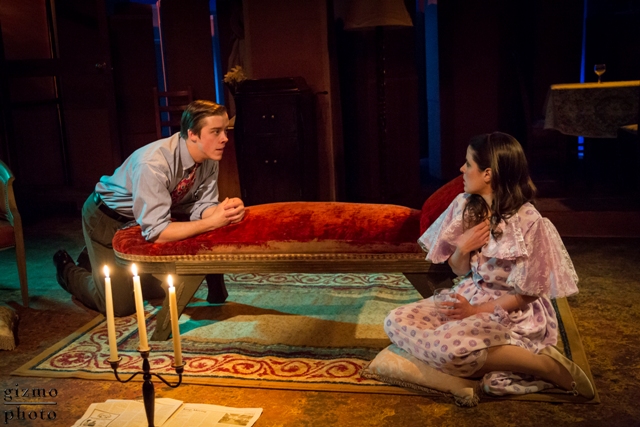
Fortunately, the rest of the cast seems to have been better directed. I especially liked the long second act pas-de-deux (pictured above) between Stringfield’s Laura and Joe Jalette’s Jim (aka the Gentleman Caller) (if only because it gets the misconceived Tom offstage for a while). Jalette credibly brings to life the kind of man who could have been an emotionally and physically crippled girl’s silent high school crush, now returned and willing, for just a moment, and without much malice, to reconnect and flirt a little. Williams wrote Laura a little surrealistically (her kind of actual swooning, for instance, had really gone out before 1937 along with the corsets that had caused it), and we do not look for precise realism in her portrayal. But whatever stricken mousiness she evinces to begin with, during that flirtation she must light up from within, and then suddenly wilt into despair when it ends. Strickland nails both the incandescence and the despair.

Julie Herber does everything right as Amanda the faded belle, more lately a controlling maternal nag who nevertheless looks (for a while) very near success in her efforts to right the capsizing family ship. Herber has the Southern accent and the annoying nagging down. What she lacks is not her fault; it takes a certain commanding presence, and a mature echo of dazzling youthful good looks to make us believe that in her salad days the character could have had seventeen gentlemen callers in one day. Even if that kind of glory was, to Williams’ way of thinking, superficial and a little bit coarse, Williams, here and elsewhere, acknowledges its power, as he acknowledges the power of rare sexual magnetism. It has to be there, even if Amanda is exaggerating for effect. Herber creditably does all the script calls for, but looks more a Medea than an Amanda.

MET is an interesting company that does novel and interesting things, and is a cultural anchor in the vibrant heart of Frederick, and I have enjoyed my visits there. But it must be said that this largely misdirected and miscast show is not MET’s finest hour.

Copyright (c) Jack L. B. Gohn, except for graphic

Theater Reviews Page | Previous Theater Review | Next Theater Review


The Secret Warriors’ Secret Law Unveiled (Sort Of)

 The Big Picture Home Page | Previous Big Picture Column | Next Big Picture Column

The Secret Warriors’ Secret Law Unveiled (Sort Of)

Published in the Maryland Daily Record February 11, 2013

            And why am I under arrest? Herr K asks in Kafka’s The Trial. That’s something we’re not allowed to tell you, the plainclothes arresting officer responds. This surprises K: K was living in a free country, after all, everywhere was at peace, all laws were decent and were upheld.

            Ordinarily, as Kafka intimated, when laws are decent and are upheld, governments are forthcoming about why they do what they do.

FOIA Foiled

            Last July I wrote in these pages about the silence surrounding the nation’s continuing drone assassination program. At the time, I pointed out that we are killing people, some of them American citizens, some of them noncombatants, and our government will not publicize its reasoning. I decried the failure of the Obama administration to release the Office of Legal Counsel memos which must exist to explain the alleged legality of the program. But there were no fuller explanations until this last month, when there were two major developments.

            Well before my earlier comments, reporters for the New York Times, followed by the ACLU, had filed Freedom of Information Act requests to obtain this information. On January 3 of this year, U.S. District Judge Colleen McMahon of the Southern District of New York ruled, in essence, that FOIA will not be the tool to pry that information out of the government’s hands.

The General Drift, Maybe

            As Judge McMahon wrote, we thought we knew the general drift of what would have been revealed, if the requests had been honored. From various public comments of various administration officials, it would appear that the legal justification for this bloodshed runs roughly like this:

  • The September 18, 2011 Authorization of the Use of Military Force was tantamount to a declaration of war upon Al Quaeda and the Taliban, despite the fact that, legally speaking, war had previously been thought to exist only between states or at least would-be states, like the American South in the Civil War, and Al Quaeda, at least, was not even arguably a state.[1]
  • In war, a nation is allowed to kill enemy combatants if it cannot capture them.
  • The people we are targeting are combatants, even if they are tracked down and blasted with missiles far away from a “hot” battle-zone.
  • We have determined that we cannot capture these combatants, and hence have the right under the laws of war to kill them.
  • The laws of war permit the killing of innocents as “collateral damage” to the killing of combatants if an appropriate determination of “proportionality” has been made.
  • If an American becomes a combatant against the U.S., he/she is not entitled to judicial due process, but only to the benefit of the “rules” listed above.

            We only thought we knew the rationale, however: a point Judge McMahon repeatedly made. For instance, in discussing Attorney General Holder’s speech at Northwestern University on March 5, 2012, the Judge summarized: “Nor can it be said that Mr. Holder revealed the exact legal reasoning behind the Government’s conclusion that its actions comply with domestic and international law. In fact, when you really dissect the speech, all it does is recite general principles of law and the Government’s legal conclusions.” She characterized her own analysis of the government’s position as nothing better than “reverse engineering,” an “informed guess” by an “outsider.”

The Questions We Were Prevented From Addressing

             Judge McMahon also noted that this bland and sketchy position raises many important legal questions.

            One had to do with separation of powers; though the War on Terror is colloquially called a war, it has many of the hallmarks of a police action, and police actions end up in front of a judicial, not an executive officer. Is it really right to have the executive serve as the equivalent of judge, jury, and executioner?

            Looking at what the targeted Americans did as possible treason, it is notable that the procedural threshold for proving treason is constitutionally set very high. Is it acceptable to kill those we (supposedly) cannot arrest when they would have enjoyed such protections if we could have arrested them?

            As to the killing of innocents, Holder acknowledged that proportionality is only established if “the anticipated collateral damage [is] not excessive in relation to the anticipated military advantage.” But how can we know whether that calculus is being correctly done if we do not know what yardstick is being applied or what it is being applied to?

            Then, too, the U.S. is subject to international law, which forbids the nation to engage in “assassinations.” Apart from some utterances containing syllogistic logic which the Judge correctly treated with skepticism, we had no clear idea how the administration determined we did not run afoul of that prohibition.

            In short, a more detailed disclosure of administration thinking would have made for a much better informed public debate about the killings the drones commit constantly in our nation’s unstated name. It is even possible that public opinion would have rebelled against our occasioning this carnage, even to protect ourselves; at a bare minimum, we would have chosen it deliberately.

            Judge McMahon may well have been right that because of the FOIA exemptions (exemptions practitioners know often render the Act useless), it proved the wrong tool for eliciting the information that unlocks the debate. The problem seemed to be that there was no right tool. Without one, a detailed answer to the question what justification? was as impregnably protected from meaningful disclosure as the name of the crime Herr K was charged with and executed for.

The Leakocracy Intervenes

            However, at this juncture what I once described in these pages as “the messy but necessary leakocracy” came to the rescue. On February 5, NBC News revealed that someone had provided it with a “white paper” culled from the Office of Legal Counsel memos the Times, the ACLU and the public had all sought. This was not the memos themselves, but instead a congressional briefing. The style is unmistakable, however. This is the stuff of OLC memos. Indeed Daniel Klaidman of the Daily Beast reports that it is an abridgement of them.

            It turns out, as Klaidman reports, that there was, all the time, a struggle within the Obama administration, as there has been within the commentariat, about whether the killing rationale should be publicized. Predictably, the CIA was in one corner and State and Justice were in the other. Initially, the CIA won, and all we got were general remarks like Holder’s. But someone interested in providing some fodder for the interrogation of John Brennan, nominee for CIA head, whom the New York Times calls the “chief architect” of the drone killing program, resolved the matter by making the white paper public.

            That apparently decided President Obama. On February 6, the White House announced it would make the full texts of the secret memos available to Congress. We’ll all surely see them eventually.

Not OK

            For the moment, we already have something semi-substantive. We should have had it long ago. This is not Kafka’s Mitteleuropa. It’s our government and our information. We should not have had to wait for leakers to get our hands on it.

            Next time, I’ll discuss what we have learned about the legal rationale as we know it by then.


[1].         And I leave aside the fact that the document is not captioned a declaration of war. See my discussion of Congressional declarations of hostilities that stop short of war here.


Copyright (c) Jack L. B. Gohn

Shepherdstown 2012 and the Rise of the Rolling Premiere

Theater Reviews Page | Previous Theater Review | Next Theater Review

Shepherdstown 2012 and the Rise of the Rolling Premiere

Published in the Hopkins Review, Winter 2013, New Series 6.1


Take a healthy organism, deny it the environment in which it grows, and it may seek a new environment and new ways of propagating. Serious American theater has negotiated that kind of change.

Once Upon a Time

Once upon a time, plays were nurtured to maturity in a system of tryout houses in places like New Haven and Philadelphia. But those showcases largely disappeared over the second half of the last century.[1] Even for musicals, the tryout theater system has largely been replaced. This does not remotely mean that most new plays are, out of the box, “ready for their closeup,” i.e. the Broadway or Off-Broadway production that garners a review in the New York Times, a sort of stamp of approval that then makes the play marketable for production in regional theater. Rather, new plays are apt to run through a more complex system of developmental venues that seems to be still evolving.

One sort of venue that lends itself to this purpose is the theater festival (for example the Humana Festival of New American Plays in Louisville each year). Another is regional theater itself, although regional theaters are more apt to be the places where new plays are transplanted, after having successfully blossomed in the nursery of New York. It is uncommon, however, for seedling plays to pop up just once in one of these locations and then go direct to New York. Rather, the tryout seems to have been replaced by what Ed Herendeen, Producing Director of the Shepherdstown (West Virginia) Contemporary American Theater Festival, described to me as a rolling world premiere.

Rolling On

The rolling premiere differs from tryouts because the former involve a single creative team (playwright, actors, directors, tech people) honing a play, whereas the latter typically involves different productions of the same play at different places around the country, timed closely together. The creative teams may be collaborating to some degree, but the productions will remain separate. However, the playwright and the play benefit from being able to build on what works and what does not.

Shepherdstown, which this last summer presented its twenty-second season over four July weeks, typifies the “rolling premiere” approach. Five new plays appeared there, all of major league caliber, unexceptionably acted and directed. This was the first production of Johnna Adams’ Gidion’s Knot, the second of Bob Clyman’s The Exceptionals, the second American production of Neil Labute’s In a Forest, Dark and Deep (after a 2011 West End production), the second of Evan M. Wiener’s Captors, and Bess Wohl’s Barcelona, which premiered here, will go next to People’s Light & Theatre in Malvern, Pa. It is likely that each play will end up in New York, but equally unlikely that most if any of them will go there directly.

At Shepherdstown, the plays are timed so that a theatergoer can take them all in over one weekend, and experiencing the plays that way is highly recommended. As we shall see, a picture emerges, not only of the plays chosen, but perhaps of the state of serious American playwriting at this point.

Barcelona: Lost Souls Inching Toward the Light

The strongest of this year’s entrants was Barcelona, which takes two characters from completely different worlds and frames of reference, united only by a hollow core in each of their lives. In little more than a stage hour, each has put a name to the other’s problem, has challenged the other to surmount it, and has met the challenge received in return. At the end of this luminous play, the stage is, fittingly, flooded with light. The miracle that each has wrought in the other’s life is tiny and deliberately underplayed, it is interesting, and it is believable. At the same time, it is quite possible to believe that by forcing the other to make an important alteration in plans, each has fundamentally saved the other. A playwright who can pull off something this wonderful deserves all the stagings I predict this play will receive.

The two initially lost souls are Irene (Anne Marie Nest), a Colorado real estate agent who has come to Barcelona to have a destination bachelorette party, and Manuel (Jason Manuel Olazàbal), a Spaniard whose family was destroyed by the loss of one of its members in the March 11, 2004 terrorist attack at Atocha station in Madrid. Irene is a fascinating character, raised to embrace a world view of stupefying superficiality, but, it emerges, bright enough to own it in her own peculiar way.

IRENE

No, I’m fucked up, that’s obvious, but, I mean, part of what my life depends on is that the other people around me not, like, sink to my level.

MANUEL

That’s not a good thing to depend on.

IRENE

Apparently not.

Manuel’s despair has congealed into hatred and disdain of Americans, whose feckless and dishonest military adventure in Iraq occasioned the terrorist attack, as he sees it. Having deposited his grief, as it were, in the vessel of distrust, he can only stand a chance of fixing it if the vessel is shattered. As he phrases it: “I just think it would be nice, for once, to see an American tell the truth.” Surprisingly, and at some personal cost, she does, and the vessel is shattered. And so he lacks justification for not moving on, and is just honest enough himself to realize his justification is gone.

Barcelona, then, is a beautifully well-made play. Whatever contrivances make it so neat do not detract from its power or the cautious optimism with which it ends. It is ready to go (albeit the last six pages were heavily rewritten and expanded two days before previews).

The Exceptionals: A Big Brother Moment?

Bob Clyman’s The Exceptionals is also sturdily constructed and ready out of the box. I guess it could be called science fiction, though the technology central to it, artificial insemination, already exists. What does not exist yet, evidently, is the use put to it in the play, what amounts to eugenics. The action takes place in an institute that inseminates the wives of childless couples with sperm from geniuses, and then studies the resulting children and the families around them. Clyman is quoted in the program note as commenting that this experiment was tried once, as chronicled in David Plotz’s book The Genius Factory (2005). Apparently, that effort failed in large measure because artificial insemination is tricky. But there is nothing in that story that would render the concept unworkable if the trickiness were overcome and, more important, if the concept’s unproven premise (nature over nurture, i.e. the principle that giftedness truly is inheritable) turned out to be true.

And as the play begins, the institute is ready to take the concept to the next level, schooling a few of the children together, the better to turbocharge their genetic advantages. The play then considers what the human impact of such activities might be. Would there simply be more super-bright, happy kids, or would we be heading for Aldous Huxley’s Brave New World (1931) where eugenics defined social classes and reinforced totalitarian social control? The play cannily provides evidence to support both sides, and leaves the question ultimately unanswered, though it does convincingly show that, if the program were effectively administered, there surely would be takers.

Three representative parents are on display: Allie (Anne Marie Nest again) and her husband Tom (Joseph Tisa), a lower middle-class couple (so identified by his insecure job and her reading habits) and single mom Gwen (Rebecca Harris), a research scientist. The unnamed institute is represented by Claire, the Director of Parent Services (Deirdre Madigan). The couple and the scientist are all in the “Platinum Program,” with superior sperm that has produced superior boys, one for each family. In order for the institute’s plans to be realized, each family will need to give up part of normal parental control over its situation. The couple, looking to have another child, must set aside the idea of pleasing the average-guy husband by conceiving that second child with “normal” sperm, so as to wind up with a child he might relate to better. The single-mother scientist must allow the institute to take over the raising of her child.

The evidence that this is a sinister undertaking is subtle but unmistakable. There is double-talk: “Try not to think of this as a competition. I mean, in a way it is … in a way that’s exactly what it is … but …” or “I really don’t mean this as a threat, although I suppose you could take it as one…” There is spying on the communications of the parents with the sperm donors, which is supposed to be done in such a way as to assure anonymity on both sides. There is economic compulsion exercised on the couple, taking advantage of the husband’s having lost his job. And there is a carrot rather than a stick held out to the research scientist, in the form of a position with the institute, and a chance to restart her botched doctoral oral process.

At the same time, however, the desirability of what the institute has to offer is real. In sharply-etched dialogue, Claire exposes the inner eugenicist in all mothers, simply by asking about hookup fantasies. (The object always turns out to be George Clooney.)

CLAIRE

Can anyone guess the point of my exercise?!

(BEAT)

Every woman needs a man to father her child, but how does she know which man? The one who writes beautiful sonnets to her on her birthday but has blotchy skin? The one who pulled her out of a half-frozen lake once and made soup to keep her warm but showed pictures of her naked to his friends? Whoever she chooses, he will be flawed, which is how it should be. She may even truly love this man, and I say thank God for that. It won’t do her any good to mope around waiting for George Clooney to send her flowers, because he won’t, and she knows that, and yet whenever I ask a woman to try this, she almost always pictures him, but … and here’s my point … she doesn’t want George Clooney. She may think she does, but she really wants his genes.

An argument that goes back at least to George Bernard Shaw, and probably to Much Ado About Nothing, but nicely delivered.

In similar fashion, the super-boys turn out to need each other. The play closes with a revelation of why the institute is trying to get them into its school, a computer simulation of the two of them playing together. Claire’s comments:

[T]he problems that lie ahead of us will be far too complex for any one person … we’ll need great collaborators to solve them. We spent hundreds of hours … every combination of children, and there were only a handful of pitch perfect moments like this one. Neither of your boys ever came close with any other child, but when they were together … I wish you could’ve been in the room with us, because when it happened a second time … I don’t think anyone breathed for more than a minute.

In other words, not only are the mothers eugenicists, but the whole society is too. Seeing the bliss of the two sons simulatedly playing together and giggling excitedly, all the parental resistance melts away. Parental objectives, the demands of evolution, and social utility merge and blend into blissful acceptance. So is this really a good thing, or is this a “He loved Big Brother” moment? Impossible to say, but certainly this play poses the question piquantly and without unnecessarily taking sides.

What Is Gidion’s Knot Really About?

Gidion’s Knot, by contrast, is not a well-made play, or at least not yet, and from the comments I am about to make, it might seem that I liked it less than I did. In fact I found it almost as absorbing as Barcelona and maybe more so than The Exceptionals. Johnna Adams’ writing is strong and keenly observed, but it still cannot be denied that the play needs work. In this tale of a teacher, a mother, two boys and a girl, it is very hard to figure out what actually happened, what to make of it, and why all the parts are there.

Set in a suburban Chicago classroom (and performed at Shepherdstown in an actual college classroom decked out as if for and by fifth-graders), it starts out as a parent-teacher conference. However, it quickly emerges that Gidion, the fifth-grader whose mother is there to talk to the teacher, is dead by his own hand, and that, in light of that, Heather, the teacher (Joey Parsons) had reasonably assumed the conference moot and abandoned. Yet there Corryn, the mother (Robin Walsh), stands, insisting on the conference, one that must, in light of what has gone before, rapidly degenerate into a post-mortem.

Over the next hour, secrets emerge that explain – sort of – why Gidion did what he did. Corryn blames it on Heather for suspending Gidion over a graphically-worded tale Gidion wrote (and Heather is forced to read aloud) in which the school’s students massacre the teachers and use their intestines as art supplies. Heather blames it on Corryn, who filled Gidion’s head with Ossianic dreams of glory and de Sade-ian valuation of art over conventional morality and empathy. Neither, it seems, turns out to be right. Instead, the truth apparently lies in the conflicted behavior of Gidion and his sixth-grade friend Jake as they struggle with emerging homosexuality in one or both of them. But in reaching that conclusion, I am drawing on clues that leave it very unclear which rejected the other’s advances or whether that rejection was tinged with ambivalence; all we know for sure is that it did not end well.

Part of the problem is that if Heather and Corryn are both wrong, and the true explanation is garden variety teen angst (gay division), that is actually far less interesting than it would have been if the suicide really had been over the story Gidion wrote. Truly transgressive art (and this disgusting if interesting story certainly qualifies), raises an important problem: can esthetic values either trump or simply ignore social ones? And even if we believe they can, what rights should conventional society have to defend itself? In concrete terms, if Gidion is indeed a budding de Sade, is it right or wrong to suspend him from school in response?

Conversely, if this is fundamentally a story about emerging gay identity, where is the opposition that made Gidion a casualty? True, we see glimpses of peer pressure (e.g. the heterosexual interest in Gidion by Seneca, an artistic girl who sits near Gidion in the classroom, and Facebook accusations against Gidion of being a “faggot”). But to have produced such a story in the first place, Gidion must be of such strong mettle that he would predictably be next to impervious to such pressure. So rather than the suicide being over sexual identity as such, it may simply have been over disappointed love. For my money, that is just not an interesting enough motivator. The Sorrows of Young Werther may be a classic, but there’s a reason they’re not writing plays or books like that today.

Finally, as would ordinarily be fitting in a two-character play, playwright Adams attempts to give Heather, the teacher, nearly as much attention as Corryn and the deceased Gidion receive, but the back story (advertiser turned teacher, whose cat is about to be put to sleep) hardly seems necessary or compelling. The play would lack for nothing if Heather’s interior life were ignored, if she were presented simply as an authoritarian who (for narrative purposes if none other) were also honest enough to spill beans as the plot required them to be spilled.

I hope that the play will continue to develop, and that as it does, these issues come to be worked through.

Who the Captor? Who the Captive?

Evan M. Wiener’s Captors is a more finished work, although I am of two minds how successful the product under the finish is. It focuses on a short period in the life of Adolf Eichmann, chief implementer of the Final Solution, between May 11 and May 20, 1960, respectively the date Eichmann was seized in Buenos Aires by agents of Mossad and the date he was spirited out of the country to Israel on an El Al flight that had come ostensibly to take home a delegation of Israeli diplomats honoring the 150th anniversary of Argentinian independence. The primary source is the memoir Eichmann In My Hands, by Peter Z. Malkin and Harry Stein (1990). Malkin was, at least on the evidence of the play, the primary interrogator though not the planner, and, on that same evidence, the man who persuaded Eichmann to sign a paper submitting himself to trial in Israel. The paper later became central to the Israel’s claim, in the face of widespread international outrage at the kidnaping, that the proceedings were legitimate.

Wiener’s model seems to have been Peter Morgan’s Frost/Nixon. It follows two historical individuals in a protracted duel of words in which the roles of quarry and game become jumbled. In both plays, even though what the world at large would deem a clear winner and a clear loser emerge, there remain senses in which the personae have switched. (In this regard, there are also echoes of the mano-a-mano of Hannibal and Clarice in Silence of the Lambs.) The title Captors is nicely ambiguous, since Eichmann’s unspeakableness looms over his nominal captor, Malkin, and commandeers his imagination in a way that suggests that in some obscure way Eichmann has the upper hand.

This Eichmann (Philip Goodwin) is not the silky monster television viewers of a certain age may recall Milton Johns portraying in 1988’s miniseries of Herman Wouk’s War and Remembrance. This Eichmann is a frightened fugitive run to ground. Even when he acknowledges his identity, he is evasive, nearly impossible to pin down.

Yet Malkin (Joey Collins) needs two things from him, and in the end secures both. One is the previously-mentioned written submission to the Israeli court’s jurisdiction. The other is the secret of what made him tick. The secret to getting Eichmann to surrender both is to allow him to talk. Like Peter Morgan’s Nixon, Wiener’s Eichmann has things he is actually bursting to share. In Nixon’s case, it’s the self-vindicating theory that if the president does it, it’s not illegal. In Eichmann’s, it is the religion he has made of following orders. He tells Malkin because he is made to think – and it may be true – that: “We — you and I and those of similar… yes? — we understand, value, heed orders…” And there is a way to do it: “It was extremely arduous work, requiring an extremely rigorous sense of responsibility. Few could have done it as I did. Proper, always proper.”

So in the end, Wiener’s Eichmann is somewhat different from the essence of Arendtian banality. In his world-view, even years after the fact, he remains a hero. What brings him down may be a failure of imagination in one direction (he cannot admit and seemingly cannot grasp the horror of liquidating one set of children while nurturing his own, and he cannot quite see how he is being seduced by Malkin), but in another sense his whole life has been an exercise in imagination, a self-apotheosis as a hero of military obedience to orders. He finally agrees to cooperate with his captors because he wants the world to appreciate him, and to bring that about, he must stand trial. And when he has his trial, this is a kind of success for one who chafed at living in the shadows. Malkin says, looking back:

Yes, we bought him to justice, and he died for his sins. Which is what I wanted. But he escaped anonymity, found his place in history. Became… bigger. Which, as you say, is what he wanted. So maybe that’s why he thanked me. I don’t know.

This is a bit more nuanced a psychological portrait than Hannah Arendt’s. Yet I’m not sure that Herman Wouk did not have the better of it, both historically and dramatically. Wiener gives us an Eichmann without overt anti-Semitism, with barely a trace of monstrosity. When Malkin points out that all that distinguished the children in his own family wiped out by the Holocaust from Eichmann’s children was that the former were Jewish, Eichmann skates right past it. He sees it, but his reaction is not hatred, only lack of empathy.

MALKIN

My sister’s boy… He was blonde, blue-eyed. Like your son. Haasi. Who likes trains. (flat) You murdered him. Yes?

EICHMANN

No. No, I told you… I never killed…

MALKIN

You know what I mean. Your people. (A pause.)

EICHMANN

(common-sense, as if this explains it)

Yes. But he was Jewish, wasn’t he?

If all that drove Eichmann was an overdeveloped sense of military hierarchy and not an inner identification with the modern era’s most devastating campaign of ethnic cleansing, this is not truly banality, but as dramatically unsatisfying as if it were. As Malkin himself remarks: “There’s nothing to be gotten from him.”

I don’t buy it; while I am no Third Reich expert, I find it hard to believe that there was not something more theatrically compelling in the real Adolf Eichmann’s heart. Naturally he was not going to share it with the Jewish man who was his captor and interrogator for nine days. But there is so much observable hateful bigotry out there – read the user comments after almost any posted article on any news website and there it will be. To accept that the COO of the Final Solution was free from all that, and just motivated – even in his own mind – by nothing more than the desire to be a good soldier, takes more credulity than I can master.

That said, Wiener has rolled his dice with this approach to the subject, and to make it otherwise would not be to tweak the play, but to write a whole different one. For what it is, it is quite well done.

In a Forest, Dark and Mechanical

Neil LaBute is probably the best-known and most esteemed of the five playwrights on display at Shepherdstown this season, which makes it surprising that his contribution, In A Forest, Dark and Deep, was both the least finished and the least interesting. To say almost anything significant about it requires a spoiler alert, because unlike the preceding plays, in which the revelations and plot developments are merely in the show, and not the show themselves, that is not the case here. So the reader is hereby officially alerted, and can skip the next eight paragraphs if so desired.

In form, Forest resembles a number of noir thrillers. There is a femme fatale, a series of revelations that show us her schemes, a murder, and a patsy, whose dawning understanding of the femme fatale’s schemes comes one step behind his developing patsy-dom. But this is – at least I think it is – an attempt to use the noir format to do something slightly more ambitious.

The play takes place in a cabin in the middle of a forest in the middle of the night in the middle of a storm, and the owner of the spookily-situated cabin is a professor named Betty (Johanna Day), who has called on her ne’er-do-well brother Bobby (Joey Collins again, in a stunningly different role from Malkin) to come over and help her clean the place up. Gradually we learn, piece by piece: a) Who lived there; b) What his relationship with Betty was; c) What this means about her marriage; d) What happened to the missing resident; e) Betty’s role in what happened to him; and f) Why Betty chose Bobby to help her. For each revelation, Bobby plays detective, sorting through his sister’s lies, and forcing retraction after retraction. Ultimately he finds himself turned into an accomplice after the fact.

This sounds noir-ish all right, but it isn’t entirely, because Bobby’s involvement – helping his sister take steps to cover up the murder she committed – isn’t the usual patsydom of the sap who’s been in la fatale’s sexual thrall. He is not really trapped into it, just reluctantly willing to help, apparently because even semi-decent guys like Bobby help out their sisters.

And the killer sister is too knowable for noir. For comparison, think of Kathleen Turner’s Mattie, in Lawrence Kasdan’s classic Body Heat. We cannot miss, by the end, that she is a consummate liar and user; we do not, however, have the faintest idea what else she is. We do not know what makes her tick, or if she ever had the slightest genuine feeling for Ned, her patsy. Like Lillian Hellman as described by Mary McCarthy, every word Kasdan’s creation utters is a lie, including “and” and “the.” Betty, by contrast, finally, after lying repeatedly, does tell the truth about herself: she did what she did because she could not resign herself to the loss of youthful sexiness:

[I]t’s not so easy to give that up. For it to pass you by. And so later, you’ll do almost anything to keep it, to [be whistled at] again just once. And from whomever. Kid down at the pharmacy. Some old man getting his coffee in Dunkin’ Donuts. That’s how pathetic ya get. Shit. (BEAT) But it does pass. Yes, it does and one day you are transparent. People walk by and don’t see you, they say, “excuse me, Ma’am” and you just want to scream, you wanna grab them and shake them and yell, “I am a fucking beautiful, desirable woman” but you don’t. You don’t do anything like it because you’ve started to know, inside somewhere you’ve begun to recognize the truth. You are not that anymore. You’re just normal now and, and middle-aged and tired most of the day and everyone, from your husband on down, has begun to see right past you. Through you. As if you’re no longer even there.

It may not be profound as LaBute probably hopes, but there is a there there. It is not very noir. But this is not a good thing. Forest lacks the frisson and the scariness of noir.

And it offers little of greater artistic weight by way of recompense for not being a true genre piece. Betty is not a 21st-Century Hedda Gabler, if only because her monstrosity is not quite as believable. She is not even an instructive exemplar of the destructive banality of sexual boredom like Emma Bovary. Because she only works as a character if we believe in her, if we can see how her frustration with no longer being a sexual player could lead her to kill a younger lover who was using her. The rules of the game for this play call for us to take it quite literally: it is set in a world of shopping-cart corrals, Dunkin’ Donuts (as we have seen) and Priuses. A critical clue picked up by Bobby as he irons out his sister’s lies is the vintage of a model of Apple laptop. And in the midst of all this literal-mindedness, LaBute wants us to believe in a psychological makeup of Betty that just does not ring true.

And this contradicts the structure of the play.  It can be said that the whole movement of the play is towards a revelation of the truth. The keynote is an oft-repeated early remark by Bobby: “The truth hurts, don’t it?” Allegedly hurtful skeletons hurtle out of the closet at the rate of about one every twenty minutes. They pile up like the bodies in the final scene of a Jacobean bloodfest. There are too many of them, and their serial presentation consequently turns unintentionally comic.  Of course there’s going to be another revelation, we say to ourselves; it’s been twenty minutes since the last one. What will the playwright have dreamed of next? It becomes about plotting, not character or philosophy. And certainly, certainly, not about truth or whether it hurts.

If this were not enough, there is an utterly gratuitous secret that Bobby brings to the table, his sexual yen for his sister. It accomplishes nothing, since it has nothing to do with why he brings himself to help her with the cleanup. (It hardly makes of Betty more of a belle dame sans merci that she never played along with Bobby’s forbidden yearnings, and from a plot standpoint there is no indication she was ever aware of them before.) And, as noted, the play already features too many secrets.

Unlike Captors, Forest looks unfinished enough so a major rewrite would seem possible. My own suggestion: Choose a direction, either noir or tragedy, and go with it. If it’s noir, don’t try to humanize Betty or explain her; instead, unleash the inner monster in her. If it’s tragedy, don’t have Bobby helping out with the cleanup. We need to see him condemning the sin if not the sinner, and, as the audience’s proxy, calling a halt to the madness, like the Prince at the end of Romeo and Juliet, even if the sister then turns on him and kills him too.

Secrets and Small Casts

Based on these five plays, at least, at least a couple of generalizations seem to suggest themselves about the state of contemporary American playwrighting.

First, there is a huge tendency to rely on the gradual revelation of big secrets, leading one to wonder whether playwriting classes today are all teaching their students to do exactly the same thing. Almost all of the action of Forest, Gidion’s Knot, and Barcelona consists of a sort of Dance of the Seven Veils, in which things known to one or both of the principals are pulled out of the shadows, one by one. The sharing and acknowledging of secrets seems to be the entire contents of Forest, the surmounting of them the challenge the characters successfully meet in Barcelona (in the last ten minutes, after the dropping of the veils for the first eighty), and making peace with them is at least arguably the subject of Gidion’s Knot.

To a modern theatergoer, this is commonplace enough that it does not seem remarkable until one is confronted with it repeatedly. Making the revelation of deep, dark secrets the heart of the play seems to have come into vogue around the time that psychoanalysis was placing a similar emphasis upon excavating them, and that emphasis leaked out into the plays of dramatists like Arthur Miller and Tennessee Williams.

But at mid-century, there was still a difference. With Miller and Williams, the secrets tended to be both Freudian and one-and-done. Someone’s yielding to avarice had resulted in irreparable damage (think All My Sons) or someone’s sexual hysteria had driven her into a dreamworld (Streetcar). The nature of these secrets was such that, even when they came out, there would be nothing to do about them. They would explain, perhaps, how bad things came to be so bad, and maybe the recognition would seal someone’s doom. But you don’t need many secrets of this type to make a play.

Modern plays, however, are written from a different era in popular psychology, let us call it the Dr. Phil era. At this juncture, confronting our secrets is seen in certain circles as the ultimate cure for whatever psychologically ails us, a form of motion from one place to another, probably better one.  So getting everything, each and every secret, out on the table, and dealing with the herd of elephants that may share the room with us, mostly by screaming and then hugging, seems like the way to make progress towards mental health and happier lives.

There is little Dr. Phil-ish about these three secrets-based plays, I grant, but in them unveiling of secrets still is viewed as transformative, and not merely revelatory.  To appreciate how strange this is in the history of Western theater, one need only compare the role of secrets in, say, the works of Shakespeare. There few secrets have any importance unless the audience is in on them from the start, be it the malevolent motives of Iago or Richard III, the secret gender of Rosalind or Portia, or the fact that Polonius is hiding behind the arras.  The characters may be in the dark, but the audience is not. Surprises stem from character, and do not for the most part illuminate it.

Today’s theater, however, is such that any reasonably percipient audience member is going to be picking up quickly on the tiny signals that something is wrong, something has been left unsaid, there is some hidden agenda, and that all will doubtless be revealed in due course. This trope is becoming overworked, and modern playwrights need to lay off it for a while.

The other thing that stands out in all of these selections is the extremely small casts. This obviously reflects a realistic response by contemporary playwrights to the economics of getting a play produced, and hence of earning royalties. This economic compulsion drives playwrights to a lot of skills and strategies one can admire – for instance figuring out ways to describe absent figures and their activities so vividly they seem as present as if shown onstage, doubling (so that an actor plays more than one role), or making the very absence of a character a driving force of the action (as in Forest and Gidion’s Knot). But it can leave audiences feeling a bit claustrophobic, particularly if presented repeatedly. Three of these plays deployed only two actors, and the other two only four and five.  And I can say that by the end of the process, I was grateful for the plays with the larger casts, and fighting an unconscious feeling at moments that I was stuck in an endless loop of No Exit.

Fortunately, the larger feeling I got was that contemporary American playwriting is a wondrous, dynamic thing, and that the new ecosystem, featuring rolling premieres at places like Shepherdstown is a very good way to capture playwriting lightning in a bottle, and to help it flash its brightest when it finally strikes earth in New York.

Through the Heat

 Theme Songs Page | Previous Theme Song | Next Theme Song

Through the Heat

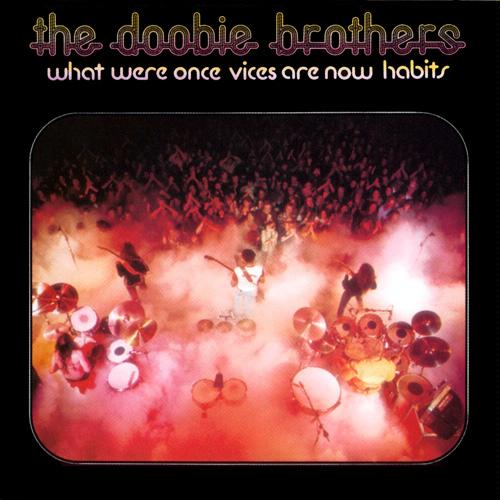
Eternal Caravan of Reincarnation, by Michael Shrieve, Neal Schon & Tom Rutley, performed by Santana (1972), encountered 1975

Buy it here | See it here

In the summer of 1975, S. and I faced the necessity of moving: the one-bedroom student apartment in which we had lived for four years[1] was now going to be too small, as we were expecting a baby in September. While we’d hoped that the move would take us to some other college town now that I’d earned my doctorate, no university had picked up my option.

So the move was bound to be within Baltimore. We had both budgetary limitations and ideas about how we wanted to live our lives that militated jointly against doing what the in-laws would have like and moving to their suburbs. Our idea was to stay near the Johns Hopkins campus.

But it had to be a house now. And so we went looking in various dubious neighborhoods – for a couple of months, if memory serves. For the longest time we could find nothing affordable that wasn’t also grim. Eventually, I forget how, we discovered 3035 Guilford, little more than two blocks away, a rowhouse with three bedrooms and a semi-finished basement to work in as well. It wasn’t in bad shape, in fact, as I wrote at the time, “it is pleasant, airy, and gas-heated.” The price was right.

I wrote to my mom and stepdad on July 5 that we had the place (I assume I’d just inked the rental contract). And we moved in August. In between lay much making of arrangements and then the moving itself. And when I think of that time, there is always one image – except it’s not merely visual – that comes into view. In my mind’s eye, I’m walking that two-block long stretch of 31st Street in blistering, shimmering, soul-annihilating heat.

And instantly, the song that comes to my mind is Santana’s Eternal Caravan of Reincarnation. It’s an instrumental that starts with a generous helping of chirping-cricket sounds with a saxophone behind them (played by Hadley Caliman) making strange noises like some Mideastern horn. One is immediately transported to a desert oasis (crickets do live in deserts, among other places).[2] Then, at 1:45, comes swaying music marked off by a bass figure (Tom Rutley plucking away) followed 15 seconds later by a shimmering phased electric piano (Wendy Hass), making one almost see the vibration of the air with the mirage effect, and clearly we are contemplating the arrival of camels in caravan, just as the title suggests, through a desert haze. And although Carlos Santana does play some chords, the song from that point belongs to Hass and her shimmering piano.[3] Never have I heard a number that so vividly conveys sheer atmospheric heat.[4]

I may have been only myself, not a caravan, but that song is me, trudging through the blast of a Baltimore summer in that season of making ready for a change.

Santana had recorded it three years earlier, so you may ask why it had only just come to my attention in 1975. The answer: I had recently discovered that the Towson Public Library possessed a great, if somewhat idiosyncratic collection of pop, jazz, and rock LPs which you could borrow and capture on your reel-to-reel. The newest stuff tended to circulate more, meaning that there was more competition for it, and the older stuff, at the end of its physical lifespan, was more available. So if you didn’t mind your taped copy being full of pops and scratches, you could score amazing stuff. (My copy of the song today, however, is ripped from a CD.)

Walking through that heat to the new house, perhaps carrying something as a caravan would, I was clearly making progress, despite impediments, despite not finding a job, despite being turned down even by local prep schools for positions teaching high schoolers. I had finished my dissertation, and I was going to be a father. Those were big things.

And here is a photo taken a couple of months later in the new house, with my perfect little girl, still obviously coping with the heat.


[1]  This was at 3120 St. Paul Street, a lovely place with a grand grassy courtyard in the middle, stucco walls, wide staircases and some family history attached. My stepdad had lived there when he was a grad student. (And my daughter, whose gestation is mentioned just below, lived there later on when she was a student at Hopkins.) The real estate agent who had located the place for us, a friend of S.’s parents, was one of those peculiar characters from an era ended only in 1948 in Baltimore, the time of restrictive covenants that had limited the residential opportunities for blacks and Jews, well delineated in Not in My Neighborhood, by Antero Pietila. The agent, being Jewish, had been involved in promotion of certain properties into which he himself could not have moved. His having run both with the hare and the hounds, as it were, had led to his being viewed with some resentment within his own community, including by my Jewish in-laws, but this resentment did not prevent them using his connection to land us a good place to live.

[2] I’d be willing to bet that the composers were taking a page from Pink Floyd’s Grantchester Meadows, released three years earlier, which opens with an extensive excerpt of birdsong.

[3] A very helpful note on the song is here.

[4]   No, not Estate, not Something Cool, not Lazy Afternoon, not Too Darn Hot, not Summer in the City, not Under The Boardwalk or Up on the Roof. Not even the Body Heat theme.

Copyright (c) Jack L. B. Gohn, except for album artwork

 Theme Songs Page | Previous Theme Song | Next Theme Song

Spring Cleaning

 The Big Picture Home Page | Previous Big Picture Column | Next Big Picture Column

Spring Cleaning

 Published in the Maryland Daily Record January 14, 2013

            Periodically, the moment known as spring cleaning arrives.  We scour out closets and garages and attics, and rid ourselves of accumulated bric-a-brac, of objects that (rightly or wrongly) seemed like good ideas when we acquired them, but no longer do. Garage sales, passing things along to Goodwill, and just putting junk out on the curb for the sanitation workers – all these tactics are vital to our domestic success. If we didn’t cull and toss the accumulated flotsam now and then, it would eventually render our homes impassable and uninhabitable.

            The national household is no different. And what with a presidential inauguration and a new Congress right around the corner, it seems like spring cleaning time right now, even in the dead of winter. Time to rid ourselves of some laws that block up the hallways of our national home and impede the country’s progress. I have three that I would suggest hauling away.

The Obsolete Second

            The first is the Second Amendment. The post-Newtown discussion seems to be shaking down, all too quickly, to talk of an assault weapons ban and checking up on gun purchasers for mental health problems and criminal history. These are certainly worthy goals, but one root of the problem is the Second Amendment itself. It may have been a good idea at one time, but only because at that time, 1789 to be precise, in the very words of the Amendment, a “well-regulated Militia” was “necessary to the security of a free State.” The United States faced real threats to its security, in the forms of England, France, and the Native Americans, all of whom it would have to fight in the following three decades. And it had but a negligible standing army.

            In these modern times, however, we have this thing called the Pentagon. Also a standing armed force of about 1.5 million, augmented by reserves and a National Guard about doubling that strength. This force has an annual budget of about $700 billion, as big as those of the next twenty military spenders combined. To suggest that a citizen militia dependent upon weapons owned by individuals is “necessary” to our “security” in view of this massive military ownership of weapons is simply absurd.

            Even more absurd is the fantasy that local militias (if they truly existed outside the National Guard) could “take back” America from its rulers if the need arose. If this notion of the purpose of militias ever had any validity, it has none now. The U.S. military would crush any armed rebellion. In fact law enforcement could do the job without military help.

            The fantasy is so hare-brained one might almost think it harmless. But the parents of Newtown probably do not think it so. We need to get rid of the notion of an individual constitutional entitlement to bear arms. What privileges to bear arms might follow repeal could be tailored to a more realistic public policy.

The Busted Filibuster

            Secondly, we need to get rid of the Senate filibuster. Technically, there is no “filibuster rule,” only the absence of any rule limiting Senate debate, save for Rule XXII, the “cloture” rule, which requires a super-majority to close a debate. Effectively, the filibuster gives a Senate minority enormous power to prevent action by the majority. At one time, this restraint might have been thought a desirable feature of the Senate’s constitutionally-anticipated role of ensuring deliberation and caution in the legislative process, as a counterweight to the overeager populism of the House of Representatives. But if one can speak of restraint gone wild, that is what has happened with the filibuster. It used to be rare, and now is commonplace. (There were, for instance, over 100 cloture votes in 2009.) And to gauge the obstructive power of the rule, consider just this: there are 33 federal judicial nominees awaiting Senate confirmation, and many have been held up over a year, mostly because the minority will not allow them to be voted on.

            We are at a very definite “spring cleaning” moment with respect to the filibuster. A rule change that would dis-enable filibusters would ordinarily be sought to be filibustered itself, but at the start of a new Congress, the rules of a previous Congress arguably do not exist and a simple majority of the Senate can at least theoretically vote, filibuster-free, to amend the rules. (Alternatively, the constitutional power of the Senate to determine its own rules may be held not to be subject to those rules; this is the so-called “constitutional option.”) I put the matter in somewhat iffy terms because no one is exactly sure what can be accomplished. But this does seem to be the moment, with an American public clearly disgusted by Congressional inertia, for which filibusters and the threat thereof clearly bear their share of the blame.

            So let’s do it. Let’s have the Senate pass a rule that brings every motion to the floor in a reasonable time.

Marijuana Prohibition: Solution to a Non-Problem

            Third, let’s repeal 21 U.S.C. § 812(c)(10), the provision that makes a “Schedule 1 controlled substance” out of marijuana. To be on that list in the first place, marijuana had to appear to have a “high potential for abuse” and to have no accepted medical application. Perhaps at one time there was a consensus on those two points. But a majority of Americans would now differ with both propositions. What does “abuse” even mean for a recreational drug? If one smokes marijuana to get high and succeeds, is that not “use” rather than “abuse” by definition?[1] As to accepted medical application, at least two states would, left to their own devices, permit medical marijuana.

            Marijuana may not be good for you. It seems not to be terribly bad for you, however. It will intoxicate you and might habituate you and might be mildly associated with other diseases, but with alcohol, we have already accepted a very addictive and rather toxic intoxicant in our midst. This horse-is-out-of-the-barn-already argument, standing alone, might not be a good enough reason to legalize pot, but the human cost of all the incarceration for marijuana cultivation and possession certainly is. We are currently imprisoning about 45,000 Americans for possession of this not-terribly-bad-at-worst substance – and the vast majority of the marijuana prisoners are users, not dealers. Nor should we forget the financial cost; in 2000, it was estimated that the total cost of marijuana prosecutions and incarcerations was $14 billion. To me, spending that kind of money to seriously disrupt the lives of so many people for something that poses so little real threat to public health and happiness – and whose legalization public opinion favors – is one terrible idea.

            The federal statute is the key. If we get rid of it, the states will be free to respond to public pressure. Polls suggest that we have passed the tipping point, with more Americans favoring repeal than not, and more Americans opposed to federal enforcement than not. We survived the end of Prohibition, and we would survive the end of marijuana prohibition as well.

            So there you have it: three commonsense suggestions for laws the nation could leave at the curb at this moment of national renewal. Letting things go is as vital a skill for a nation as for a householder. So let’s haul trash! Last one out is a rotten hoarder


[1].  It is apparent that the framers of the law were thinking in terms of medicinal drugs when they inserted this language. It is meaningfully “abuse” to divert medicine to use as an intoxicant, because there is a proper, i.e. medicinal, “use.” See  Hoffmann-La Roche, Inc. v. Kleindienst, 478 F.2d 1, 6 (3d Cir. 1973). But if one denies the propriety of using as an intoxicant a plant grown purely for its properties as an intoxicant, then effectively one denies that there is any lawful “use” for it. “Abuse,” however, linguistically depends for meaning upon its opposite, namely “use.” The absence of any accepted “use” thus seems to negate the meaningfulness of “abuse” in turn. Arguably, therefore, the assignment of marijuana to Schedule 1 is erroneous because, linguistically speaking, there is no “potential for abuse,” never mind the “high potential” the statute requires.

Copyright (c) Jack L. B. Gohn

 The Big Picture Home Page | Previous Big Picture Column | Next Big Picture Column

A Slap in the Face? Really?

 The Big Picture Home Page | Previous Big Picture Column | Next Big Picture Column

A Slap In The Face? Really?

Published in the Maryland Daily Record December 3, 2012

  One standard knock on amnesty for illegal immigrants is that it would show disrespect to those who followed the rules when they entered, and undermine the rule of law.  I quote amnesty foe Rep. James Sensenbrenner: “This would be a slap in the face to all those who have followed the law and have come to America legally.”[1]

An Experiment

Now I am the descendant of Europeans who all, so far as I know, arrived here legally. So I thought it was a reasonable experiment to ask myself how “slapped in the face” an immigration amnesty would have made my law-abiding ancestors feel.

There were a lot of British-surnamed forbears I don’t know much about who came to these shores in pre-Revolutionary times. Like as not, they arrived when the only immigration policy the Crown had for the British colonies was to shovel as many subjects onto the North American continent as it could, the better to balance Native Americans, and the Spanish and the French in competing colonies, and maintain a ratio of whites to African American slaves.[2] Otherwise put, the colonies’ immigration policy was simply the flip side of the mother country’s emigration policy. The idea that the government would try to block anyone from coming here would have seemed laughable to them. No big slap there.

Post-Revolutionary

My first ancestor to make a post-Revolutionary arrival (and to marry into those British bloodlines) was probably one Henry Motz, who came from what is various described as Germany and Holland, eventually working at the Pembroke, Maine iron works. There was no national immigration law then for anyone either to comply with or to disobey, and none when my great-great-great grandfather James Mincher immigrated with his wife Jane, from Birmingham, England sometime before 1816. He too became a hand at the Pembroke Iron Company. The Minchers and the Motzes would, I suspect, have been nonplused by the current debate. They wanted to come here, and they came: end of story. (The same would have held for my stepdad’s family; the Gohns arrived in Tennessee before 1900.) They “paid no dues” to enter legally.

Mincher and Motz children married, and became the parents of my grandfather Leon Mincher (Phi Beta Kappa, Bowdoin College ‘07). Leon worked as a banker, mostly, but fate sometimes directed him into different jobs. One day about 1912, for instance, he was peddling encyclopedias door-to-door, on the Vermont side of Lake Champlain. A pretty young serving-woman answered the door. I have no information about how many books Leon sold that day, but I do know that he and the serving-woman, Mary Elinor (“Nellie”) Dalton, were married in 1913.

Nellie

Nellie, my grandmother, was born to a family of Irish-heritage farmers and shopkeepers on Canada’s Prince Edward Island. She went down to New England about 1903, at the age of 16, to go into domestic service because her family was down on its luck.

The posture of immigration enforcement faced by Nellie was different – a little – from what my earlier-arriving forbears had encountered. In Henderson v. City of New York (1875), the Supreme Court had established that the federal government, and only the federal government, had the right to regulate immigration. The municipal measure the Court struck down would have laid a tax on new arrivals to establish they were not paupers and to pay for the care of immigrants who were poor. The exercise of this newly-asserted federal power to regulate the entry of the poor was not immediately delegated to any enforcement agency; that happened only in 1891, with the creation of a Superintendent of Immigration in the Treasury Department,[3] partly also to enforce the laws passed in the late 19th Century against Chinese immigration.

Those laws were augmented over the years. By the time Nellie arrived, various pieces of legislation had rendered excludable, in addition to the Chinese: convicts, prostitutes, paupers, lunatics, idiots, insane persons, persons likely to become a public charge, persons suffering from a loathsome or a dangerous contagious disease, persons who had been convicted of a felony or other infamous crime or misdemeanor involving moral turpitude, polygamists, epileptics, professional beggars, anarchists, feebleminded persons, and children under 16 unaccompanied by their parents.[4] Significantly, though, anyone being inspected at the border would only need to show she was none of the above, and in she would come. As my cousin put it, all Nellie really needed to do was buy a train ticket.

Isadore and Rosina

The first of Nellie’s and Leon’s four children was my mother, Louise, who went to Radcliffe College in Boston. In one of her classes there she encountered my father Emile Smullyan, a Harvard grad student. Emile’s parents Isadore and Rosina had entered the country in 1907 under the same general regime Nellie had encountered in 1903. Isadore hailed from Zagare, on the border between Lithuania and Latvia, and became something of a refugee at a very young age. Zagare’s Jewish population seems to have dwelt there on sufferance of the nobility and the tolerance of the Catholic priest. Isadore’s father, Schumaria, the “Jewish mayor,” got crosswise with these authorities somehow and had to leave, as did the majority of Zagare’s Jews over the next few years. (Which turned out fortunately for them, as the Nazis killed off every single Jew remaining in the town one day in 1941.)[5] Young Isadore sojourned in Antwerp, in Johannesburg, and in London (where he met and married Rosina), before coming to New York.

When Isadore and Rosina sailed into the New York harbor, they were well-off enough not even to put in time on Ellis Island, which was reserved for the passengers in steerage. My grandparents disembarked in Hoboken and got right to work on their American lives.

To Sum Up

To sum up: Not one of my immigrating ancestors had to show a reason to come here or had to stand in line: they just came. Do you think they’d object to other people getting the same deal? I don’t.

Contrast that with the situation now. Since the 1952 passage of the Immigration and Nationality Act, a would-be immigrant could no longer just show up.[6] He or she would generally need to show one of two reasons for being here: either a family relationship to a legal resident or citizen, or some U.S. employer’s demonstrated need of him/her. And in many legal categories of immigrants, lines are prohibitively long. For instance, immigrant visas are just now being issued for skilled worker applicants who applied November 22, 2006 or earlier.

Old White Guys Lack Standing

So while newcomers today may have considerable dues to pay, most of us old white guys with ancestors who arrived before 1952 lack standing to claim that amnesty would be a “slap in the face.” Certainly not Rep. Sensenbrenner, who was born in 1943 in Chicago.

And as to the rule of law, consider: The Minchers and the Motzes and the Daltons and the Smullyans and the Gohns – who didn’t have to wait in line or pay dues – gave the country a railroad conductor, shopkeepers, professors, a mathematician, a diplomat, a World War II naval officer who helped develop radar in the Pacific, a senior lab tech in the development of the Bomb, an architect, a skilled taxi fleet mechanic, a Hollywood actress, at least three lawyers, and much more. It would have been crazy to make their forbears wait in line or punish line-jumping, and it’s no saner to do it now just because the family names are apt to be Diaz and Chang and Ahmad.

The rule of law is a fine thing, when it’s not stupid law. Amnesty would eliminate one kind of stupidity. And my face, for one, would not be stinging at all about it.

My thanks to cousins Steven Szabo of Halifax and Deborah Smullyan of Boston, as well as my likely cousin Lawrence Schmulian of Edinburgh, for some of the genealogy in this piece.


[1]. The same points are made in slightly less emotional terms on the Congressman’s website, accessed 11/26/12, here.

[2]. There was considerable distress in the north of England, Scotland, and in Ireland in the mid-18th Century. The entire mercantile policy of the Empire encouraged and facilitated emigration to the Colonies.

[3].  Daniel W. Sutherland, The Federal Immigration Bureaucracy:  The Achilles Heel of Immigration Reform, 10 Geo. Immigr. L.J. 109, 112 (1996).

[4]. Alison Umberger, Free Trade Visas: Exploring the Constitutional Boundaries of Trade Promotion Authority, 22 Geo. Immigr. L.J. 319, 350 (2008).

[5]  See here and here.

[6]. Before the INA was passed, it was already getting harder to come in. The turning point was the Emergency Quota Act of 1921, which set national quotas with an eye to stabilizing the ethnic mix. Together with subsequent legislation, these laws might have made it difficult for my Jewish ancestors to immigrate – and became a national scandal when Eastern European Jews were turned away during the Holocaust. But fortunately my relatives were all here already before 1921.

Copyright (c) Jack L. B. Gohn

 The Big Picture Home Page | Previous Big Picture Column | Next Big Picture Column

Not in Kansas Anymore: Bus Stop at Center Stage

Theater Reviews Page | Previous Theater Review | Next Theater Review

Not in Kansas Anymore: Bus Stop at Center Stage

Posted on BroadwayWorld.com on November 30, 2012

Here in Baltimore, it seems to be Bus Stop season. It’s been less than a month since I reviewed the Spotlighters’ community theater production of the William Inge 1955 classic; now it’s Center Stage’s turn. And of course Center Stage (or is it Centerstage these days?) gives it a full-dress professional staging. The difference is surprisingly great.

It is easy to be so impressed by the credentials and the skills that modern community theaters bring to bear, particularly in this vibrant theater town (of which more below), that one forgets how much more firepower a truly professional outfit can train on a show. Without showing an ounce of disrespect to Spotlighters, this production is so much more impressive in every way, from acting to sets to direction, that it’s almost like watching a different play.

I said, speaking of the earlier production, that Inge had built certain problems into the fabric of the play, that the three couples that come into a bus-stop diner on the Kansas steppes or form there require a pretty heavy suspension of disbelief, and that it’s hard to reconstruct the attitude we’re apparently supposed to have about them. And indeed the program notes by this production’s director, David Schweizer, confront that problem head-on. He writes:

“Doesn’t Bus Stop feature a deviant alcoholic, a physically abusive cowboy who kidnaps a young woman to drag her across state lines, a lonely and sex-starved café owner, a brooding sheriff with a shady past, and many others…?”

Despite that, he maintains, this play is intended to be and succeeds as theatrical “comfort food.” I don’t necessarily concur with that conclusion, but I do have to say that he has employed the unique resources of a professional company to sand down some of the rough edges in the script, in a way smaller companies couldn’t do. Using those resources, he has sneakily transformed a mid-century work of American realism into something fantastical like Midsummer Night’s Dream or As You Like It, and thereby has solved a lot of problems.

It starts with stage snow, lots and lots of it, which never lets up through the entire show. At the beginning , before and while James Noone’s impressive set is wheeled in, piece by piece, the snow falls inside the diner area, to be relegated to the scrim at the back of the stage only once the diner is assembled.  And even then a generous expanse of actively snowy sky remains on view. We are not truly in Kansas anymore: we have entered a snow-world as separated and set apart from our own as are the woods outside Athens or the Forest of Arden in the two Shakespeare comedies just mentioned. In this realm, magical and fantastic things can occur, and ids can be released without permanent danger. We are almost required not to take things too literally. And that fantastic note continues throughout what follows.

Consider the “physically abusive cowboy,” Bo (Jack Fellows), and Cherie (Susannah Hoffman), the young chanteuse he has more or less kidnapped to take back to his Montana ranch. Taken literally, his behavior is so assaultive, sexist, and egotistical, that even with his reformation before the end, it would offend us for Cherie to be attracted to him enough to remark, despite herself, that she has a feeling she’s going to end up in Montana. In this production, however, Cherie is Marilyn Monroe, almost literally. Monroe played Cherie in the movie, and Hoffman is made up to look like her. And when the characters stage a cabaret in Scene 3, she puts on a Monroe dress – not a showgirl dress such as Monroe herself wore in the movie, but a shimmery “Happy Birthday, Mr. President” dress. Cherie/Monroe are performing: performing resistance to Bo’s impetuosity, performing yielding to his masculinity, performing Monroe-and-DiMaggio. By extension, then, Bo is performing, too. His never-believable naivete about women is not meant to be believed any more than Frederic’s in The Pirates of Penzance; it becomes simply a ritual of courtship, a display of peacock tailfeathers. And if you don’t have to believe it in, you don’t have to be offended by it.

Closely following the Bo-Cherie romance in challenge to the sensibilities and the credibility is the momentary pursuit of the 16 year-old waitress, Elma (Kayla Ferguson) by Dr. Lyman (Patrick Husted), a raffish old reprobate with a fondness for Shakespeare sonnets, drink, ex-wives, and inappropriately young girls. And I suspect Inge just put the ex-wives in to blur the picture slightly, so that we were not looking at an unmitigated ephebophile like Humbert Humbert. But much more than Humbert with Lolita, Dr. Lyman seems to seek a genuine rapport with Elma; if, as it appears, he is engaging in grooming behavior by making what amounts to a date with her in Topeka, it is grooming he falls for himself to a great extent. He seems genuinely to harmonize with her own appreciation of Shakespeare. Are we then supposed to think that in some crazy way this “marriage of true minds” could come to pass?  Clearly not, but a choice by the director makes this apparent in a charming way. This couple is to do the Balcony Scene from Romeo and Juliet as their contribution to the cabaret (pictured above). Dr. Lyman may be far too drunk and far too old to do the scene justice, but he is delivering the words correctly. In this production, unlike the one I had just seen, Dr. Lyman knows how to declaim Shakespeare’s lines. But Director Schweizer has Elma, standing on the lunch counter, go the other direction.  She recites her speech tonelessly, far too fast, and obviously wrongly, thus destroying any semblance of a mood. Dr. Lyman can hardly fail to be aware after this that Elma is not a plausible soulmate. This allows Dr. Lyman to disengage with a dignity he would not otherwise be able to muster.

And to revert to both the snow and the Shakespearean echoes one more time, there’s the coda to the play, where Virgil, Bo’s mentor (Larry Tobias), the odd man out like Antonio at the end of Merchant of Venice after all the couples depart rejoicing (in this case to get back on the bus or go upstairs and lie down), is ejected from the café. This necessary but casual casting aside of a man who has been like a parent is rendered all the more poignant by the way the café set is disassembled before our eyes as he is dismissed, and we are back at the end, with Virgil, in the solitary cold with the snow still falling. It’s like leaving the Athens woods or the Forest of Arden.

In sum: cast great, direction great, technically great, Inge saved from himself.

Just one thing. I recall sitting with Center Stage’s new artistic director, Kwame Kwei-Armah at a getting-to-know-you lunch with local theater critics, and hearing him talk the talk about Center Stage becoming more a part of the local theater scene. I’ve been aware of some initiatives to make good on that pledge, and that the centerpiece of the previous production was local actor Bruce Nelson. But it was really upsetting to read the biographies of the actors and see that seven of eight of them had never appeared at Center Stage before. And where had they been? New World Stages, Signature Theater (and not the one in Arlington), Playwrights Horizons, Roundabout Theatre. What regional theaters? Well, none from this neck of the woods that I could discern. Training? Oh, Tisch School, University of Connecticut, Harvard. What we have here, in other words, is a fine off-Broadway show. The finest. But it is not local theater. It is simply an evening of off-Broadway dumped into a local venue.

Baltimore and Washington have some first-class theatrical training grounds. We have a great and vibrant local theater scene, one of which Center Stage was once a part, before Kwei-Armah’s predecessor Irene Lewis destroyed the repertory concept for the company, and handed the operation over to casts-du-jour from New York. Count me among those still waiting for Center Stage to return to its roots, and begin living up again – and consistently so — to its title of the State Theater of Maryland, not New York.

Copyright (c) Jack L. B. Gohn, except for production photo

Theater Reviews Page | Previous Theater Review | Next Theater Review