Not Treason

The Big Picture Home Page | Previous Big Picture Column | Next Big Picture Column

Not Treason

Published in the Maryland Daily Record January 21, 2014

The fight to shape the public’s perception of Edward Snowden has recently steered us into interesting constitutional territory. The Obama Administration and the NSA, losing control of the debate Snowden sparked, seem desperate to characterize him as a criminal. But that effort hasn’t gone well. The New York Times recently editorialized that “It is time for the United States to offer Mr. Snowden a plea bargain or some form of clemency that would allow him to return home, [and] face at least substantially reduced punishment in light of his role as a whistle-blower.” And, as mentioned in these pages recently, John McCain has lamented that young people perceive Snowden to be a hero. In alarm at the hero and whistleblower talk, Michael Hayden, former NSA director, riposted that he was “drifting in the direction” of calling Snowden a “traitor.” This echoed earlier uses of the term by Marco Rubio, Dick Cheney, and Dianne Feinstein.

Traitor? Hmm.

These seem like impulsive denunciations, not carefully thought out. And we need some careful thinking, because “traitor” is one of the most stigmatizing words in our lexicon. It bears mention that Snowden has been charged criminally, but not under the treason statute, 18 U.S.C. § 2381. Then too, if the word “traitor” is being bandied about to offset “hero,” it’s not a very thoughtful bit of rhetoric, because most of us know instinctively that a single course of action may be both treasonous and heroic. To choose one notable instance, Claus von Stauffenberg, the German colonel who tried to assassinate Hitler, was certainly both traitor and hero. As Stauffenberg showed, it may be heroic to commit treason in certain circumstances, and arguably, with the NSA violating the Constitution on a grand scale (as one federal judge has provisionally found), this may be the exact kind of moment in which treason, if treason it were, could be deemed heroic.

What the Constitution Says

However, were Snowden’s actions treasonous? It would be an ominous day if they were held to be so.

Treason is the only crime defined in the Constitution; it “shall consist only in levying War against [the United States], or in adhering to their Enemies, giving them Aid and Comfort.” (The statute merely tracks the constitutional definition.) This language stringently limiting the scope of treason was critical to our nation’s emergence from royal absolutism, and was no doubt adopted in reaction to British statutes making all sorts of things treasonous, including sleeping with the King’s daughter, killing a justice of the peace, or striving to hinder the royal succession.[1] American jurisprudence does follow British in regarding treason as the unique worst of crimes. All the more reason the Framers were careful to prevent it from becoming a catch-all for behavior that happened to displease the authorities. It has been said, for instance,[2] that there can be no such thing as “constructive treason.” It must be the real thing.

And the facts of the Snowden case highlight why the Framers’ narrowing of the definition is important.

Not Levying War

Let me start with the easy part. No one, I think, would seriously accuse Snowden of “levying war” against this nation. There is no indication he seeks to overthrow our government, by arms or by any other means. And even if terrorism with goals short of these is considered war, he has not leagued himself with those who practice it.

His treason, if any, must lie in the second half of the definition: “adhering to” the nation’s “Enemies, giving them Aid and Comfort.”

The phrasing of the second half of the definition strongly suggests that the two actions, “adhering” and “giving Aid and Comfort,” must both be present, and that the principal act is “adhering,” while the “giving Aid and Comfort” is merely the way “adhering” is embodied. Otherwise put, the incidental “giving” of “Aid and Comfort” is not the definition of nor a synonym for “adhering.

It had better be that way, because if it means anything else – if giving Aid and Comfort to our Enemies is uncoupled from adhering to those Enemies, we’re all in trouble. We would all be open to inadvertent acts of treason on a daily basis, as becomes apparent on a moment’s reflection.

Making Our Enemies Comfortable?

Let’s assume this nation has “Enemies” within the meaning of the Clause – an assumption that, however, sits badly with the decisional law we have on the term “Enemy.” (Generally something close to declared war waged by a sovereign nation is required to constitute that nation or a citizen thereof our “Enemy” for Treason Clause purposes.[3] And currently we are in no such war.) But assume anyway that we have “Enemies.” We can further safely assume these “Enemies” would be happy to see anything – anything at all – happening that frustrated the purposes of our government. Of course it could be something that the intelligence community hated, like Snowden’s exposure of the NSA’s metadata sweep. But it could just as well be the foulups in Obamacare. Our Enemies would cheer any of it. Hence, any action calculated to promote the frustration of any governmental purpose could be deemed “Aid and Comfort.”

The immediate instinctive response I would anticipate from the Snowden-is-a-traitor crowd would be that of course treason can only relate to aid and comfort in the military or national security arena. Really? Where does it say that in the Constitution? Anyway, students of history know that in wartime, recurrent propaganda emphasizes the military significance of non-military activities, specifically including civilian economic activities on the homefront. It all helps defeat the enemy. If we’re at war, then everything counts toward that war, and anything that frustrates the government or hobbles the economy must logically be counted as giving Aid and Comfort.

And now we can see the trap close. Any public speech, for example, opposing any government program, say dairy subsidies, would have a tendency to weaken support for the government, thereby giving Aid and Comfort to Enemies. All acts of dissent would be treason.

Indispensable Intent

Wait, you say, surely there must be an intent to give Aid and Comfort. Surely, too, if the primary objective is to exercise one’s citizenly franchise responsibly, the incidental Aid and Comfort our Enemies receive, however great, should not render our speech treasonous.

I happen to agree. Aid and Comfort to Enemies should only be specifically intended and should only become treasonous if we undertake it because we are “adhering” to those Enemies. Those who for other reasons – like concern about privacy – engage in speech that frustrates the government should not be deemed traitors, even if – and here’s where Snowden walks out of the trap – that frustration takes the form of whistle-blowing. Maybe it violates other laws, but not the law against treason.

Ergo Snowden is no traitor. And those who level that accusation should be more careful. It’s a dangerous word, maybe even more threatening in its implications than scooping up our metadata. Or, if you like, maybe more threatening than revealing how our metadata is scooped. 

And On A Personal Note

This piece marks the 10th anniversary of The Big Picture. Thanks to the Daily Record, it has been my distinct honor to share my views in this column for the last decade, and I hope you have enjoyed the encounter as much as I have, and do.


[1]. In so commenting, I am admittedly contradicting the bluff assertion of a Circuit Judge 180 years closer than we are to the Framers to the effect that the constitutional definition should be interpreted exactly as the British statutes read. In re Charge to Grand Jury- Treason, 30 F. Cas. 1047, 1048 (C.C.E.D. Pa. 1851).  Nineteenth-Century American jurisprudence seems full of bland and unsupportable ipse dixits like that.

[3]. See, e.g. United States v. Greathouse, 26 F. Cas. 18, 23 (C.C.N.D. Cal. 1863) (Confederacy not an “enemy” for treason purposes, because not a recognized government in open war against us). I have previously argued that “War” within the meaning of the War Powers clause, was originally meant to require the same kinds of facts, i.e. a sovereign nation after one or both sides have proclaimed formal declarations of war. But the great bulk of our wars are technically “imperfect wars,” i.e. wars without declaration, and this has been deemed acceptable within the meaning of the War Powers clause, no matter how much the Framers would have objected. That said, it should be noted that the Clauses remain independent. Hence we could be in an “imperfect war” and our adversary might still not qualify as a Treason Clause “Enemy.” The position of the Snowden-is-a-traitor crowd appears premised upon both “imperfect war” and “imperfect enemies.”

Copyright (c) Jack L. B. Gohn

The Big Picture Home Page | Previous Big Picture Column | Next Big Picture Column

Walking Music

 Theme Songs Page | Previous Theme Song | Next Theme Song

Walking Music

Metheny Travels

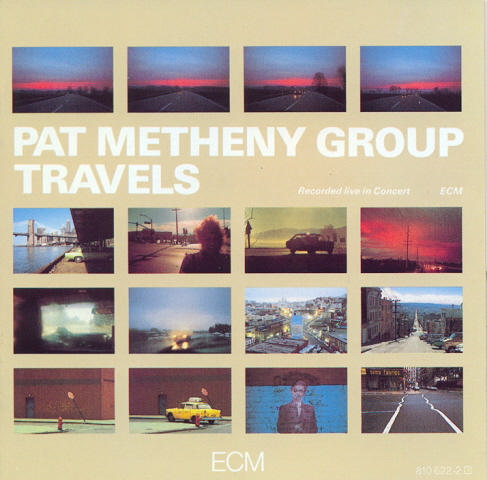
Are You Going With Me?, by Lyle Mays/Pat Metheny, performed by the Pat Metheny Group (1983), encountered 1984

Buy it here | See it here and here and here | Sheet music here

And so there I was, completely alone, trying to figure out what to do about my marriage. The woman I might have distracted myself with had left town and was gone. She soon made it clear she did not want me to write to her. What I did next was entirely up to me. It was immensely and productively lonely.

Getting Help

Anyone who’s had a marriage fall apart will recognize the fix I was in. The person I would ordinarily turn to to help me make any important decision was the person I was contemplating quitting. In this context, my closest counselor was de facto my adversary. She was not – could not be – on my side in this, and I did not find what she said helpful.[1]

I wasn’t very good help to myself either, at least not initially. I kept asking myself the wrong questions, which had a lot to do with my inability to do anything other than think in unproductive circles.

But I did get help.

The one who finally dragged me over to the correct questions and then waited impatiently while I answered them was a new therapist. Her name was Jo. Our marriage counselor, in suspending the marriage counseling, had referred me on to her (about the only useful thing he did). Jo and I met in her Chinese-decorated office[2]on the ground floor of a Towson high-rise that I would drive to twice a week.[3] And there I also made the acquaintance of a therapy group who became a second family, a healthy and intimate second family with just a couple of peculiarities: no one had last names, and, tragically, one’s rate of success would be measured in how quickly one was able to “graduate,” i.e. to say goodbye to it, never to see the other family members again. The group was even firmer than Jo was in calling people on their BS, which was indeed a vital talent because we all had so much of it to offer, I as much as anyone.

The Answers

I’m not going to drag you through the specifics of what the right questions were or how I answered them. I’ll simply say that eventually I struggled past the paralysis and those great loops of thought I had not been able to escape on my own. In general, I came to three major perceptions. These were: a) the marriage was irretrievable; b) until I worked through some of my own problems, I could not be a good husband to anyone; and c) in the examination of conscience as regarded my children, I could not forget the example of the oxygen mask. (You know, when flying with children, that if the cabin becomes depressurized, you use the oxygen mask first. Otherwise you may not be able to help either the children or yourself. Maybe you were wrong to have taken them on the plane in the first place, but once aloft, you still have to be the one to use the oxygen mask first.)

Between Contractions

Getting to that point was a process. The emotional part of it would probably be familiar to anyone who had been there himself or herself. It resembled dealing with waves of nausea. There would be periods where one felt desperate to leave, and then there would be periods of relief, when just the absence of pain felt good, and made one cautiously optimistic that the marriage could be saved.

Christmas of 1983, for example, was one of those periods between the contractions. After all the hustle and bustle of preparation was done, after the cards and the presents and the tree were all in place, I took my children to see the Christmas Story movie, which was just out then. We drove out to an old-fashioned two-screen theater in the suburbs. We were all by ourselves in the cold before filing into the popcorn-smelling warmth of the moviehouse, the film was an obvious and instant bit of wonderfulness, and a feeling of peace descended on me. Maybe, I thought for a moment, we could all be happy together again.

That Christmas glow lasted less than a week. By New Year’s Eve, which we saw in at a party aboard a vintage train car on a siding at the old Camden Station in downtown Baltimore, I astonished my friend the host by telling him privately: “Here’s to being a free man in 1984.”

Acceptance

By the end of February 1984, I had finally reached the point where I no longer wavered in my realization that I needed to leave.

But acceptance, though assertedly the last stage of dealing with impending death, is only the first phase of deciding to divorce. Then you need to summon courage, logistical skill, and cash. And the greatest of these is courage. You need the courage to overcome your own tendency to backslide into the more comfortable life you had built, the courage to stand up for yourself against the person you had up to that point been identifying as your other self, the courage to break children’s hearts and brave the disappointment of in-laws and friends, the courage to face a life of at least comparative economic hardship.

But courage you must have. Very quickly, in the group, I became acquainted with two people who had made themselves utterly miserable by hanging on for years in the marriages that had made them miserable, marriages they should have left. But they were never brave enough; until I left the group two years thereafter, they remained stuck. And that, I resolved, would not be me. Whatever else I would be, I refused to be stuck, even if some bravery was required.

Concrete Steps

In late March I started taking some of the concrete steps one has to take (getting things out of the safe deposit box and obtaining legal representation). And, prodded by the group, I announced my intentions to my wife. The fracturing had begun.

The day after Easter I went further and signed the inevitable apartment lease. I wrote at the time I felt like a lawyer going to trial when the facts are against him, a feeling I was not unfamiliar with. You’re going to do as well as you can, whatever the outcome, but you know the experience, however necessary and inevitable, won’t be pleasant. I also wrote that I was “blotting the … copybook, enrolling myself forever in the club of the sadder but wiser.”

There remained three weeks to go, three weeks in which to finish all that had to be finished before I moved out. “As the ordeal goes on,” I commented, “you lose track. You never know what’s round the next curve. You lose all orientation. One moment you’re cold, the next you’re crying hysterically. There are hundreds of practical details to cope with, and you’re so out of it you can’t cope with any of them.” The hardest task of all was talking to the children. And I will just mention it without further comment; the details are personal.

The Truck Came

And then, eventually, blessedly, came May 15. The truck came and picked up my things; two friends took off from work and helped me. After they left, I was sitting surrounded by boxes waiting for me to unpack them in a huge, well-lit two-bedroom apartment in one of the classic old apartment houses just off the Hopkins campus. For my purposes of the next two years, it was perfect.[4]

And the ecstasy hit. This was not the faintly pleasurable interstice between bouts of nausea of which I have written above. This was the full-throated thing. Whatever had been good or bad about the marriage, it was all now in the past tense. My future was entirely to be written, to be built, piece by piece, according to my own design. And I was animated by a fixed resolve to design it far better this time.

A Determined Walk

And that’s why the Pat Metheny Group’s Are You Going With Me? is the music that always comes to mind when I remember those first few days of being out on my own. From the first beat of the song almost to the ending over nine minutes later, drummer Dan Gottlieb’s strutting beat (probably augmented by Nana Vasconcelos on percussion) does not falter. It is the rhythm of a determined walk. And as the walk proceeds, the scenery changes several times, and it seems as if the affect of the walker changes with it, as scenery and affect are presented through Metheny’s guitar synthesizer and his collaborator Lyle Mays’ synclavier. The constant is not that the walker is in ecstasy, as I now was, but that he is always in challenging minor-key environments. But despite the challenges, despite the minor key, the mood is always joyful to my ear. The melodies grow ever more complex and elaborate, the pitch rises, the volumes rise, and always the walker rejoices, striding on. Eventually, at about the 8-minute mark, the intensity becomes orgasmic, and only after that climax has been achieved do Gottlieb’s drums go silent.

I was always realistic enough to anticipate that my landscape would be one of continuous, and continuously changing, challenge. But I felt now that I could be happy passing through it all.

I listened to this number many times in the months surrounding my departure. Guitarist Metheny’s brilliance (like that of keyboard man Lyle Mays, which I later grew to appreciate separately), set off by interactions with the live crowds in front of which the album was recorded, were to me the sound of a life fully lived. I felt personally beckoned to live as daringly, as soaringly as that song. And I resolved to try.

______________

[1] In the 1998 movie of James Jones’ The Thin Red Line, an impressionistic take on the story of the Army on Guadalcanal, a “dear John” letter is voiced by the faithless wife: “Help me to leave you.” That was what I wanted.

[2] I remember screens with stylized vistas of landscapes (arched little footbridges and pagodas), and when I wasn’t looking at Jo, I would spend a lot of time with my eyes focused on the screens, trying to make out or at least imagine the faraway objects hinted at there, and wondering with part of my mind what the lives of the inhabitants of that little land might be like. For some reason the exercise was liberating.

[3] A round trip from downtown to Towson plus an hour session would take about two hours out of a working day. A young legal associate could hardly leave his office at a regular time, week after week, and give no explanation, without incurring unhappy comment from his superiors, and I was not about to give any explanation. That unfavorable notice was part of the price I paid to do this, and in so doing, to use a contemporary bit of jargon, I “valorized” it. If I was going to be dinged for a regular AWOL, I was damn well going to make it work.

[4] By perfect I don’t really mean perfect in all respects, as I shall write in succeeding pieces. Stil, I had all the six ground-floor windows on the left (plus three more around the corner):

3700 N. Charles

While this is a current photo (as of 2013), I can discern nothing that has changed in the past thirty years.

Copyright (c) Jack L. B. Gohn, except for artwork

Theme Songs Page | Previous Theme Song | Next Theme Song


Protected: Protected Page

This content is password-protected. To view it, please enter the password below.

Not So Law-Abiding, Not So Exceptional

The Big Picture Home Page | Previous Big Picture Column | Next Big Picture Column

Not So Law-Abiding, Not So Exceptional

Published in the Maryland Daily Record December 16, 2013

In a recent Wall Street Journal opinion piece, Daniel Hannan posits that America is indeed exceptional, and that what makes it so is its adherence to law. To which my immediate reaction was that we would be a more exceptional country if we did adhere to law. But we aren’t. Because we don’t.

We have usually been every bit as prone to following raisons d’état as the most cynical, hard-bitten totalitarian state. When Abraham Lincoln imprisoned suspected Confederate sympathizers without trial and defied writs of habeas corpus so as to keep them locked up, he could not possibly have believed that he was behaving constitutionally; he must have been thinking that it was better to save the Union than to save its Constitution. But he was unquestionably breaking the law as written, and making a mockery of any notion that we were an exceptional nation because of the rule of law. When MacArthur defied President Hoover’s direct orders and rode down and gassed the Bonus Army (unemployed World War I veterans), he cannot have imagined he was following the law. When FDR interned the Japanese Americans, we can be pretty sure he knew he was violating fundamental civil rights. All of these leaders may have reasonably believed they were preserving order, but they must have known they were undermining the law.

Sometimes, like Lincoln, we violate the laws as written. The more common recent tack is to justify what the rest of humanity would consider lawless behavior by citing our technical conformity with the law as exoneration. With a tangled thicket of laws and a nation full of lawyers, we can usually find a way to bless absolutely any behavior as legal. George W. Bush’s Office of Legal Counsel’s memos blandly asseverating that our acts of torture were legal were chilling classics of this genre.

One path of rationalization is to assert that the only laws that bind us are our own. This is often an approach nations take in matters like espionage. Every nation has laws against espionage – by other nations; few have laws against espionage by themselves. But again, if everyone breaks everyone else’s law, and we do too, we are not all that exceptional in our respect for law. We can assert that we are behaving perfectly legally, and yet we are observing the laws of only one of the world’s two hundred or so nations, which is not a very impressive statistic.

A corollary is refusal to sign treaties that establish new norms of international law. It is an abiding shame of this country that we have refused to sign global climate treaties, a treaty establishing a law of the sea, or even a treaty against land mines. We’re exceptional, all right – in the way a rogue state is exceptional.

Another way is to break other countries’ laws and violate international norms, and pretend we didn’t. We have a long and rich tradition of coups and assassinations committed by our proxies, trained and funded by us. Some highlights just since World War Two: Mohammad Mosaddegh (prime minister of Iran ousted in our 1953 coup), Jacobo Arbenz (president of Guatemala ousted in our 1954 coup), Ngo Dinh Diem (president of South Vietnam assassinated in our 1963 coup), Salvador Allende (president of Chile assassinated in our 1973 coup). Technically it wasn’t exceptional old us breaking the laws and trampling on the constitutions of those countries. Pay no attention to that man behind the curtain!

Undoubtedly the way we do it the most, these days, is by unprecedented intermingling of the law of law enforcement and the law of war. The drones and the continued detentions at Guantanamo seem to have been justified by skipping back and forth between what police can do and what soldiers can do, as is most convenient to us. I do not see much true adherence to neutral principles of law in all of that.

And there are times when the law may truly be on the government’s side, but it is not the kind of law that bespeaks any sort of governmental integrity. The NSA’s apparent reading of everyone’s communications everywhere violates the principle, enunciated in 1929 by Secretary of State Henry Stimson, that “gentlemen do not read each other’s mail.” When we choose to do so anyway, we cease to be gentlemen – which is another way of saying we cease to be exceptional. We trespass upon people’s privacy in exactly the same way as other governments do. Move on, folks, nothing exceptional to see here. We’re acting like lowlifes, just the way everyone else does.

Correction: worse than everyone else does. To all accounts, we are the international masters of poke and pry.

So even if it is all legal – technically speaking –  we win no bragging rights about following the rule of law. Go back and rent Judgment at Nuremberg from Netflix. There you will be reminded how the Nazi Reichstag solemnly passed laws that made the Holocaust possible. The post-war tribunals properly convicted the judges who enforced them. Nuremberg established that laws themselves can be illegitimate when they violate human decency and basic rights.

And when you think of the number of horrible things our laws have sanctioned, you can be quite certain we are grand masters of the game of illegitimate laws. We have plenty of them. We deprive the world’s highest percentage of our citizens of basic liberties by imprisoning them, all according to the forms of law. And if our war on drugs isn’t intentionally a war on racial minorities in our country, it sure has a funny habit of looking that way, in violation of our fundamental guarantee of equal protection. Strange too how our laws give full support to grotesque imbalances of wealth between our richest and our poorest citizens, an outcome Pope Francis has justifiably dubbed theft.

No, if by exceptional we mean something good (and not merely egregiously bad), our exceptionalness may perhaps rest more in our aspirations than our achievements in abiding by the law. I’m not suggesting we’ve done nothing exceptional in the good sense. We certainly have done more than our share in changing international norms regarding individual rights of religion, speech, association, and business, as well as the rights of minorities of all sorts.

But it seems we aspire less these days. We never seem to have met a privacy right we did not seek to nullify, usually in the sneakiest way. We have set the law of warfare back a century by rendering the fundamental design of the Geneva Accords a dead letter, not just for us but for all the Western powers who have joined in our mideastern wars. We refuse to join treaties basic to the preservation of life and safety on this threatened planet. Instead of protecting the news reporters who throw light on our shortcomings, we are engaged in unprecedented attempts to disempower them and silence dissent by prosecuting leaks. And we fail, time and again, to fix the problems that so recently melted down international finance. Where is that vaunted commitment to the rule of law when we need it?

Mr. Hannan is wrong. When it comes to the rule of law, we’re quite ordinary.

Copyright (c) Jack L. B. Gohn

The Big Picture Home Page | Previous Big Picture Column | Next Big Picture Column

Walk Like The Four Seasons: JERSEY BOYS Tour Hits the Hippodrome

Theater Reviews Page | Previous Theater Review | Next Theater Review

Walk Like The Four Seasons: JERSEY BOYS Tour Hits The Hippodrome

Posted on BroadwayWorld.com November 15, 2013

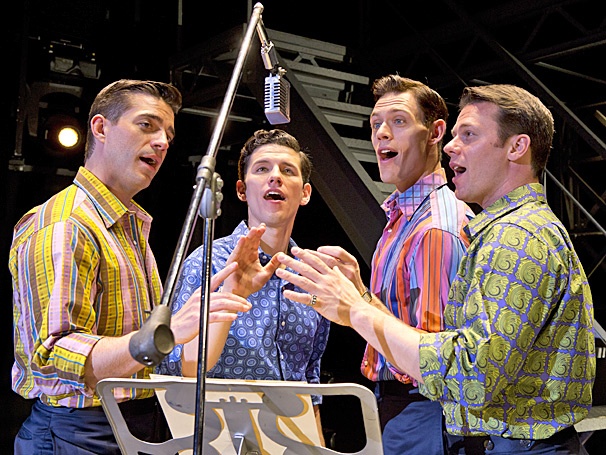
We do love our jukebox musicals, i.e. musicals where the songs come from preexisting pop or jazz songbooks. Of the 20 musicals playing on Broadway as of this writing, 6 are of the jukebox variety. And one of the longest-running of them is Jersey Boys, which opened in 2005, and is playing not only on Broadway but also in Las Vegas and on tour. The tour version, happily for Baltimore audiences, is parked at the Hippodrome Theatre for a little while, and it is very nearly the equal of the Broadway mother ship production. Local audiences can see for themselves exactly why Jersey Boys goes on and on.

It might seem that jukebox musicals are easy: just pick a part of the great rock or jazz songbook and hang a show on it, right? Actually it’s hard; songs, even the simplest, imply narratives, and those narratives are wont to clash with each other and with any framework the show’s creator tries to piece them together within. By far the most congenial framework is the one Marshall Brickman and Rick Elice, the book authors, employ here: the biopic. Then the songs become events in the story, rather than what songs are more typically used for in musicals, expressing the characters’ own feelings or moving the action along. Of course, if a song was written to reflect events in the life of the composer or the singer, then so much the better, but it’s not a requirement.

So Jersey Boys is, as most audiences are well aware, the story of the pop supergroup the Four Seasons, whose heyday ran from 1962 to 1976, and it has an embarrassment of riches to choose from, as the Four Seasons charted with 47 different singles, and Frankie Valli, the group’s lead singer, had an additional 11 charted singles over the same time frame. 33 songs make it into the show, though some of them are not from the Four Seasons’ own songbook, but date back to when the Seasons were primarily a cover band. The four actor/singers who are charged with impersonating the band, Jason Kappus as Bob Gaudio, Brandon Andrus as Nick Massi, Nicolas Dromard as Tommy DeVito, and Nick Cosgrove (the night I saw the show) as Frankie Valli (alternating in the part with Hayden Milanes), do a fine job of reproducing the Seasons’ distinctive sound. So from a musical standpoint, this show is a decent substitute for a reunion concert. But the artistic success of Jersey Boys is owing to more than that.

What makes Jersey Boys special is not just the music, although the songs were and are wonderful, and beautifully performed, but also the intrinsic interest of the story and the comedy. Though I have no doubt the tale was artfully reshaped, there are several who-knew? moments: when, for instance, we learn that Joe Pesci introduced Bob Gaudio (the one who would become the group’s primary tunesmith) to the rest of the group, or that the members had a relationship with the local godfather a lot like the fictionalized story of Johnny Fontaine and the Corleones. Who knew that three of the members were involved in burglaries and two did time? Or that at one point the Four Seasons had a half-million-dollar debt to the IRS to work off?

The parts of the story that aren’t sensational are nonetheless poignant and well-told: from Bob Gaudio’s deflowering to Frankie Valli’s loss of a beloved daughter to heroin to the never-quite-healed rift between Frankie and Tommy. The revelations are a little surprising to those of us who grew up seeing the group’s squeaky-clean appearance, and, even in these confessional times, still somewhat surprising in that this is in effect an authorized project, based on interviews with the three surviving members of the original band as well as lyricist and producer Bob Crewe, who allows himself to be portrayed not merely as gay (no shame there) but as extremely swishy (a bit more controversial), and a serious adherent of astrology (no comment).

And there are many moments in the show that are just laugh-out-loud funny. As when man-of-the-world Tommy advises Frankie that there are two kinds of women in the world: “Type A: they play hard to get, then they bust your balls. Type B: they jump right in bed with you, then later on they bust your balls.” Or, about New Jersey: “Of course, certain individuals aren’t crazy about living in a state where you have to drive through a landfill, next to a dump, next to a turnpike to cheer for a team that’s from New York, anyway!” One way you know something funny is about to be said is when Nick opens his mouth. It is interesting, because he is the only member of the group not interviewed by the creators of the show (having died in 2000), but they give him some of the best lines, typically delivered in the driest of dead-pan, except for one surprising and memorable moment when his voice rises to a screech. Brandon Andrus’ timing delivering Nick’s zingers is utterly perfect.

And there are a couple of moments in the show that are musical nirvana. One is the moment when Gaudio walks into the other boys’ lives, sits down at the piano, and brings them together as he demonstrates CRY FOR ME, not a hit, a song no one who has not seen the show has probably ever heard, and will not respond to reflexively at the first familiar cadence, as the audience will to BIG MAN IN TOWN. But gradually the three join in with voices and instruments, and we can literally hear the distinctive Four Seasons sound being assembled in front of us. Did it really happen this way? Doesn’t matter: it’s magic. The other is Frankie’s rendition of Gaudio and Crewe’s masterpiece CAN’T TAKE MY EYES OFF YOU, after a buildup which purports to show how only Gaudio’s persistence with DJs got the song on the air at all. When five brass players march onto an aerial catwalk to blast the all-important brass chorale accompaniment, there cannot possibly be a single pulse in the theater not racing.

So, could I possibly write a review of a show about the Four Seasons without using the word “falsetto”? Of course not. We would probably never have heard of the Four Seasons were it not for Frankie Valli’s distinctive vocal range (I have never seen it specified, but some claim it spanned four octaves), which allowed him to soar to incredible heights. His falsetto was seldom sweet or angelic; there was a toughness to it, just as there was to the lower registers. But it enabled Valli’s voice to soar above whatever else was on offer from the instruments or the other singers.

And here is one place where the Broadway show has (or at least had) a slight edge: John Lloyd Young, who originated and as of this spring when I saw it still held down the role (his erstwhile understudy took over in July), is probably the closest thing nature will ever provide to Valli’s vocal double embodied in a young man with a reasonable physical resemblance to Valli. Nick Cosgrove comes close too, but not quite as close: from a vocal point of view, it’s actually less in the falsetto than in the lower registers that the difference is noticeable. There’s a slightly more breathy and nasal quality down below. And the physical resemblance is not as striking. One is more conscious of seeing and hearing Valli portrayed as opposed to magically thrust into our midst.

But this is a minor carp. This is probably the preeminent jukebox musical, beautifully presented. And if you can’t visit the New York mother ship, this will do nicely.

 Copyright (c) Jack L. B. Gohn except for production photo

Theater Reviews Page | Previous Theater Review | Next Theater Review

Truth Transcending Mere Facts: I AM MY OWN WIFE at The REP

Theater Reviews Page | Previous Theater Review | Next Theater Review

Truth Transcending Mere Facts: I AM MY OWN WIFE at The REP

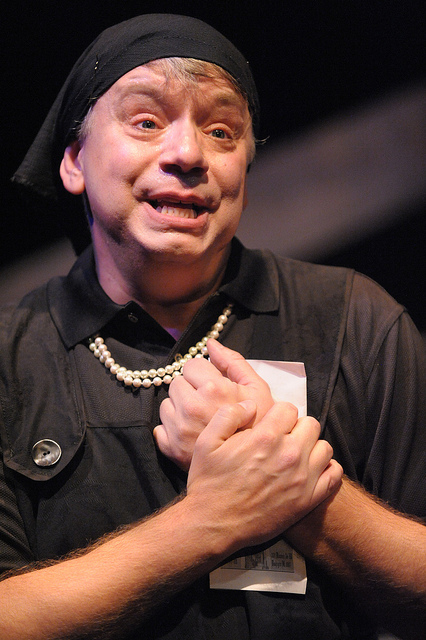
Michael Stebbins as Charlotte von Mahlsdorf

Posted on BroadwayWorld November 4, 2013

A one-man show, it is a tour-de-force for both the playwright, who appears as a character confronting the issues he wants his audience to consider, and the play’s solo performer, called upon to play between thirty and forty roles. I am speaking, of course, of Doug Wright’s I Am My Own Wife, the 2004 Tony Award-winner for Best Play, now in perhaps its third Maryland revival at the REP in Columbia, with Michael Stebbins, holding down the Walt Whitmanesque job of containing multitudes.

Briefly, the play recounts two stories. One is that of Charlotte von Mahlsdorf, transvestite, antiquarian, and curator of a museum preserving, among other things, memorabilia of Berlin’s homosexual underground from the Nazi era through the Communist one. The other is that of Wright, who interviews von Mahlsdorf, becomes her partisan while trying to build a play around those interviews, and then is forced to confront his subject’s unreliability as a witness to her own history, and the feet of clay she may be concealing.

It is the genius of the play that by the end, the audience may (although it is not compelled to) forgive von Mahlsdorf’s dishonesty, and even her treachery in betraying a friend and perhaps lover to the notorious Stasi (the East German secret police). If she really did that, we understand why; if she didn’t do it, and outsmarted the Stasi, which is the way she tells it, we understand that too. Either way, Wright the character and Wright the playwright conclude, and we are meant to conclude as well, there is something admirable about her steadfastness, her sheer endurance, in being the preserver and curator of a unique and priceless collection, the last woman standing, as it were.

This is no minor accomplishment for performer or playwright. I could better appreciate this accomplishment in light of having within the previous two weeks seen a play that tackled many of the same issues, and did it so much less effectively, Centerstage’s rendering of Marcus Gardley’s dance of the holy ghosts, also reviewed in these pages. There, as here, the playwright appears as a younger character confronting a somewhat inexplicable older figure. Both plays beg the question what makes the older character tick. In both plays it’s a dramatically urgent question: Gardley’s alter ego wants to see something of himself in his grandfather so he can establish a sense of connection with his own roots, while Wright, as a young gay man raised in a freer, more open era, still wants to tip his hat to a worthy predecessor. Gardley’s play never comes close to giving us a key to his grandfather’s unpleasant character; Wright’s wisely achieves the opposite extreme, giving us not one, but multiple plausible versions. Even when Wright and others confront Charlotte with a documentary record that seems to give some of her stories the lie, Charlotte comes back with a believable and sympathetic back-story that seems to trump the lie.

Gardley calls his show “a play on memory,” obviously laying claim to Tennessee Williams’ label of “memory play,” i.e. one in which the dramatic truth comes out even if the literal truth is somewhat obscured and contradicted by the swirling mists of memory. But Gardley doesn’t deliver, because there isn’t much truth there, just the absence of an explanation for abandonment. Wright does deliver, plentifully. In the end, the point of von Mahlsdorf was that she survived, and in doing so permitted her collection and the world it evoked to survive as well. As she tells the audience at the end: “You must save everything and you must show it as is. It is a record of life.” Everything, in this case, including accounts that cannot entirely be reconciled with the documentary history. It is all, in some sense, true, all, in some sense, a record of life.

This is my first experience of the play, so I have nothing to compare it, and especially Stebbins’ performance, to. But I can tell you that I was blown away by Stebbins’ ability to convey so many different voices, so many different personalities, mostly without the aid of changes of costume or makeup. I’ve had occasion in these pages to compliment dialogue/vocal coach Nancy Krebs before, and it’s time do it again, since she obviously had a hand in the shaping Stebbins’ versatility. The set, by Elizabeth Jenkins McFadden, struck me as a little sparse for a play in which descriptions of the sensual qualities of furniture played such a large role. But again, I have little to compare it to. Jay Herzog’s lighting design was imaginative and resourceful. And the direction, by local fixture Tony Tsendeas, seemed surefooted enough, though in a single-performer production it is difficult to determine where one participant’s contribution ends and another’s begins.

This production is a keeper. Unfortunately, it can’t be kept, with only two more weeks of performances. See it while there’s time.

Copyright (c) Jack L. B. Gohn except for production photo

Theater Reviews Page | Previous Theater Review | Next Theater Review

The Doug Gansler Photo and Teen Drinking: Unresolvable Questions

The Big Picture Home Page | Previous Big Picture Column | Next Big Picture Column

The Doug Gansler Photo and Teen Drinking: Unresolvable Questions

Source: http://www.baltimorenewsjournal.com/2013/10/24/ag-doug-gansler-caught-in-teen-party-photo/

Published in the Maryland Daily Record November 13, 2013

The picture of Maryland’s attorney general Douglas Gansler in the midst of a beach house party full of clearly inebriated just-graduated high school seniors has drawn national attention and provoked national amusement, including a mention on Leno. It has also rekindled perennial discussions about the proper role of parents, especially those who happen to be in law enforcement. For me, the photo begged questions not addressed in last month’s column.

Very Strange Very Quickly

Last time, I argued that prohibition of hard drugs and of marijuana is self-defeating, that criminalization does not stop people from marketing, buying, or using addictive substances but only makes everything worse. For adult users, that is, I think, beyond reasonable debate. But arguably the issues weigh differently when we are talking about minors and alcohol. My conclusion after wrestling with it: The issues are different all right, and they get very strange very quickly.

There seem to be two principal benefits urged to justify criminalizing drinking before age 21: improved health and life effects, and reduced drunk driving deaths. From a survey I saw of the scientific literature between 1960 and 2000 (Wagenaar & Toomey, 2005), however, the impact of raising the legal age for drinking upon health and life outcomes seems to have been oversold; for many of the supposed benefits, there seems to be little evidence of a correlation. There is no doubt the adolescent brain is still developing, and animal research strongly suggests alcohol does bad things to a developing brain. But this case seems yet to be proved in human drinkers.[1]

11.2% To Be Precise

Drunk driving is another matter. What was reportedly the best-controlled study of the effects of minimum drinking age laws upon drunk driving was published in July 2008 in the journal Accident Analysis and Prevention.[2] The subject is maddeningly complicated statistically, but the overall conclusion seems clear enough: the ratio of intoxicated teens involved in accidents to unintoxicated teens involved in accidents went down after Congress imposed a universal 21-year-old mandatory drinking age to take effect by 1988. The difference is not huge, an 11.2% reduction in the ratio just mentioned, but it is statistically significant. In other words, laws that chill teenage drinking must have saved lives on the highway.

That is in fact the pitch that those in favor of the minimum drinking age laws use; indeed the most influential lobby in favor of such laws goes by that very name: Mothers Against Drunk Driving – so much so that the group’s founder quit the organization because she felt it had strayed from a focus on drunk driving to sheer naked prohibitionism.

89% To Be Precise

The MADD view seems to be that directly interfering with all teenaged drinking so as to save lives indirectly on the highway is justified, whatever the teenagers and their parents who have been interfered with may think. Implicit in the position is a disregard of the aspirations and views of teenaged drinkers who were never going to get behind the wheel. Maybe it is felt that they are a small minority.

The trouble is that they are not a small minority. As a matter of fact, over 89% of teen drinkers don’t drive, down by 54% since 1991, according to a 2010 Centers for Disease Control study.[3]

On its face, that calls into question the MADD rationale: how urgent is it to use direct alcohol control if the real objective is indirect control of drunk driving (which is, of course, directly illegal anyway)? Is that not, in effect, “punishing” the vast non-driving majority of drinking teens for the “sins” of their relatively few driving compeers?

The Way We Actually Learn

And that’s not the only thing wrong. Are minimum drinking age laws not a bit irrational and contrary to experience? Irrational, because the notion that you can’t hold your liquor through 11:59 p.m. on the eve of your 21st birthday and then, at midnight suddenly you can is laughable. Contrary to experience as well, because the way most of us learn to drink is with experiences that begin well before our 21st birthdays. According to a 2011 study 46.8% of American 18-20-year-olds report being current users of alcohol – and according to the CDC the percentage of high schoolers who have ever tried alcohol is 70.8%. A survey by Southern Illinois University’s Core Institute revealed that in college, the “current user” rate rises to 82%. In other words, this is a law that most of us have broken, a fact which by itself undermines the law’s legitimacy. But the fact that most of us broke that law tells us more than that. It tells us that few of us become responsible adult drinkers or for that matter non-drinkers without having done some drinking – and thereby breaking the minimum drinking age law – before we turned 21.

Now this early use can be regarded as irresponsible “jumping the gun” that makes no positive contribution to patterns of responsible drinking that may emerge later. Or – and I’m guessing that the parents who sanctioned the party at which Mr. Gansler was photographed felt this way – it may reasonably be viewed as integral to the way responsible drinking is actually learned in our society. (You learn what excess feels like – what the kids in the Gansler photo were doubtless feeling – and then you learn how to avoid that feeling.)

Lawbreakers of Us All

The non-driving majority of drinking teens should stay part of the policy equation, and in the end that majority does pose an agonizing philosophical dilemma. And here it is: Can we legitimately interfere with the free choices of young Americans – many of whom (let it be remembered) are old enough to vote, to marry, to enter binding contracts, to pay taxes, commit adult crimes, and to fight and die for this country – and, to be blunt – can we make lawbreakers of the majority of Americans in this age bracket – merely because we know from experience that a small but significant proportion of them will become more dangerous on the highways without that interference? (An admittedly extreme analogy: We don’t lock up the entire population because we know that if we don’t there will be some criminals on the street.)

Or do we, on the other hand, treat our youngsters with a respect consistent with the respect we show them in most other contexts – and accept some dreadful adverse consequences that might well have been prevented had we shown less respect?

The solution that the parents who threw that party reportedly tried to enforce (allowing the drinking but preventing driving) seems like an agonized compromise in the face of this impossible dilemma, in the face of laws that are a blunt instrument dealing with a delicate problem.

No Condemnations

Well, I for one do not condemn the parents for having chosen one reasonable resolution. I understand why legislatures pass the minimum drinking age laws, and I understand why few young people obey them, and I understand why parents as well quietly rebel.

And I don’t think we know the proper way to resolve these dilemmas.


[1]. Fetal alcohol syndrome of course arises with drunk teen mothers just as it does with drunk mothers over 21, but that is a separate issue. I am speaking of the brains of the mothers, not of their unfortunate offspring.

[2]. J. Fell, D. Fisher, R. Boas, K. Blackman & A. Tippetts, The relationship of underage drinking laws to reductions in drinking drivers in fatal crashes in the United States, 40 Accident Analysis and Prevention 1430 (2008). Disgracefully, this important paper is hidden behind a very expensive pay wall; the legitimacy of pay walls to research funded in whole or in part by public funds is perhaps a subject for another column.

[3]. Of course, CDC claims, doubtless with some justification, that that growing reluctance of drinking teens to drive is itself an artifact of the minimum drinking age laws, since kids, even drunk ones, don’t want to get caught breaking the minimum drinking age laws, as they might more likely be if they ventured out behind the wheel – and hence if we didn’t have the laws, they’d be far more likely to drive drunk.

Copyright (c) Jack L. B. Gohn, except for photograph, copied from this source: http://www.baltimorenewsjournal.com/2013/10/24/ag-doug-gansler-caught-in-teen-party-photo/

The Big Picture Home Page | Previous Big Picture Column | Next Big Picture Column

Halloween

Theme Songs Page | Previous Theme Song | Next Theme Song

Halloween

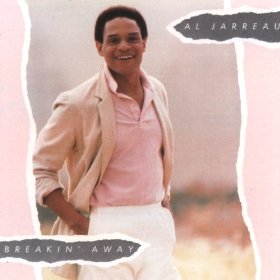
Teach Me Tonight, by Sammy Cahn and Gene De Paul, performed by Al Jarreau (1981), encountered 1983

 Buy it here | See it here | Lyrics here

So, as recounted last time, I had met someone. When she came into my life that hot July night, I was raw with the wounds of my marriage. In my moments with her, passion deadened the pain. But still I clung to some hopes of salvaging the marriage.

Timeclocks

It was as if I had simultaneously punched two timers, one on my marriage, one on my new relationship. Time was running out on both, and I was shuttling insanely between them.

S. and I had just entered marriage counseling. Many people who have set out on that road will recognize immediately what I mean by the timer. You have only certain reserves of love and patience, and you have to save the marriage somehow before those reserves run out. (Maybe a better metaphor would be the bomb counting down at the end of a James Bond movie.)[1]

But my affair also began with a short and preset duration; when I met her, the woman was in negotiations to take a job far away, and that was fortunate for me in a sense, because with my baggage her sense of self-preservation would probably have dissuaded her from allowing things to start between us – were there not a definite terminus ad quem. The affair could not extend beyond November 1, the date she was likely to start her duties on her new job.

Of course a condition laid down by the marriage counselor was that I had to be faithful as we went forward. And so I had hardly met my new love before I had to stop meeting her. I went to her and said goodbye – and stuck by that goodbye for the rest of the summer, knowing that her job-clock was ticking away, and seeing her face before me wherever I went.

Suffocating

But all that this self-denial accomplished was underlining for me how miserable and bleak things were at home. Again, I am telling only my own story, so I’ll leave it at that. Suffice it to say that I was breaking my resolution and my promises by September; I was suffocating, and I needed the air for a few moments, even if there was only a small supply of it left.

Sweet as they were, those stolen moments (a date at the racquet club, a walk in the park, a drink at a bar above the Harbor)  were all filled with foreboding; whatever we did or didn’t do, November was coming. I think in one mad conversation I begged her both to stay and to allow me to go on with my marriage. (Thank goodness she was too sensible to give that proposition a moment’s consideration.) So nothing would prevent November coming.

I started seeing my own therapist, a nice but useless man.

And the clocks went on ticking down.

The clash between conscience and longing was excruciating. There was an evening, for instance, my family went to the symphony, and the children were angels, and my son fell asleep on my arm, a living reproach to my fantasies of independence. There was the hiding of presents between me and my lover. There was lying. There was talking with my friends, who one and all gave me good reasons to fear a separation. And there was always the anger at home. Meanwhile the wonderful interludes presented me fully-realized illustrations of the alternative to all of this.

Four days before she was to leave, I snuck out from the children’s swimming lesson to have a coffee with her. She observed that I would probably be relieved when she left. And I knew it was true, not because I wasn’t in love with her, but because I was.

No Reserve

On what was to have been our last date, I blew my resolution (bred of counseling and of trying to make up my mind to revive the marriage), failed to keep any reserve, and just declared my love repeatedly. Having done which, I insanely bade her goodbye, went to a lecture (which was my official cover activity for the whole evening), and came home.

The very last day, Halloween, was similar in its mixture of mundaneness and heartbreak. I took advantage of an anomaly in my schedule (I actually did have to leave the car at an uptown repair shop) to pay an unscheduled visit to her on her last day of work at a midtown location. I got off the bus, found her at her office, we stood on the bus stop, embraced, and then I caught the bus the rest of the way downtown.

At 5:00 p.m., when I knew the plane was departing, I was in my office, on the 15th floor, with a western exposure. From where I sat, I could see that sun go down, all orange and lonesome. I knew that she was flying westward into it and out of my life. I was desperate, and could do nothing. Stirring myself, I tried to get a friend to come drinking with me, but he was busy.  So I came home and had dinner with the family, doled out trick-or-treats, washed the dishes, and tried to act as if nothing was wrong. Distracted and trying to be bright and competent. “I don’t know when or how it ends,” I wrote.

As the sun was sliding down the horizon, carrying her away, the song in my cassette player was Teach Me Tonight, in Al Jarreau’s then-recently-released version. I kept replaying it, and it made me feel a little better. Until you think about it, it might seem a strange song, both in subject and treatment, to have addressed what I was feeling then. But not when you think about it.

Read Into The Program

It’s a making-out song (I’ve already limned two of them in these pieces), featuring producer Jay Graydon’s brittle and bright arrangements that had so attracted me when I first heard his work with The Manhattan Transfer. In other words, a song sung by the man who’s got his squeeze within reach, and it’s making him as bright and happy as the shiny surface of the music. It’s even playful, tongue-in-cheek as make-out songs usually are,[2] conceiving of the beloved as a teacher, reading the singer into the love program, as it were:

Did you say, I’ve got a lot to learn
Well don’t think I’m trying not to learn
Since this is the perfect spot to learn
Teach me tonight
 
Starting with the ABC of it
Getting right down to the XYZ of it
Help me solve the mystery of it
Teach me tonight

For the singer, it’s uncomplicated; he wants something wonderful without reservations and he’s going to get it. Jarreau conveys the feeling beautifully.[3] The uncomplicated part was what got me, I think. Of course I wanted the sex. But more than I knew or recognized, I wanted my life to be straight again, easily explained, simple, honest. And on that Halloween it was anything but. Still, a man could listen and yearn.

And maybe aspire to more.


[1]. I was glad to read of a recent study that found that 75% of the marriages that go into counseling are saved.

[2]. Just think of the ultimate make-out piece, Je T’Aime, Moi Non Plus (sung by Serge Gainsbourg and Jane Birkin). It may be borderline pornographic, but it is also self-consciously a performance designed to epater le bourgeoisie, and as such, a bit of a put-on. (The lyrics are well-translated here.)

[3]. The song has been recorded by hundreds of artists. Two of my favorite versions are by Frank Sinatra and by Amy Winehouse, though Winehouse, to be fair, seems to be channeling Dinah Washington. But I think Jarreau holds his own.

Copyright (c) Jack L. B. Gohn

Theme Songs Page | Previous Theme Song | Next Theme Song

An Absence, Inadequately Explained: Gardley’s dance of the holy ghosts at Centerstage

Theater Reviews Page | Previous Theater Review | Next Theater Review

An Absence, Inadequately Explained: Gardley’s dance of the holy ghosts at Centerstage

Posted on BroadwayWorld.com October 24, 2013

Marcus Gardley’s dance of the holy ghosts, at Baltimore’s Centerstage, is centrally about missing fathers and the holes they leave in the lives of their children, grandchildren, and themselves. But it also a sort of bildungsroman, a portrait of the artist, here the playwright, as a growing young man. Tackling these two subjects in one play may not be the best choice.

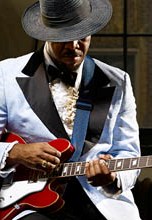
The “missing” father and grandfather, Oscar (Michael Genet), seen principally at age 72, the resident of a senior living community of some unspecified sort, and at earlier ages in flashback, is a retired blues man, a guitarist and singer who followed his career out the door of his family home, leaving behind a smart, loving wife Olivia (Denise Burse). Olivia’s life is largely destroyed by the abandonment, and the destruction is magnified by what happens upon Oscar’s return from the road. Then Oscar repeats the abandonment act by a moment of total irresponsibility regarding his young grandson Marcus (Sheldon Best), when Oscar’s daughter Darlene (Chandra Thomas) most needs him to help her.

Because these characters are all African American, this show has the potential to explore dramatically how the effects of missing fatherdom play out in that community. My companion watching the play, who happened to be black, certainly found it resonant in that regard, although I was not convinced. Of course, the issue of the absent dad is not exclusive to black society or to dramas about black characters. Paternal abdication of one kind or another can be found in the works of Eugene O’Neill, Oscar Hammerstein and Arthur Miller, to name just a few white playwrights who have addressed it. But every community has its own way of experiencing the issue, and can say legitimately different things about it.

Unfortunately, I cannot honestly report I saw much profundity in what was said here. We learn next to nothing about Oscar’s need to walk out the door, where it came from, why he yields to it so willingly and thoughtlessly, why he is so stubbornly resistant to his family’s promptings to man up, stick around, and step up to the plate on occasion. We likewise learn nothing about his equally stubborn adherence to a world-view in which it is his absolute right, whenever he deigns to return, to have his wife waiting exactly as he left her, or why he cannot even bring his mind to accept the finality of her death. It would seem that his eagerness to leave initially was tied up with some totally unrealistic expectations about what life entitled him to – in short, that he was spectacularly foolish even by the standards of foolish youth – but that hypothesis is hardly developed.

This also would have been a good place to illustrate or at least talk about the incidents of and the alienation bred by a musician’s road life (subject of a thousand popular songs by musicians afflicted with anomie or braggadocio), but there’s hardly a clue here, except for a remark by the aged Oscar to his grandson suggesting there were many women attracted to him. The attractions of that life might have made the character’s behavior more comprehensible.

Instead, what we have is a very creaky interplay with the grandson’s story. To start with the obvious, when a playwright named Marcus Gardley creates a character his own age named Marcus, you can pretty much rule out coincidence. When the playwright named Marcus then gives an interview to the dramaturg in which he talks about the inspiration for the play being the correspondence of his grandparents and the memories of family members including himself, you know you are deep in heart of autobiography-land. Not surprisingly, Gardley’s interest in his own development is strong, and one can see the elements of a separate interesting play in the story of that development. But it’s on display in this play, for which it is entirely too strong, forcing upon dance of the holy ghosts scenes and themes that distract from and are at odds with the story of the missing blues man father.

Specifically, Marcus grows up gay and fatherless and grandfatherless. The grandfatherless part works here, even though the additional abandonment by his Oscar is presented in only one incident. The gay part does not work as well, because it is very confusingly rolled out. In Act I, there is a flashback, very amusingly done, to a grade school-age incident in which Marcus tries to flirt with a girl, but finds himself far more motivated by a countervailing protectiveness of his 64-pack of Crayolas than by romantic feelings. This could easily be taken as an amusing speed-bump on the road to heterosexuality rather than a leading indicator of contrary tendencies. It is not until Act II that the adult Marcus declares himself sexually, although there have been enough mannerisms in Marcus’ appearances from the first so that his gayness does not come as a great surprise.

But the interplay with the story of the grandfather gets in the way. The story with the grade-school girl (Jasmine Carmichael) seems at first to be laid before us because it happens as the incident of Oscar’s neglect of Marcus is unfolding. But it takes on so much interest of its own, it robs the consequences of Oscar’s neglectfulness of almost any dramatic sense of urgency.

And the Act II declaration is worse. It comes out in an amusingly presented scene in which grandfather and grandson are in an automobile together, and Oscar, who has been putting two and two together, asks Marcus about it. Of course, Oscar lacks both subtlety and understanding, and cannot discuss it in any way that does not drive Marcus crazy. Of course, he comes out with old-fashioned notions of the causes of homosexuality: the absence of strong fathers and the influence of domineering mothers. Of course Marcus is scornful – but Marcus the playwright has set this dialogue in the midst of a play in which Marcus the character is bereft of a father or a grandfather and is raised by a strong mother. The dramatic evidence of the play would seem to support the very theories that Marcus the character and surely Marcus the playwright would reject. But there is no articulated or enacted response to Oscar’s pop-psych except Marcus’ tapping foot communicating his irritation.

The eventual dramatic crisis of the play, however, returns us to the absent-father focus. The issue to be resolved in the final frame is whether Oscar can bring himself to turn up at a funeral, an act which might have some redemptive effect. As it happened, I saw this play three days after taking in Motown: The Musical on Broadway, where the dramatic action, such as it is, comes down to whether Berry Gordy, Jr. will attend a tribute show or not. And I had the same sense of “oh, come on, it’s too obvious” as to how both dilemmas were resolved. Be that as it may, you don’t fill much of the hole of years of neglect simply by turning up at a funeral. At best, it’s potentially a start.

Gardley was a poet before he was a playwright. Critics commonly remark of Gardley that his lines are fraught with poetry. And much of dance is quite evocative, but much of it also less than clear, and the language is partly to blame. The problem is exacerbated by the way some of the minor roles are introduced (four of them played by Doug Eskew), without sufficient detail to make clear quickly who they are or what they are even doing in this story.  Particularly in a tale not told in consecutive order, any lack of clarity can be a problem. In post-show conversations with two other members of the audience, we each found ourselves trying to put together what had “really” happened in one place or another.

To be sure, Gardley calls this “a play on memory,” in what must be an allusion to The Glass Menagerie, another bildungsroman by and about a gay playwright. Tennessee Williams stated in the introduction to that play: “The scene is memory and is therefore non-realistic. Memory takes a lot of poetic licence. It omits some details; others are exaggerated…” One must assume Gardley meant to appropriate this explanation and the artistic license it claims. Hence what “really” happened is allowed to be elusive. But it cannot be elusive in the manner of theater of the absurd. At some point there must be a “there there,” whether we can see it clearly or not. And what is there matters. So Gardley cannot afford as much obscurity as he might like.

If I am reconstructing the production history correctly, this play premiered in 2006 at the Yale Repertory Theater, and has gone unproduced since. From reviews of the earlier incarnation, it is plain the play has been tinkered with in the intervening seven years, and that the tinkering has probably improved it. But the need for further tinkering remains. Personally, I’d sever the gay issues (putting them in a separate play) and flesh out the fatherhood material. But maybe there are other ways to solve the play’s problems. What seems clear to me, however, is that in its current state, the play is not, as other reviewers have suggested, a triumph, and it is not yet ready for its New York closeup. Instead, it is a solid work in progress, still in need of major pruning and revision.

That is not to say that Centerstage should not have produced it; indeed Centerstage is precisely the kind of venue it needs, a thoroughly professional stage traditionally committed to new works as well as classics, which will assemble a cast and crew fully capable of taking a good but flawed play on a complete shakedown cruise.

This cast, and crew – and the direction of Kwame Kwei-Armah, the theater’s Artistic Director – are unexceptionable, as one would expect at Centerstage. And they keep what might be a somewhat unsatisfying evening of theater far above that level.

Copyright (c) Jack L. B. Gohn

Theater Reviews Page | Previous Theater Review | Next Theater Review
There Goes the Neighborhood

Theater Reviews Page | Previous Theater Review | Next Theater Review

There Goes The Neighborhood

Published in The Hopkins Review, Fall 2013, New Series 6.4

In all forms of narrative art, highbrow or lowbrow, we love sequels. Visit any multiplex and half the movies may be part of what the trade calls “franchises.” But these are generally the easiest kind of sequel: products of the same creative team with most of the same elements. Even if set chronologically after the first work, they essentially revisit its world. Holmes and Watson, the Hardy Boys, Rocky, and the James Bond novels come from this world (though an intelligent disagreement is possible about the Bond of the movies). The audience for this kind of sequel generally seeks and generally gets repetition of whatever appealed to them the first time round.

More Advanced Stunts

Sequels that truly advance the story are a step up from this. Think of the Shakespeare history plays, or some of the most intelligent television series.

More challenging still are sequels that reimagine the initial work, build around it and in some sense subvert it. The two works combined in the Roman de la Rose (one an allegory of courtly love, the other a blowing up of the mystique of courtly love), are of this type. Wordsworth’s bathetic narrative poem Peter Bell provoked Peter Bell parodies by other hands (it was easy to poke fun at), and one, by Shelley, a reply in satirical form that was at the same time a bit of a takeoff from the original. Pamela and Shamela would be another example. From a strictly narrative standpoint, the second of the Back to the Future movies deconstructed much of the plot of the first, and I think qualifies as the same kind of feat.

Bruce Norris’s Clybourne Park, which I wrote about in these pages last year, was a stunt of this more advanced type. Visiting “another part of the forest,” the fictional Chicago-area neighborhood of Clybourne Park, to which the Younger family of A Raisin in the Sun was preparing to move, it purported to show what was happening there at exactly the same time as the center city action of Raisin – and then leapt forward half a century. Raisin (1959) was an encyclopedic exploration of black concerns in its era; Clybourne Park (Off-Broadway 2010, Broadway 2012), audaciously covered an enormous amount of territory in the ongoing and probably endless national dialogue about race. It has been widely acclaimed (winning the Tony, the Pulitzer and the Olivier awards), and justly so. However, there can be no denying it is in some ways subversive of Hansberry’s views. And, though hilariously even-handed in some ways, it was definitely a white take on many of the issues Hansberry opened up from a black perspective.

Big Event

This whiteness of Norris’s take (and no doubt the commercial hope of riding the coattails of Clybourne Park as, newly released from the exclusivity of Broadway, it makes the circuit of regional theater throughout the country) has provoked playwright Kwame Kwei-Armah, a Briton of Grenadan and ultimately Ghanian heritage, now artistic director at Centerstage, Baltimore’s foremost Equity company, to try his own hand at a Raisin sequel. Earlier this year, Centerstage premiered Kwei-Armah’s own entry in the Raisin sequel sweepstakes, Beneatha’s Place, in repertory with Baltimore’s first revival of Clybourne Park, packaging the two together as The Raisin Cycle. This artistic “twofer” was well covered in the national press (see, e.g. here and here), and is the subject of an upcoming hour-long special on PBS. Centerstage, which never does a play other than impeccably, of course served up these two plays in customary style, with a great cast (singular, as we shall see) and great direction by Derrick Saunders (a protégé of August Wilson). So this was An Event.

As theatrical events go, it was admittedly oddly shaped: two sequels without the original seminal work. But Beneatha’s Place is, no doubt by design, written to be performed by nearly the same-sized cast as Clybourne Park (one additional actress is required), and the cast (with that addition) required has the same racial breakdown (these being plays in which racially unconventional casting would be a non-starter). The racial breakdown is completely different from the nearly all-black cast of Raisin (which also must be conventionally cast). Moreover, Beneatha’s Place is structured similarly to Clybourne Park, in two acts set in different time periods, with the cast from the first act doubling in different roles in the second (except that the character of Beneatha appears in both acts of Kwei-Armah’s play). So the packaging of the two plays gives almost every cast member the responsibility to play four roles (and Beneatha young and Beneatha old are in effect two roles as well), posing the opportunities and challenges of an instant repertoire for each actor, and conjuring up an instant repertory company from amongst the performers.

A Riposte

Beyond that, Beneatha’s Place is clearly a response to what Kwei-Armah in interviews has suggested may be the implicit message of Clybourne Park. And beyond even that, the latter is a provocative expansion of the subjects of both earlier ones. So there is much logic in placing the Norris and the Kwei-Armah plays together. (Baltimore audiences have also been provided with a recent well-received Raisin revival courtesy of the Everyman Theatre, the city’s other major-league Equity company.)

The implicit message in Clybourne Park that Kwei-Armah perceived and which he has stated bothered him was that whites build and blacks destroy. Critical to an understanding of the interplay of the two plays is how this at least perceived message is conveyed and how it is rebutted.

Sympathy for the Blockbusted Devil

To recapitulate a little of what I formerly wrote in these pages about Clybourne Park, when, at the time of Raisin, black families moved into previously white neighborhoods, the effect was historically not the integration of those neighborhoods but merely a movement of the boundaries between black and white. I cited Not In My Neighborhood, Antero Pietila’s detailed 2010 study of the process in Baltimore, which showed how laws and covenants had bottled up an expanding African-American population in an area too small for it, and how, when the existing boundaries ruptured because scattered white homeowners broke ranks and sold, the entire machinery of real estate commerce combined to turn on the previously white neighborhoods, evacuate all white residents, and sell those neighborhoods exclusively to blacks – all, of course, at a considerable profit to the middlemen, bankers and builders. And what happened in Baltimore happened in the Youngers’ Chicago and pretty much everywhere else as well. From the perspective of certain characters in Clybourne Park, this process, a matter of historical fact of which contemporary audiences are well aware, would appear to be blacks destroying what whites had built.

Certainly it appears that way to Karl Lindner, the one character who crosses over from Raisin to Clybourne Park. Lindner, the representative of the Clybourne Park Improvement Association, says in the latter play:

…I’m not here to solve society’s problems. I’m simply telling you what will happen, and it will happen as follows: First one family will leave, then another, and another, and each time they do, the values of these properties will decline, and once that process begins, once you break that egg, … all the king’s horses, etcetera ….

– and some of us, you see, those who don’t have the opportunity to simply pick up and move at the drop of a hat, then those folks are left holding the bag, and it’s a fairly worthless bag, at that point.

In Raisin, Lindner is presented as simply despicable. He calls the Youngers “you people” and patronizingly urges them that “our Negro families are happier when they live in their own communities.” And he tries to buy them out, at a price which Beneatha Younger, the daughter of the family, tellingly refers to as “Thirty pieces and not a coin less!” But in Clybourne Park a good side of him is posited and presented, his solicitude toward a deaf wife and an unborn child. So in Norris’s dramatic universe, Lindner’s dismay has some basis, even if the audience is not invited to share it, and does not make him utterly despicable. He is plainly the same character as Hansberry’s, yet more fully realized.

Mean and Lena

In commensurate fashion, when in Norris’s Act II Steve and Lindsey, a gentrifying white couple, are trying to buy and remodel the same house in 2009, after it has become a derelict property in what is now a black enclave, they are opposed by Lena, the great-niece of Lena Younger, the matriarch in Raisin who bought the house. Lena’s arguments are vague, but the thrust of them seems to be that allowing young white gentrifiers to fix up a house, even one that is clearly in dire need of repair, when it happens on black turf, would challenge the pride of the neighborhood. It is left unclear at the end of the play whether her campaign to repel the white invaders (by invocation of building codes to frustrate their redesign of the house) will succeed. But clearly this too fits within what Kwei-Armah sees as the dialectic of the play: black characters trying to prevent the rebuilding by white characters of what black characters ruined.

Kwei-Armah has tried to reverse this dynamic. In the fictional world he evokes, it is the arrival of the white people that wrecks things. The central character in both halves of the play is Beneatha Younger. In Raisin we see her being wooed by Joseph Asagai, a Nigerian graduate student, and resolving to go with Asagai back to his homeland, study medicine there, and help him with his mission to assist the Nigerian struggle for independence. In Beneatha’s Place we start with Beneatha recently arrived in Nigeria and, in Act II follow her upon her return there in 2013. When she first arrives, the country is in the throes of independence, which Kwei-Armah depicts as a corrupt, bloody business, the source of whose problems is white colonialism and white neo-colonialism.

There Goes the African Neighborhood

Aunty Fola, a basket vendor in the market, a font of common sense and folk wisdom, describes the genesis of the problem in a way that is no doubt intended to echo Lindner’s speech reproduced above:

My grandfather use to tell the story of the old man on the hill who saw the first white men coming from the sea. He warned his chief but the chief could not see for the gifts they were offering were so bright. So he ran to the bigger chiefs and he proclaimed in his most prophetic voice “This is how it will happen! One will come. Then another, then another, and each time they do, the value of our ancestral land will be reduced. For us at least. And before you know it, the ground we are all standing upon will be like an empty bag. Worthless.[“] But they did not listen. And here you [Beneatha] are in Crescent Grove–surrounded by their children, a stranger in your own land. Beware of white people carrying gifts, Alaiyo.

And while it seems as if frank colonialism is about to end, all of the other leaders of the independence movement have been bought out by the departing British and/or by the corporations. Chillingly, Asagai, now Beneatha’s husband, is also solicited by one of them, a “white person bearing gifts,” a neighbor who claims to work for the multinational company that runs the telephone system and offers a cash contribution to Asagai on behalf of the chamber of commerce. As of the end of Act I, Asagai has not clearly rejected the buyout (as the Youngers rejected Lindner’s). Then, with that issue unresolved, he dies in a car-bombing which itself is clearly the result of factionalism fomented, directly or indirectly, by the nascent neo-colonialists like the shadowy neighbor.

There Goes Academia

Act II features a different, at least potentially destructive, kind of white arrivisme: the displacement of what had been an African-American studies program at an American university by white academics with a different academic focus. This is not so clearly a case of “there goes the neighborhood” as is the colonialism and neo-colonialism limned in Act I. In the universe of the play, after her husband’s assassination, Beneatha left the study of medicine and became a professor of social anthropology, becoming a member of the vanguard that pioneered black studies in American academia. As Act II opens, she is the dean of the college of social sciences at an unnamed University of California System institution. Things have changed since Beneatha and Black Studies got their start, however, as described by one of Beneatha’s white colleagues:

Dean, you think when the new college President arrives he’s not going to see that six outta ten of your lecturers of African American studies are Caucasian? Two thirds of your students are white?… He’s gonna see that and he’s gonna change it up, because the truth is the few black students we do get at this university are not interested in race any more. And that’s why we, if you wanna put it that way, are the rightful inheritor because we care and we, I, don’t want this subject to whither on the vine of yesterdays struggles.

In place of this focus, “looking at the subject of race and identity through the lens of the black,” as that colleague puts it, the colleague proposes to substitute Critical Whiteness Studies. These were helpfully described by Prof. Gregory Jay in language quoted by Khalid Yaya Long in the Centerstage program notes in this fashion:

“Whiteness Studies attempts to trace the economic and political history behind the invention of ‘whiteness’” devised as a warrant for systems of power, privilege, and superiority. It offers a lens to understand, and in theory to challenge “the privileges given to so-called ‘whites,’ and to analyze the cultural practices (in art, music, literature, and popular media) that create and perpetuate the fiction of ‘whiteness.’”

A shift to this may be what Beneatha’s Nigerian colleage describes as “colonizing all over again.” Or it may be the natural way forward for the discipline. The dilemma of Kwei-Armah’s Act II, then, is whether Beneatha should give her critical support to the supplanting of Black Studies with Critical Whiteness Studies.

The Nigerian colleague’s characterization of the prospective change as “colonizing” comes from the second act’s now-obligatory “there goes the neighborhood” speech, which I now quote at greater length:

This is what these people do every time… Must the Caucasian voice be dominant in everything?!!!  Climb and conquer every….because that’s all you’re doing … call it what you will but you are colonizing all over again. Covering for white people … who are … simply fed up of having being made to feel guilty about standing on the wealth of all your racist forebears.

A Serious Question

The Act II question in Clybourne Park is not truly whether the white arrivistes are destroying anything valuable; Lena’s vague speech evoking “pride” never pinpoints anything truly valuable that is under threat, and seems irrational. The gentrification of any poor neighborhood, black or white, brings destruction of a sort, but Lena is not talking about that kind of destruction. She is defending incoherently against an attack on racial solidarity. By contrast, the Act II question in Beneatha’s Place is serious. Black Studies has served an important function in the African American community. It was critical to the civil rights movement, and provided intellectual context to what came in that movement’s wake. It may also be played out, at least in the format and with the focuses that worked well at one time.

John McWhorter suggested in a 2009 essay that Black Studies programs across the country were so devoted to chronicling the structures of oppression and so politically alienated from the mainstream of American society that they were in effect preaching hopelessness and estrangement, and thereby courting irrelevance and unpopularity within a black community that was neither hopeless nor disengaged from the larger society. His proposals for reform were African-American-centric, not progression to Critical Whiteness Studies, but he stands as witness to the perception held by some at least that the discipline as originally formulated may be played out.

Beneatha does not show her hand in this dispute until late in Act II, but it is clear she is listening carefully to the white colleague’s pitch to change the program’s focus at her school. Still, replacing African-American studies, her discipline and her legacy, with a discipline in which white players may predominate requires trust, to say the least. The question Kwei-Armah seems to be posing in Act II, then, may be summarized as whether the black characters, who in their own lives and in those of their ancestors have seen what happened to “the neighborhood” when white people arrived, should make themselves vulnerable again?

A Victory in Hand

The answer seems to have something to do with mutuality. To engender trust, the game must be one black people have a fair chance to win. Beneatha goes through the meeting knowing she has a victory in her pocket, knowing (though her colleagues as yet have no idea of this) that she has been chosen president of the university. And consistent with that, her last action in the play, the last action before the fadeout, is her placing a portrait of President Obama in the center of the set. The symbolism is unmistakable. Lena in Clybourne Park may not be able to bring herself to say yes to a white presence on black turf, but Beneatha can manage it, because for her the trust is justifiable if not yet fully justified. And when the two plays are packaged together, the sour, inconclusive note on which Norris’s play ends is in effect transcended by the way Kwei-Armah’s play ends. (To be clear, I do not speak of the sad note struck at the very end of Clybourne Park when the ghost of a suicide from before the beginning of Act I appears and banishes all frivolity, but of the conclusion for the 21st-century characters; they disperse before the fight over building codes, which is a fight about racial turf in thin disguise, is resolved, with their reserves of goodwill and tact badly depleted.)

The pairing of these plays works not only by the interplay of their messages but also by that of their styles, which may be every bit as important. Act I of each play includes a confrontation between basically clueless (and hence tactless) white people and more sensitive black ones, played for laughs, but with a tragic undertext. Act II of each play is a savage comedy of race.

Jokes That Double-Bind

Norris’s Act II success surely owes much to both transgressiveness and evenhandedness. The characters stereotype, disrespect, argue with, and joke about each other. The jokes are really important; in the second Act of Clybourne Park, there are four jokes told, playing on various racial and sexual stereotypes that, in a crescendo of tactlessness, cause embarrassment and umbrage to just about every character. It is a kind of laboratory demonstration that the jokes people tell reflect various kinds of group animosity, and that the animosities linger. Once a joke is told, the dissed party faces a double-bind choice: get angry (and thus appear unable to take a joke) or not (and show oneself lacking in group solidarity and self-respect). Either response is a loser. But similarly, the choice whether to tell the joke is an index of one’s capacity for dissimulation of one’s real anxieties and animosities, and it too presents a double bind: tell the joke (and give offense) or don’t tell the joke (and be dishonest about how you feel about those elephants that may inhabit the room). This melee, a kind of humorous war of all against all, is hilarious, the major point of which seems to be that everyone is double-bound all the time.

Kwei-Armah’s Act II tries for much the same effect, without the jokes. As the academics enter a free-for-all over the proposed curriculum change, there is a similar sense that everyone is stuck trying to speak his or her mind without giving offense and failing, sometimes in comically unpredictable ways. This group, a bit more given to abstract thinking than Norris’s second-act crew, may be a bit slower to give or take offense over jokes. In fact at one point Beneatha and an African-born colleague discuss a joke the audience will surely recognize as one that sparked Norris’s Act II:

BENEATHA: …You know I sat in the cafeteria of our very liberal campus the other day and I heard a young man recite a joke he’d heard.  “What’s long and hard on a black male?”- “First grade”! …and all around, black and white started laughing.

WALE: You dealt with him good, right?

BENEATHA: Oh no, I didn’t say a thing. I was pleased that he felt free enough to say it in my presence.  It indicates either great social progress or…

WALE: …that we’re the butt of everyone’s jokes?!

But even without the transgressive jokes, there is the same sense that everyone is walking on eggshells, ones that keep cracking. It is the same device and produces much the same tone.

Work to be Done

So this coupling of plays shows real promise of a future. It may become as predictable as couplings of The Sorcerer with Cox and Box. But Beneatha’s Place will require some further polishing first. It is manifestly a work in progress, whereas Clybourne Park is bright and shiny, and ready to be rolled out in every town and hamlet. Beneatha’s Place still has problems, great and small.

One problem – and at this juncture it’s hard to say whether it is great or small – is the continuity with Raisin. The events of Raisin take place in the second half of 1959. The first act of Beneatha’s Place must also take place in 1959 or early in 1960, because for plot reasons it precedes Nigeria’s independence, which came in October of 1960. And indeed, the script says it is 1959. We are presumably meant to understand that Beneatha marries Asagai and moves with him to Nigeria over the course of 1959.

So far so good; but if so, when and where did Asagai receive his education, and how far did he go? Hansberry’s Beneatha describes Asagai as “an African boy I met on campus. He’s been studying in Canada all summer.” From this it would appear that Asagai and Beneatha are fellow-undergraduates. Yet later that year, if Kwei-Armah is to be believed, Asagai has a doctorate from the University of Wisconsin. There are various complicated scenarios that might barely make these things compatible, but they are clumsy, as is what seems to have happened in a few short months to Beneatha’s academic career – transitioning from American undergraduate in the fall of 1959 (after the summer Asagai spent in Canada) to medical student (already using a stethoscope for diagnostic purposes) in Nigeria before the end of the year, one who also has considerable command of the Yoruba language – after, in Raisin and hence only a little earlier in the year, having had to have the Yoruba endearment “Alaiyo” translated for her. It is obvious that somewhere in Kwei-Armah’s conception he wanted to have the couple be a little older, but then also wanted to put the action of Act I before Nigerian independence, and probably wanted to echo the temporal closeness of Norris’ play’s first act to the events of Raisin. So he cheated a little.

Continuity Matters

Does it make a difference? I would argue that it does. The rules of this game call for continuity with Raisin; whether one is going to subvert it or amplify it, Raisin, its events and its characters, are a given. And if Beneatha and Asagai are going to transition over from Raisin to Beneatha’s Place, they can grow and develop in the second play, but they must start as the same characters. And I think they do not quite do this, and not merely because they seem to have considerably more education under their belts at the beginning of Beneatha’s Place than they had at the end of Raisin, a point that must be a matter of scant weeks earlier in their fictional lives. Their characters are subtly but significantly different.

The alteration in Asagai is more disturbing. In Hansberry’s play Asagai’s hallmarks are serenity and good cheer. When Beneatha is in despair because her brother has squandered money that was supposed to fund her education, among other things, Asagai tells her that he “live[s] the answer” to despair, and voices a confidence that he “will teach and work and things will happen…” Remarkably, he even foresees the possibility that he may die in the struggle for the betterment of Nigeria (“perhaps for it I will be butchered in my bed some night by the servants of empire”), and even this does not disturb his equanimity. Yet from the moment we see him in Beneatha’s Place he is apprehensive, resistant to Beneatha’s calls for affection, apparently jealous when he mistakenly thinks Beneatha is flirting with the telephone company man who brings bribes, very concerned indeed that she make the right impression on Asagai’s colleague – and worried that he might be killed (as indeed becomes his fate). This is just not Hansberry’s Asagai.

Beneatha, at least the Beneatha of Kwei-Armah’s Act I, does not suffer white fools with much grace, first playing along with their condescension, then showing them up. The contrast with the way Hansberry’s Beneatha handled herself in Lindner’s presence is subtle but definite; Hansberry’s Beneatha was immediately prickly and on guard, showing an increasing level of hostility as Lindner laid out his case for the Youngers to accept his buyout. There was no holding back of sarcasm to tempt the white fool to go on being foolish a bit longer.

The rehearsal script that was shared with me bears clear evidence that Kwei-Armah had at some point intended part of the action to take place in 1971, and the discontinuities I have just mentioned make sense for a Beneatha and an Asagai twelve years older than their counterparts in Raisin. People do pick up plenty of education over a period that long, and their personalities can change materially. But that temporal setting seems to have been discontinued.

Location, Location, Location

Besides the discontinuities, there is the improbability of the setting of Act II. Following Norris’s example, Kwei-Armah situates both Acts in the same location, in this instance a house in Nigeria. For the action of Act I, this makes perfect sense; Act I is about developments in Nigeria. But Act II, as already indicated, concerns American academic disciplines and politics. In order to present a plausible reason for a circle of faculty from a single California university to find themselves in Nigeria, Kwei-Armah must conjure up a conference they are all attending. It would be a bit more probable if they were all in the same discipline, but we have a social scientist, a professor of African American studies, a cognitive scientist, an economist, and a professor of ethnic studies. How all these disciplines might be organized in a real-life university, or for that matter, at Beneatha’s institution, is not entirely clear, but that an entire multidisciplinary academic committee would find itself at a single conference in a faraway country is just not credible.

This begs the inevitable question whether anything would be lost in setting Act II in California, where logic indicates it ought to be. Apart from evoking the wistful notes that are struck whenever any character revisits the scene of long-ago momentous events in her life, I can see no dramatic advantages accruing from Kwei-Armah’s choice to keep Act II in Nigeria. His real motivations may be the understandable extra-dramatic ones of saving companies the expense of building two sets and echoing Norris’ use of the single set in different time frames so as to emphasize the “package” nature of the two plays. But improbability in a play that purports to be realistic can tell on an audience, and there were sound logical and dramatic reasons for the single set in Clybourne Park that do not apply in Beneatha’s Place.

For all these reasons, as Kwei-Armah continues to polish this work, I foresee some tough choices. He absolutely has to do something about the discontinuities between Raisin and Act I; the simplest choice would be to move Act I forward a few years into the 1960s. (I know that Nigeria did not lose all factions and tribalism after 1959, nor did neo-colonialism go away, so the external conditions would remain quite similar.) Granted, that temporal shift would mean that the parallelism with Clybourne Park would be diminished, but the head-scratching among those who remember Raisin would stop. And for my money the smart thing for Act II would be to move it back to the United States, even if that further diminished the parallelism with Clybourne Park. The real continuity between Kwei-Armah’s two acts is not a house; it is the character of Beneatha, who is sturdy and interesting enough to support a whole play.

How To Do It

I would also like to see Kwei-Armah drop a conceit that Asagai collected a vast trove of “coon memorabilia,” kitschy art that plays on white racial stereotypes about blacks. One of the items is a Sambo mask, behind which white speakers are encouraged to give vent to their inner racist – at least I think that’s what’s going on, though it’s a bit clouded by a sense of mysticism or magic surrounding it. How Raisin’s sunny-spirited Asagai could have morphed into someone who collected this assemblage of mean-spiritedness (even as a memento of what he rejects) is not explained, and the mystical magic mask echoes the most incoherent moments of August Wilson – which is not a good thing. The play has enough going for it without this messy and pointless trope.

As already noted, Beneatha’s plot resolves in a way that the plot of Clybourne Park does not. It is no good pretending that Beneatha’s Place is merely Clybourne Park’s mirror image, Clybourne Park in blackface, if you will. Norris’ play suggests that the more things change, the more they stay the same: that, regardless of the colors of the players’ skins, the old turf battles and the old rationalizations persist, generation to generation. Beneatha’s Place on the other hand suggests that we may after all be making some progress. When, at the end, all the characters who have been squabbling throughout Act II and have left Beneatha’s house learn that Beneatha has been named the new university president, they dash back to help her celebrate, and in their congratulations to her there is no note of reserve; they all see it as a happy ending. And in light of her triumph, we can look back and appreciate how this came about. Kwei-Armah has believably created a character of simultaneous forcefulness and tact, a natural leader who has learned from every bit of her experience, including not only the ones that incline one to watchfulness and distrust in matters of race but also the ones that tilt you in the opposite direction. With reasonable luck, such a person would be handed the great responsibilities of such an office.

Hence we can all agree that the conclusions of Beneatha’s Place, both dramatic and thematic, make the play as a whole a satisfying contrast with Clybourne Park, if not yet its equal. The jury is still out on this coupling, however. I predict much greater success for it if Kwei-Armah, a man who seems incredibly busy on two continents, can find the time to work the kinks out his half of the pair. Paradoxically, the less slavish his adherence to Norris’s template, the greater the likelihood his play will be invited along on Clybourne Park’s victory lap.

Copyright (c) Jack L. B. Gohn

Theater Reviews Page | Previous Theater Review | Next Theater Review