Wash Your Mouth Out! Bite Your Tongue! The Uses of Political Correctness

The Big Picture Home Page | Previous Big Picture Column | Next Big Picture Column

Wash Your Mouth Out! Bite Your Tongue!  The Uses of Political Correctness

Published in the Maryland Daily Record October 4, 2010

I wrote a couple of months back about my bemusement at the continued flourishing of Confederate commemoration in the South, which struck me as glorifying treason and tacitly rehabilitating slavery. By way of follow-up, a reader forwarded me a link about a very recent development in that story. It seems that Virginia Governor Robert McDonnell has recently experienced a change of heart on the subject.

In April, at the request of the Sons of Confederate Veterans, he proclaimed Confederate History Month, omitting all references to slavery. There was a storm of protest from many quarters: from the NAACP, from prominent black supporters including Virginia’s former governor, even from President Obama.

McDonnell’s two gubernatorial predecessors had sidestepped associating April with the Civil War, though it had been customary during George Allen’s earlier administration. That McDonnell should have had any truck with the Sons of Confederate Veterans was a faux pas. Their website welcomes you with a video proclaiming the North’s invasion “illegal,” and the accompanying text states: “The preservation of liberty and freedom was the motivating factor in the South’s decision to fight the Second American Revolution.” No mention of slavery there either.

It was obvious McDonnell had to extricate himself from these people, and he did, issuing a statement a week later, acknowledging that slavery was “an evil, vicious and inhumane practice” which “led to” the Civil War, and that commemorations of that war should include it. And last month he went further, proclaiming that next April would be Civil War in Virginia month, a name that conveyed a very different emphasis for the celebration. The Sons of Confederate Veterans then denounced the Governor as a “cowardly” soul who had caved to “the media.”

Well, of course he had caved. In today’s political landscape, he’d said things, and leagued himself with people who say things that just aren’t said. He was being Politically Incorrect.

And thus we see one of the benign uses of Political Correctness. It penalizes speakers who articulate certain views. They cannot publicly challenge with impunity hard-won consensus about previously divisive issues, like whether the Confederacy was ok, or whether it’s acceptable to speak disrespectfully of other races, ethnic groups, genders, sexual orientations, etc. And yes, it may well prevent people from saying what’s on their minds.

This gag effect is deeply resented in some quarters, though admitting how much you mind by crying “Political Correctness” it is apt to expose you to ridicule in its own right. I love this quote from British columnist Polly Toynbee: “The phrase ‘political correctness’ was born as a coded cover for all who still want to say Paki, spastic or queer, all those who still want to pick on anyone not like them, playground bullies who never grew up.”

It is not a First Amendment issue, of course. The First Amendment protects politically offensive speech, including offensive pejoratives against minorities – but only from government interference. This is a subtlety that Sarah Palin famously got wrong in the 2008 campaign when she claimed that media uproars over some of her remarks suggesting that Barack Obama was a friend of radicals posed a threat to the First Amendment. Nor is she alone. There’s a right-wing website called politicalcorrectness.com, whose function is to rail against instances of Political Correctness it collects, and whose tagline includes the phrase “guarding the First Amendment.” That’s one thing the website surely does not often do.

This isn’t about the First Amendment; it’s about preserving society’s hard-fought victories. We defeated the Confederacy and the principal things it stood for (slavery, slavery and slavery, in that order) and the Confederacy’s claim that it was acting lawfully and the Union unlawfully. We paid an enormous price in blood to do it. And if you want to say otherwise, even today, society protects itself against you by marginalizing you. Political Correctness is an antibody that attaches itself to your diseased discourse and protects the American immune system.

We cannot be refighting the Civil War – or the struggle to integrate our laws and society – constantly. There’s too much that gets rubbed raw if we have to go back to Square One again and again. To illustrate, let me quote my friend who sent me the link to the McDonnell story. He noted that the reformed Governor McDonnell was pledging to emphasize what his predecessor Douglas Wilder called “real history, not revisionist history.” In response, my friend wrote: “A good start would be an honest history curriculum in our public schools.”

He ticks off the things that students should learn about: “breeding and enslaving at birth and in perpetuity, separation of families, destruction of culture, prohibition of learning, grisly executions for minor or no offense, rape as a right, the concept of people as chattel worth less than livestock.”

And then children should learn about “President Wilson who lauded Griffith’s racist film Birth of A Nation and characterized it as regrettably true, and about lynching as civic right and responsibility. They should see those photos of frolicking party-goers smiling and posing with charred and hanging corpses, men, women and children participating.”

Then the youngsters need to be taught “how that legacy continued through their parents’ lifetimes with Emmett Till, and Medgar Evers and the four little girls in a Birmingham church, and Goodman, Chaney and Schwerner, Viola Liuzzo, and hundreds of others, and lest they think it a relic of the past, learn of James Byrd, who in their lifetime was lynched by being chained to the back of a pickup truck and dragged through the streets of a Texas town until his head was pulled from his body. Then maybe we can talk about and commemorate the Civil War in Virginia in context.”

Now this furnace of totally justified anger that I just opened the door to momentarily should stay closed most of the time. It has to, or we can’t function as a society. But it’s hard to hold back if one is being continuously provoked. That, I think, is the most powerful reason for these taboos we call Political Correctness.

We shouldn’t have to get furious, shouldn’t have to explain every time somebody wants to act like a racist fool. We should not have to re-fight the Civil War, or such progress as we’ve made in areas like the rights of and respect due to women, gays, immigrants, and the differently abled. It’s too painful, and takes too much of a toll. When a consensus forms, we should be able to enforce it, and move on.

Those who decry Political Correctness tend to focus on the trivial side of it, especially the fact that the rules for what can and can’t be said change. That the unwritten rules constantly change is undeniable, but that’s because we live in a dynamic society whose consensus keeps developing. But if you think, because, say, acceptable terminology for people of color shifts a bit, that this shows it ought to be ok to deride them, or glorify the regime that fought to keep them enslaved, then PC will, I hope shut you down.

And you deserve it.

Copyright (c) Jack L. B. Gohn

The Big Picture Home Page | Previous Big Picture Column | Next Big Picture Column
The Ground Was Shaking

Theme Songs Page | Previous Theme Song |  Next Theme Song

The Ground Was Shaking

Temptation, Music by Nacio Herbert Brown (1933), Arranged by Jerry Bilik (ca. 1962?), Performed by the University of Michigan Marching Band, First Encountered 1962?

           It’s amazing how, when you look back on your youth, certain events seem to have been constantly repeated, yet if you possess the means of counting, you’ll see that they were actually infrequent and relatively few in number.  There are things can make outsized impressions in one’s memory.

           One sterling example of this for me was University of Michigan football games.  Of course, growing up in Ann Arbor, Michigan, I experienced football as a secular religion that no church could ever compete with.  The town pretty much stopped doing business on home game Saturdays.  Most Ann Arborites were at the game: the Stadium had about as many seats as the town had people.  Even a relatively unathletic and un-sports-struck young man like myself stood no chance of standing aside from the spectacle.  And in those days, it was possible for youngsters to get up front and personal with Michigan football even without the aid of a rich parent.[1]  In fact with a high school ID, I could get into end zone seats for a dollar, if the game didn’t sell out.

            And in my memory, as I was saying, it seems as if I was going all the time, at least in my high school years.  My mom’s diary says otherwise.  It reflects that I went once in first grade, and 18 times in junior high and high school.  Now that’s not negligible, but it’s not constant.  About one percent of the days in my high school years.  And yet the memory is golden and large for me.  It feels like a constant and frequent thing.

          I think the discrepancy between what I feel and what I know is to be explained by a number of things, not least that even if I wasn’t there at the game because it was away or sold out, I was still listening to it and living it along with everyone else in town.  (Even my parents, who affected far more lack of interest and scorn for this distinctly unintellectual pursuit than they actually felt.)

          Games actually experienced in person were cathartic.  You entered what they now call The Big House by climbing a hill, walking under stands that towered over you, and then the world would suddenly open up, as the field was well below the outside grade, and you were suspended in this huge bowl halfway between earth and sky.  And that was the environment in which you’d start to experience all the wonderful things U.S. football culture does to heighten the experience, including the cheerleaders (then an all-male gymnastic corps, very natty in Michigan maize sweaters), the crowd, awash in the colors of the University and its rivals, the booming amplified voice of the announcers, and the game itself.  And you’d be there with friends, and/or sometimes a date, and the sharing of the experience would add a whole other dimension.

          And, then, of course, there was the marching band.

        That band was almost as much a religious idol as the team itself.  There’s an excellent Wikipedia article that explains better than I can the folkways and traditions of the band around and during the games.  Suffice it to say that you heard the music long before the band or you entered the Stadium, and for a while after the game as well.  The band would warm up in the morning elsewhere around the campus and march into the Stadium in the run-up to the game.  If you lived anywhere around the heart of town, you’d hear them echoing through the streets.  And they’d fill the field after the game and play some more.

          That’s the part I want to write about.  That’s the part where I could exit the stands and swarm on out to the field myself. Understand that it can get pretty cold in the stands, no matter how enthusiastic you might be and however much time you might have spent on your feet.  The sun might be sinking lower in the sky at that point; 3:30 p.m. on a late fall day can be distinctly tinged with dusk, particularly if it’s overcast.  The glorious disorientation you might have felt upon emerging into the Stadium three hours earlier will have worn off, and you have been focusing on a patch of grass for most of those hours, but needless to say you have been kept from coming near that beautifully tended and inviting-looking by ushers and cops.[2]

          And then suddenly, the constraints begin to come off just as the tension of the game, for better or for worse, falls away.  In the last few minutes, the marching band  begins to file back onto the sidelines.  And as the game actually ends, the band occupies the field and starts to play.  The police officers who had blocked fan access to the field stand aside, and we fans who want the flavor to last for a few more minutes can relieve the psychic tension and go down there, onto that legendary parch of grass, and stand almost amidst the band.


          There are various musical experiences that are so intense nothing else, certainly nothing recorded, can duplicate them.  And one of them is being in the midst of a top-notch marching band in full voice.

          The Band will certainly play the Jerry Bilik arrangement of Temptation,[3] which has a thunderous but dexterous drum line that rapidly hands the timekeeping and embellishment back and forth among a variety of timpani.  You can stand right there a couple of feet from the bass drummers, as they shake the earth, unpredictably contributing to an overall boom-ba-ba-ba-boom-ba-ba-ba-boom-ba-ba-ba-boom in time to the song, and it is a form of aural ecstasy.

          You are at the center of the universe, in a place filled with the power of blaring tubas and resounding drums.  If, like me then and now, you believe in theme songs, then this for the moment is yours, a rousing challenge to the universe.

          You think I’m exaggerating?  There’s a modern video that captures the musical power of the number, though it’s a grainy rendering (and I notice they don’t allow fans on the field any more).  This one’s not bad either though also grainy, and in this instance shot away from the Stadium.  (I think these modern versions may have a few more trick moves by the guys with the cymbals, but otherwise they look and sound the same as what I recall.)

          So where did all this percussive power come from?  To start with, never underestimate the power of a good arranger. Bilik was wonderful.  He completed the redesign of the song from a crooner ballad to a power number.  The process seems to have taken about thirty years.  Wikipedia says that it was published in 1933 by Nacio Herbert Brown (music) and Arthur Freed (lyrics).  Freed at least was a big name, the king of the early MGM musicals.  And indeed the song appeared first in an MGM musical, Going Hollywood, with Bing Crosby and Marion Davies, in that year.  Crosby also recorded it that year with Len Hayton’s orchestra, an exercise in pure crooning.  Others who gave it that treatment were Perry Como, who tangoed it up in 1945,[4] and Mario Lanza, who did the same in 1952.  The tango element was played up even more in a version played in the movie Singin’ in the Rain (1952), where it was actually called Temptation (Tango).  But the man who truly taught the song to swing was bandleader Artie Shaw around 1940.  In the syncopated tom-toms that propel his version, you can hear the beat that must have set Jerry Bilik’s imagination wandering.

          Not that Bilik merely transcribed Shaw’s version for the marching band, not at all.  Shaw’s version is still a dance number, although the dancing would have had to have been pretty energetic (GIs just going away to war when the Shaw version came out would have been motivated to toss their sweethearts around with abandon, no doubt).  Bilik, a Michigan man himself, and shown in the middle of the group from the 2002 Homecoming at the right, took this slightly antique-sounding piece of pre-war pop (published the year Bilik was born),[5] swapped the tango rhythm for a bolero rhythm, took out the croony bridge and threw in something that Khatchaturian would have used for a Dervish dance, and turned the thing into a bellow of athletic power, causing the earth to tremble and the ears to tingle with the heavy use of cymbals.  In his hands, it’s nobody’s love song; it’s something much more brilliant and dynamic, but also more primitive.  It’s a hymn to the football war god.

          The previously-mentioned Wikipedia article on the Marching Band itself, accessed in 2010, says that the band’s post-game routine with Temptation goes back around forty years.  I’m here to say that as of 2010 it was more like 50.  The song was a constant at least by my early game-attending years.

          And when I think back to the whole Michigan football experience of my youth, I always start with a vivid picture of myself, standing on that field under a darkening, cold sky, being consoled for a team loss (and maybe misfortunes in my own young life at the time) by the indomitable sound of those drums and tympani shaking the earth.  Mischance is being defied.  For a moment at least, Michigan, and I as one of its fans, are transcendent.  The universe is ours.

          Go Blue!

Note: Source for the Jerry Bilik picture: http://www.umbaa.org/about/pictures.html

[1]. Today, even season end zone tickets seem to require a personal seat license fee (the official website coyly calls it a “donation”) of $50, on top of the seat price, which exceeds $50. (If I’m reading it right.)

[2]. Once, with some friends, I snuck into the Stadium when there was no one there, and we played a game of touch football for a while on that legendary surface.  Only once, though.  My guess is that couldn’t happen since 9/11.

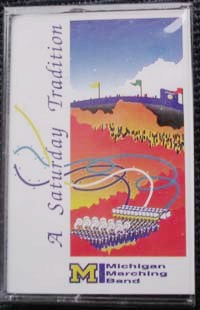
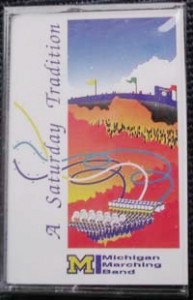
[3]. Not downloadable from anywhere, so far as I can see.  You can buy it at Amazon as part of a CD, the cassette version of which is copied above.

[4]. I think the version hyperlinked is the one referenced, but I understand that it might be a 1974 remake.

[5]. He is reportedly now the Creative Director for Disney on Ice.

  Copyright (c) Jack L. B. Gohn, except for album art

Theme Songs Page | Previous Theme Song |  Next Theme Song


Dances for Tolkien

Theme Songs Page | Previous Theme Song | Next Theme Song

Dances for Tolkien

Polovetsian Dances by Alexander Borodin (with Nikolai Rimsky-Korsakov and Alexander Glazunov) (1890)

The Sorceror’s Apprentice by Paul Dukas (1897)

Encountered 1961?

I come now to a record, indeed a kind of record, that seems to have disappeared, even from the electronic yard sale racks of E-Bay.  Heaven only knows where my own copy disappeared to, probably four decades ago.  I’m speaking of my grocery store classical music anthology.

Many people can remember grocery store encyclopedias, sold a volume a week.[1] This was the same idea, but instead of volumes, the grocery store would sell classical records.  Along with the first one, you got a leatherette binder about four inches thick, all in burgundy with black accents and gold lettering, with a title something like The Treasury of the World’s Great Music.  Whatever the title was exactly, I know it suggested that once you bought and learned about all the pieces inside, you’d be a connoisseur.  Well, I wanted to be that, so I persuaded my mom to pop for a dollar or so at the A&P on Huron Street each time one more piece of vinyl sophistication was issued.

As I’ve said before, my parents were out to make an intellectual, so they took little persuading.  They had their own quite extensive collection of classical music, but if I wanted a set for myself, they’d see to it that I got one.

The arrival of each LP was an event.  Each record came in a sleeve punched to fit in the binder.  Accompanying it was a lavishly-illustrated (in black ink plus one extra color) leaflet, I think of eight pages, that told you all about the pieces on the record, and the life of the composer.  I’d crack open the cellophane package, unscrew the binder, insert my leaflet and liner, rescrew it, and get right to work listening and reading.

And this was what brought Beethoven and Bach and Berlioz and Grieg and Tchaikovsky and a host of others into my life.  I learned of Beethoven’s deafness, and what his symphonies sounded like (I think they packaged two of them).  I learned that something had been dreadfully wrong with Tchaikovsky’s marriage (though not precisely what) and how he had been rescued by the kindly benefactress Mme. Von Meck, and I came to recognize the sound of the Pathétique.  And incidentally, I came across the perfect theme music to accompany one of my most gripping literary experiences.

I wish I could tell you exactly when my parents introduced me to J.R.R. Tolkien.  I’m pretty certain it was sort of an afterthought after I’d kind of exhausted C.S. Lewis’ Narnia series.  I had literally grown up with the Narnia books; Lewis had started to publish them in 1950, and my mother and I were living in London then, and she bought them for me hot off the press.  I still have The Lion, The Witch and the Wardrobe and Prince Caspian in their British hardback editions, much the worse for wear.  By 1956, though, Lewis had finished his seventh and last Narnia book.[2]  Somewhere my parents heard about Tolkien, how he was somewhat the same kind of thing.

And so, kind of as an experiment, I think, they got me the first Houghton Mifflin edition hardback Tolkien.

That took – boy, did it take!  So they bought me the second, and then the third.  Again, I still have these, though unfortunately the dust jackets are long gone.  I read them over and over.  I copied runes, and actually tried to send people messages in runes.  And of course I was making a movie in my head, though I had no idea how it could possibly be done.[3]

I have a memory of reading The Lord of the Rings in my bed early in the morning. There was a second-floor window close to the head of my bed, and there was a mulberry tree below it on which birds liked to perch and sing.  In summer the windows would be open (no air conditioning).  So naturally I’d be up early.  It was a wonderful, quiet time.  And there I would sit with various books.

I could riff on some of the other books, but my point is that I very specifically recall the thrill of reading Tolkien sitting there.  And while I was reading it, I often had playing softly, so as not to wake my parents (on my grey two-tone Columbia record player) one particular record from The Treasury of the World’s Great Music.  This LP combined on one side the symphonic version of Borodin’s Polovetsian Dances and Dukas’ The Sorceror’s Apprentice.  Now with all respect to Howard Shore’s estimable soundtrack for the Peter Jackson’s near-definitive movies, once you’ve listened to these pieces, you will never think of Shore as being in the same class in capturing the thrill of those books.

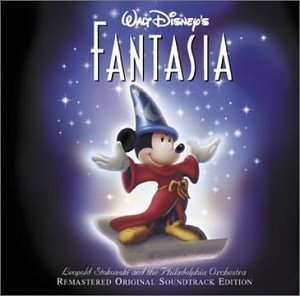
Yes, I know that these pieces were written to capture something rather different.  Borodin (together with his posthumous collaborators Mussorgsky and Glazunov), was seeking to convey the exoticism of the Central Asian Polovtsi people, who are not Russian like the audience, and not the good guys.  Paul Dukas was setting an ancient cautionary tale in a dark but humorous scherzo.  And probably I would never have associated these things with Tolkien if I’d seen them in their more accustomed settings, the grand opera for Borodin (see a video here), and Fantasia for Dukas (see the complete video here).  I was at least on notice with the Dukas, as there was in my booklet a still of Mickey Mouse as the Sorceror’s Apprentice from the 1940 movie.  But it made little impression.

If you can listen to these pieces without that baggage, though, you can see what wonderful accompaniments they make to Tolkien’s epic.  You think about what’s in those books and, as they say, there’s an app for that.

Much of the books is about traveling, mostly to unfamiliar, desolate places.  Listen to the opening notes of the Introduction to the Dances, and see if you don’t agree this is perfect.  This is the theme that got made into the song Stranger in Paradise in the musical Kismet.  It combines wonder with just the right subdued quality to mirror the emotions of the Fellowship as they would cross downs and tramp through forests.   The same theme turns up in the fifth movement, the Moderato alla breve, and there there’s so much filigree and ornamentation jumping mischievously around, you could envision the younger hobbits doing foolish things while on the road.

And when you get to the second movement, the Allegro Vivo, it will conjure up troops of horsemen, the Rohirrim, let us say.

Movement three, the Allegro: at least intermittently a battle scene.  It would work with the big fight outside Minas Tirith, for instance.

Movement four, the Presto: a fight or a flight by night, such as might have happened at the Inn at Bree, or Weathertop.  This theme returns in the sixth movement, also a Presto.

The final movement, Allegro con spiritu, known to Kismet fans as Not Since Nineveh, conjures up a busy town like Minas Tirith.

Now, although there are certainly dark notes in Polovetsian Dances, they don’t begin to compare with the darkness in Sorceror’s Apprentice.  There’s definitely a wintry kind of joviality there too, obviously, but this is programmatic music, and the story it tells is set in a sorceror’s den.  Which is the ideal place to begin a setting of Tolkien; the Ring, after all, starts in exactly such a place.  There are other dark places in the story, lots of them, Mirkwood, and Weathertop by night, and the mines of Moria, and the Paths of the Dead, and Shelob’s Lair, and Mordor itself.  And Dukas’ brooding tones are perfect for this.

The apprentice is a Pippin type, getting in trouble through bumptious overconfidence.  The capriccioso themes that depict him work perfectly for that.

And then there is music depicting something magic gone completely out of control – which is really what Tolkien’s whole story is all about.  It gets more and more tumultuous and scary, until it stops.  Just like Tolkien.

Obviously the books are long and the pieces are short, less than 20 minutes total, which is why they fit nicely on a single side of an LP.  And obviously I was listening to lots of other things over the several readings I gave those books.  But there was never any question what record of mine gave the most scope to my musing how to make – and score – a movie based on them.


[1]. In fact, I’ve recently seen a 2008 blog post that suggests these are still available somewhere.

[2]. I believe, although I cannot substantiate this with Web research, that the American editions came out somewhat later.  I think, for instance, I was given the last one, The Last Battle, shortly after its American publication.  And I certainly was older than seven, which is the age I turned in 1956, the date of its British publication.

[3].  Peter Jackson, who actually directed the epic film trilogy, and who must have been born just about exactly the time I was discovering Tolkien (Halloween 1961 was his birthdate), would have to await digital technology just like everyone else.

Copyright (C) Jack L. B. Gohn, except for album and book artwork

Theme Songs Page | Previous Theme Song | Next Theme Song

The Messy But Necessary Leakocracy

The Big Picture Home Page         Previous Big Picture Column      Next Big Picture Column

The Messy But Necessary Leakocracy

Published in the Maryland Daily Record September 7, 2010

          I suspect many of us reacted with some glee at the initial tale of the big Wikileaks document dump concerning the Afghan war.  I suspect, though, that few continued to feel unmixed glee at hearing reasonable-sounding claims that the revelation of the documents might cost lives, for instance among the U.S. network of Afghan informants, now identified to the Taliban.

          It’s a familiar dance of ambivalence.  We all like seeing government cut down to size.  But we also want government to remain strong enough to do whatever it is we happen to like seeing government do.

          So it balances out.  Except for true-blue anarchists, most of us want government to have some secrets.  We understand that military and intelligence organizations whose doings were an open book would not be able to function.  We don’t usually want our military plans to be freely known, nor the names of our secret agents. 

          On the other hand, these are our secrets.  We the people established this government, and we feel entitled to exact accountability from  it.  We want it understood that the government makes and keeps these secrets as a trustee.  Like every trustee, it has received what it administers for definite purposes.  Not all uses are legitimate.

          And therein lies the problem.  Year after year, administration after administration, secrecy is abused to cover up policy choices that could not have been made publicly, because the government knew the public would probably not agree to them, like, to choose two known examples from the Bush administration, illegal wiretaps and torture.  To choose a likely example from the Obama administration, drone assassinations that kill lots of innocent civilians.  Often, secrecy is used to evade accountability for lies or for corruption.

          And it would be easier if  the trustees of the trustees, for instance, in military and intelligence spheres, the chairs and ranking members of the Congressional intelligence and armed services committees (sometimes augmented by their four counterparts across the aisle), could be trusted to talk intelligently if tactfully to the public when the keepers of the secrets they oversee are covering up something wrong.  But don’t hold your breath.  The aforementioned torture program was divulged to these purported legislative overseers, but  they could not speak publicly without fear of prosecution, and they could not even talk to other members of Congress to urge legislative counteraction.  As a result, Congress was not informed, and the “Gang of Four/Eight” served of no real use to America.

          Enter the leakers and the press and blogger community who disseminate what the leakers share.  Their role is not institutionalized, and there is little or no quality control on what leaked information they divulge, save what they themselves provide.  As a result, things that should stay secret often become public, but things that need to be made public, like the torture and the wiretaps, often are publicized as well.  Governments hate this, although with a caveat: surreptitious official leaks designed to influence public opinion and embarrass one’s political adversaries are every bit as common as unofficial ones designed to subvert secrecy.  The unmasking of Valerie Plame was a prime example, but it goes on all the time.

          That caveat aside, though, it seems that of late governmental hatred of the leakocracy, to coin a phrase, has grown.  Partly that’s because the power of leakers has grown.  Back in 1971[1] Daniel Ellsberg had to put in six weeks of hard work to copy the Pentagon Papers.  The tens of thousands of Afghan War documents Wikileaks recently made public were probably maintained in portable format in the first place and then pirated on a peripheral drive.  Loading all of them could take less than an hour.  This was, of course, a drop in the bucket; the recent Washington Post series on the size of America’s secret government gives some idea of the sheer volume of secrets out there.  The font of unspilled secrets is not about to run dry.  But computers have given the leakers a wider reach and the ability to move faster.

          Still, there is now a new concerted effort by federal prosecutors to force journalists to divulge leakers’ names.  The jailing of Judith Miller for refusing to divulge her sources regarding Plame, and the near-jailing of Mark Fainaru-Wada and Lance Williams of the San Francisco Chronicle, who reported on grand jury testimony in the BALCO athlete-doping scandal , are ominous.  Because of the failure of institutional overseers, the leakocracy serves as a valuable if not vital safety valve in our society.  

          The game has always contained a delicate if unspoken balancing act: everyone accepts that leakers can be prosecuted or at least sued if caught, but when they speak to the press they are in a kind of sanctuary.  There is no national press shield law; the sanctuary mostly exists by virtue of prosecutorial self-restraint.  Hence if leakers are caught, it’s not because the journalists turned them in.  This balance has made possible a much better informed public debate on security matters.

          An example of that value and the threat to it: the threats to prosecute James Risen of the New York Times, apparently for his refusal to identify to investigators the sources of the leaks evident in his invaluable book State of War (2006), which this column has cited.  That book is a searing indictment of CIA and NSA ineptness in a variety of contexts (vouching for WMD they knew didn’t exist, sending nuclear secrets to the Iranians, betraying the names of our entire network of Iranian informants, and engaging in warrantless NSA wiretapping).  It was a fine and responsible piece of journalism.  It was also a huge embarrassment to the government.

          For protecting his book’s sources from prosecutors interested in leaks about the Iran material, it appears likely Risen is headed for prison – even though no one denies the accuracy of any of Risen’s information, and there were no evident compromises of ongoing national security in the book.  There was an argument to be made that Risen damaged national security by being one of the Times team that had broken the NSA surveillance story in 2005Bush called that “a shameful act,” if you recall.  But as I argued at the time that disclosure was justified by the wound the NSA surveillance program inflicted on our Constitutional culture, disinfectable only by sunlight – and in any case the State of War Iran material was entirely separate.  No fair punishing Risen indirectly.

          What may happen to James Risen can dampen the marketplace for leaks a bit, but cannot quell it.  Effective independent oversight of the secret-keepers would address the root of the problem, but we don’t have that and are unlikely to get it.  Failing that, leaks are inevitable, and, on balance, a good thing.

          If we ever actually get oversight of our institutions that reliably restrains them from doing unconstitutional and or improper things, then and only then could plugging leaks by hounding journalists and bloggers for their sources begin to make sense.  Until then, chilling their activities this way will predictably encourage abuses, by government, by business, even, as we’ve seen, by big-time sports, more than it protects useful secrecy.


[1].            Alasdair Roberts, Blacked Out: Government Secrecy in the Information Age at 73 (2006).

                                              Copyright © Jack L. B. Gohn

The Big Picture Home Page       Previous Big Picture Column      Next Big Picture Column

A Kitschy Gilde

Theme Songs Page | Previous Theme Song | Next Theme Song

A Kitschy Glide

                        Calcutta, by Heino Gaze, performed by Lawrence Welk

                                       Recorded 1960, Encountered 1961?

If you’re going to be entirely honest about the “theme songs” in your life, you’re going to have to own up to some unsophisticated moments.  Let’s face it: none of us is born erudite.  Things are likely to have thrilled you along the line that you might not want the world to know about now, because they make you look like exactly what you genuinely were, unsophisticated.  This is my moment for owning up.

Up to this point I’ve been talking about music that may have been forged in popular idioms, but I’ve been praising its perhaps unnoticed sophistication.  Have I been defending my youthful tastes a little by portraying myself as a sophisticate-in-training with a yen for the challenging hidden within the mundane like a diamond in the rough?  Probably.  But with this next item, Lawrence Welk’s version of Calcutta, there is absolutely no making that argument.  However intelligently constructed, it is musical kitsch, and one has to start with that.

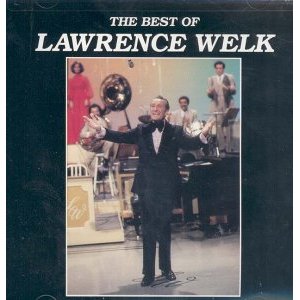
How kitschy?  Try this video from Lawrence Welk’s show which incidentally gives you the complete performance of the song with the exact orchestration of the 1961 hit.[1]  One’s jaw hangs loose as one watches it, especially when one considers it was shot in 1971: the accordion-and-harpsichord orchestration, the dreadful clothing choices, the green jackets on the musicians, the female singers clapping in time adorned with the helmet-coifs and the matching puce dresses, the dancers, many of whom are unapologetically old and dowdy-looking, being watched by an even grayer audience – all of this captured in the same year that Jim Morrison died.  And I haven’t even got to the music yet.

Now, let’s acknowledge that some of the greatest composers in the world were German.  The classical repertoire is stuffed with German names, men (well, mostly) of great musical profundity.  But the converse is also true.  There is also a very German kind of musical superficiality, honed by the polka and the drinking song, and this number is from that tradition.  The melody, composed in 1958, is by Heino Gaze (1908-1967), a journeyman German film composer who also did a considerable business in drinking songs and cute little melodies.  It pretty much defines Easy Listening, German Division.  It conjures up a world of resolute cheeriness.

Could it be that there was something slightly deeper under the surface?  After all, it’s not called Hamburg.  Is there any concession to any kind of exoticism – an exoticism that might cause a composer to break an imaginative sweat and dig a little deeper – suggested by the title?  Well, there was a German lyric, irrelevant to the Welk rendering, which was presented as an orchestral number, that I’ve not heard, but I have heard the English lyric, which was recorded by the Four Preps in a sort of cover of the Welk version,[2] and that charted in February 1961, two months after Welk’s.  Basically, it’s all about how the lucky protagonist has kissed girls all around the world, and the ones in Calcutta kiss the best.  The same idea as California Girls, only coming down elsewhere as a choice for the promised land of dating.  So no, when the listener hears no real hint of other musical idioms that might conjure up the Indian city of ideal kissers,[3] he or she is correctly not hearing what isn’t there.  The cheerfully propulsive rhythm and Western melody and chord structure are all the cosmopolitanism the protagonist needs.  After all, per the lyric, he’s kissed girls in Naples, Spain, and Par-ee.  One suspects that Calcutta was chosen as the final destination simply because it scanned properly.

So what was my connection with all of this?  That may be the most embarrassing revelation of all, because, though I can’t be quite certain, it appears that somewhere in the recesses of my mind I’ve forged an association that has no real-life basis.

Let me explain.

My parochial school, St. Thomas the Apostle in Ann Arbor, Michigan, had, for at least one year of my youth, a summer recreation program.  Now, I made a lot of good use of my summers as a kid, learning to type, learning to swim, learning how to play tennis, doing advanced studies in Math and German.  But at least during the summer of 1959, I took part in that rec program.  I think that was the most summer fun I ever had.  And most of it was pretty basic.  We piled into buses and went to lakes to swim.  We took the buses to amusement parks. And we roller skated in the former school gym, which was now the auditorium when folding seats were lined up there.  Of course they were put away in racks when we skated.

I loved the skating the best.  And it was a remarkably unsophisticated pleasure.  Just get yourself issued the old-fashioned 2X2 skates in your shoe size, strap them on, and go round and round on the green vinyl tiles.

While listening to easy listening music.

I know they were big on Mitch Miller.  Calcutta is very much the kind of thing Miller would have had his choristers sing.  And I could have sworn, until I checked carefully through my mom’s diary, that the most popular song of all that summer was Calcutta.  But here you hit an anachronism like a brick wall.  Calcutta hadn’t even been recorded yet that summer.  There was, I understand, a German version from 1958, but I can’t imagine that we were playing that.

So the bottom line is I have an impossible association here.  My favorite association from the summer of 1959 is inextricably linked to a 1961 song.

Sometimes, when presented with the impossible, you just have to go with it.  It’s my story and I’m sticking to it.  The song that always reminds me of those simple unsophisticated afternoons of skating lazily around in circles is a song I probably first heard two years later.  The song is as square and kitschy, as reassuring that nothing will ever change for the worse, as the pleasure that will always come to mind when I hear it.  In the song’s lyrics, the singer’s encounters with the women who kiss him all over the world don’t entail any heartbreak or betrayal, any regrets, any chance of STDs.[4]  Music with any shadows in it, any exoticism even, would be all wrong.  It’s all a charming game, just like roller-skating on a Sunday afternoon.  And that connection, I guess, will have to be enough.


[1]. Well, actually it first charted as a single December 12, 1960 according to my trusty Billboard Top Pop Singles Guide.

[2]. Available on iTunes.

[3]. A good comparison, if one wants to hear how Western light composers of that era would suggest the musical palette of India, is the incidental music India Country Side from 1956’s Around the World in 80 Days, by Victor Young, that plays while the train carries the travelers into the heart of the country.  This is actually wonderful composing, if perhaps a little patronizing to the sound of real Indian music.

[4]. To modern, post-Women’s Movement ears, the whole casual approach to the women he’s experienced as not as individuals but as geographic categories, like regional varietal wines, seems so superficial and dismissive one nastily wonders whether the singer is romanticizing visits to brothels in various places.  Maybe, if Calcutta was selected for more than its scansion, the subtext is that there was something really special about the way tricks were turned there.  One hopes not.

Copyright © Jack L. B. Gohn, except for album art

Theme Songs Page | Previous Theme Song | Next Theme Song

In Praise of Foreign Moods

The Big Picture Home Page

Previous Big Picture Column      Next Big Picture Column

In Praise of Foreign Moods

Published in The Daily Record August 2, 2010

          Justice Thomas has said,[1] while ignoring the views of other countries about some aspect of criminal punishment, that courts should not “impose foreign moods, fads, or fashions on Americans.” Justice Scalia quoted the phrase[2] to resist decriminalization of homosexuality.  How far we have come from the words of Thomas Jefferson in the Declaration of Independence extolling “a decent respect to the opinions of mankind”![3]

          To me it’s obvious that we should attend to what other countries do and think – just as they should be looking at us.  Nobody’s too dumb to teach or too smart to learn.  American “exceptionalism” rarely has much to recommend it.  Two recent news stories have illustrated that for me.

          But first – a story of my own.  When I was four my mother and I were guests at a Carmelite monastery for a month.  I was told before we arrived that all the nuns would be veiled, and you could not see their faces, though at the time we were welcomed the mother superior took the veil away so as not to frighten me.  The rest of the time I did not see any of their faces, or, I guess, much else of them.  I’m sure there were some in that era, inclined to view “Papists” with distrust, who heartily disapproved and found the Carmelites’ habit a little sinister.  But surely nobody seriously considered telling the good nuns they couldn’t dress that way.

          I thought of this experience when reading about France’s headlong drive to ban the burqa, a similar form of garb: a religiously-inspired complete covering of the body and face of a woman.  I am quite certain that even with our nation’s current conflicts with Muslim zealots and, some say, with Islam itself, such a ban would run smack up against the Free Exercise clause of our First Amendment.  We might require driver’s license photos or make other reasonable exceptions, but we wouldn’t forbid the burqa outright.  That kind of garb just never has been and never would be a big deal here.  But France is making an issue of it.

          There has been excellent blogging on the subject by Martha Nussbaum on the New York Times website,[4] which I shall not attempt to duplicate or summarize.  But among other things, Nussbaum points out the subtle differences in U.S. and French constitutional culture which enable the different results.  The U.S. First Amendment is neutral, not only among religions, but also between religion and atheism.  French law, on other other hand, is vigilant to shield the nation from the heavy hand of religion, and while atheism is not compelled, it is protected in a way that faith is not.  For France to legislate against religious observance is acceptable in a way it would never be here.

          Meanwhile, there is a strong sense that the state has a right to compel newcomers to adopt culturally French ways.  We Americans flirt with formally requiring English; this is mild compared with what France does, exerting many legally permissible pressures on French immigrants to assimilate.  Perhaps not surprisingly, it doesn’t succeed all that well.  Blame the heavy-handedness, plus the unwillingness to have immigrants add their own flavors to French culture.  By contrast, every group that comes to the U.S. ends up culturally American in a couple of generations, but enlarges and amends what it means to be American in the process.  Accepting that amendment is part of America’s secret of success.

          The moral?  France would do well to study and internalize some American First Amendment values.  It’s going to do no damage to France to have the occasional burqa on the street.  (French police estimate there are perhaps 2,000 burqa wearers in the country.)  The refusal to allow it may well cost lives, and paradoxically slow down the integration of Muslim immigrants into the French mainstream.

          We too have things to learn.  We received a subtle rebuke from the Swiss courts three weeks ago, when they set Roman Polanski free.  (If you just came in, Polanski, a renowned director, raped a 13 year old in 1977, and served 42 days before being released, but fled when it seemed likely the judge was going to go back on a promise to give no more jail time.  He has lived and worked since in countries where he felt safe from extradition.  Switzerland had seized him, however, to entertain an extradition request.)

           The stated reason  the Swiss gave for freeing Polanski was that the authorities seeking Polanski’s expatriation had failed to provide transcripts of testimony by a prosecutor concerning sentencing negotiations at the time of the original trial.  The transcripts would likely have confirmed the contours of the original sentencing deal, relevant under Swiss extradition law, but also, not coincidentally, relevant to the whole reason Polanski had run.  In other words, the Swiss would not turn over Polanski without paying some heed to the judicial misconduct.

          The Los Angeles prosecutors had been trying to put issues in the opposite order: Polanski’s fugitive status here and now, the judicial bad faith to be resolved later, maybe.  This order envisioned Polanski as burdened with an ineradicable stain that blotted out his own claim for justice – at least in the extradition proceeding.  The Continental view shies away from this rigidity, and the Swiss ruling echoed it.

            The Europeans have the better of this difference.  However bad what the Polanski of 1977 did was – and it was – you cannot punish him.  He no longer exists, worn away by half a lifetime of subsequent experiences and choices.  The offender escaped, and in truth cannot be recaptured, even if today’s Roman Polanski were put in prison.

          The real question was much more complex: how do you respond to demands to put in jeopardy of imprisonment a man who a) committed a serious crime 33 years ago but has done nothing similar since; b) was apparently the victim of an intended judicial doublecross that might or might not be rectified were the fugitive rendered up; c) has been making a major creative contribution to society; and d) whose victim has publicly stated she wants the matter dropped?

          Long ago the Continental view was crystallized in Victor Hugo’s Les Miserables.  To the implacable Inspector Javert, once Jean Valjean had committed a crime, he had placed himself in a category from which he could never escape, come what might, and he needed to be pursued and exiled from society.  However admirable Javert’s zeal for the law, he remains the villain of the piece, and Valjean the hero.  The correct moral calculus, in Hugo’s view, rested on the totality of circumstances, not broad and rigid categories.  Javert’s villainy stemmed directly from his inability to see matters that way.

          There is something awfully Javert-ish, and not all that atypical of U.S. law enforcement, about the way the Los Angeles prosecutors are behaving this time.  And it looks as if the Swiss court saw that, and called them on it.  I suspect most Europeans who cared were cheering them on.

          A teachable moment, if those prosecutors are willing to learn.

          As I say, we should all be learning from each other.

Copyright (c) Jack L. B. Gohn


[1].         Foster v. Florida, 537 U.S. 990 Note, 123 S.Ct. 470 Note (2002) (Thomas, J. concurring).                                                                           

[2].         Lawrence v. Texas, 539 U.S. 558, 597, 123 S.Ct. 2472, 2495 (2003) (Scalia, J. dissenting).

[3].         In fairness, there is no suggestion by either Thomas or Scalia that they would consider it illegitimate for legislatures or members of the executive branch to consider foreign examples.  The rule of disregard they would urge probably would affect just the courts.  The Continental Congress which promulgated the Declaration was more akin to a legislature than to a court.  But even granting the distinction, the difference in tone describing foreign outlooks (Thomas belittling, Jefferson respectful) is unsettling.

[4].         See http://opinionator.blogs.nytimes.com/2010/07/11/veiled-threats/?scp=1&sq=nussbaum%20burqa&st=Search and http://opinionator.blogs.nytimes.com/2010/07/15/beyond-the-veil-a-response/?scp=2&sq=nussbaum%20burqa&st=Search

The Big Picture Home Page

Previous Big Picture Column      Next Big Picture Column

A Stately Roll

Theme Songs Page | Previous Theme Song| Next Theme Song

A Stately Roll

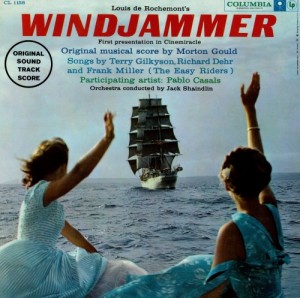
Windjammer (The Ship) by Morton Gould (1958), Encountered 1960

I had the rare good luck to be raised by two loving parents and two loving step-parents, and I loved all of them back.  Each of them, whatever their flaws might have been, was unambiguously my loyal supporter.  A young man can ask for few better things.  I believe that in consequence my experience of what they called in that era a “broken home” was about as painless as it is ever possible for that kind of thing to be.

But that is not to say that there wasn’t some pain involved, or that all of the foursome could participate equally in my life.  My mom and stepfather were the custodial parents, and my home was with them in Ann Arbor, Michigan, which lies about 40 miles to the west of Detroit.  For some reason we never visited Detroit as a family.  My father lived in New York, and of course tried to make a big occasion of it every time he visited with me.  The biggest occasions in the neighborhood frequently were to be found in Detroit.  Hence it was with my dad, not my mom and stepdad, that I received most of my experiences of the car-making metropolis to the east.

Thus I had some very good feelings about Detroit simply owing to the fact that my dad took me there – and made a fuss over me there.  You’d expect, and you’d be correct, that music associated with such visits might resonate with me.

For instance, on one Saturday in October of 1960,[1] my father flew into Willow Run airport where I was waiting for him and from whence we traveled into Detroit, stayed at the large and swanky Park Shelton Hotel,[2] and made an evening of it by going to the grand art deco Music Hall Theatre[3] and seeing Windjammer.

Windjammer was the one and only feature movie made in Cinemiracle, a rival process to Cinerama.  I recognize that neither name may mean much over 50 years later.  Each technology involved filming with three cameras and exhibiting with three projectors.  With all that square footage of celluloid, the resulting image could be huge.  The screen was designed to wrap around its audience (similar to IMAX today, but more so).  The idea was to give the viewer the sense of being in the midst of the action.

Despite the technical imperfections of the processes (join lines where the pictures bordered being probably the worst), Cinerama/Cinemiracle did have the uncanny power of putting you in the middle of things.  So far as I am aware, there was never a truly great movie made by either process, but the depiction of certain things like roller coaster rides or buffalo stampedes would be so awe-inspiring, no one was going to be carping at the mere absence of great art.

Windjammer in particular, which had its U.S. premiere in April of 1958, follows the men and boys of the Christian Radich, a Norwegian tall ship used as a training vessel for that nation’s merchant marine.  They have adventures like a squall in the Bay of Biscay, attending a private cello recital by Pablo Casals, riding basket sleds in Madeira, and experiencing the bright lights of New York City.  I had a riotous time, and came out with my eleven year-old brain intoxicated by the wild spectacle.  My father, who was always one to make the flavor last when he could, bought me the LP on the way out the door, where it was on sale.

When I got back to Ann Arbor, that record promptly became one of my favorites, and not merely because of the associations I’ve mentioned.

I still have it. It is a musical potpourri doubtless designed to appeal to a wide variety of tastes: not only the aforementioned Casals track, but also some purpose-composed “easy listening” ballads allegedly sung spontaneously by the crewmen, a couple of dollops of Caribbean steel band, and regular film score music.  The latter was composed by Morton Gould, a remarkable American composer comfortable as Leonard Bernstein writing in popular genres but just as clearly capable of working in the classical tradition.[4]  I think I recognized immediately the difference between the quality of the hackwork on the “spontaneous” songs of the crew and the haunting melodies and orchestration that emanated from Gould.

The gem of the album is the ship’s own theme song, Windjammer (The Ship), which somehow captures the stately roll of a powerful rigged vessel, and conveys a sense of the adventures two which such a vessel is capable of bearing its crew.

Listening to it carefully now, I can sort of see how Gould does it.  There are two themes playing against each other for most of the song.  To oversimplify a lot (because I’m not a trained musician nor do I want to do a real blow-by-blow of it) here’s what I hear.  There’s a rolling theme, usually articulated by the strings, in upward and downward arpeggios, mainly inversions of the tonic (D) chord dropping down to the minor and then springing back.  Over and separate from that background, there’s a melody, carried originally by the strings, later mostly by the brass, that sounds all at once wistful and questing, ending up on the subdominant, with the tonic note emphasized.  The whole thing is flavored with harps, cymbals, and nautical-sounding bells.  After about a minute of this, the brass starts coming in and making everything sound bolder and more adventurous.  Toward the end, the brass even takes over the job of doing the arpeggios for a bit.  There are quiet bridge sections and a key change dropped in here and there to help the listener catch his/her breath, but it always comes back even louder and bolder than before, building to a big crescendo at the end, tailing off into quietness in the last couple of seconds, with another nautical bell. This ravishing little package, about three and a quarter minutes’ worth, would make anyone fantasize about going to sea.

In a way, the outlandishness of it, especially in the great Midwest, was the point for me.  I could not see myself as a seafarer.  Though I’d crossed the ocean three times by my 12th year, I understood without having to be told that this experience had little in common with actual sailing.  And I was okay with that.  But if I was not looking for sea adventures, I was looking for adventures of some kind, and the music spoke to that too.

Getting taken to fancy hotels and movie houses by my dad was a pretty good start.

I didn’t know exactly what I was headed for, but this music helped me feel pretty good about my prospects of having stirring times along the way.  I hummed it a lot for a while.


[1].         Saturday, October 29, 1960 to be specific.  My thanks to my friend Walter Hogan, Technical Services Coordinator at Eastern Michigan University Library, who did the necessary research to confirm the date.

[2].        That swanky hotel has had various owners and names over the years, and is now condominiums but that was the name then.

[3].         The Music Hall was the Cinerama theater in Detroit, and, though, as discussed below, Windjammer was in Cinemiracle, Windjammer was shown in the same venue.  I understand (again thanks to my friend Walter Hogan’s research), that Windjammer opened there in March of 1960; I’m guessing it had to wait for a window of opportunity amongst competing Cinerama productions.  This explains why I saw the movie over two years after it premiered.

[4].         In fact I’d make so bold as to say that in his New York number, part of the Windjammer score, Gould was “quoting” Bernstein’s Ballet at the Village Vortex which had been part of the score of the musical Wonderful Town (1953) and some of the sequences in Bernstein’s On The Town (1944).  To the mid-century ear, Bernstein had sort of set the pattern for what the musical evocation of New York sounded like, but Gould worked easily and with comparative originality within that pattern.

Copyright (c) Jack L. B. Gohn, except for album art

Theme Songs Page | Previous Theme Song| Next Theme Song

The Case of the Missing Monuments, or None Dare Call It Treason

 (Published in the Daily Record July 6, 2010) 

            Recently my travels took me through several Southern states on US Route 1, which runs up the Eastern seaboard from Key West.  As with most of the highways that had been locally named “trails” but changed to the standard US numbering system around 1926, pre-existing names also continue to be attached to parts of US-1, and incorporated into the signage.  For example, sometimes US-1 is the Dixie Highway, sometimes the Federal Highway.  Nothing wrong with that. But I found myself taking exception when I discovered that long stretches of it are named the Jefferson Davis Highway.  Now, there is much federal money invested in this road,[1] some of which I saw used in construction projects I passed.  And Davis is not being commemorated for his service to the federal government (in the U.S. Congress or in the Franklin Pierce administration): he is remembered primarily for having been the president of the Confederacy.

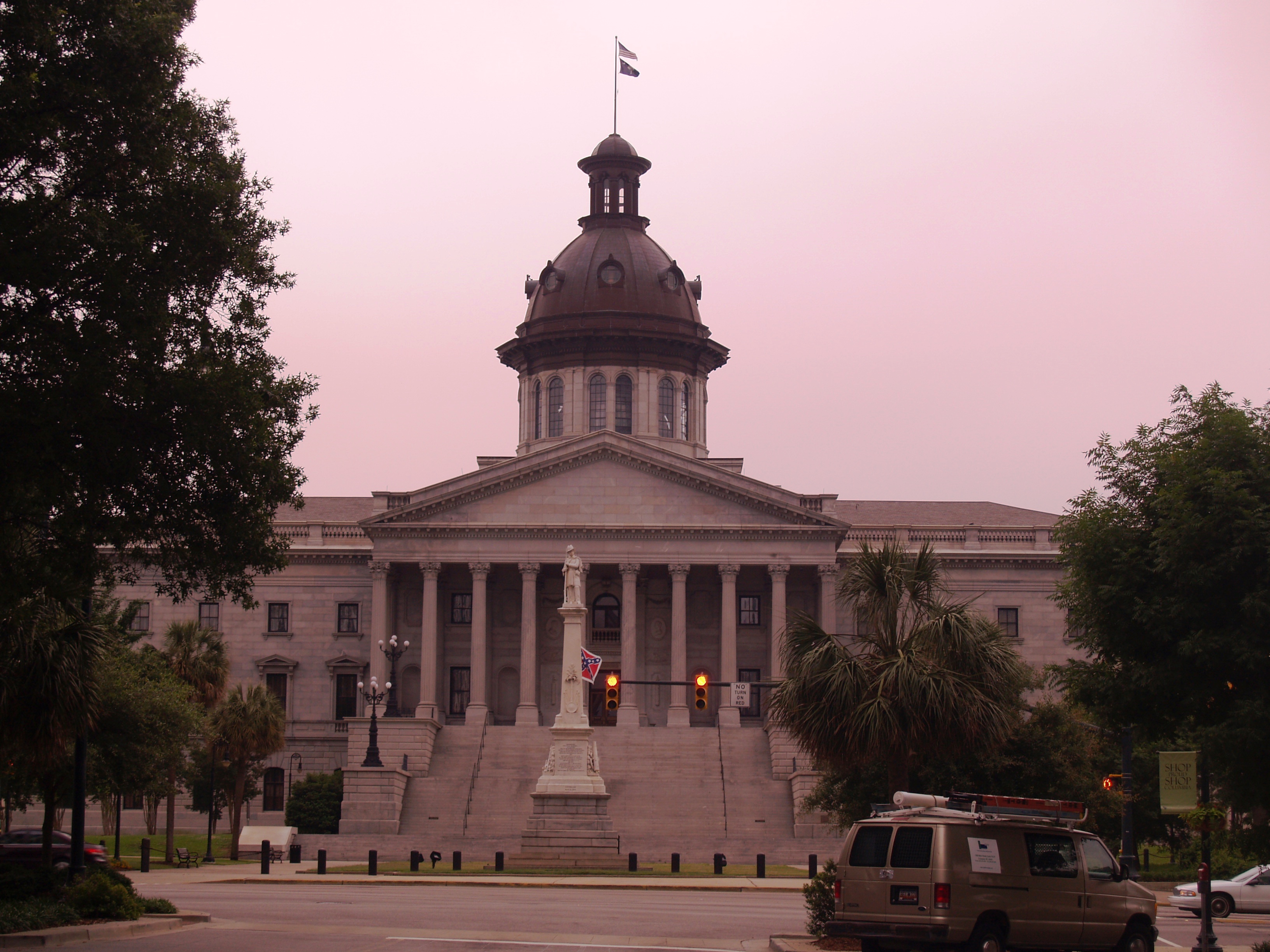
Confederate Monument & Stars and Bars

           And the last time I checked, the Confederates were rebels against and traitors to the federal government.  (Levying war against the United States is treason, under Art. III, § 3 of the Constitution.)  Davis himself was actually charged with treason after he was captured in 1865, though President Andrew Johnson, exiting his office, granted Davis a pardon, so that Johnson’s successor Ulysses Grant could not prosecute him.  But what does it mean that the man is honored at all?

            My bemusement grew as I visited the state capitals of South and North Carolina and Virginia, all of which also lie astride US-1.  The overwhelming impression one would get, from touring the capitol grounds in the Carolinas and looking at the monumentation, is that: a) the Civil War was a glorious affair, whose causes for some reason no one remembers; b) the South seems to have won the Civil War, though the details are vague; c) there never was such a thing as slavery; d) there was never a significant African American or Native American population in these states; and e) very little happened after the Civil War except for other wars, to which the gallant South sent (white) heroes.

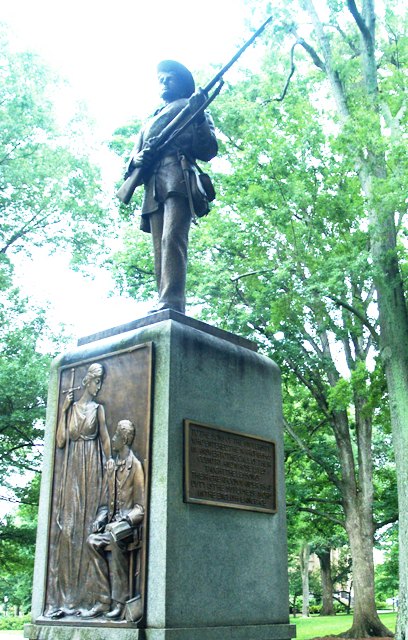
            There is one monument among the 27 surrounding the Columbia, SC capitol that explicitly acknowledges African Americans.  The place of honor in front of the capitol, to be sure, is given over to a Confederate soldier on a pillar, close to a flagpole from which the Stars and Bars flutter.  (It took a well-publicized fight in 2000 to remove them from the capitol dome.)  But halfway between there and the Strom Thurmond memorial, you can see the African American History Monument.  It was placed there in 2001 only after a colossal political struggle.  And its promoters were not permitted to acknowledge any specific person, though there have been many nationally-prominent African Americans to emerge from the Palmetto State, including Dizzy Gillespie and Mary McLeod BethuneOut of the 12 monuments on the grounds there that depict the human form, this monument is the only one with non-white faces.  (And I’m not even counting the Jefferson Davis and Robert E. Lee highway monuments.)

            In North Carolina the exclusion is even more profound.  On the grounds are 14 monuments.  Score: Whites 14, Others 0.  Confederate figures depicted: 4. 

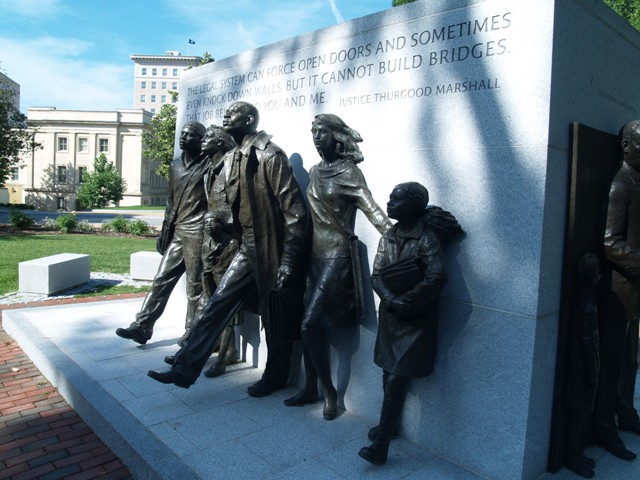
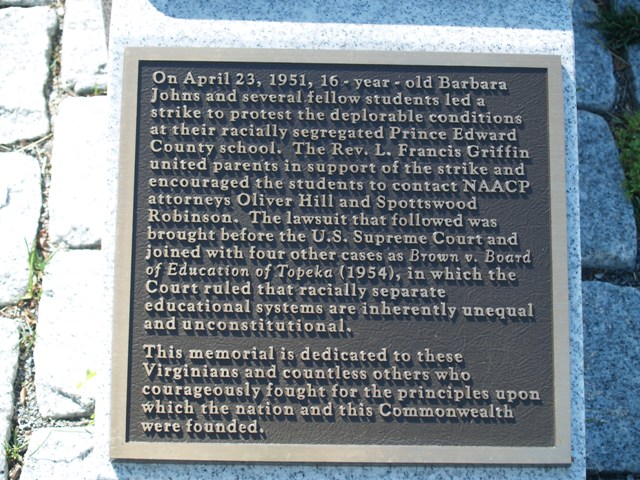
            Virginia came late (2008) to the notion that African American history deserved mention in the monumentation around a state capitol.  But when they did it, they did it much better.  For one thing, there are only six monuments altogether.  The Civil Rights Memorial is thus far more prominent.  And the Memorial is focused on a particular event, the Virginia lawsuit that, together with cases from four other states, became Brown v. Board of Education, and on certain individuals, including the two lawyers who brought the suit, Oliver Hill and Spottiswood Robinson.  (It’s always gratifying to see monuments commemorating lawyers.)  The positioning is a bit weird, two monuments down from Stonewall Jackson.  But the monument at least acknowledges the existence of a deep problem in Virginia’s history, and some of the efforts to address it.  And though it is the object of some competition from the one true Civil War monument, the aforementioned Jackson, it is not drowned out by Confederate and Jim Crow nostalgia, as is the African American History Monument in South Carolina.  And just the fact that it exists distinguishes Virginia from North Carolina.

Civil Rights Memorial: One Face
Civil Rights Memorial Plaque

            That said, large stretches of “Jefferson Davis” Highway are superimposed on US-1 in Virginia.  So the Old Dominion State is hardly free of inappropriate Confederate commemoration.

            History, we are told, is written by the victors; apparently there’s an exception for the South, where the commemorated history barely includes the victory, and consistently omits slavery, the casus belli.  This peculiar history written by the vanquished apparently extends to the law. In this Cloud Cuckoo Land of Confederate commemoration, it does not seem to matter that the CSA came about through treason, secession being illegal, and existed primarily and fundamentally to perpetuate one of the worst human rights abuses in history.  (There were 4 million slaves in the South at the outset of the Civil War.)  The federal government poured out lives and treasure to establish that secession was illegal, and that slavery must be abolished. 

            It is all very well to strive for reconciliation, but there is no justification for pretending that the sides were morally or legally equivalent.  Even the truism that one man’s rebel is another man’s freedom fighter applies, if at all, only at the outset of a conflict.  If the dispute has been settled against the insurgents by war, the pejorative label of rebel becomes more objectively certain, and arguments to the contrary more frivolous.  As Ulysses Grant wrote of the purported legitimacy of secession: “The right of a state to secede from the Union [has been] settled forever by the highest tribunal – arms – that man can resort to.”[2]

            And that truth explains the fundamental perversity of the inscription on yet another statue, this in the middle of the campus at Chapel Hill: “To the sons of the University

Chapel Hill Monument

 who entered the War of 1861-65 in answer to the call of their country … ”

            With all due respect, it wasn’t a country.  It tried to be one, but failed.  And it tried to be one first and foremost in order to preserve slavery, a system that should have evoked nothing but shame in its defenders.  Those “sons of the University” gave their devotion and their lives for worse than nothing.  Their cause was so unworthy, their valor ought to forfeit any claim to commemoration, in statutes, on highway signs, or anywhere else.  Especially while all the offsetting monuments – to the slaves, to the Underground Railway, to those who fought Jim Crow, to prominent descendants of slaves – are mysteriously missing. 

            A hundred and fifty years after the fact, we have apparently not learned that lesson.


[1]. Typical federal funding for highways in one year alone can be seen in http://www.fhwa.dot.gov/ohim/hwytaxes/2008/f106.cfm .

[2]. Quoted in http://jimostrowski.com/articles/secession.html , Note 93, citing D. Tipton, Nullification and Interposition in American Political Thought (University of New Mexico Press, 1969) at 50.  (Citation to Ostrowski should not imply agreement with his arguments.)

Copyright © Jack L. B. Gohn

Telling Our War Stories, We Need to Be Honest

Previous I Read The News Today Entry | Next I Read The News Today Entry

Telling Our War Stories, We Need to Be Honest

As Richard Blumenthal recently found, being dishonest about our own personal histories during the time of the Vietnamese War can backfire.  Mr. Blumenthal, Democratic candidate for Senator in Connecticut, claimed to have been a veteran of that combat.  This simply wasn’t so; all he had been was a reservist during that period, and those of us who can remember it know that being a reservist pretty much assured that you weren’t going to fight in that War.  Time will tell whether this bit of prevarication sinks his candidacy.  But he has done us no favors by not being honest.

Why?  Because this nation keeps being confronted with invitations to go to war.  Choosing our response to those invitations is not a simple task.  It requires wisdom.  And unhappy experiences breed the surest kind of wisdom.  As a generation, Blumenthal and his contemporaries (including me) certainly had some unhappy experiences that are relevant.  We ought to share what we remember, not pretend to remember what never happened.

There was a divide in this generation.  To oversimplify, on the one side we were the Woodstock Nation; on the other, the Warriors.  Almost all of us were on both sides to some extent, at one time or another.  The Warriors largely took drugs and enjoyed the license of the Sexual Revolution, and most of them liked the same music as the Nation.  Many of them ended up opposed to the War.  The Nation, as we all know, for all its anti-Establishment and altruistic rhetoric, ended up providing most of today’s bosses — and came to be called the Me Generation, not without some cause.

And as far as the War part went, many of us Woodstock Nation types had originally favored the War because of its early associations with the idealism of the New Frontier and the Great Society, then come to oppose it — not irrelevantly, about the point when it became apparent we might be called upon to serve.  A change in position is not necessarily discreditable.  You could say it was about people concerned to save their skin, or you could say that it was a case of the personal being political.  Surely both were true to some extent.

Take my story.  When I graduated from high school in 1967, I supported the War.  On February 8, 1968, during my freshman year in college, though, I happened to attend a poetry reading and lecture by Allen Ginsberg.  After sitting though excerpts from Wichita Vortex Sutra, I saw the matter differently.  Ginsberg was able to convey the chaos, the waste, the inhumanity of the enterprise.  And as the additional evidence piled up (the secret illegal bombing of Cambodia, the corruption of the Vietnamese government, My Lai), I turned firmly against it.

And yes, there was the Draft.  It was far from the only thing on my mind when I rejected the War.  But the Draft was certainly on my mind.  It was more a matter of feeling guilty and angry than of feeling scared.

All during my college years, I was exempted from the Draft by a student deferment.  I saw my share of contemporaries who were going Over There.

I did not want to be someone who let others bear his fair share of the risks and burdens.  But I sensed in a half-articulated way that in a truly free county, the choice to make fighting and dying in a war an accepted part of those risks and burdens would be decided by the marketplace.  If enough young men chose to fight, then there would be a War and some sort of consensus behind it, otherwise not.  But nobody had asked me.  And as long as there was a Draft, it wasn’t necessary to ask.  That not being the case, I felt the demands of good citizenship a good deal lessened.

This weakened the pull of civic impulses, not only for me but for untold numbers of my contemporaries.  And yes, there was a strong class component to it.  It’s no secret that the fighting and killing and dying was done mainly by guys whose parents couldn’t afford to send them to college or fight for deferments.

In my own case, long story short, when my deferment ran out, I had a low lottery number and faced certain induction.  I applied for and was denied two more deferments, and then was spontaneously given one I hadn’t sought.  I probably qualified for one of the denied deferments, but my applications for both were infected with a kind of insincerity that left a terrible taste in my mouth.  Telling half-lies to preserve my freedom was not the way I wanted to live.  Had I not received the unsought deferment as a gift from heaven, I would certainly have gone to Canada; no question about it.  I would never have fought in that War.  And I don’t think I would have ever forgiven the United States for forcing that kind of decision upon me.

The alienating experience of my generation with the Draft has been taken to heart.  The volunteer army certainly makes wars more legitimate from that standpoint, though it is again noteworthy that social class is as strong a determinant as ever in sorting out who serves.

But solving this one issue papers over all the others.  The War had been promoted by can-do types who really believed that you could control and predict all important variables, and that it was the right and duty of our nation to interfere in insurgencies around the globe. People from my half of my generation recognized these same kinds of personalities again starting the wars in which we are currently engaged, but we were not listened to.

The utter predominance of the Executive Branch in war-making, without effective judicial review, was another hallmark of our experience.  We couldn’t get a court to invalidate the Draft despite the 13th Amendment, we couldn’t get a court to invalidate the War though it had not been declared, we couldn’t get courts to do anything useful.  Without judges in the loop, we had no way of checking exercises of presidential power against our basic social and legal norms.  That problem has only intensified in the years since.  And no one listens to us on that subject either.

The military-industrial complex goes right on doing what it did then too: making shiny new gadgets and promising to alter the tides of history with them — while making a buck.  Again, the note of caution this spectacle should elicit is not struck.

Part of the reason we don’t get heard is the hagiography of military service, the feeling that only those who served deserve a voice in the national dialogue, and that special attention is reserved for those who took fire.  That fallacy is obviously why Blumenthal lied.  The messy truth — that there was experience valuable to legislative policy-making in reserve service, in protesting wars, in running to Canada, for that matter, that’s what Blumenthal should have had the guts to articulate.

Copyright (c) Jack L. B. Gohn

Previous I Read The News Today Entry | Next I Read The News Today Entry

The Good Ship Jurisdiction: Sunk to a Foggy Bottom

by Jack L. B. Gohn

Maryland Daily Record, May 3, 2010

            Stop me if you’ve heard this one before.  How is the Pope like a Peruvian steamship?  Give up?  You’ll love this: the State Department stopped both of them from getting sued!  What’s that you say? It’s not funny?  Come to think of it, you’re right; it’s not funny at all.

           The Peruvian steamship was the Ucayali.  In early 1942,  Galban Lobo Co., a Cuban concern, filed an admiralty action against Ucayali in the Eastern District of Louisiana, claiming that Ucayali had failed to live up to an agreement to transport sugar to New York.  (Probably prompted by a sudden fear of U-boats after Germany and the U.S. went unexpectedly to war.)  Ucayali was no ordinary steamship however; she was owned by the Peruvian government.  In short order, therefore, the U.S. Department of State filed a suggestion of sovereign immunity on behalf of the ship.  The judge disagreed,[1] saying that any immunity had been waived by the extensive participation of Ucayali’s owners in early stages of the litigation – a commonplace route to inadvertent waiver of immunity. 

            The Supreme Court (In re Republic of Peru (1943)), did not even wait for appeals or cert petitions.  Instead, it leapt in with its little-used mandamus powers, and held that once the Department of State had spoken on the subject of sovereign immunity, that was the end of the discussion.  It acknowledged that whether Ucayali had sovereign immunity was a legal question, and that the District Court had jurisdiction to adjudicate this legal question, but it held that the Department of State also had jurisdiction to determine the question.  And the courts were supposed to defer once DOS had ruled, even if the question had been presented to the courts first. 

            This result seems peculiar.  Generally, courts review agency action; agencies don’t correct courts.  And in the end, this goes right back to Marbury v. Madison.  “It is emphatically the province and duty” of the courts, as Justice Marshall wrote there, in words each first-year law student learns, “to say what the law is.”  Yet here we have an agency saying what the law is, and the courts are unable to contradict. 

            Of course, the central vice of this ruling was not the injustice to Cuban sugar interests.  (The Court hinted that the Cubans were being taken care of in diplomatic negotiations.)   It was the characterization of State’s claim of Ucayali’s immunity as a matter of law.  Peru should stand for the proposition that the Executive, in fulfilment of its control of foreign affairs, can keep courts from interfering, not that State can overrule the courts on a matter of law.  There was no need for the Supreme Court to make of the State Department a mini-Supreme Court.  Yet that is what it did.  

            And as a matter of law, State probably got it wrong.  It seems likely that, on the strength of Ucayali’s owners’ participation in the litigation, any claim of sovereign immunity had indeed been waived.  Whatever the State Department honchos may have been thinking in deciding to assert sovereign immunity for Ucayali, we can be sure they weren’t bothering their little heads about whether there had been an inadvertent procedural waiver. 

            The mischief of Peru surfaced in 2005, in Doe v. Roman Catholic Diocese of Galveston-Houston, [2] in the Southern District of Texas.  This was one of the priest-abuse lawsuits, with the then-unusual feature that among the defendants was Cardinal Joseph Ratzinger, who became Pope Benedict XVI almost immediately after the suit was filed.[3]  The complaint alleged, as has now apparently been well-documented, that then-Cardinal Ratzinger was involved in various ways over the years with the Church’s former practice of attempting to determine the guilt of abusers in secret, to rehabilitate them secretly, and to return them to service as priests secretly, without a public accounting.  It should be noted that defenders of Benedict would say that after these actions, Benedict changed his own and the Church’s course.  The dispute between these narratives is not for this column to resolve;[4] the point is that a colorable allegation of tortious conspiracy was made, relating to actions Benedict took before the outset of his papacy or his ascension to the role of head of state. 

            The State Department duly filed a suggestion, in part relying on Peru, that Benedict was immune from suit as the head of state of the Vatican.[5]  And Judge Lee Rosenthal, in part relying on Peru as well, acceded, dismissing the Pope. 

            The fact that this lawsuit related to actions taken before Benedict’s papacy and head-of-state status made the case a lot like Clinton v. Jones (1997) a circumstance the plaintiffs’ counsel noted.  There, President Clinton was compelled to participate in a private lawsuit against him, even though he was the sitting president, because the case related to actions he allegedly took while governor of Arkansas.  Judge Rosenthal turned this argument aside with the observation that there is a big difference between suing a foreign head of state over the objection of the State Department, thereby trenching on State’s power to conduct foreign affairs, and suing the head of our own government. 

            Well, yes in theory.  Still, it is peculiar that a foreign head of state enjoys greater practical immunity than our own president.  Or that the inconvenience to the country when its president must defend against a private lawsuit matters less than the embarrassment to the Executive if the courts are allowed to do justice when it displeases Foggy Bottom. 

            There is also something inconsistent about vaunted claims that our courts dispense justice to all if the Department of State can come in and make the arbitrary decision to shut them down for the benefit of some.  There are no standards after Peru that the courts are allowed to apply to DOS’s decision-making.  Peru expressly forbids a court to inquire, for instance, whether DOS correctly applied its own procedures and criteria in making the decision to suggest immunity. 

            And what of the comparison to former Panamanian president Manuel Noriega, who, though just extradited to France, spent years in U.S. prisons at the behest of U.S. courts?  Not only was he tried criminally, but the courts processed a civil class action against various alleged participants in the fraud that was the Bank of Credit & Commerce International , including Noriega, though the suit was dismissed for other reasons.  After the coup the U.S. staged against Noriega, he, unlike the Pope, had no friends at Foggy Bottom to make suggestions for him. 

            So it depends on what State wants to do.  But how can make-it-up-as-they-go decisions by the State Department in effect control an Article III court’s jurisdiction? 

            Moreover, what becomes of the pursuit of justice when laws granting damages for child abuse and conspiracy to cover up child abuse cannot be implemented, and when the aggrieved cannot find a place to lodge their claims because a faceless State Department bureaucrat objects?  Are we still a nation of laws?


[1]          Ucayali (ED La 1942).

[2]          Doe (SD Tex 2005).

[3]          See the docket here: Doe Docket.

[4]          That is, it was not for this column as published in the Daily Record; see my blog entries on the subject: Benedict: Unfit to Serve, The Church in Darkness, and Benedict: The Counter-Narrative Forms.

[5]          See an excerpt from the Suggestion here: Suggestion.

Copyright (c) Jack L. B. Gohn