Bliss Was It In That Dawn

Theme Songs Page | Previous Theme Song | Next Theme Song

Bliss Was It In That Dawn

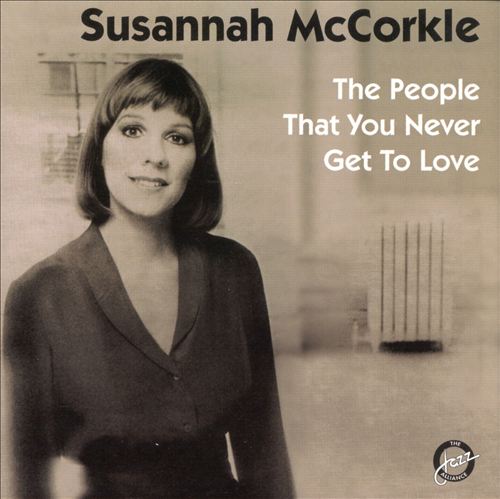
The People That You Never Get To Love

The People That You Never Get To Love, by Rupert Holmes, sung by Susannah McCorkle (1981), encountered 1984-1986

Buy it here | See it here [1] | Lyrics here | Sheet music here

When I became single again, like many men in my position, after a bit of a delay to mourn and regroup, I started inviting women into my life. I was free to ask, notwithstanding the serious girlfriend off in Nebraska (and then later in Charlottesville), who like me was seeing other people too. Many of my invitations were accepted.

I had some very unoriginal things to prove: that I was attractive, that I had the maturity to deal with simultaneous relationships, that I wasn’t making a mistake with the serious girlfriend. Standard recently-separated stuff.

Not Possible

It would have been nice not to have anything to prove: just to be out to have a good time and smell the roses. Nice, but not possible. I couldn’t magically become someone fifteen years younger and without a history. I had children, I had burned through a marriage, and I was at least thinking about another marriage while still in my prime. I needed to know some things about myself and I needed to know them soon. I didn’t give myself any deadlines, but, objectively, I had to get a move on because there was a decision day somewhere up ahead.

So I asked out a lot of women. I would have liked to have asked them all. Sure, it’s absurd. But I very much wanted to try. Rupert Holmes had the perfect lyric for this thought process in his song The People That You Never Get To Love, which I knew at the time through a lovely cover[2] done by Susannah McCorkle (who reversed the genders – though I reverse them back here):

You’re browsing through a second hand bookstore
And you see her in Non-Fiction V through Y
She looks up from World War II
And then you catch her catching you catching her eye
 
And you quickly turn away your wishful stare
And take a sudden interest in your shoes
If you only had the courage but you don’t
She turns and leaves and you both lose
 
And you think about
The people that you never get to love
It’s not as if you even have the chance
So many worth a second life
But rarely do you get a second glance
Until fate cuts in on your dance

 Except I could not leave it up to fate to cut in on my dance. I had to be aggressive, and I was, for a while. I asked out a woman I frequently encountered in the lobby of our apartment house. At the Downtown Racquet Club, I chased down a woman I saw with beautiful pre-Raphaelite red hair, caught up with her at the exit, and asked her out on the spot. I drove home a prep school teacher I met in a bar. I fell in love with someone’s legs in a Jacuzzi and asked her out. When our office crowd went out drinking, I slipped my arm around a colleague’s waist. They all said yes. And there were others.

Could Have Been A Contender

What happened afterwards varied. Sometimes the attraction dissipated before the evening was out. Sometimes we ended up between the sheets. Sometimes we dated for several months.

Whoever it was, though, it never lasted. Many times they lost interest in me, which I accepted without too much hurt; they were, after all, on their own scavenger hunts of the heart, pursuits I had to respect as much as I respected my own. Just as often, I lost interest.

But there were a couple of them that under slightly different circumstances might have been contenders. As Holmes put it, in the lyric I’ve already quoted: “So many worth a second life.” I am thinking particularly about the woman with the pre-Raphaelite hair, who turned out to be kind and idealistic, one of the nicest people I had ever known. In another life, maybe I would have met her first; we could have built something lasting together. Yet in the life I was actually leading, she could not establish a lasting beachhead in my affections; that shore turned out still to be held by my out-of-town girlfriend.

For me, despite honest experimenting, no one else came close. I have talked about but haven’t described Mary in these pages, and I wouldn’t try. I lack the gift to explain why the chemistry with one person is so much stronger than the chemistry with anyone else. But I can honestly say I was not putting my thumb on the scale when I was going through this process. My mind was truly open. Exciting as my other relationships were, though, they remained diversions for me. (Which was not to say that I was not acutely aware of and sometimes humbled by the value of the gifts I was turning down.)

Cursed Ethics

The worst was the ethical side of it. That had come up with Jo, my therapist, in the first few weeks of my work with her, before I had even positively made up my mind to leave my marriage. She’d asked me what my fantasy of freedom was, and I’d said I wanted to be with a lot of women. My therapist was dismissive. It will never work, she told me. I wish you luck, she said, but the only successful mass-womanizers are either sociopaths or narcissists who can deceive themselves into believing anything about others which suits their self-interest, and you’re neither. My face fell. Shucks? she suggested.

Shucks indeed. I didn’t want to hurt people, but achieving what I did want ran a constant risk of trifling with people’s affections. I tried hard to avoid that, mostly by being honest at all times, but I knew I was not always succeeding.

Even when I was not running the risk of breaking hearts, there was the delicate dance of not explaining to the person I might be spending Friday night with where I might be, say, on Saturday night. It can be implicitly or explicitly acknowledged that one or both are seeing more than one person, but that’s still somewhat theoretical. More concrete are the silences that fall when one is discussing one’s activities or one’s schedule. Love thrives on accountability; playing the field thrives on its opposite.

In That Dawn

At its best, though, and for a little while, the experience was liberating. It was tremendously exciting to be what they now call a player. I remember one moment that crystallized it for me. I was walking out of an apartment house down by Baltimore’s waterfront in a brisk, sunny dawn. I had spent the night with a woman with whom there was mercifully no possibility of deep attachment, a true friend with benefits (a friend to this day, actually, nearly three decades later), and it had been great fun. She had been the third woman I’d spent the night with that week. And as I stood out there in the sunlight, a phrase from Wordsworth came unbidden to my mind: “Bliss was it in that dawn to be alive.” Wordsworth, it’s true, was speaking of far more important things than an exciting stretch in one’s love life. But that was the phrase in my head.

I knew this blissful dawn wasn’t going to last, that the sun was going to rise further, leaving me in some kind of workaday world. But at least I’d had that dawn. That was something.

A Telling Postscript

A postscript about the role of that song in my life may demonstrate why my little experiment with casting a wide net for love was likely to succeed only in proving a negative. I had acquired McCorkle’s album, also entitled The People That You Never Get To Love,  probably within a week or two of moving into my bachelor apartment. The song and the whole album had become instant hits with me, and I had wanted to share them with everyone. Towards the end of August that summer, I went back to Michigan for a few days with my parents there, and I played them a tape I’d dubbed of the album. I mentioned that the Holmes song nicely summed up the quest I was on at that point: to find the people that I’d never got to love.

My mother was unimpressed (and I fear unimpressed with McCorkle). Isn’t there anyone more important than the others? she asked. I said there was. She asked for the name, and I mentioned Mary for the first time to her. Good, she said, I’m glad. I don’t think she even really heard that I was looking around, that there was a wider focus just now, and that there was a song here that spoke to it. All she heard or wanted to hear was that there was someone special. And though I would have been happier had she taken in more of what I was saying, I was glad she was glad. So I have to chalk up what can only be called a competing association for this song. Yes, even this one.

But Rupert Holmes and Susannah McCorkle could hear what Mother could or would not. They understood the sadness in the limits life places on our love lives. We can try, for a little while – I did – to break the short tether of human finitude that so restricts our access to romance, but we can never pull hard enough to snap it. We can, at best, meet an infinitesimal fraction of the people with whom we could have mated. Good things may come from crying uncle in this struggle, but let us not disguise the defeat as a victory.

We want everything. And we can’t have everything. Disappointment is guaranteed: a more-than-appropriate reason to sing a melancholy song. Which was something McCorkle knew how to do, superbly.[3]


[1]. This video is the only one I could find, but the recording is not from the 1981 release; instead (notwithstanding that it features the 1981 cover art) it comes from the somewhat differently phrased and differently orchestrated re-recording McCorkle released in 1993, in her album From Bessie to Brazil.

[2]. Holmes’ own version had come out in 1979 in his album Partners in Crime.

[3]. McCorkle was special, by all accounts a brilliant woman, talented with languages, letters, and song. When I heard, sometime after the fact in 2001, that she’d leapt to her death, it took my breath away. I hope (and I have read) that it was psychiatric, not existential, despair that led her to that extremity.

Copyright (c) Jack L. B. Gohn, except for cover art

Theme Songs Page | Previous Theme Song | Next Theme Song

WILD WITH HAPPY Will Make You, Well, Wild With Happy

Theater Reviews Page | Previous Theater Review | Next Theater Review
WILD WITH HAPPY Will Make You, Well, Wild With Happy

Chivas Michael

Chivas Michael

 Posted on BroadwayWorld.com June 8, 2014

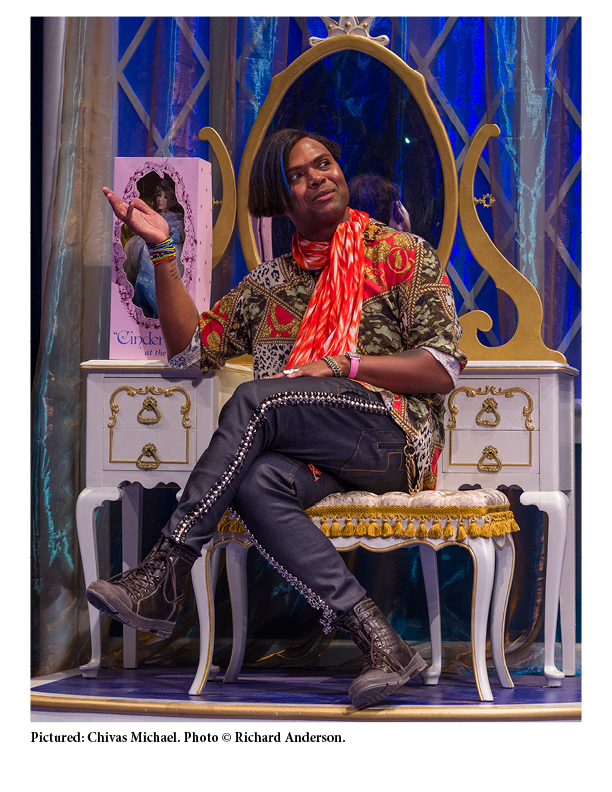
“Sprinkle ourselves with fairy dust.” That’s the prescription the flamboyantly gay Mo (Chivas Michael) has for the broken heart of his good friend, the less flamboyant Gil (Forrest McClendon), as Gil tries to put his life back together after the death of his mother Adelaide (Stephanie Berry), in Colman Domingo‘s Wild With Happy, now at Center Stage. Gil’s been going downhill from even before her passing, with his acting career doing nothing much, his love life on hold, and his brooding self-absorption blinding him to his mother’s terminal state even as she’s been reaching out for him. But Adelaide’s death completes the decline and fall.

Partly it’s because the people who claim to be helping him with this transition don’t help much, at least at first. There’s his Aunt Glo (Stephanie Berry again), who alternates between looting her dead sister’s wardrobe and berating Gil because he doesn’t want to do the conventional black funeral (and after a phantasmagoric brief church scene from Gil’s childhood in which a harpyish church lady keeps singling him out for his “limp wrist,” one can well understand his reluctance). There’s neophyte funeral director Terry (James Ijames) who tries to sell Gil coffins he can’t afford, and then confuses him (albeit gratifies him too) by having sex with him.

Eventually Gil wins the struggle for the right to define his mother’s obsequies. He is handed the urn with her ashes. He has sole custody. But then what?

The second half of the play answers that question. It turns out that while Gil doesn’t have the answer, Mo does. It involves a car chase down I-95 and the Cinderella Castle Suite at Disneyland, and a vision of Adelaide dancing in a magical white dress, and fireworks.

In short, when all else fails, use fairy dust. Magic may make meaningful that which nothing else can: that is Domingo’s message. It’s a message that certainly chimed with the audience the night I saw it. It’s been a good while since I’ve seen a crowd at a non-musical having quite so uproarious a time. In fact, the one thing about the show that needs improvement is that the actors have to learn better how to avoid speaking lines which will only become unintelligible during the laughs.

I’ve read about an earlier production that was not so well received, and I suspect that, as sound as this play clearly is, it benefits mightily from the Center Stage treatment of which I’ve written before, which I can simply sum up as first-rate everything. The cast is outstanding, especially Chivas Michael, all hair-tossing and bracelets and spangled jeans, who renders entirely believable his character’s inspiration for getting Gil’s groove back. And one must also cheer Stephanie Berry, who somehow managed, throughout most of the play, to keep me from realizing she was playing both Adelaide and Aunt Glo (sometimes the reviewer doesn’t get to read the program until after the show, all right?). These two women are so different, and yet so fully realized. Jeremy Cohen‘s direction made everything count, and kept the pacing perfect.

It is also time to mention that Kwame Kwei-Armah, in his third season as Center Stage’s artistic director, has infused Center Stage’s long-standing polish with a vital and often mischievous new spirit that carries on from production to production. Audiences are responding to this new spirit; one can feel it.

It is interesting, in light of this, that the organization has to put on two plays in one season with an avowedly autobiographical black and gay focus; the other was the season-opener, Marcus Gardley‘s dance of the holy ghosts. There is a notable resonance between the two plays. Both plays are, moreover, about two things: the playwright’s efforts to come to terms with two difficult older members of his family, and the playwright’s own development as a black gay artist. In dance, as I commented at the time, those two subjects related only indifferently well, seeming at times as if they were components of two different plays; in Wild With Happy it’s a total fit. Partly that’s because for Domingo’s hero, the sexuality is not so much an issue as a circumstance. Out to his mother and his aunt and perfectly well accepted by both, Gil is therefore missing one obstacle that Marcus, Gardley’s alter ego, faces in trying to bridge the gap with his grandfather. Nothing quite resolves that problem for Marcus. The solution for Gil in dealing with both dead mother and annoying living aunt is a retreat into a kind of fabulousness likely to resonate particularly with certain gay men, but it works believably in dramatic terms, and is something all audiences can relate to.

Last season, Center Stage of course put on two plays that took off from Raisin in the Sun, and clearly set out to provoke comparisons. This may have been a more subtle invitation, but I’m pretty sure it was deliberate too.

That said, no one needs to be at all analytical to have a wonderful time at this show.

Copyright (c) Jack L. B. Gohn, except for production still

Theater Reviews Page | Previous Theater Review | Next Theater Review
Better Living Through Electricity: A Stimulating VIBRATOR PLAY at the MET

Theater Reviews Page | Previous Theater Review | Next Theater Review
Better Living Through Electricity: A Stimulating VIBRATOR PLAY at the MET

Posted on BroadwayWorld.com June 2, 2014

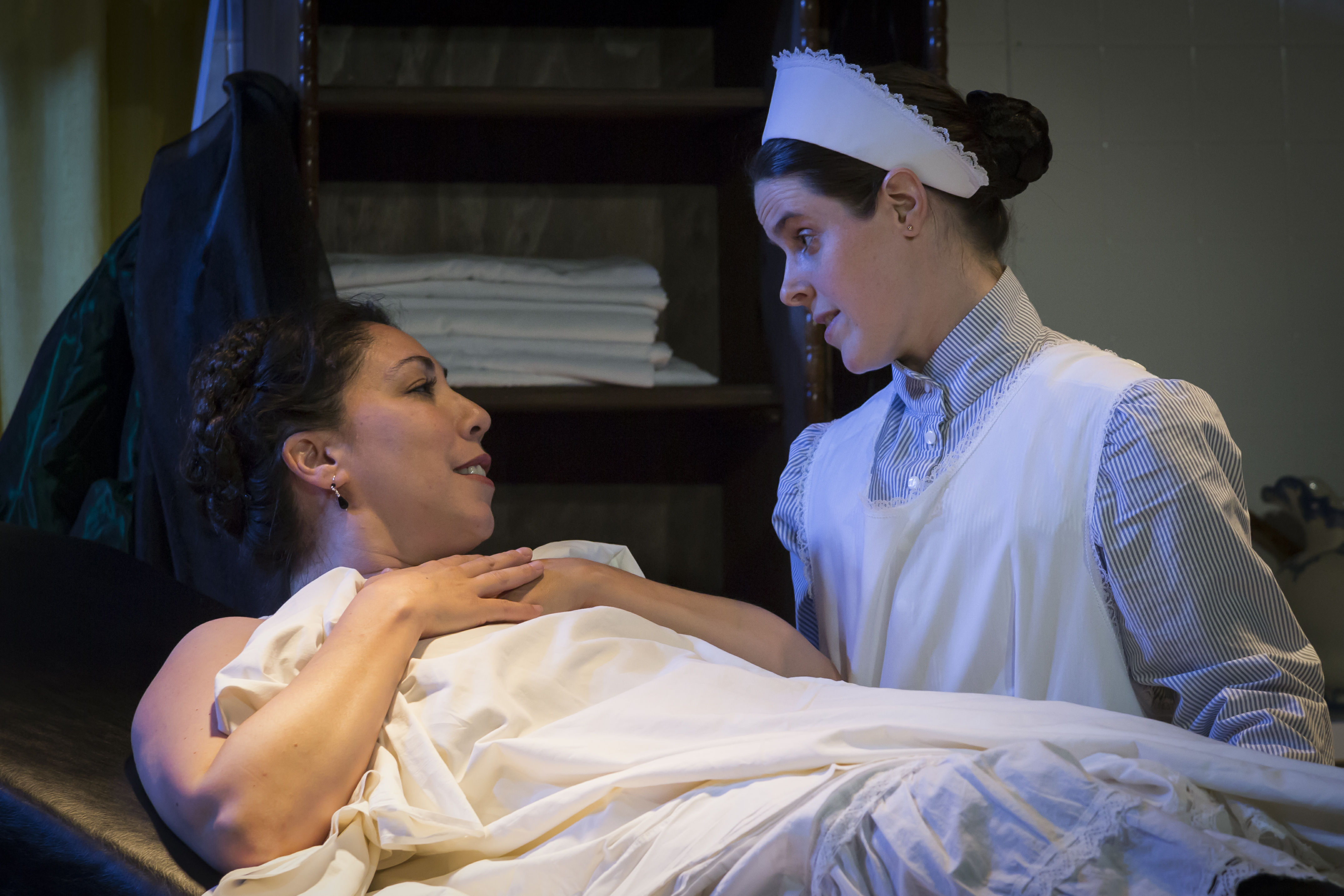
Lia Seltzer and Vanessa Strickland

Lia Seltzer and Vanessa Strickland

Sure, In the Next Room (or the Vibrator Play) is not Raisin in the Sun. But just as Lorraine Hansberry‘s classic embraced all of the issues surrounding race in 1959, so Sarah Ruhl‘s 2009 offering manages to deal in two acts only with a huge sample of the issues surrounding female sexuality and reproductive life – in two eras, the Victorian years and today. We get not only the female orgasm (a given, in light of the subtitle) but childbirth, lactation, lesbianism, the discontent Betty Friedan called the feminine mystique, the loss of children, the way medicine approaches the female body, and the contents and discontents of heterosexual intercourse. And thrown in for good measure are many aspects of the social relations of men and women. The whole discourse is carefully disguised as a drawing-room comedy shot through, particularly at the end, with Marquezian magical realism.

In short, the play is a treat that keeps you not only laughing gently but thinking. The MET, Frederick’s professional ensemble troupe, is giving it a welcome revival (this seems to be about the third Maryland production).

As many know, Next Room, set in a genteel town in New York State in the 1880s, just as Thomas Edison is busy electrifying life, turns on two different Edisonian innovations: the light-bulb and what we now call the vibrator. Like teenagers fighting for the TV remote, the sexes are struggling for control of these new technologies. The men, led by the perhaps ironically-named Dr. Givings (Reiner Prochaska), see light bulbs as a convenient substitute for candles, and the “apparatus” as a medical treatment for “hysteria.” The women, led by the doctor’s sexually-frustrated wife Catherine (Allison Duvall), see light bulbs as things to be dimmed, switched off, or even made magical in the service of sex, romance, and the imagination, “hysteria” as a male label for women’s legitimate discontents, and a proto-vibrator as a way to have a wonderful time. There are no clear-cut victories in these struggles, any more than the opposition between the sexes is absolute, but by the end, the women have better lines and greater success.

The cast keeps Ruhl’s fun going strong. Lia Seltzer is Sabrina, a patient, regal with her clothes on, comically orgasmic with most of her voluminous clothes off atop the doctor’s treating table, who learns through the process what and whom she is actually craving (not her husband, it emerges). Rona Mensah is regal in a different way, as Elizabeth, an African American wet nurse trying to function after the death of a child. And Vanessa Stricklandwhom I admired as Laura in The Glass Menagerie, gets everything possible out a more meager role, as Annie, the nurse who is called upon to maintain a stoic scientific look whatever “paroxysms” her apparatus or her fingers may be inducing – until she finds something her poker face is not immune to. As a man who might be Dr. William Masters’ lower-IQ grandfather, Prochaska is agreeably thick about the very subject in which he professes expertise.

Director Julie Herber keeps them all on their toes. My only criticism was that there were frequently moments when I felt a lack of clarity that the direction should not have permitted in Catherine’s motivations and those of Leo (Jack Evans), a male patient and artist, who gets treated with a different device that has the same general effect.

That effect is orgasm, of course, but it is also the breaking down of walls, the most visible of which (in the mind’s eye, anyway) is the wall separating each room from the other (and hence the title). The living room, at the outset a female space, is separated from the “operating theater,” a male space, by a wall and a locked door. The inhabitants of each space need to spend more time with those on the other side, and men need to change their paradigms of what is acceptable and desirable (the women as well, to some extent). As the barriers finally fall, the mood turns lyrical, and the action ends with a kind of latter-day echo of the wedding dance that would often finish a Shakespeare comedy.

A very amusing and uplifting time, at least for those who are mindful of Yeats’ apercu that “Love has pitched his mansion in the place of excrement.” It is about sex, but mostly because that is where love starts.

Copyright (c) Jack L. B. Gohn, except for production still

Theater Reviews Page | Previous Theater Review | Next Theater Review
Worked For Me

Theme Songs Page | Previous Theme Song | Next Theme Song 

Worked For Me

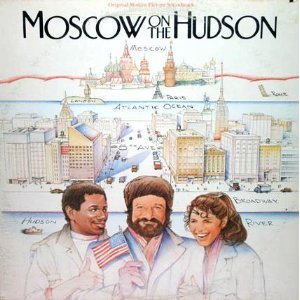
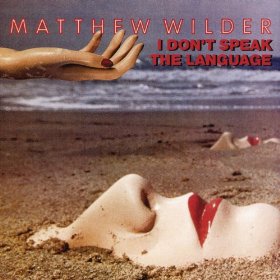
Moscow on the Hudson I Don't Speak The Language

Freedom, by Dave McHugh, performed by Chaka Khan and Michael Rod (1984), encountered 1985

Buy it here | See it here[1] | Lyrics here

Break My Stride, by Matthew Wilder (1983), encountered 1985

Buy it here | See it here[2] | Lyrics here

By the time I was a few months into my divorce, I had made it my business to see quite a few divorce movies, a genre in which the period was rich: Smash Palace, Twice in a Lifetime, An Unmarried Woman, Shoot the Moon, Kramer vs. Kramer. I found them all utterly absorbing. No mystery to it: I wanted to check out as many different artistic takes on what I was going through as I could. Even though I saw them all in the theaters, I also rented and watched them multiple times, completely absorbed. This was my story up there, one way or another.

Expatriate

The movie in this obsessed process that affected me most, though, wasn’t actually devoted to divorce. Moscow on the Hudson focused on a rarer subject: expatriation. The thing was, defecting from the Soviet Union in 1984 as screenwriter and director Paul Mazursky depicted it looked an awful lot like the divorce I was going through: the longing to escape, the sense of daring and danger when one did it, the initial high, the practical problems, the unexpected new friends and allies, the bouts of missing the situation one had left, the strain on old family ties, the need to be willing to forge a new identity: all there.

The part of Moscow on the Hudson I rewound and replayed the most was the end credits. They start with Robin Williams as the defector, a saxophonist named Vladimir Ivanoff, as he finishes a letter from New York, where he lives now, to his family back in Russia, summing up the good and the bad, but mostly the good of his new life. The visual behind the voiceover is of Vladimir busking with his saxophone in a park. The song he plays is the first song we got to know him with at the outset when he was a musician in a Russian circus band. In that milieu the melody (no doubt by design) sounded cheerful but superficial. Now, played solo with lots of jazz riffs, it sounds distinctly mournful and much more profound. Michael Rod (the actual musician playing for Robin Williams) leaves pauses between the phrases, which begin to be filled in by singer Chaka Khan, singing a song called Freedom. As the titles fade to a black crawl, Khan’s song merges with Rod’s, and the sax provides continuous counterpoint throughout the titles to Khan’s soulful pop evocation of freedom (political and personal).

Freedom, she sings, I just want to love you. Possibly it’s deliberately ambiguous about whether the love object is another person or just the state of being free. Nor is it clear if the freedom is personal or political. Any way you construed it, it worked for me.[3]

Disco-ey

Another song from that era that always reminds me of that stage of my life was a bouncy, disco-ey piece called Break My Stride, by a near one-hit wonder named Matthew Wilder (this being the one hit). The picture it instantly brings to my mind is of me going around the running track at Baltimore’s Downtown Racquet Club (in later years the Downtown Athletic Club, which I have belonged to, off and on, to this very day). There was and still is a PA system there that plays hits calculated to put you in the mood to sweat, and I can recall hearing that oh-so-appropriate song as I was pounding along:

Ain’t nothin’ gonna break my stride
Nobody’s gonna slow me down, oh‑no
I got to keep on moving
Ain’t nothin’ gonna break my stride
I’m running and I won’t touch ground
Oh‑no, I got to keep on moving 

This is not a song about exercise (though it goes perfectly with that pursuit). The above lyrics are the expression of a woman who has left the singer behind. But the singer has the same attitude:

Never let another girl like you, work me over
Never let another girl like you, drag me under
If I meet another girl like you, I will tell her
Never want another girl like you, have to say
Ooooooh
Ain’t nothin’ gonna break my stride

In short, this is a breakup song; it’s a song about two people who are moving on in both metaphorical and literal senses.

The Racquet Club was a special place to feel that way. It had opened in a disused-but-then-converted Railway Express Agency[4] shed only a few years before, during the first flush of the Baltimore renaissance presided over by the city’s great cheerleader, Mayor William Donald Schaefer, when the city seemed to have done more than recover from its 1968 riots, and to have become radiant with possibility.[5] Young professionals flocked to the Club but also more established folks; it had quite a bit of singles action, too, at its bar. With all those atmospherics, it was hard not to feel that one was indeed getting on with one’s life rounding that tenth-of-a-mile oval, while being urged on by the bounce of a song that trumpeted above all else a determination to keep on going.

Again, it worked for me.


[1]. This version, notwithstanding it is from the official soundtrack, does not have most of the Michael Rod saxophone interpolations that gave the song so much meaning in context (as described below), but Khan’s voice comes through much more clearly. It sounds as if this version has more of the Richard Perry production that was lavished on the Pointer Sisters’ version (see Note 3 below) than was in the movie too.

[2]. Only don’t view the video before reading this piece; it contains every laughable disco mannerism of that era. Once you see it, you can never hear the piece the same way.

[3]. The movie soundtrack LP is rare and hard to find. In 1985 the Pointer Sisters did a very comparable version (minus the saxophone), produced by Richard Perry.

[4]. I’ve reminisced about the Railway Express Agency a little bit here.

[5]. I’d say that era lasted until the savings-and-loan crisis of 1986 (which ravaged my Baltimore world) and the AIDS scare (which also kicked some of the disco out of straight people as well).

Copyright (c) Jack L. B. Gohn, except for cover art

Theme Songs Page | Previous Theme Song | Next Theme Song


First Crack at a New Comic Classic: VANYA AND SONIA at Center Stage

Theater Reviews Page | Previous Theater Review | Next Theater Review
First Crack at a New Comic Classic: Vanya and Sonia at Center Stage

Vanya and Sonia Image

Posted on BroadwayWorld.com April 26, 2014

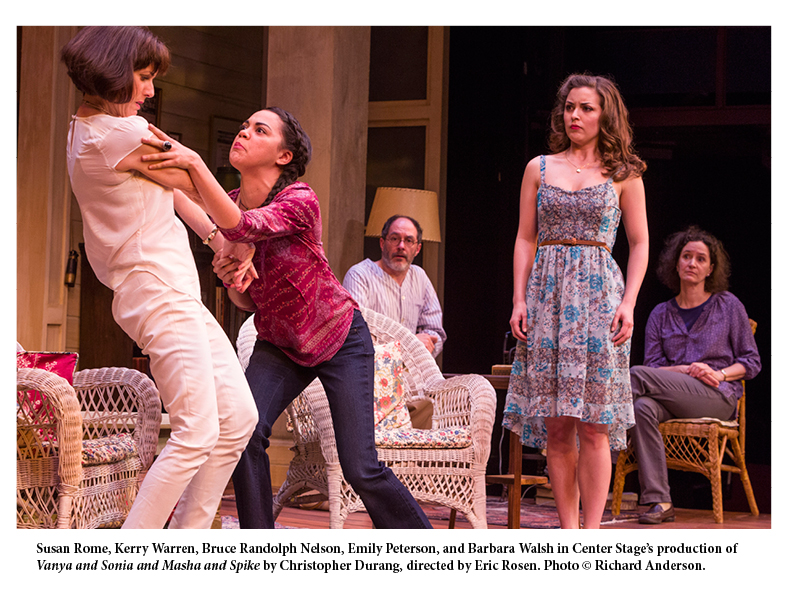
It is gratifying that Christopher Durang‘s latest comedy, Vanya and Sonia and Masha and Spike, which is assuredly going to be produced in time by every community theater company in the country, gets its Baltimore premiere in style at Center Stage, as a sort of reference production by which other local ones can be gauged. The show, which rolled out over the last two years in regional test runs, then at the Lincoln Center, and then on Broadway, where it closed last year, is in joint production here with the Kansas City Repertory Theatre. The fun seems effortless; with a solid cast and wonderful direction by Eric Rosen at Center Stage, of course nothing is going to go wrong. But I’m willing to bet it would take a lot of trying to do this well-made play badly; I expect we’ll find out.

The conceit is that a Chekhovian family situation could as easily spring from the soil of contemporary Bucks County, PA as from that of the prerevolutionary Russian countryside. There three adult siblings, Vanya, Sonia, and Masha (Bruce Nelson, Barbara Walsh, and Susan Rome) named by literature professor parents with (obviously) more of a penchant for allusiveness than good sense, live somnolent and under-eventful lives in a stately but undercapitalized exurban home. Well, two of them do. Masha went off to become a glamorous movie star and supports her siblings, visiting them just occasionally. (The parents are now deceased.)

The play takes place during one of Masha’s infrequent visits, disturbing the decidedly Chekhovian atmosphere of regret Sonia feels keenly, and Vanya perhaps a little less so, over not having “lived.” Masha, by contrast, has “lived,” if maybe a smidge too long, as becomes apparent when she brings a boy-toy named Spike in her train (Zachary Andrews). (Although he too has a Russian name if you dig deep enough; he’s actually named Vlad.) The moment Spike takes off his shirt and strips down to his undies (as he rapidly does), two things become apparent: a) Masha is in denial about her age, and b) Andrews must spend a couple of hours a day working out. (I was reminded of the moment the marginally more ripped Sebastian Stan went shirtless in a recent revival of Picnic on Broadway.) In the course of the play, Masha is going to have to come clean with herself about her little denial problem.

Help – for Vanya and Sonia with their empty lives, for Masha with her denial – comes in the form of the two other characters. One is dewy neighbor Nina (of course she’d be named Nina) (Emily Peterson), so awestruck by Masha’s celebrity and by what she interprets with only partial accuracy as everyone else’s niceness that she is proof against the bitchiness and insanity that the siblings generate. The other is the sole character whose name comes from a different frame of literary reference, the zany and somewhat prophetic cleaning lady Cassandra. Kerry Warren is incandescent in that role; of course the play is not a competition, but if it were, her over-the-top portrayal, sliding constantly from frenzy to matter-of-factness to solemn, eye-rolling intimations of doom, would win the palm. As her name implies, she is the predictor of ominous fates whom no one ever believes – which is just as well much of the time because she gets so many details wrong. She is also a dab hand at voodoo. Unlike Hamlet, where the play-within-the-play is the thing, here the thing is an offstage costume ball, which provides an occasion for physical comedy, fashion jokes, and a plausible catalyst for the sort of happy ending Durang bestows upon his characters.

As the ending suggests, Christopher Durang seems to have mellowed. The rage that informed his earlier plays Sister Mary Ignatius Explains It All For You and The Marriage of Bette and Boo is not on display here, which is one of the reasons I predict a community theater apotheosis for this work (no one being perturbed anymore by a couple of salty expressions hither and yon). While no character escapes ridicule, at bottom this is a celebration of an extended family in all its flawed diversity. Because this is the theme, Vanya and Sonia feels more the way You Can’t Take It With You or Ah, Wilderness! do than the way Mary Ignatius does.

The only thing likely to keep this play from becoming a permanent fixture of the American stage is its extreme topicality. For instance, a repeated joke is that Spike’s claim to fame is that he was nearly cast in a television series called Entourage 2. In twenty years, mostly only oldsters will get the reference. Indeed, the one weak moment in the play is an Act Two rant by Vanya against modernity, which will suffer over time as the modern things he doesn’t like become yesteryear’s playthings.

The speech doesn’t even work on its own terms. It starts out promisingly, with Vanya properly if a little excessively incensed at Spike’s “multitasking” with his cellphone while Vanya’s fledgling effort as a playwright is being read aloud (and thus Vanya’s soul is being bared). But Vanya’s bile at bad cellphone manners comically degenerates quickly into a paean to the lost art of licking postage stamps, and then goes on and on. We get the point much more quickly than Durang evidently supposes. And we lose sympathy with Vanya’s fogeydom as the postage stamp monologue proceeds. It’s not Bruce Nelson‘s fault; he is a performer with great timing. If it were possible to keep the speech from curdling, he could do it. He can’t.

But that is a minor carp. Whatever may happen to the play in years to come, today’s playgoers are absolutely going to love it. It’s a typically impeccable Center Stage affair – great sets, lighting, costumes, direction, acting – at the disposal of a simply hilarious show. Not to be missed.

Copyright (c) Jack L. B. Gohn, except for production still

Theater Reviews Page | Previous Theater Review | Next Theater Review
The Bad Character of “Good Character”

The Big Picture Home Page | Previous Big Picture Column | Next Big Picture Column

The Bad Character of “Good Character”

Published in the Maryland Daily Record June 9, 2014

To engage in many occupations, you will need a government-issued license.  To win or renew your license, some statute will almost certainly require you to show “good character,” “good moral character,” “good character and reputation,” or something similar.[1] And if you have run into trouble in making that showing, there’s a decent chance your path has crossed with mine. My legal practice has often required me to engage with licensing authorities over an applicant’s “character.”

In Quotes

I put “character” in quotes because these engagements have convinced me it is an ineffable abstraction. Science has uncovered no good character gene, no good character organ of the body. You cannot measure it. And no two people are likely to agree about another person’s “character.” As people use the phrase in conversation, they seem to be talking about some kind of essence of a person’s psyche, which they assess in the most subjective fashion imaginable. Regulators, being neither priests nor psychologists nor philosophers, don’t usually try. Instead, they focus on what the applicant has done in the past. They try to extrapolate future behavior from past behavior. The “character” label becomes just that: a label. The focus is behavior.

But any honest and insightful regulator would have to acknowledge never having known a person who has behaved consistently well his or her whole life. As St. Paul trenchantly put it, “What I would, that do I not; but what I hate, that do I.”[2] And this was a saint talking, and he was using present tense. A saint whose deeds were imperfect even as he spoke, he typified us all.

We are all mixed bags.

The regulator, however, cannot make a mixed choice. The regulator must assign the label of good or bad character to each applicant’s behavior. In practice, this means ferreting out the names of the applicants who’ve been caught. Has the applicant been apprehended in the act of losing his or her temper, succumbing to a temptation to be less than honest, hitting the bottle, being convicted of a crime? In other words, has the applicant been sanctioned for human imperfection? If the answer is yes, the applicant is assigned the “bad character” label. The survivors of this round of elimination are said to exhibit “good character.”

The Appearance of Public Safety

Does this really protect the public from misbehaving licensees? Yes, to those who believe that only the worst are caught. (And yes, it was really the Tooth Fairy who left those quarters under their pillow.)

Say this for a focus on who’s been caught: it works as a way of narrowing the field. It screens out some applicants, but not too many. It creates the impression that regulators have protected the public, but leaves enough licensees to fill our professions and occupations.

The Rehabilitation Runaround

For those who are screened out, however, the unfairness is just beginning. The next question comes straight out of Alice’s Restaurant: “Kid, have you rehabilitated yourself?”[3] But rehabilitation, it turns out, is almost impossible to show. Applicants seldom achieve much by simply claiming rehabilitation, despite their being the people best acquainted with their own mental state.

Typically, regulators don’t credit a claim like that unless it is coupled with taking ownership of past misdeeds and expressing remorse over having committed them. However, in my experience all humans with blots on their records, including license applicants, are possessed of an unfortunate reluctance to admit fault, even to themselves. We all tend to believe, along with the married murderesses in the musical Chicago, that “If you’d have been there, if you’d have seen it, I betcha you would have done the same.” Applicants who strike me as committed to playing by their prospective profession’s rulebook in future may still be unable to muster much contrition or insight when confronting things they were found to have done wrong in the past. Why an absence of insight is thought a predictor of future bad behavior is a mystery, especially when one considers that psychopaths, the kind of people one might expect to become the most transgressive professionals, have plenty of insight – at least into the regulators’ thought processes. They naturally tend to excel at saying what regulators want to hear. So the contrition test just lets the psychopaths back in and does little else.

There’s another reason, even less fair, why the applicant may not come up with the insightful contrition the regulators are listening for. The applicant may be correctly claiming innocence of whatever misbehavior he or she was sanctioned for. That does happen; talk to the Innocence Project people if you don’t believe me.[4] The applicant who maintains innocence of some alleged past misdeed faces a Hobson’s choice: falsely admit guilt or be deemed unrehabilitated. A collateral attack on some previous conviction or administrative finding of misbehavior is never permitted, even when such an attack would be the only path to the truth. God forbid, after all, that we should sacrifice collateral estoppel just to get to the truth!

The Snowball

In any case, it is always the applicant’s burden to prove “good character,” which amounts to proving a negative, i.e. that he or she will never do anything bad again. Negatives are hard to prove. And negatives about the future are 100% unprovable. So strictly speaking, there is no way to carry this burden successfully. And yet applicants are required to carry it every day.

Assume, then, that the burden isn’t carried, and the applicant is rejected and of course stigmatized with the “bad character” label.[5] Things will tend to snowball after that. The rule is: get yourself turned down for a license in one state because of your character, prepare not even to be considered in any other state, and to lose your license wherever you already have one. Lose or be turned down for a license on character grounds, prepare for possible debarment and being unable to work for any employer that receives federal funds.[6] And forget those security clearances while you’re at it. Oh, and forget about changing careers either; that “good character” requirement, and your history with it, will follow you if you seek a license in any other field.

Culling the Herd

Tragically, “good character” is often used as a way of eliminating licensees who haven’t actually broken any rules related to their profession but just make regulators uneasy. In practice, it’s a handy way of culling injured and hurting professionals from the herd. The protestations of people with mental illness, substance abuse problems and the like that they could still function professionally are ignored. Rather than figure out how these unfortunates could be reasonably accommodated without making them show that they have miraculously shed their problems – and to my observation most of them could practice “as is” without unduly endangering the public – licensing authorities would rather just impose the professional death sentence and have done with it. Sometimes the regulators are covering their tails (they don’t want to be the one who licensed a bad apple) and sometimes they are just being sanctimonious and short-sighted.

Either way, the regulators’ associating themselves with such a process shows – um, bad character. But don’t look for any of them to revoke their own licenses for that.


[1]. In Maryland, where I practice, you need “good character” to practice law (Md. Code Ann., Bus. Occ. & Prof. § 10-207), work as a security guard (Md. Code Ann., Bus. Occ. & Prof. § 19-302), or as a private detective (Md. Code Ann., Bus. Occ. & Prof. § 13-302), private home detention monitor (Md. Code Ann., Bus. Occ. & Prof. § 20-302), tax preparer (Md. Code Ann., Bus. Occ. & Prof. § 21-302), or security systems installer (Md. Code Ann., Bus. Occ. & Prof. § 18-3A-02), to own a real estate appraisal management company (Md. Code Ann., Bus. Occ. & Prof. § 16-5B-05), to serve as a real estate broker (Md. Code Ann., Bus. Occ. & Prof. § 17-305) or an architect (Md. Code Ann., Bus. Occ. & Prof. § 3-303). And those are just 9 of the 40 or so professions listed in one article of the Code. There are such requirements in other articles.

[2]Romans 7:15.

[3]. And yes, as every true fan knows, the question should by rights be “in parentheses, capital letters, quotated.” But I took some liberties.

[4]. See some interesting statistics here.

[5]. I recognize the intellectual distinction between “You haven’t carried your burden of proving good character” and “You have bad character.” But in the real world, the consequences of the first statement seldom differ from the consequences of the second.

[6]. The relationship between administrative bad character findings and debarment is not automatic, but it is pervasive. Typically, character is a factor to be considered rather than an automatic qualifier or disqualifier. See, e.g., In the Matter of Proposed Debarment for Labor Standards Violations by Facchino Construction Co., 1990 WL 506487 (DOL O.A.L.J.), 9; In the Matter of Robert Gordon Darby, HUDALJ 89-1373-DB (LDP). There are times when the connection to loss of government business or business assistance may be more direct. See, e.g. 13 C.F.R. § 115.13, a Small Business Administration regulation that may disqualify from eligibility for an SBA bond those businesses whose principals have been denied professional licenses for bad character.

Copyright (c) Jack L. B. Gohn

The Big Picture Home Page | Previous Big Picture Column | Next Big Picture Column


We Need Congress To Be The Boss

The Big Picture Home Page | Previous Big Picture Column | Next Big Picture Column

We Need Congress To Be The Boss

Published in the Maryland Daily Record on May 6, 2014

I haven’t read it, and you haven’t read it, but now we kind of know what the 6000+-page December 2012 Senate Select Committee on Intelligence report says: that the CIA’s War on Terror-era torture-and-rendition program brought no actionable intelligence to us, and was far more brutal than previously admitted. It says that the CIA misled Congress, the Justice Department, and President Bush. The White House has been in possession of the report for over a year. On April 7, Senator Dianne Feinstein, the Chair, sent the White House the report’s 480-page Executive Summary, pointedly asking the White House, not the CIA, to “declassify” the Summary, so it can be released to the public.

Think about that fact for a moment.

Why should the Executive Branch have anything to say about the contents or release of any report authored by the Legislative Branch? These are coordinate branches of government, and the report’s issuance was an exercise of Congressional power dead center within its constitutional responsibilities.

The Executive Red Pen

The Congressional oversight power is one of the most strongly established legislative prerogatives; hearings into Executive Branch functioning date back all the way to 1791.[1] The Supreme Court held in 1957 that: “The power of the Congress to conduct investigations is inherent in the legislative process.” Inherent in that power is the power to compel members of the Executive Branch to testify and to disclose documents concerning Executive Branch activities. Clearly, any report concerning a key activity of an Executive agency (and the torture-and-rendition program was certainly a crucial activity for some years) would relate to matters on which Congress would inevitably legislate, so this investigation and its resulting report were firmly rooted in Congress’ constitutional prerogatives.

Then what business does the Executive have to be vetting it for public consumption? (Even if – which is more than we know yet – it turns out to be the White House rather than the CIA in charge of declassifying documents that do not flatter the CIA.)

Set aside the oddity of the Executive red pen on a Congressional finished product; the freedom even to research the document was at best incomplete. The reality is that on Capitol Hill there is a long tradition of coöptation by the CIA. As Ivan Eland, then an investigator with the House Committee on Government Reform, wrote back in 2001, while Congressional committees with oversight over the CIA “claim the right to hire their staff members over the security objections of the [CIA] but in practice it rarely occurs” and that they are “willing to restrict the scope of their requests for classified information or limit the manner in which it is handled.” That happened here. The Select Committee agreed to a regimen where Capitol Hill investigators could only examine documents at CIA facilities. Eventually this access was also permitted at a secure facility on Capitol Hill.

Trying a Clawback

But not trusting even these arguably unconstitutional protections, the CIA still held back something critical; a large internal review document known as the Panetta Report that admitted wrongdoing which the agency was still disavowing before Congress. Held back though it was, somehow the Panetta Report made its way into the investigators’ files. That reportedly prompted the CIA to try clawing back the document by what Senator Feinstein called “hacking” Congressional computers. The effort was only partly successful; the Committee still possesses copies of the Panetta Report. The CIA then went to the Justice Department demanding prosecution of someone, presumably staffers, for illegal possession of the document.

And that is something else to think about. To paraphrase the most notorious phrase in the Dredd Scott case wildly out of context: What CIA secrecy boundaries is Congress constitutionally bound to respect? The CIA after all is Congress’s creation. Congress established the CIA in 1947; Congress establishes the CIA’s budget and (supposedly) dictates the parameters of its activities. But it goes deeper. The CIA can maintain great secrecy from us citizens, for instance under the Public Information Act, and it is granted near-immunity from judicial oversight. But that is only justifiable (if at all) because Congressional oversight theoretically provides a check and balance. How, in a constitutional scheme where everyone else is kept out, can Congress be told that there is anything, anything at all, about the CIA that it can learn only by means that expose its staffers to prosecution?

Executive Privilege vs. Congressional Investigatory Power

The CIA’s response to such questions has been to characterize the Panetta Report as “pre-decisional” and “deliberative,” the kind of thing that has been routinely shielded from Freedom of Information Act disclosure and often from prosecutorial subpoenas by executive privilege. But a Congressional subpoena is not a FOIA request or a DOJ subpoena. As already noted, Congressional subpoenas stem directly from the legislative power, central to our constitutional design, unlike FOIA requests. Also unlike judicial-branch subpoenas, legislative-branch subpoenas have never been tested in the Supreme Court against claims of executive privilege.[2]

The Executive may be spoiling to have that fight, judging from the actions of the last two administrations. The George W. Bush administration defied Congressional subpoenas several times based on executive privileges claims. And the Obama administration followed suit by invoking executive privilege against a Congressional subpoena in 2012, in connection with Congress’ investigation into the “Fast and Furious” scandal.

The values that executive privilege exists to foster (principally giving senior Executive Branch officials the benefit of receiving advice unconstrained by the fear of later public exposure and opprobrium) would still exist were the document seekers Congressional investigators rather than curious members of the public proceeding under FOIA. But it could equally be argued that access to the off-the-record remarks made in the Executive Branch is precisely what Congress needs in order best to do its constitutional job. In this very case, hearing what CIA bosses were saying when they thought no one is listening seems to have been a great deal more useful to the legislative process and hence to the public than the sanitized version of the facts the CIA tried to fob Congress off with.

CIA Crimes?

Meanwhile, Congress has gone to the Justice Department as well. To quote Senator Feinstein: “Besides the constitutional implications, the CIA’s search may also have violated the Fourth Amendment, the Computer Fraud and Abuse Act, as well as Executive Order 12333, which prohibits the CIA from conducting domestic searches or surveillance.”

I will leave to others the political aspects of this fight and the technicalities of the law the CIA may have broken. But we should all be concerned about the constitutional aspects that Senator Feinstein mentioned in passing. For most Executive agencies, there are multiple forms of accountability outside the Executive itself: Congress, the courts, the press. The CIA is almost unburdened by any of that – except for its accountability to Congress. Which makes it all the more vital that Congress be allowed to keep an eye on the Agency, and not to have the Agency controlling Congress’ control of the Agency.

The CIA operates in stealth; it is associated with some of the worst abuses of power in recent American history, including assassinations, coups, and torture; it has military capabilities. Congress needs to be firmly in control of its relationship with such an agency. The Constitution demands no less.

_________________

[1]. The House reportedly convened a special committee in 1791 to investigate the U.S. Army’s defeat by Native American forces in the Battle of the Wabash. Brian D. Feinstein, Avoiding Oversight: Legislator Preferences and Congressional Monitoring of the Administrative State, 8 J.L. Econ. & Pol’y 23, 43 (2011), citing M. Nelson McGeary, Congressional Investigations: Historical Development, 18 U. Chi. L. Rev. 425, 425 (1951).

[2]. Compare the Watergate-era case about executive privilege and a special prosecutor’s subpoena: U.S. v. Nixon (1974), which did allow the subpoena, but using language that could well support the CIA were it to contest a Congressional subpoena. Quoting United States v. Reynolds (1953), the Nixon Court stated: “It may be possible to satisfy the court, from all the circumstances of the case, that there is a reasonable danger that compulsion of the evidence will expose military matters which, in the interest of national security, should not be divulged. When this is the case, the occasion for the privilege is appropriate, and the court should not jeopardize the security which the privilege is meant to protect by insisting upon an examination of the evidence, even by the judge alone, in chambers.” Of course the history of the likely CIA wrongdoing here probably is tied up with “military matters” and “national security.” To allow those considerations, however, to end a Congressional quest for this material would be tantamount to saying that the Congressional investigatory power stops whenever an agency invokes the national security shibboleth.

Copyright (c) Jack L. B. Gohn

The Big Picture Home Page | Previous Big Picture Column | Next Big Picture Column


Two Trees

Religious Writings Page | Previous Religious Writing | Next Religious Writing

Two Trees

 Delivered at Easter Vigil, St. Vincent de Paul Church, April 19, 2014

In Genesis 1 and 2, God gave us a world that was bursting with everything good. Then in Genesis 3, He kicked us out of it.

My mother’s diary reflects that Thursday, September 8, 1955 was my first full day of elementary school. I believe that was also the day I received my first religious instruction. I recall how I and twenty-five or so boys and girls sat at our little desks in a basement classroom at St. Thomas the Apostle School in Ann Arbor, Michigan, listening to Sister George Ellen, a sweet-tempered and benevolent young woman, teaching her opening lesson. It was the story of Adam and Eve.

Appalling

And she proceeded to tell a bunch of impressionable and easily frightened first-graders all about how Adam and Eve disobeyed God and so He told them that they were going to die, and so would everyone else who would ever live after them. I was appalled. At six I didn’t really grasp that I personally was going to die; and I hardly knew anyone who had. But that just made it worse. Death was this exotic terrible thing, it was almost inconceivably rare, and now God was saying that it was coming for me and my parents and everyone I’d ever loved, just because two people I’d never heard of had disobeyed one lousy order long, long ago.

I mean, so what if they disobeyed? I’d been known to do that too. I certainly didn’t think I deserved to die for doing that. And even if I had deserved it, what about every other human being who had ever lived or would ever live? Just ‘cause I disobeyed one time?

Now, as a child growing up in the Fifties, I trusted authority. If Sister George Ellen said God was a good guy, then I kind of had to take her word for it, because I sure couldn’t work out for myself how that could be. I wasn’t much of a profound moral thinker at Age 6, and I don’t think I’d ever heard the word “disproportionate,” but I did know that good guys don’t go around wiping out millions of people because of any one person’s sin.

Forestry

Later on, in my adolescent years, when everything was about sex, I remember hearing from non-Catholic sources that Adam and Eve’s sin was about sex, and being relieved that the Catholic authorities at least didn’t preach that, because if God made inherently sinful the activities necessary for Adam and Eve to produce Cain and Abel and the rest of the human race, it would certainly ruin my chances of salvation. But if that wasn’t the key to the story, what was?

By the time I got to college, I started studying the Bible as literature and as historical artifact, and recognized that the heart of the story was the two trees: the Tree of the Knowledge of Good and Evil and the Tree of Life. Whatever it means, clearly Adam and Eve get the benefit of the Tree of Life only so long as they don’t seek to add the benefit of the Tree of the Knowledge of Good and Evil.

Presumptuous? Or Mission Statement?

For now let me focus on that second Tree. In the world of Genesis, knowing the difference between good and evil seems to be a bad thing. Adam and Eve develop what in English we call modesty, the sense that some things should stay private, which they experience as embarrassment. And somehow that makes them God-like. And even more confusingly, God treats this as a bad thing, objecting as if He were afraid of the competition.

What a thematic mess, at least for a modern-day Christian! We’re always told to be perfect as our God is perfect. We can’t succeed at this, but we can try. For us aspiring to be like God is precisely the description of our mission, not some kind of presumptuousness. And surely an aspect of perfection is distinguishing good from evil. Jesus spends a great deal of time, after all, teaching us the difference between good and evil. So we have to accept that either Genesis Chapter 3 has it backwards or Jesus does. Well, I personally am not prepared to say Jesus has it backwards.

Still, Genesis 3 is part of Scripture. We’re supposed to know it, supposed to derive something from it. Well, what? – and note by the way that I’m leaving to one side all the insane stuff with the serpent.[1]

Stick with the Questions

The conclusion I’ve reached, after obsessing over this tale for about three weeks, is that what Genesis 3 is useful for is not the answers there, but the questions. This is the very beginning, Bronze Age stuff. The community that wrote it was just starting to come to terms with a bunch of propositions anyone of faith is going to have trouble reconciling even today, and this was just a first draft, and a rough one at that.

But I think one thing they got right was that good and evil can be known.

As the name of the Tree of the Knowledge of Good and Evil suggests, these things can be known, they can be distinguished. They are real.

Bare Naked

Now, I’m not sure I’d start illustrating that the way Genesis does, namely with Adam and Eve’s shame about their nakedness. My own attitude on the subject was summed up by a seven-year old girl in a lake cottage one summer’s afternoon when I couldn’t have been more than ten myself, and four of us kids were all getting out of our swimsuits and into warmer clothes. She gave a moment’s thought to doing something to be more modest but then shrugged and slipped out of her suit saying “It doesn’t matter if you’re bare naked.” My attitude precisely. If it matters that you’re bare naked, it matters only because of all the cultural attitudes surrounding it, not because it’s inherently bad.

But there are a lot of things that really are bad. And a lot of things that really are good. And we humans know it. That’s part of what it means to be human, is to have that knowledge. Sometimes we call it a conscience.

Think about that for a moment. Conscience tells us, so we know it, that certain things ought to be or ought not to be. And it’s elementary philosophy that you cannot reason from “is” to “ought.” There is no set of facts, no information from what is, that can prove morality, what ought to be. There is no way to know, just from information about the material world we occupy, what is right or wrong. But we do know.

Disagreements Illusory and Real

And mostly we agree about it. Oh, views may vary some from individual to individual and from society to society, but that can be deceptive. Differences tend to fall in the areas where one principle, say, devotion to the well-being of the society, conflicts with another principle, say devotion to the value of individual human lives. That’s why we have debates over the morality of war and over the morality of the death penalty. Those who think war and the death penalty are permissible don’t think human life is of no value, and those who think war and the death penalty are unacceptable still do care about the security and well-being the societies they live in. The only difference is in how they balance those considerations. But there are remarkably few basic considerations to balance. C.S. Lewis, in his book The Abolition of Man, listed only eight of them.

In the last century there were many committed philosophical materialists (and by the label materialist I mean one who thinks that there is no transcendent world, but only the one we occupy daily). The militant atheists of today, the Richard Dawkins types, also usually fit into this category. These materialists argue that we only have those few core values because evolution has programmed us to hold those few core values, and that evolution resulted in that programming because those values were most conducive to the survival of societies and of the individuals who made them up. But to really believe that, to hold that our values are simply the outcome of our breeding, is to hold that our values are arbitrary – including, of course, the values of those who say that our values are simply the result of our breeding. Their values by definition must be as worthless as everyone else’s. They’re sawing off the branch on which they sit.

The existentialists who also bloomed in the last century were at least were more consistent. Their position was that all values are arbitrary, including their own. There is no objectivity to our consciences, they said. We each decide whether to have a code, and what that code is. But, said the existentialists, we have to accept that it comes from within us, and there is no objective right or wrong to which we can refer.

But it’s almost impossible to hold this position for long. Every day, all day long, we make choices and decisions based on our sense of right and wrong. It doesn’t feel a bit like something arbitrary. Indeed, I would submit that we can’t consciously choose our values any more than we can consciously choose our own idea of the color yellow or the law of gravity or the sum of 2 + 2. Our values don’t really meet the definition of values unless we consider them to be true, meaning they make demands on us regardless of what we choose or don’t choose. If we’re the ones doing the choosing, they’re not values.

Valuing Values

And sane human have values. They may be taught, but only the way math is taught. You may not start out knowing what 2 + 2 is, but once someone teaches you, you recognize that it’s objectively so.

It’s a glorious aspect of humanity, that we know these things.

So, let’s get back to that roomful of horrified first graders.

The Tree of Life may have some positive meaning, but for us it mainly comes down to the fact that we were sent away from that Tree, and in the process life was taken away from us. We’re mortal now. In fact, not merely mortal but sentenced to painful childbirth and hard labor in the fields up to the point at which we do die. Rapper NAS sums it up for us in words we all know: “Life’s a bitch, and then you die.” Comedian Woody Allen opened the classic Annie Hall with the same idea: “There’s an old joke; two women are at a Catskill mountain resort, and one of them says ‘The food at this place is really terrible.’ The other one says, ‘Yeah, I know, and such small portions.’”

The Bible tries to blame the small portions on Adam and Eve. Which again raises the proportionality question. Okay, Adam and Eve. We’ll give you Adam and Eve, ‘cause they ate the forbidden fruit. But all of us? Later thinkers, like St. Augustine, tried to justify the unjustifiable by saying that somehow we all participate in Adam and Eve’s sin. As the New England Primer succinctly put it: “In Adam’s fall/ We sinned all.”

Not Taking the Fall or the Credit

But the linkage Genesis draws between sin on the one hand, whether Adam’s or anyone else’s, and death on the other, is a non-starter once you know modern science. We didn’t cause death. Death had been part of our universe for billions of years before there were any humans to commit sins of any kind. All the metal in our world was cooked for us in exploded stars, long deceased. The metals are vital to our bodies and our lives. All animals – and there were animals for eons before there were humans – from the very first have survived only by dint of the death of the other creatures, the plants and animals that they eat. In other words, our universe is designed so that there is no life that does not owe its existence to earlier deaths. And there is no life that does not end.

In other words, death enables life enables death enables life … ad infinitum.

Whatever else we may think we know of the Divine plan, therefore, death must be an integral part of it, integral to its creativity, and we can’t claim the blame or the credit.

A Good and Painful Thing

And indeed it’s hard to imagine how social life would progress if there were no death, if all the people that ever lived were still with us. If older workers never retired and made room for younger ones.  Think of the pileup. Prince Charles wouldn’t just be waiting for Queen Elizabeth to go so he could get his crack at the throne. He’d be waiting for the first Queen Elizabeth to go. He’d be waiting for William the Conqueror to go.

It would be a nightmare.

Of course, while death may be on balance a good and necessary thing, that doesn’t mean we like it. How could we like something that in the end rips every friendship and every love apart? How could we like something that hurts so much?

How could we like something that so mocks all human aspirations? For, make no mistake, nothing we build and nothing we achieve will ultimately survive. Death awaits our species, our planet, even our universe, thanks to the Law of Entropy.

Adam didn’t cause this and we didn’t cause this. That part Genesis has wrong.

And Then You Really, Really Die

But at least Genesis confronts it for us. It tells us that whatever we finally decide about God, we have to reconcile our idea of him, and our idea of morality, with the fact that we die. And this is an uncompromising view of death at the outset of Genesis. It’s more definitive than that, even. For the community that gave us Genesis, once you die you’re dead. There’s no eternal reward or punishment to serve as some kind of basis of morality. You’re just outta here. And God doesn’t care. Having decided to banish us from the Tree of Life, God seems to have turned his back.

Of course further on in Genesis, we’ll hear of a significant change in the perceived Divine response to the human plight. He unturns his back by promising immortality of a sort to Abraham, but it’s not personal, only tribal.

We’re hundreds if not thousands of years away still from the answers the New Testament provides, that death is not the end, that there is justice and proportionality in the Universe, that God didn’t just throw us out of the Garden and turn his back.

But what we have at the end of Genesis 3 is still simply what NAS promised: Life’s a bitch, and then we die. And that God is okay with that.

Not Okay

And that, I would submit, is something we humans can never be okay with, even if we believe it to be true.


[1]. To me, the serpent’s name will always be not Satan but Rollo. Back in law school we had two professors who drew up their exams as a joint project. You’d encounter the same characters in both professors’ exams. One of these joint characters was Rollo the Snake, personal property in one exam, a dangerous, liability-creating pet in another, an instrumentality of crime in a third. I’ve always felt that the serpent here was Rollo the Snake, who had crawled out of my professors’ exams and taken refuge in the wrong story.

More seriously, Rollo has the feel of a refugee from a different folktale doing a cameo role in this one.

Copyright (c) Jack L. B. Gohn

Religious Writings Page | Previous Religious Writing | Next Religious Writing

Satisfying JOHN & JEN at Red Branch

 Theater Reviews Page | Previous Theater Review | Next Theater Review

Satisfying john & jen at Red Branch

Patrick J. Prebula and Danielle Sherry

Patrick J. Prebula and Danielle Sherry

Posted on BroadwayWorld.com April 21, 2014

Andrew Lippa and Tom Greenwald‘s john & jen (1995), being staged as The Love/Loss Cycle by Red Branch Theatre in repertory with The Last 5 Years (reviewed in this space two weeks ago), is not nearly as well-known as its companion-piece (only four productions scheduled for this year, compared to The Last 5 Years‘ 34). That is a shame. Although the music is not as strong as Jason Robert Brown‘s score for The Last 5 Years, the script is stronger. As I pointed out two weeks ago, there is a problem with the continuity between the vignettes in The Last 5 Years which sometimes leaves the characters’ motivations unexplained. No such problem with jen & john, a sort of longitudinal study covering nearly 40 years in the emotional life of Jen (Danielle Sherry), presented through her interactions with the two most important men in her life, her kid brother John and then her son John (both portrayed by Patrick J. Prebula). One can clearly discern how the dynamics of Jen’s family of origin (abusive right-wing father, abused mother) shape what happens in these relationships all the way from 1952 to 1990.

Of course, the musical is not just the tale of the working-out and the ultimate dispelling of a family curse. It is also a poignant account of a woman relating to a treasured younger brother and an even more treasured son in light of the early loss of the brother. And the show is also an intriguing exercise in structuring so that events in each relationship are paralleled with events in the other.

Sherry is almost perfect as Jen, fiercely protective of each John, yet also struggling to shape her own life at the same time, against the backdrop of a radically changing America. She passes swiftly through a number of developmental phases that are presented perhaps a bit too sketchily with pop culture references (schoolgirl, hippie college student, divorced single mother), but she breathes life into them all. The fierceness is the most endearing and complex of Jen’s emotions. “I won’t fail my son/ The same way I failed you,” she sings to her brother’s memory, but of course keeping such a resolution poses the threat of failing her son in new and different ways, because the situations may be similar and the dramatic structure may render one a direct echo of another, but the son is a different person who must be dealt with in different ways, and Jen’s learning this is key to the ultimate resolution of the story.

Prebula’s challenge is to present two characters, each deliberately limned more as a series of sketches rather than as fully realized portrayals. This is Jen’s show more than it is either John’s. There are, for instance, two numbers that simply consist of one John and later the other as a baby, under a coverlet, back to the audience, without any lines. But even when the moment calls for interaction, for instance in the scene where Jen as a high-school basketball player is asking her pesky younger brother to be inconspicuous and not to embarrass her by talking to a potential boyfriend, or the parallel scene in which as a mom, Jen is asked by her son not to be a loud, intrusive parent at his softball game, her emotions seem to count for more. Prebula is good at this sketch stuff, and good at being a sullen, emotional young man, which both Johns end up doing.

I admit to having entertained some skepticism whether putting the two shows together as a “cycle” was more than a gimmick, but I came away impressed by how appropriate the pairing is. Both are two-performer chamber musicals built around a pair of stories told in ways that cause each to echo the other in great detail. They even sound the same; Jason Robert Brown orchestrated both shows. (Small, cello-heavy band.) And, as presented by Red Branch, they use the identical set, down to an illuminated-Christmas-tree-in-a-box prop built into the set. Each ends with a farewell between the central characters (The Last 5 Years actually ends with two simultaneously).

There is also one important difference between the shows: The Last 5 Years is mostly a series of solos, while john & jen is mostly a series of pas-de-deux. The dynamics between the actors, therefore, are quite different. If the challenge in The Last 5 Years is frequently for the actor to evoke the other character without anyone actually onstage to play off, the challenge in john & jen is the more conventional one of playing off another live character. Sometimes, the challenge is ratcheted up here, not only by the way that the characters evolve from sketch to sketch, but also by one number, TALK SHOW, in which the two performers rapidly switch roles and locations in the auditorium in a sort of surreal mash-up of talk shows in which John is “interviewed” about his problems with Jen, and then Jen is interviewed about her problems with John, etc. (The interviews are sort of a mini-parallel to the Loveland sequence in Follies.) Prebula and Sherry display the necessary physical agility and acting gifts to make the changes funny only by design.

In short, the two productions are guaranteed to set up an enjoyable, if somewhat somber, compare-and-contrast exercise.

The shows are definitely worth a visit, with at least one opportunity remaining for taking them both in on the same day. But if you’re choosing one, john & jen is the one.

Copyright (c) Jack L. B. Gohn, except for production still

 Theater Reviews Page | Previous Theater Review | Next Theater Review

Jukebox

Theater Reviews Page | Previous Theater Review | Next Theater Review

Jukebox

Published in The Hopkins Review, New Series 7.2 (Spring 2014)

Juke Box e una magica invenzion. Fred Buscaglione, Juke Box (1959)

We love our jukebox musicals. Of the twenty musicals playing on Broadway as of this writing, six are of the jukebox genre, i.e. built around a preexisting pop or jazz songbook. At least three more are announced for the near future. This is noteworthy, considering that the whole notion of the jukebox musical has only been around for about thirty-five years (getting started about the time of Ain’t Misbehavin’), and there were years in which none of them premiered on Broadway until 2001.

When You First Got Formed

In retrospect the concept seems obvious: if the songbook is popular, the show putting it before the public comes, in effect, presold. And better yet, as long as the reprise of old hits is done well, the audience will probably go home the happier for having re-experienced something it already knows. The appetite for familiar tunes was pithily explained by comedian Chris Rock: “You are always going to love the music you were listening to when you first got laid.” With all respect, though, Rock stated it too narrowly; you are always going to love the music you were listening to in your musically and emotionally formative years whether you got laid or didn’t. A jukebox musical, whatever its dramatic blueprint, is first and foremost a delivery vehicle for that kind of  nostalgia. This is a popular thing and to a great extent a good one.

It is no easy trick, though. Almost every song tells some sort of story. The stories in most songs, even the simplest ones, imply surprisingly extensive contexts, and taken together, these contexts tangle rapidly. There exist only a few possible fundamental ways to minimize those tangles.

Ways To Do It

The simplest way is to do what the creators of the songs themselves did: don’t try to tell a story, coherent or otherwise, just sing the songs. Recreate a concert, or, as Rain, the Beatles tribute show does, imagine what a Beatles concert would have been like if the Beatles had ever performed their later music live. The concert approach, however, is not all that clearly a theater performance. Theater generally implies at least some feint in the direction of narrative. Moreover, concerts lack a fourth wall, and I would contend that the fourth wall is key to what happens in true theater, even if the wall gets breached in the course of the proceedings. (More on this problem below.)

A step toward true musical theater is a cabaret or revue performance, where the songs are presented as set-piece performances that make use of theatrical artifice. Perhaps cast members at time perform the role of audience, as happened in Ain’t Misbehavin’. Even here the theater label is iffy, hinging perhaps on the hard-to-maintain The line to theater proper is definitively crossed with what one might call the curated cabaret: where the “story” is the narration and perhaps a token reenactment of the audience’s love affair with the music in question, e.g. Beehive (an anthology of girl-group and female performer songs of the 50s through the 70s, in which the youthful cast – not actually veterans of that era, of course – narrate what it was like to be a young woman listening to that music).

But on Broadway the two most usual approaches demand more theatricality still. One (call it the “original story” approach) simply makes a head-on attempt to fabricate an original narrative that threads all the songs together. The other retells the one narrative naturally connected with the music, the history of the creative talent behind the songs (“the biopic approach”). This review considers two exemplars of each.

Resisting Assimilation

Rock of Ages (the Helen Hayes Theatre and on tour) tells an “original story.” Backing the action with one-time monster hits originally performed by bands from the great era of “hair rock” like Styx, Twisted Sister, and Starship and performers like Pat Benatar and Jon Bon Jovi, the book presents a stock love story set against the struggle between a rock bar called the Bourbon Room, apparently a stand-in for the Whiskey a Go Go in Los Angeles, and community leaders and real-estate developers who scheme to close it.

Because the songs are selected songs from the entire hair-rock “hymnal,” one would think that Chris Arienzo, the book author, could have easily located songs roughly appropriate to the story line. In practice, not so much. The narratives in the songs resist assimilation more than one might expect. Take, for instance, how Rock of Ages uses SISTER CHRISTIAN, which came out in 1984, performed by Night Ranger. The title itself is unhelpfully a misnomer; the song was actually originally about composer Kelly Keagy’s sister Christy. The lyrics express concern that Keagy’s sister (ten years the composer’s junior), who is growing up, may miss out on her chances at a full life. The song is ambiguous about what maximizing those chances may mean: staying young a bit longer or negotiating a mature relationship with “mister right.” There’s authority in the lyrics for either position, an ambiguity which may explain its reported popularity at high school graduation parties. In any case, “motoring” is somehow part of the process. So geographical mobility seems tied up with growing up effectively.

The theme (youthful determination to live a full life and being willing to drive somewhere in order to fulfill that determination) is enough to make the song somewhat appropriate for the moment in the show where Sherrie, the dewy heroine, decides to ditch Kansas and take a bus to Los Angeles, defying her parents in the process. But the devil is in the details. Her name isn’t either Christian (a word which imports its own powerful associations) or Christy. For that reason if no other, no character can sing the song as part of the action. Instead, other performers sing it in snippets as, in between the snippets, Sherrie quarrels with her parents and storms out, arrives in LA, meets Drew, her boyfriend-to-be, and gets herself hired at the Bourbon. In other words, it’s relegated to background music while a lot of exposition gets exposed; it’s rather on-point for background music, but background music it remains. There are several big hits reduced to musical backdrops in Rock of Ages.

Low-Quality Laughs

Or take the defiant HIT ME WITH YOUR BEST SHOT, a 1980 song indelibly associated with Pat Benatar. The song was surely critical to the development of Benatar’s persona as a tough, fearless personality, and specifically a female one. (She would later go on to sing Love Is A Battlefield, along the same lines.) In other words, this is a song that Benatar has branded as a woman’s song. Rock of Ages plays against this branding and has the song sung for laughs by Franz, the son of the German developer who aspires to raze the Bourbon. Although Franz is nominally straight, he is played with effeminate manners that could not go less consistently with the “ballsy” quality the song evokes. And in the show, the song is addressed to his father, not the predatory lover the lyrics unmistakably evoke. This rendering essentially throws the song away for some low-quality laughs (a mistake the movie of the show does not repeat, handing HIT ME over to the very ballsy Catherine Zeta-Jones).

So even with the benefit of a very large songbook, Arienzo find it hard to make his selections fit tightly. He gets one freebie, of course, naming a character after a name from one of the songs; the ingenue of the piece is named Sherrie, which sets up a predictable dramatic inflection point using Steve Perry’s OH SHERRIE (1984). But the songs get little opportunity to serve as expressions or illuminations of character or devices to move the plot. Porter, Hammerstein, Lerner, and Sondheim are not facing serious competition here.

Coals to Newcastle

The net effect of the imprecise join between song and action is that the songs are somewhat reduced in stature, and largely played for parody. And that requisite parody begets a coals-to-Newcastle problem; the songs already were parodic; they had to be. The reigning style for the original artists who sang these songs was histrionic  – no Sinatra-esque reserve or delicacy, not even a Beatles-esque sense of play. This sheer bigness was amplified by the scale of the concert arenas, the light shows and pyrotechnics, with which these artists mostly worked. The problems of the songs’ personae, the characters supposedly singing the songs, however important to the personae themselves, would probably not be felt by the singers, and would obviously be ridiculously unimportant to an arena-ful of strangers. Everyone in the audiences therefore understood that the singers held their own displays of operatic emotion at an ironic distance, just as the ritualized displays of emotion by the concert-goers (moshing, waving lit cigarette lighters, flashing, throwing underwear, rushing the stage) contained their own self-conscious irony. The singers and their audiences were both enacting the roles of overly emotional adolescents. The parody in Rock of Ages can thus get a bit attenuated. Real dramatic power is not possible.

So, if the songs can’t inspire serious feeling, and if, in keeping with the spirit of gentle parody, the love-plot is a tissue (girl meets boy, boy blows initial chance to get together with girl, girl demeans self by having cheap rebound sex with rock star, girl is rejected by rock star and descends to stripper-dom before she and boy rediscover each other and true love), is there anything to get serious about, any bottom to this pool of easy inconsequentiality? There certainly aren’t any actual big issues, although there is one bogus one: the importance of rock.

No Threat

Rock’s energetic defiance of cultural conformity is a theme both in this show and in We Will Rock You, to be discussed in a moment. As already noted, in Rock of Ages, the Bourbon Room is targeted for extinction by developers who partly sell their scheme to the powers that be based on the notion of cleansing the Sunset Strip of rock-and-roll culture. In rebellion and in tribute to the Bourbon Room’s importance, rock fans riot. This is bad history (the actual Sunset Strip riots started in 1966, and not in reaction to plans to close the Whisky a Go Go, which was not under threat – and remains in business to this day). And it is dramatically unconvincing. If the onstage band “Arsenal,” which both serves as a dramatic character, the house band of the Bourbon Room, and provides the show’s actual musical accompaniment, is any yardstick, the fans are rioting about not much. Yes, Drew, the young hero, sings Twisted Sister’s I WANNA ROCK, and the community activist Regina sings the same group’s WE’RE NOT GONNA TAKE IT after drawing the connection to rock music in WE BUILT THIS CITY, evincing the rock community’s defiance of cultural and social gentrification. But given that Drew is pictured as not all that talented and not predestined for genuine stardom, and given that, in the end, the dreams that Drew and Sherrie take with them – to Glendale – are no longer of rock stardom but instead of domesticity, rock must be deemed an attitude, and moreover an attitude that colored the past but not the present, for an audience filled with theatergoers who may have crowded the Strip in their golden youth (if they were lucky) but who have now moved on to their own individual Glendales.

At least the songs in Rock of Ages could mostly be sung without irony – if delivered away from the arena. The same could not be said of most of the songs in We Will Rock You (2002, a revival tour now active in the U.S.), built around the songbook of Queen, surely the most dadaistic supergroup of all time. Sincere emotion is only evoked by actual experiences, reducible to narrative. And many of Queen’s promiscuously allusive and logically inconsequential lyrics are not about discernable narrative. To choose the most obvious example, the pieces of Queen’s multi-movement 6-minute masterpiece, BOHEMIAN RHAPSODY (1975), though some critics think they hear a narrative in it, its fragments cannot easily be reconciled as a single story, and if there is a story buried there, it certainly is not very literal. (Did the central character actually kill a man? Is he really being judged at some kind of celestial trial? What means the character’s terminal lapse into apathy (“nothing really matters much to me”)?)

Fantastic Storyline

Many of the songs in We Will Rock You exhibit this propensity. KILLER QUEEN is a fine example; so is ANOTHER ONE BITES THE DUST. It would have been a challenge indeed to craft a story around any one of them; to craft one around all of them inevitably meant in some way changing them all. Queen’s accomplishments were too varied and too idiosyncratic to dramatize any other way.

Again, this show is of the “original story” variety. There had to be a storyline, and there is one. But where the narrative of Rock of Ages is mundane, We Will Rock You’s is fantastic and futuristic, filled with allusions to the Queen oeuvre. Briefly, it concerns the young people in an unimaginable future where there is only one corporate entity that has taken over all channels of culture. The entity is dominated by the Killer Queen, a videogame character who has escaped from cyberspace into our world. Like the developers in Rock of Ages, the corporation’s bent is anti-rock-and-roll, and, unlike the developers, the corporation has managed to erase almost all memory of it. Into this world comes a mysterious avatar of the old glories of rock-and-roll, a reincarnation of Freddie Mercury (Queen’s lead composer and singer) named Galileo Figaro. He joins forces with a rebellious young woman named Scaramouche and a male outlaw who has chosen the nom-de-guerre of Britney Spears to overthrow the existing order. This can only be accomplished by a pilgrimage to the ruins of Graceland (in the original British production, Wembley Stadium, where Queen gave its greatest concerts) to achieve a nirvana known as the Bohemian Rhapsody. Even a summary this brief gives a notion of how thoroughly the allusions in the Queen songbook have been mined, but also how thoroughly the songs would have to be rewritten to fit the storyline.

Retooling a Song

In the way he did this, the creator of the show, Ben Elton, deserves much credit. To choose but one example, the song RADIO GA GA, when Mercury so memorably sang it at Wembley, the piece was a nostalgic paean to the bygone best of the radio medium in the MTV era: 

Let’s hope you never leave old friend
Like all good things on you we depend
So stick around cos we might miss you
When we grow tired of all this visual
You had your time, you had the power
You’ve yet to have your finest hour
Radio – Radio.

Freddie Mercury (1946-1991) did not survive to see downloads replace CD purchases or YouTube take over the importance of MTV. Mercury’s song was a protest of sorts. Elton’s ingeious update is a protest of different sort: instead of a commentary, it is the bleat of a chorus of nearly robotic high-school graduates in an utterly conformist future, too brainwashed to protest against an Internet-powered takeover by corporate culture: 

We’re not alone, we have our friends
On cyber love we can depend
So stick around cos we might miss you
We need our graphics, need our visual
Complete control, you are the power
We use our lives up, hour by hour
Globalsoft – Globalsoft

In other words, the protest message is prompted by purported alarm that Internet culture could become totalitarian and drably homogeneous.

Rock Totalitarianism

But at the same time it must be said that (unlike Mercury’s original protest) the new message is suspect in the same way and for much the same reasons as the message of Rock of Ages was. It demolishes a straw man. The modifications of the market for popular music fostered by the Internet tend toward neither homogenization nor mediocrity, merely demonetization. And while demonetization may be a threat of another kind, it does not threaten the extinction of the creative spark in popular music or amnesia about what had gone before. We cannot say that rock and roll will never die, but if it does, it will not die from being forgotten nor from being gentrified to death. And a musical which hangs its dramatic hat on the tale of a fight to save it from such nonexistent threats just will not be taken seriously, whether it tries to be or not.

Beyond that, and ironically, Queen’s music is itself the vehicle of a certain corporate totalitarianism. WE WILL ROCK YOU and WE ARE THE CHAMPIONS are likely played every day around the world at the vast majority of athletic competitions. As soon as that repetitious Thump-Thump THUMP rhythm is heard echoing from the stadium PA system, how many sports audiences stamp in obedient conformity to the sound and sing along, and thereby pay tribute to the selling power of the corporate interests that control the teams and profit from the fans?

The example of both We Will Rock You and Rock of Ages suggests that there will probably be practical limits to the dramatic seriousness or range of “original story” jukebox musicals.

Biopic Nitpick

The biopic jukebox musical, by contrast, presents the songs primarily as artifacts in a story about the music’s creators. The creators’ songs justifiably appear simply as events in a story into which they already fit. They need not be, as in the “original story” jukebox musical, expressions of the characters’ own feelings or vehicles for moving the action along. Of course, if a song was written to reflect events in the life of the composer or the singer, then so much the better, but it’s not a requirement.  

That said, having the biopic’s ready-made pegs on which to hang the songs, though perhaps a guarantee of convenience, does not similarly guarantee artistic success. Motown the  Musical (Lunt-Fontanne Theatre) stands as a case in point. No doubt the oeuvre of the Motown record label between 1959 and 1988 (when the label was sold) contains an imposing array of songs, and its signature tambourine-and-baritone saxophone sound was unique and wonderful, and it ushered black talent into corners of mainstream culture where it had never before been welcome. And if the biopic structure is to be chosen to showcase pieces of that historical songbook, the obvious figure to focus on is Berry Gordy, Jr., the man who founded the label and headed it all those years. In other hands, the feat probably could be pulled off more successfully. But since Gordy was not only the focus but also the author of the musical, he not surprisingly fell victim to two temptations.

Prettified

First, he prettified himself, albeit he also prettified everyone else depicted as well. The framework is telling. The show opens with Gordy in 1983, sitting in his den, sulking like Achilles in his tent, refusing to attend a big televised reunion full of old Motown artists, apparently because all of the artists involved had left the label. By way of explanation for this mass departure, the show suggests that bigger labels had deeper pockets to lure away the talent Gordy had assembled. This slides over the fact, chronicled in many places (try Gerald Posner’s Motown: Music, Money, Sex and Power (2002)), that Gordy had run the company like a plantation, contracting with artists and staff on terms that were exploitative to a degree unusual even in the highly exploitative music industry of the day. The contracts tied up the artists for many years, seized all publication rights, and – unbeknownst to most of the artists – charged back to them as expenses the costs of recording sessions, room and board while they were on tour, the salaries of their handlers, clothes and wigs, so that after earning millions of dollars for Gordy’s company, and believing they were rich, performers might find themselves barely solvent. Almost all of the performers left because of Gordy’s business practices, and ended up in litigation with their old employer because of them.

In dramatic terms, the issue is whether, by the inevitable big finale of Act Two, Gordy will have made up his mind to attend the reunion and in some measure forgive the defectors. But, because Gordy pictures himself as coming off his big sulk, his appearance at the show (no spoiler alert needed for this unsurprising plot point) demonstrates his magnanimity. And there is his biggest star, Diana Ross, ready to welcome him back to the circle of good feeling.

The trouble is, this is all incredibly false. Gordy wasn’t sulking; he was producing the show, because he needed to make money for a company falling on hard times. (For instance, he visited Michael Jackson to beg him to perform.) The question wasn’t whether he would forgive the deserters; it was whether they would forgive him. Diana Ross wasn’t radiating good cheer; she was snubbing her old fellow-Supremes, literally pushing one away from her in a moment so ungracious it was cut from the broadcast version of the show.

History Written and Rewritten

This wholesale rewriting of history weirdly coexists with the presentation of an enormous number of details that do tally with the public record: the Gordy family council that staked Berry Gordy Jr. to the seed money to start the company, the “quality control” sessions that picked the hits, the competition among song-writing teams, the group tours through towns that frequently were racially segregated, the collision of the Motown ethos with a civil rights movement it largely tried to ignore.

 Does it matter that Gordy makes himself a whole lot nicer than he really was, or that the ugliness of the drugs and the gambling and the sexual inconstancy that were pretty much endemic around Hitsville, and Gordy’s neglect of the record business while he made movies with Diana Ross get wholly or mostly airbrushed out? Comparing small things to great, one could argue that the same standard should be applied to Gordy’s treatment of Gordy as critics apply to Shakespeare’s fidelity to fact in his history plays. And perhaps on this analogy you could make a case that Gordy the dramatist owes no allegiance to historical accuracy.

Chain Gang Medleys

 But you cannot ignore dramatically inept steps that Gordy the dramatist takes in order to cram in a bunch of hits and provide an apologia pro vita sua. He ought to have done a lot less of both. Hits are rushed in and out the door in medleys like prisoners chained together moving through a courthouse; the opening number alone (a battle of the bands between the Four Tops and the Temptations) exposes us in short order to PAPA WAS A ROLLING STONE, I CAN’T HELP MYSELF (SUGAR PIE HONEY BUNCH), AIN’T TOO PROUD TO BEG, BABY I NEED YOUR LOVING, I CAN’T GET NEXT TO YOU, REACH OUT I’LL BE THERE, and (I KNOW) I’M LOSING YOU. Even if you grew up with this music, you’re likely to get confused (partly by the doubling and tripling of parts, partly by the sketchy musical and character development) whether you’re supposed to be looking at Mary Wells or a spare Vandella, whether  at Brian Holland the songwriter of an unidentified member of the Four Tops. By contrast, to continue the analogy, you can generally keep the Plantaganets and the Tudors straight.

The one thing a musical ought to do above all others is give us memorable songs; oddly, the experience of hearing mostly snippets of 56 songs from the Motown catalogue and three new ones written for the show makes one feel like a force-fed goose. And at the same time as we’re getting too much we’re getting too little. Our time is being wasted with the “back story” of young Berry thrilling to Joe Louis’ victory over Max Schmelling and resolving that being black won’t keep him back from big things. We. Don’t. Care. Just Give Us The Music. (Particularly if we know how uninterested the real-life Gordy proved to be in matters of race, running what was largely a color-blind company on the corporate end, hostile to Marvin Gaye’s efforts to sing about political issues, and initially resistant to Stevie Wonder’s drive to make Martin Luther King’s birthday a national holiday.)

Paradoxically, audiences would probably come away with greater admiration of Gordy as the facilitator and curator of probably the greatest stable of performers and songwriters in the history of American popular song if Gordy the playwright had kept Gordy the character in the background, and simply allowed Marvin Gaye to spend more time radiating sexual magnetism, the Supremes gliding silkily, the Temptations creating multi-part ecstasy, Michael Jackson singing and gyrating as only he could do, Rick James being outrageous, etc., etc. Broadway audiences know from Sunday in the Park With George that great artists can be what Brits call right bastards. And more so with great impressarios. It’s the art that gets them forgiven, not the turning up at a big choreographed televised event at which a bunch of people you’ve cheated go through the motions of forgiving you.

Getting It Right

Most of the errors afflicting Motown The Musical are absent from Jersey Boys (August Wilson Theatre, on tour and in Las Vegas), featuring the oeuvre and telling the story of the Four Seasons. Though based on interviews with the three surviving Four Seasons and Bob Crewe, their producer and lyricist, the book is not by any of the parties depicted, though tunesmith Bob Gaudio and Bob Crewe reportedly had veto power over the script by Marshall Brickman and Rick Elice. If there’s damage control regarding people’s reputations, it avoids being gratingly obvious or hijacking the project. In fact, Jersey Boys goes the opposite way, by giving each of the four principals his own quarter of the show in which to render account. And, as Tommy DeVito comments at the outset, “How’d that happen? You ask four guys, you get four different versions.” Thus when, as seems to be inevitable in biopics, we reach the point in the tale where the creative team sunders acrimoniously, the members are allowed to badmouth each other, and it is up to the audience to weigh the evidence.

And though there are quite a few songs (albeit about half as many as in Motown), the show relies minimally on medleys, and also keeps to a minimum the relegation of great songs to the background à la Rock of Ages. There is, to be fair, a lot of editing to cut down the running time of the hits, but it seems to do far less damage.

Assembled Before Our Eyes

There are a couple of moments in the show that are musical nirvana. One is the moment when Gaudio walks into the other boys’ lives, sits down at the piano, and brings them together as he demonstrates CRY FOR ME, not a hit, a song no one who has not seen the show has probably ever heard. But gradually the other three join in with voices and instruments, and we can literally hear the distinctive Four Seasons sound being assembled in front of us. (Did it really happen this way? Doesn’t matter: it’s magic.) The other is Frankie’s rendition of Gaudio and Crewe’s masterpiece CAN’T TAKE MY EYES OFF YOU, after a buildup which purports to show how only Gaudio’s persistence with DJs got the song on the air at all. When five brass players march onto an aerial catwalk to blast the all-important brass chorale accompaniment, there cannot possibly be a single pulse in the theater not racing.

That said, what makes Jersey Boys special is not just the music, but an intrinsically interesting story delivered with a good dollop of comedy. There are several “who-knew? moments”: when, for instance, we learn that Joe Pesci introduced Bob Gaudio to the rest of the group, or that the members had a relationship with the local godfather a lot like the fictionalized story of Johnny Fontane and the Corleones. Who knew that three of the members were involved in burglaries and two did time? Or that at one point the Four Seasons had a half-million-dollar debt to the IRS to work off?

The parts of the story that aren’t sensational are nonetheless poignant and well-told: from Bob Gaudio’s deflowering to Frankie Valli’s loss of a beloved daughter to the never-quite-healed rift between Frankie and Tommy. The revelations are a little unexpected to those of us who grew up seeing the group’s squeaky-clean appearance, and, even in these confessional times, still somewhat surprising in that this is in effect an authorized project. For instance, Bob Crewe, who had veto power, as noted, allowed himself to be portrayed not merely as gay (no shame there, but something not always shared with the world) but also as extremely swishy (a bit more controversial), a serious adherent of astrology (no comment) and a somewhat mendacious businessman. Meanwhile, if there was a mention in the show of Crewe’s role as the group’s principal lyricist, I missed it. It must be concluded that he concurred in the book authors’ giving his portrait significant warts and in the process less artistic credit than due, so as not to distract attention from the main story. (Would that Gordy had displayed such modesty!)

There are also many moments in the show that are just laugh-out-loud funny, as when man-of-the-world Tommy advises Frankie that there are two kinds of women in the world: “Type A: they play hard to get, then they bust your balls. Type B: they jump right in bed with you, then later on they bust your balls.” Or, about New Jersey: “Of course, certain individuals aren’t crazy about living in a state where you have to drive through a landfill, next to a dump, next to a turnpike to cheer for a team that’s from New York, anyway!” One way you know something funny is about to be said is when Nick opens his mouth. It is interesting, because he is the only member of the group not interviewed by the creators of the show (having died in 2000), but they give him some of the best lines, typically delivered in the driest of dead-pan, except for one surprising and memorable moment when his voice rises to a screech.

But How Theatrical, Really?

From these observations, the rise of the jukebox musicals appears to have bestowed a mixed blessing. The material, though popular, is more intractable than it might seem. It is hard to produce a great musical when one cannot shape the songs at a nearly molecular level, the way more conventional musicals do as a matter of course.

But there is also another problem: the tendency to pull the audience away from truly theatrical experiences. There is usually a fourth wall in a play; there is no fourth wall at a rock concert. At a concert or at a comedy club not only the audience as a whole but individual members of the audience become part of the performance, become performers of a sort. With that in mind, consider these two speeches of Lonny, the second-in-command of the Bourbon Room in Rock of Ages, the first to a member of the audience, the second to another character: 

(To a WOMAN) Look at this one. She’s practically beggin’ for it… Aren’t you, you nasty little, Playbill holdin’, freak machine. Nurse get this little lass a Riuniti on ice… so nice. (pause) Now where was I?

LONNY

Well, I’m not just a sound guy, Drew. I also happen to be a narrator. A dramatic conjurer!

DREW

I don’t get it.

LONNY

“Rock Of Ages.” (handing DREW a show program) It’s the musical you’re in. (off DREW’s blank face) It’s not important. 

The first is pure comedy club heckle, creating discomfort by denying individual audience members the anonymity the fourth wall ordinarily affords, the second a threatened violation of the fourth-wall principle that among the characters only the narrator is privileged to “know” he/she is in a performance.

Or consider the moment in Motown at the 25th anniversary special show in 1983 when Diana Ross asks the audience to help out with REACH OUT AND TOUCH (SOMEBODY’S HAND). The actress playing the role physically leaves the stage, joins hands with a member of the audience and urges each of the ticket-holders: “Now take the person’s hand sitting next to you and hold it high in the air and sway back and forth.” If they comply, the result could be viewed in at least one of two ways: a) the entire audience is now pretending to be part of something that happened in 1983; or b) the pretense that the onstage characters are in 1983 has been punted aside. Under the first theory, the audience has been pulled through the fourth wall. Under the second, the cast has yanked itself the other way through that wall, the better to allow the audience to wallow in a shallow and content-less paean to the betterment of the world, thereby cheapening both the performers’ professionalism and the audience’s critical standards.

Using a Finite Resource

In short, the rise of the jukebox musicals may give rise to more enjoyable evenings in theaters than enjoyable evenings of theater. Given that theaters are a finite resource, this should weigh in our contemplation of just how much and how frequently we should welcome these shows on our stages.

Copyright (c) Jack L. B. Gohn

Theater Reviews Page | Previous Theater Review | Next Theater Review