Too Much Information

There’s no secret nothin’

It’s all on display

Cellophane City by Steve Forbert (1980)


Over the past year alone: John Edwards, Elliot Spitzer, David Paterson, Kwame Kilpatrick, Larry Craig, former Senator Edward Brooke, Gavin Newsom, and now Bristol Palin. People whose ill-managed sex lives got publicized because of their political roles, or, in the case of young Ms. Palin, because of her proximity to someone who has a political role.

It’s hard to be even-handed about this. Let’s face it, our gut reaction is largely a matter of whose ox is being gored at the moment. Ha! we are apt to say when it’s someone we dislike: I knew it! Rotten through and through! But when it’s someone we have respected before, we may say something more like: We have to be sophisticated about this, and distinguish between the public servant and the faithless husband/inattentive mom/bisexually torn spouse.We do so want politicians to be honest and admirable in all things! But let us be honest with ourselves: This is not necessarily our most admirable national trait. Our votes are often little more than moral fashion statements. We like to vote for politicians who affirm our ideal of ourselves – no matter how unrealistic the self-portrait. Whatever the state of our individual consciences and whatever the addictions, divorces and discords in our families, and however afflicted with religious doubt we may privately be, we like to vote for politicians who stand for “family values” and profess a strong faith. We vote, in other words, for the people we identify with in our fantasies about ourselves. In so doing, we are staking an inarticulate claim to be better people than we – or anyone else – really are. It is fascinating to note, for instance, that the divorce rate is highest in the Bible Belt, and highest there among the strongest “values voters” demographic: Southern Baptists.

Other peoples are less apt to vote this way. They vote their policies or their tribal identities or their economic self-interest. Mitterand’s mistress? Who cares? We want to know where he stands on the farm subsidy!It would help if we could accept that, whether we like it or not, randy behavior is inextricable from political leadership. Henry Kissinger put it well: “Power is a great aphrodisiac.” Consider the political lifestyle: the power to bestow patronage, a job which requires and enables large irregular and hard-to-account-for blocks of time outside the home, the pressure from lobbyists who only desire to please, and then add power’s aphrodisiac effect on others of which Kissinger spoke. How many of us could get through a term of office without straying?

We don’t have to like it, though there have been civilizations that do. (The Bible actually brags of Solomon’s three hundred concubines – not to mention his seven hundred legitimate wives.) But let’s be realistic about it, at least.

And, to continue in this realistic vein, let us acknowledge that the sexual peccadillos of politicians usually tell us comparatively little about the quality of the public service we receive from the perpetrators. FDR was, by most accounts, the pre-eminent 20th Century president, although he was unfaithful to his admirable wife Eleanor, and died in the presence of his mistress. JFK’s galvanizing leadership sent us to the moon and stiffened our spines against Communism, although it is likely that no other president, not even Harding, spent more time with doxies while in office. LBJ had a complicated record that included not only the disgrace of Vietnam but the triumph of the civil rights laws – and that complexity was mirrored in his marriage. And in the end, was Monica Lewinsky anything more than a terrible distraction from the largely successful Clinton presidency?

And look at the flip side: Richard Nixon was apparently faithful to Pat, and somehow we got Watergate, arguably the worst failure of presidential character until George W. Bush came along. And W. is to all appearances, as constant as the Northern Star when it comes to sex (these days at least) – and his is by common consent simply the worst presidency ever. So there it is: a politician’s sex life is generally a distraction. Deal with it.

And that realization is still really the easier part of our task. The harder part is coming to terms with how this has to play out in a world with both “values voters” and a National Enquirer.

Gone are the days when a Hugh Sidey covering the White House for Time might be perfectly in the know about JFK’s extracurricular activities – without ever publishing a word. That changed about the time of Gary Hart’s 1987 presidential run, doomed by revelations concerning Donna Rice and the good ship Monkey Business. We cannot go back, as there is no legal sanction against publicizing true facts about any politician’s life, and no commercial or social disincentive either. And there is no taboo against asking a politician about it to his face.

However, what has not changed is that no politician can fail to court “values voters.”

The upshot is the kind of moment we saw with John Edwards not so long ago, parrying questions from journalists who had clearly heard the rumors, asking him to confirm or disconfirm. There was no way for him to say “none of your business.” Had he done so, everyone would have accurately deemed it something close to an admission of guilt. It was their business, after all, by today’s reckoning. So Edwards had to tell the truth, which would have finished him, or to lie. Which a little bit later also finished him, because we then engaged in a national orgy of despising the man as much for his dishonesty as his disloyalty. We turn on the liar for his lies even if we would be broad-minded about same person in the role of adulterer.

But this is stupid. When a John Edwards or a Kwame Kilpatrick is carrying on an affair, or for that matter, a Bill Clinton or a Mark Foley is merely swiving interns for sport, a resort by the sinner to lies and denial is – must be – Standard Operating Procedure. Yet that kind of lie by itself really tells us little more about the politician than does the underlying misbehavior. Edwards and Clinton were good leaders while Kilpatrick was a thug, and Foley’s service undistinguished at best. Similar dishonesty, varying qualities of service.

That is not to minimize the harm lies do. Much of the poison in our national political culture is the result of deliberate lies told by politicos and their corps of spinmeisters, flacks, and kept journalists. Still, it is best to bear in mind that a lie to protect one’s privacy (regardless of which discreditable thing one might do in private) may be a little different from a lie about receiving payoffs, torturing detainees, or swift boats. There are lies and there are lies.

And in our brave new Cellophane City, we had better make that distinction, or we shall probably be depriving ourselves of some pretty good public servants. We cannot afford that.
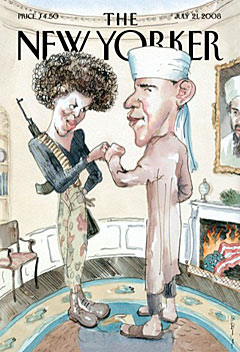
Can’t Take A Joke?

Barry Blitt New Yorker cover of the fist-bumping Obamas.

By now, you’ve undoubtedly seen the New Yorker cover that had everyone emoting. Entitled “The Politics of Fear,” drawn by cartoonist Barry Blitt, it features Barack Obama as a Muslim radical and Michelle Obama as Angela Davis, fist-bumping in the Oval Office, with the U.S. flag ablaze in the fireplace, while a portrait of Osama bin Laden stares down from the mantlepiece.

I loved it. I’ve been appalled by the Internet-powered whispering campaign that has convinced 1 in 10 Americans that Obama is a Muslim. It’s a devil’s twofer: it panders to bigotry against Muslims when we all need to clear our minds of it, and it confuses voters at a time we all need facts. Reasonable minds can differ on many things, and there are lots of good reasons to vote either for against Obama. But people shouldn’t be voting against him because he’s falsely associated with a stereotype that is itself largely false. (Yes, of course there are murderous Muslim radicals who hate us, but they are not in the Islamic mainstream.) It was nice to see somebody going after the smears, if only satirically.

But even if I had hated the cartoon, I would have been taken aback by the rancor the cover inspired in certain quarters, one of those quarters being the top of the political pyramid. John McCain called it “tasteless and offensive” – doubtless in part to put some at least ostensible distance between his campaign and the dirty tricksters who have spread the rumors lampooned by the cover. Obama retaliated – there is no other word for it – by banning the New Yorker correspondent from his Mideastern and European junket plane. (Apparently all the hopefulness in the world doesn’t stop Obama from acting like Rudy Giuliani where the press is concerned.) Interestingly, though, once you get past the top, the hysteria cools rapidly. Pretty much the entire blogosphere and commentariat, left and right, gets the joke.

Instead, the reactions there have mostly proven thoughtful. I was particularly struck by Sophia Nelson’s melancholy op-ed in the Washington Post, reflecting on her conversations with sisters in her African American professional sorority. They have focused on the Michelle figure in the cartoon. It reflects for them the limited public images available to the public mind for depicting black women, the angry radical stereotype used here being one of the few available in our vocabulary. The sorority sisters are looking to Michelle Obama to help broaden that vocabulary. And here Obama is being thrust back from the reality, something like Claire Huxtable, into the Angela Davis role. But Nelson is not blaming Blitt. Blitt is depicting the calumnies, not creating them.

Continuing to drill down, though, to the man and woman in the street, I have again encountered considerable outrage. You can read it in the reader response sections of the blogs and I have encountered it in conversations. People are upset by the supposed disrespect to the Obamas, the supposed affront to Muslims, even by the supposed insult to the flag. Read in its obvious context, the cover belies each and every one of these criticisms. It does not diss the Obamas, Muslims, or the flag. To the contrary, at least by negative implication, it affirms them all. The insult is entirely directed at the smear-masters (this election’s Swift Boaters), and to those credulous souls whose rejection of progressive politics, fear of racial and religious diversity, and/or general cluelessness has led them to embrace the smears and close their eyes to the truth. What Blitt and the New Yorker may not have anticipated was that so many people in the New Yorker’s own audience lacked the cultural literacy to decode the fairly obvious signs as to what the cover meant. It turns out that cluelessness is not the exclusive property of listeners to right-wing talk radio after all.

This is not quite the “niggardly” brouhaha, but it’s close. That 1999 dispute, you may recall, involved David Howard, an aide to then-D.C. Mayor Anthony Williams, who used the word in public remarks about the city budget. Despite the fact that the word has no denotative or etymological relationship to the N-word, Howard lost his job because it was widely believed he had employed a racial epithet. (It should be noted in fairness that he was later hired for another position in the city administration.) Causing both teapot tempests was the fact that some people were slow to master cultural vocabulary but quick to outrage.

The consequences of this kerfuffle should not be exaggerated. The New Yorker, reportedly, is crying all the way to the bank on the strength of increased sales for the issue. (And at some point Obama will have to let Ryan Lizza, the magazine’s correspondent, back on the plane.) No lasting damage is likely to be sustained by the Obama campaign, either.

But we really do need to do something about cultural literacy. It was correctly observed by one commentator that the cover would have meant something entirely different if it had appeared in the conservative National Review. Quite true. One bit of context changes things. But it is not a little bit, it’s a huge one. If one doesn’t know what the New Yorker logo on the cover portends about the political slant of everything in the magazine, including the cover, something is wrong. Between our high school civics classes, our college introductory literature courses, and our late-night comedians, the usual sources of our cultural education (and I’m only kidding a little), someone should be doing a better job.

And of course it bears reiterating that in a democracy, people should be free to tell jokes. Hilarious jokes. Stupid jokes. Offensive jokes. Gross jokes. Bathroom humor. Ribald jokes. Sick jokes. Jokes that upset members of minorities. Sacrilegious jokes. And especially political jokes. They are all a vital a part of our precious national discourse. Like war, in fact, they are politics by other means.

Running Out the Clock

It is naturally gratifying to see the Supreme Court spitting in the eye of the Global War on Law – uh, Terror waged by our president and his lawyers. Boumediene v. Bush, decided June 12, takes out another pillar of legal support for Guantanamo: the denial of habeas corpus review. One suspects that the peroration will often be quoted in years to come: “The laws and Constitution are designed to survive, and remain in force, in extraordinary times. Liberty and security can be reconciled, and in our system they are reconciled within the framework of law.” Yet one cannot avoid a sense of melancholy reading it. Boumediene comes at some cost, and to little likely effect.

Guantanamo was conceived as a law-free zone. Thought to be secure against judicial review because of its extraterritoriality and because its inmates were non-citizens and alleged enemy combatants, and firewalled from effective Congressional oversight by the constitutional prerogatives and political power of the presidency, Guantanamo was supposed to be a place where military and intelligence personnel could detain, degrade and waterboard literally unchecked.

The Administration correctly sized up congressional weakness, but has not had matters all its own way with the judiciary. To judge by the box score of Supreme Court rulings, it would seem that by now there should have been a new day at Guantanamo Bay. In Hamdi v. Rumsfeld, 542 U.S. 407 (2004), Rasul v. Bush, 542 U.S. 466 (2004), and Hamdan v. Rumsfeld, 548 U.S. 557 (2006), the Court, with a rising sense of exasperation, asserted the detainees’ right to real due process and the concomitant power of the courts to review claims that such due process had been denied. But each case could deal only with a small piece of the huge tapestry of statutory, treaty, constitutional, and administrative law woven by the administration and by Congress, and only with cases in the procedural posture presented to the Court. And in adhering to established standards of justiciability and deference while addressing these cases , the Court has tried to abstain from overly involving itself in Executive Branch policy-making.

As a result, the lawyers have stayed busy, new forms of kangaroo administrative tribunals have been substituted for old ones, and little else seems to have changed over six long years. Although accurate and comprehensive information is scarce, the overall picture seems to be that detainees are released when the authorities think fit, and not before. It is far from clear that the Court has hastened the release or ameliorated the condition of a single detainee.

The Boumediene majority takes this history into account. There is an unmistakable escalation of tone and impatience in Justice Kennedy’s opinion. By now the Court has obviously come to a fuller appreciation of what happens when it seeks carefully to address only the issues presented, squared off against an administration whose contempt for American constitutional values and determination not to conform to them is not merely unrelenting, but also creative and prolific. The Court has discovered that this administration can build and repair the legal fence around its atrocities a lot faster than the Court can tear the fence down.

The dissents, by Chief Justice Roberts and Justice Scalia correctly taunt the majority over its impotence actually to improve the lives and fates of the inmates. Indeed, they issue two taunts, each of which is worth considering.

The first has to do with the majority’s treatment of precedent. The administration’s internal legal memoranda justifying Guantanamo rested heavily on certain World War II Supreme Court decisions, some involving the internment of Japanese Americans, some the trial of German spies and soldiers by military commissions at home and abroad. Many of the implications of those rulings, fairly considered, probably would confirm the constitutionality of Guantanamo. But our constitutional culture has evolved, thank goodness, since those days. It bears note, for instance, that Fred Korematsu, defendant in one of the internment cases, received not only a writ of coram nobis in 1984 vacating his 1944 conviction (unopposed by the government), but in 1998 President Clinton placed a Presidential Medal of Freedom around his neck. The order granting the writ specifically noted that the Supreme Court ruling affirming his conviction technically remained precedential, but no one could seriously maintain that Korematsu’s ruling or the ones that accompanied it, fueled by wartime hysteria, would ever be reached today. The Court would not expand war powers simply to ratify acts of that particular sort of racism and tribalism now.

Justice Scalia nonetheless scalds the majority for failing to come to terms with the implications of those wartime rulings and following them as binding precedent. And to be fair, he may well be accurate as to what they say. In particular, Johnson v. Eisentrager, 339 U.S. 763 (1950) (German soldiers who fought on after surrender tried by military commission in Germany) probably should be interpreted as Scalia says. Kennedy and the Boumediene majority purport to see a far more liberal approach hinted at in Eisentrager than Scalia does. But Scalia seems accurate in his reading.

So one problem with Boumediene is that the bad law from World War II is not recognized as such and repudiated, as it should be. Of course, far better to interpret away its worst features, and get on with recognizing that enormities like the establishment of Guantanamo and its kangaroo tribunals cannot escape judicial review while we still profess to have a government of checks and balances and American values of due process. Scalia’s fault, by contrast, is in clinging to the wreckage of the disgusting and racist World War II precedents; but then, Scalia has few alternatives in other jurisprudence to support the presidential absolutism he so admires.

The other criticism is more troubling. No one, says Scalia, gets out of Guantanamo quicker as a result of this opinion. The new system of review the Court mandates will at least sometimes need to start with fresh administrative procedures, followed by a visit to District Court, followed, doubtless, by appeals to the D.C. Circuit. Had the old procedure been followed, the procedures would have started in the D.C. Circuit. Scalia slides past what would have happened there without Boumediene: review of Guantanamo tribunals conducted with the utmost deference. And when you start deferring to decisions in which the defendant cannot be represented by counsel and has no meaningful subpoena power, and his liberty may depend upon hearsay and upon witnesses and documents he may never view or confront, deference becomes surrender to tyranny. After Boumediene the scrutiny will be tougher. But Scalia is right that the process may take much longer.

What Scalia does not come out and say, but everyone knows, is that, because of the timelines built into the Supreme Court’s rerouting of these cases, there is no great likelihood of freedom for the remaining Guantanamo inmates before the administration chooses to release them or the political process does so. George Bush and Dick Cheney have effectively run out the clock. Whatever judicial or statutory wreckage they leave behind them, whatever constitutional principles may now limit their successors, it will only be just words as far as they personally and their detainee gulag on their watch are concerned. They will have taken these purported enemy fighters off the street and held them just as planned. Everything the Supreme Court has practically accomplished amounts, so far as the Bush administration is concerned, to rearrangement of the deck chairs on the Titanic.

The reckoning must be political, not judicial. If the Supreme Court is smart, it will devise some more rapid way of responding to Guantanamos before the next one arrives. It had better. Given the American proclivity for lurching occasionally toward totalitarianism, we know this much: It will arrive.

Speaking for the Muddlers

Speaking for the Muddlers

I worried about what a lifetime of work in a firm like this would turn me into. I looked around at the senior partners and I did not see anyone I wanted to be like. They lived with the insecurity of having to prove themselves continually in this highly competitive environment, both by turning out a great deal of highly polished work and by attracting corporate clients.

These are the words of Charles Halpern about his life at Arnold & Porter in the 1960s. Acting on these impulses, Halpern left – to co-found the Center for Law and Social Policy (largely responsible for what environmental safeguards exist on the Alyeska pipeline) and to become the first dean of the then-radical City University of New York School of Law, before wandering even further afield to become the executive director of a philanthropic foundation and a proponent of meditation and spirituality.

Most of us are not granted the luxury of pursuing a career path as fulfilling as Halpern’s. Yet many of us share some of his anxieties and aspirations. Halpern writes in his book Making Waves and Riding Currents (2008) about working at his elite Washington firm, being lavishly compensated for attending to the affairs of great corporations, while finding professional satisfaction only from the pro bono work that the firm permitted him to do.

The biggest financial rewards are usually found at places like Arnold & Porter, firms which exist first and foremost to serve the needs of the corporations. For lawyers with outlooks like Halpern’s, the rewards directly trigger a kind of professional schizophrenia. As Michael J. Kelly, former Dean at Maryland Law, has pointed out, there are many definitions of professionalism among which we slip easily, almost unconsciously. They include the commitment to practicing one’s craft well and the commitment to serving the community.

There is a lot of law out there to learn and master, and that mastery is essential to practicing one’s craft well. Mastery takes time and practice, things best achieved when we are well paid. There are lots of exceptions, but in general the big pay comes from the big corporate clients, most often serviced by the big corporate firms.

On the other hand, many of us believe that there are severe imbalances in wealth and power in our society. Many see that our environment is on the sick list. And many view the corporate establishment and big government as deeply implicated in the creation and perpetuation of both problems. An aspiration to serve the community – the second kind of professionalism – is going to tend to dispose us – at least at first blush – to struggle against the very pool of clients many of us depend upon to achieve the first kind.

There are lots of different ways to live as lawyers with this dilemma. Few are entirely satisfactory.

One can wander off the legal reservation entirely, as Halpern effectively did. But that is not really being a lawyer any more. One can seek to rise above it and become a judge, but with all due (and expedient) respect I would maintain that this is not exactly being a lawyer either. Ditto becoming a law professor.

Or one can go to work for the government, the one client that theoretically represents the populace, the very community that second form of professionalism predisposes us to serve. But government lawyers I encounter will, if honest, admit they find themselves increasingly working in shops that are more nakedly political than law firms, where they are frequently starved of resources, and often they are forced to focus more on institutional mission than on individualized justice. And that holds true whether one serves as a prosecutor, public defender, or consigliere to bureaucrats.

One can become a freelance tribune of the people, a/k/a a “trial lawyer.” There are moral hazards there too; a plaintiff’s lawyer can quickly get become cynical, and distracted by the pursuit of big verdicts and the lifestyle they finance. All too soon, one can find oneself as scornful of the plaintiff clientele, and in truth as dependent on resources of the corporate world, as the most ardent defense attorney.

Or one can muddle along.

I can only speak personally for the muddlers. We have at least one big truth on our side. We have learned, if we did not already know it, that we do not live in a Manichean universe. The Manicheans taught that everything not absolutely good was absolutely bad. The time for Manicheanism was when I was young, in the Sixties. Young idealists then knew exactly what they were for and exactly what they were against. But that was a long time ago. And even then, most young people really knew better. In Wavy Gravy’s phrase from the mike at the Woodstock Festival: “Capitalism isn’t all that weird.” And Mary Kay Place, in The Big Chill (1983), spoke tellingly for a generation of maturing lawyers when her character, an erstwhile public defender, said that she hadn’t expected her clients to be so … guilty.

Setting our rhetoric aside, few of us will get to represent unalloyed truth, justice and the American way, and few of us will end up advocating for pure evil.

True, little that is bad happens on this planet without the participation of the governments and the big corporations. True also, though, that little good happens without them either. This is not surprising. Companies and governments are the levers through which humans gather and focus the power to do almost everything of importance that is done, bad and good.

Likewise, individual humans have an intrinsic value that needs defending, no matter what, but individual humans can also be so … guilty. And the environment must be far better defended – and yet we cannot turn on a dime. We cannot stop our despoilment of the planet instantaneously. In fights defending either people or planet, there will be more than one side with something to say.

To practice law, then, means to compromise and to be compromised. It is why, in our system, all sides normally are allowed lawyers, and each lawyer is honor bound to put the best face he or she can on the client’s position, leaving some other trusted neutral, a judge or hearing examiner or jury, to sort out the best resolution. There are too many close cases to say of any party in advance that he, she, or it personally deserves to be lawyerless – or that our society is not best served with advocacy on all sides. Our self-righteousness would be better satisfied with speaking only for the good, the true, and the beautiful, uncontaminated by our commercial self-seeking. But we seldom get that chance, and that’s life.

Halpern tells the tale of the response of his law firm during the riots that scarred D.C. in the wake of King’s assassination. The police engaged in mass arrests, and the Arnold & Porter lawyers jumped into assisting pro bono with the mass criminal defenses that naturally ensued. With the city still literally in flames, partner Paul Porter, a Kentuckian who made a handsome living as a Washington insider, lent his Cadillac limo and his African American chauffeur to transport his lawyers down to the Court of General Sessions. Yes, there was much wrong with that picture. Too much for Halpern, as it proved. But for those of us who muddle through, it is striking how much was right, too.

It exemplifies how we live. The contradictions mean we don’t get to be perfect. But in an imperfect world, there’s a certain justice there. If I may use the phrase.

John Yoo’s Disbarable Incompetence

John Yoo’s Disbarable Incompetence

John Yoo’s Pennsylvania bar number is 69500. Recently some bloggers have urged that Yoo be deprived of that number and disbarred, for having been the ultimate legal theorist behind denial of POW status to suspected terrorist detainees, warrantless domestic surveillance, and interrogations under torture. As Jack Goldsmith, former head of the Office of Legal Counsel (“OLC”), has observed: “[N]ever in the history of the United States had lawyers had such extraordinary influence over war policy as they did after 9/11.” And all indications are that when these policies were adopted, Yoo, formerly a deputy in the OLC, was the most extraordinarily influential lawyer of the lot. The bloggers are right; the Pennsylvania Office of Disciplinary Counsel should pursue disbarment, though more for the manner of Yoo’s advice than the contents thereof.

First some background. The OLC is a 22-lawyer office that advises the President and the Attorney General, especially concerning legal issues pertaining to the presidency. Much of the advice that Office provides will inevitably concern areas in which there are no judicially tested or legislatively created rules. In the absence of external authority, particularly judicial authority, the Opinions issued by the Office have binding force throughout the Executive, and earlier Opinions are cited as stare decisis for later ones. The OLC thereby wields something akin to the power of a Supreme Court within the Executive.

Small wonder, then, that the Office has generally (though not without exception) tended to be sober and cautious in its advice. Legal Counsel have typically viewed themselves as being not merely advisors to the President, but fiduciaries of the public interest in seeing that the President “takes care that the laws be faithfully executed,” a constitutional requirement. The role of presidential advisor incentivizes approving presidential plans, the role of public fiduciary sometimes demands saying “no” to the President. These frequently competing roles call for maturity, balance, and judgment in all of the Assistant Attorneys General who work at OLC.

What OLC got instead, when Bush 43 arrived, was John Yoo. A specialist in matters of presidential war powers, Yoo served under Edward Whelan (formerly a communications lawyer) and then Jay Bybee (whose constitutional expertise was focused elsewhere), and so, after 9/11, he became in effect the senior expert within the Office on the way the Executive Branch could lawfully respond to the terrorists. And he deployed that expertise in writing memo after memo on the subject.

There is no question about the man’s brilliance. Not only was he well-groomed (summa at Harvard, J.D. at Yale, clerkship with Justice Thomas, general counselship with the Senate Judiciary Committee), but one has only to read his writings to recognize a formidable legal mind. They are dense with authority, beautifully organized, and well-phrased.

At the same time, though, they are manifestly the products of a mentality innocent of maturity, balance, or judgment. His basic mode of operation is to search for loopholes, largely located in the unreviewed fiat of earlier OLC Opinions. Having loopholed his way to a dubious conclusion, he proclaims it without fear or doubt. In plain English, he seems unable to recognize when his views fail the smell test. Nor is he bashful about stating very large and questionable principles that are hardly necessary to reaching the narrow points at issue in his memoranda.

But don’t take my word for it. Hear instead Jack Goldsmith, who succeeded Bybee as the head of the Office, and to whom fell the delicate but necessary task of repudiating and withdrawing Yoo’s Opinions on torture. It is now revealed that Yoo was the co-author of the August 1, 2002 OLC memo on torture nominally written by Bybee (discussed in my earlier column, Playbook, 8/26/05) , and was the prime author of a just-released March 14, 2003 memo that expanded much of the earlier memo’s analysis and in essence opined that in interrogating suspected Muslim terrorists, the President was subject to no legal constraints whatsoever.

In his memoir, The Terror Presidency (2007), Goldsmith had this to say: the memos showed an “unusual lack of care and sobriety in their legal analysis.” For example, Yoo advised that “Any effort by Congress to regulation the interrogation of battlefield detainees would violate the Constitution’s sole vesting of the Commander-in-Chief authority in the President.” Goldsmith’s comment: “This extreme conclusion has no foundation in prior OLC opinions, or in judicial decisions, or in any other source of law. And the conclusion’s significance sweeps far beyond the interrogation opinion or the torture statute. It implies that many other federal laws that limit interrogation … are also unconstitutional, a conclusion that would have surprised the many prior presidents who signed or ratified those laws, or complied with them during wartime.” He continues that the opinion “rested on cursory and one-sided legal arguments,” and were lacking in “the tenor of detachment and caution that usually characterizes OLC work.”

These are not the words of a wild-eyed liberal; they come from a Republican who had served as a counsel in the Defense Department and was championed by Yoo himself to fill the role of head of OLC after Yoo.

It is too early, and the proof still too sketchy, to draw a line direct enough between Yoo’s advice and the Guantanamo and Abu Ghraib atrocities to justify a Nuremberg-style trial. Nor, in my view, is it appropriate to breach academic freedom and oust Yoo from his professorship at Berkeley. But there is no reason we lawyers have to put up with having him in our profession. We have standards to uphold.

Pennsylvania follows the Model Rules of Professional Conduct. The very first of those, Rule 1.1, requires competence. It calls for “the legal knowledge [and] skill … reasonably necessary for the representation.” Yoo’s advice may have been erudite, but it was so lacking in judgment and so fraught with grievous potential that it was instantly reversed as soon as there was a grownup in the room. His juvenile fantasies of overthrowing conventional understandings of the Constitution with his memos betray a mind unfit for the practice. This is not a political judgment, just a professional one.

There is certainly ample precedent for disbarment for incompetence. Disbarable incompetence generally proves to be of a less political nature, but there is nothing inherent in the rule which immunizes incompetence when it is exercised through advice with a political aspect. Nor is there any shelter in the language of Rule 3.1, which sanctions “a good faith argument for an extension, modification or reversal of existing law.” These words understandably pertain to a lawyer’s role as advocate, not as advisor.

Moreover, we lawyers swear to uphold the Constitution, including the portion of the Supremacy Clause which makes our treaties the law of the land. Yoo failed to live up to his oath when he advised that our treaties, which have interdicted torture and commanded humane treatment of our Muslim prisoners, did not mean what they said, and/or were somehow subordinate to the President’s warmaking powers. No doubt he believed his advice, so I am not assailing his integrity. But only a lawyer exhibiting an appalling failure to appreciate the structure and meaning of our legal system could render such advice. One can surely undermine our laws negligently or recklessly; it is not a shortcoming that on its face requires specific intent. Yoo doubtless intended to keep his oath, but he was not competent enough to do so.

Few lawyers will ever know as much law as John Yoo does. But I’d like to think that few lawyers are such dangerous fools. I assume that some of the calls for disbarment are already under confidential consideration by the Pennsylvania Office of Disciplinary Counsel. For the protection of the public and our profession’s reputation, the number 69500 should be retired.

“Kristen”

“Kristen”

The tragicomic tale of “Kristen” and Client 9 rekindles the perennial debate about legalizing prostitution. And it’s as confusing as ever.

Let’s get past the obvious: there are almost always victims. Set “Kristen” aside for the moment. Client 9’s wife and children surely qualify. But I think few of us would wish to make or keep prostitution a crime solely out of solicitude for the john’s family. Bad as adultery may be, it is not something to punish criminally or even through the tort system. Arguably Client 9 himself is a victim as well. But when society tries to criminalize self-infliction of minor and intangible harm (which was probably what Client 9 anticipated when he started out), the results are not promising. The classical example of trying to prevent harm to the transgressor and his family was Prohibition, a laughable failure. The latest instance is drug prohibition, an ongoing traumatic fiasco.

Prostitution, among other illegal vices, will never be the subject of comparable enforcement effort or expense. Instead, we rest uneasily with the current status where prostitution laws are never repealed but only lightly enforced. Why not just make prostitution legal? The weightiest reason is usually concern for the hooker, who is cast as the most important victim.

That hookers can be victims is well-established fact. Prostitutes are often betrayed by families that should have nurtured them, hooked on drugs, abused by pimps, stolen from, trafficked and sometimes murdered in the end. But always? Otherwise put, if there is a segment of the prostitute population that does not fit the classical victim profile, what do we know about it?

I have recently cast about for some statistics about independent, less-clearly victimized prostitutes. I was astonished to discover how little hard data there are, and how unreliable the available data are. We know a fair amount about the unambiguously abused ones. The ones who might be doing ok, the Kristens, seem to exist in a world without numbers, except for the denizens of the few legalized brothels in Nevada. People taking good care of themselves don’t trouble the emergency room, the taxman, or the social work bureaucracy, and don’t precipitate the formation of statistics.

But this question is, I think, key to our fascination with “Kristen,” whose private identity is now widely known. If Kristen truly is as she seems to present herself, she is a well-compensated independent contractor, living in an attractive apartment house, with a music career of sorts on the side and a family that seems to be supportive. She does not appear to be in thrall to anyone, more entrepreneur than victim. She might be, could be, the genuine item: the happy hooker. And if she is one, then it is possible to be one. And if there really can be happy hookers, then like it or not, that has policy implications.

Prostitution prohibitionists tend to minimize the possibility that any prostitute could live a satisfactory life. (See, for instance, Nicholas Kristof of the New York Times.) Sex, they say, cannot be engaged in commercially without dissociation, a split between the core of the person and her actions that is always by definition a bad thing. Either the dissociation has occurred before the hooker enters the trade (via incest, abuse, or rape) or it is inflicted on the job, or both. Partly as a result, partly as a cause, the hooker’s lot is likely to be affected by drug addiction, deep depression, low self-esteem, and financial dependency upon pimps, to name some of the more oft-cited problems.

Presented as a list of inevitable circumstances accompanying prostitution, these problems would appear to make prohibition a no-brainer. Who could possibly favor giving legal countenance to a trade in which these things are always present?

But there are at least two problems with this picture. First, it is far from clear that the laws forcing prostitution deeper into the shadows have not facilitated the abuses worse than legalization and its attendant regulation would do. Second, the problems may not be inevitable. If “Kristen” is to be believed, they may not have been present in her case.

I am not suggesting that we are to take on faith what “Kristen” and her handlers have said to us about her. But I am suggesting that there may be women out there who do not at first blush conform to the victim stereotype, and that their claims ought at least to be considered.

The prostitution prohibitionists exhibit a bad tendency to ignore the voices and examples of the Kristens, those who claim that free women can enter prostitution as entrepreneurs rather than victims. An excellent example ishttp://www.justicetalking.org/viewprogram.asp?progID=219, a 2002 segment of NPR’s Justice Talking which features a debate between Christine Stark, a former prostitute, now a prohibitionist, and Carol Leigh, organizer of the Prostitutes’ Education Network, who works for prostitute empowerment. (Go to http://www.justicetalking.org/programarchive.asp, and search under “prostitution.”) Leigh and two members of the audience plus two legal Nevada hookers interviewed at the outset all assert that they personally have had mostly good experiences as prostitutes. Each time Stark is confronted with someone’s purportedly not-so-bad real life story, or with the benefits that legalization can bring, she reverts to categorical a priori assertions that prostitutes – all prostitutes – are inevitably victims. She argues that, notwithstanding these upbeat stories, all prostitution is or can ever be is organized rape, and thus it is unthinkable to legalize it. Yet if there is one thing clear in the stories Stark dismisses, it is that they are not stories of rape. If rape is what they describe, then rape is practically a meaningless term. And it is too important to become meaningless.

We know how awful trafficking can be. We understand about incest and depersonalization. We know about the effects of drug addiction on women’s choices. Most intelligent people truly get this. But it is possible to appreciate these things and still conceive that there might be degrees of victimization or even the possibility of prostitution without victimization. “Everything is rape” dumbs down our policy choices.

We cannot abolish prostitution; the only option actually presented to us is legalizing and regulating, or not doing so. And if we legalized, could we possibly improve the quality of life for the women involved? And might we not be better honoring the presumed freedom of contract each woman has in a free society?

I am not convinced either way on this. It seems immensely plausible that a legal pimp like the ones who run the Nevada bordellos, taking the house’s standard 50% and issuing a W-2 or 1099, while hardly the perfect boss, is likely to be a lot better for the woman involved than criminal pimp who just grabs the money out of her hand and beats her. And yet there may be counterintuitive aspects of the situation; claims exist that the market effects of legalized sex commerce engender more, not less, illegal and predatory sex commerce and trafficking in those countries that have legalized the sex trade. And obviously, freedom of contract for a tiny minority of happy hookers should take a lower public policy priority than the health and well-being of large exploited masses.

It all comes down, therefore, to what the experience elsewhere has been with legalization. Has it increased safety or misery? There is evidence both ways, and none of it seems very reliable. It would be most helpful if the numbers we had from places where legalization has been tried were more often assembled by scholars not connected with either side in the debate, and assembled with proper experimental controls; at present that almost never seems to be the case.

We can all have fun laughing at Client 9, but his designated playmate has reintroduced us to a baffling public policy problem that is no laughing matter. For that inadvertent benefit to public discussion, she (and hence he) deserves our thanks.

Anti-Tax Rhetoric: Another Greenhouse Gas

Anti-tax rhetoric: Another greenhouse gas

Mercifully, the primary campaign has washed over the state where I live, and with the end of the inundation we no longer have to put up with the television ads arising out of a local Congressional district. You know the district I’m talking about, the place where three candidates, all current legislators, had been accusing each other – incessantly – of voting to raise taxes, as if funding our government were self-evidently not merely a bad, but a nearly unspeakable, act. The catchphrases that accompanied these accusations included “wasteful spending” (the existence of any other kind of spending not being hinted at) and “big government” (the calamity wasteful spending enables).

Unfortunately, the rules stipulated that they couldn’t all lose. One of them had to win. The victor was or at least pretended to be an ignoramus: his ads showed him commenting scornfully that “big government never created a job.” Apparently his high-school history books had omitted the Works Progress Administration and the Job Corps; apparently he’d overlooked a rather large military facility just outside his district at which thousands of his constituents are reportedly gainfully employed; apparently he’d forgotten the official government line we’ve been living with since Reagan to the effect that when the government transfers wealth from the poorest taxpayers to the richest, the effect is job creation, albeit via the proxy of private entrepreneurship.

I’d submit that his kind of talk (and that of his primary election adversaries) is the equivalent of the CO2 filling up our atmosphere: a poison that accumulates and makes our world hotter and more dangerous. Indeed, the real CO2 in our atmosphere is the single most urgent reason why such talk is perilous, and we need to get it out of our discourse.

We face difficulties of Biblical proportions, far more destructive than any likely presented by Muslim extremists. The seas are going to rise and drown places where multitudes of us live, large portions of our agricultural resources will die from excessive heat, fisheries will collapse, energy sources will disappear, killer storms will multiply. This is already well under way, and life is about to get uglier fast. As our ecosphere degrades and energy becomes scarcer and costlier, we as individuals and as a country shall face immense problems, far beyond the ability of the private sector to address. Only governmental planning, only widespread sacrifice of a nature only government can direct, only international accords that governments alone can make and enforce, can possibly promise any path to eventual salvation.

Hence rhetoric that mocks and vilifies government, while glorifying private enterprise and the goods and the lifestyle it can produce, are deadlier than a terrorist’s bomb at this point in our history. The private sector is geared toward the individual gain of the workers, investors and entrepreneurs who staff it, and the professionals who serve it. This is partly a good thing; the “invisible hand” of the market also produces common benefits for us all, like the enormous prosperity most of us in this land have long enjoyed.


But economists have also long recognized the existence of “negative externalities.” These are bad effects external to the benefits and incentives of the commercial marketplace, of which the marketplace takes but a limited account. And it turns out, in light of incontrovertible science, that the potential death of our planet is one of those little negative externalities. It turns out that the very prosperity virtually all of our politicians of both parties praise with that deadly phrase “the American dream” – that prosperity we are repeatedly told it is particularly American for us to want for our kids – that prosperity is the curse of the world.

In pursuit of “the American dream” we gravitate toward houses that gorge on farmland and forest, sapping the greenery that removes CO2 from the atmosphere. In consequence, just to go to work and to shop, we must drive vast distances in huge vehicles that increase both CO2 and other poisons, while they incidentally hasten the day when no one has any oil. We work and play consuming power the generation of which almost inevitably heats the atmosphere and emits chemicals that destroy the pH balance of the seas, wrecking coral reefs and the ecosystems that depend on them. We eat lots of meat, the raising of which is water-intensive in destructive ways, and lots of overfished seafood. We take our food home in disposable plastic bags that consume irreplaceable petroleum, our vital chemical feedstock, and pollute the environment when they escape into it. That – and a myriad of other offenses against the welfare of our race and our planet – is what is generally involved in pursuing the American dream.

We all do this, including you and I, dear reader. Most of us know that this American dream, rapidly becoming the standard that other countries are achieving as well, is killing our futures and those of our children. But individually, we are almost powerless to stop pursuing it. That is the hard truth. Even collectively, as private members of the economic marketplace, we cannot do much, as there is not, or at least not yet, a sufficient profit motive for the private sector to change our course. A well-funded government is the only possible brake on our deadly momentum.

And we do not need a brake on that brake. Hence when politicians romanticize business profits and demonize government, when they encourage, nay, idealize, the pursuit of a lifestyle of intense consumption, when they give rhetorical legitimacy to efforts to starve government of taxes, they attack our very survival.

Instead of educating voters about the need to curb consumption, instead of directing the development of our infrastructure to discourage wasteful building, driving and eating, politicians glorify the wrong-headed course we have been pursuing, hastening the downfall we are careening towards. Instead of reinforcing that we are all going to have to sacrifice and tax ourselves and pull together, they bless a rugged individualism and distrust of the very elites – the government scientists, economists, engineers, regulators and diplomats – who are inevitably going to have to direct the enterprise of common salvation.

So in the upcoming elections, I’d urge that we listen carefully to the rhetoric. If we hear politicians blast taxes, extol small government, and limn the American dream, we shall know that those are the politicians to vote against. Government on the cheap is far too expensive for us. Too much personal prosperity will bankrupt us, in fact it will probably kill us. We need to wake up now, and recognize these realities. And politicians who fail to acknowledge the truth of them need to go, along with their dangerous talk.

T&A TV and its Fig Leaves

T&A TV and its Fig Leaves

Believe it or not, with the approach of this years Festivus Maximus, we are already about to celebrate the fourth anniversary of The Wardrobe Malfunction. Only a small percentage of the population, even of those who watched it, remembers who was playing in Super Bowl XXXVIII, and fewer yet remember the score (Patriots 32, Panthers 29 if you care). But everyone remembers the Malfunction.

If, like me, you were hanging on grimly during the halftime, hoping for the fun to begin (the first half having been a dull defensive slog), you probably didn’t feel the tedium lifting during the halftime show. It was a wallow in sexualized vulgarity of a sort to which, thanks to popular culture, we have all become numb. I quote from the Federal Communication Commission’s brief filed in the 3d U.S. Circuit Court of Appeals last year:

The show began with Janet Jackson’s performance of the song, “All for You,” which opened as follows:

All my girls at the party

Look at that body

Shakin’ that thing

Like I never did see

Got a nice package alright

Guess I’m gonna have to ride it tonight.

Jackson repeated these lyrics – two additional times – during the song. Two other performers, P. Diddy and Nelly, followed with a song medley that also included sexual references. Among the lyrics in the Nelly song “Hot in Here” were: “I was like good gracious ass bodacious … I’m waiting for the right time to shoot my steam (you know)”and “[i]t’s gettin’ hot in here (so hot), so take off all your clothes (I am gettin’ so hot).” During this medley, Nelly grabbed his crotch several times.

As the halftime show’s finale, Jackson reappeared to perform “Rhythm Nation” and “Rock Your Body.” During the latter song, singer Justin Timberlake joined Jackson on stage and followed her around while periodically grabbing her, rubbing against her in a manner suggestive of sexual activity, and slapping her buttocks. As he did this, he asked Jackson to allow him to “rock your body” and “just let me rock you ’til the break of day.

You could watch this whole thing and never experience a moment of involvement, never mind sexual stimulation. The only interesting thought it provoked (and I’m sure I was not alone in thinking it) was that this certainly was not your father’s halftime show. Then came the Malfunction, and I return to the FCC brief:

At the culminating moment of both the song and the halftime show, Timberlake sang the lyric, “gonna have you naked by the end of this song” and simultaneously pulled off the right portion of Jackson’s bustier, clearly exposing her breast to the television audience.

As the FCC wordsmiths nicely evoked, confirming my contemporaneous impression as a viewer, the Malfunction was of a piece with everything that had gone before. And yet we all know that, without the Malfunction, there would never have been any enforcement action against CBS. That 9/16ths of a second of Janet’s breast, the nipple encircled by a sunburst medallion, made all the difference.

Because of that 9/16ths of a second, the FCC commenced File No. EB 04 IH 0011, an enforcement action to fine CBS over half a million dollars. The enforcement action was the FCC’s comic regulatory counterpart of FEMA’s tragic Katrina response and the Pentagon’s far more tragic mismanagement of Iraq: an insanely incompetent piece of governance conducted by administrators chosen for their allegiances rather than their smarts or their integrity.

In order to penalize CBS, the FCC had to ride roughshod over all the limitations in the Supreme Court’s decision in FCC v. Pacifica Foundation (1978), and its own prior decisions following Pacifica which cautioned that in enforcing decency rules, fleeting and unrepeated presentations of indecent material must not be penalized. The FCC had to ignore Supreme Court precedent giving “breathing space” for offensive speech in order to allow protected speech to occur. The FCC had to ignore its own recent precedent allowing fleeting nudity in primetime TV. The FCC had to close its mind to strong evidence that CBS had no idea the Malfunction had been planned, not to mention obliterating constitutional scienter requirements. And most of all, the FCC presumed, rather than investigated, the answer to a key regulatory question: whether contemporary community standards were truly offended by the Malfunction.

And that is the rub. A truly dispassionate look at the issue, devoid of context, i.e. the Super Bowl, would probably have found very little offense. The fact is, we live in a society drenched in sexual imagery, much of it quite pornographic. Compared to what most of us see most days, 9/16ths of a second of bare nipple is nothing. (You don’t need Playboy; this week’s issue of the tony New Yorker reproduces quite an erotic and very detailed bare-breasted photo of Lee Miller by Man Ray, for instance. My more than casual glance at it undoubtedly consumed more than 9/16th of a second.) Were we as a society so offended by all that imagery, all that sex talk, all that porn, the sense of offense would be far more articulate and pronounced. In truth, most of us revel in the better erotica and are turned off by the worse, e.g. the 2004 Super Bowl show.

But the Super Bowl is a unique context. The regulators undoubtedly and rightly felt they could read the applicable standards unmediated by any poll. Let us be frank. The Super Bowl is beloved by much of the populace, but especially, it is a high sacrament of so-called “values voters,” a key constituency that put Bush and the majority of the FCC Commissioners in office.

Football is thought, all the ambiguous evidence notwithstanding, to build character, faith and patriotism. Hence football, along with stock car racing, is the quintessential Bible Belt sport. But football also plays to a cleavage, if I may use the term here, between the professed and the actual standards of many of its fans.

Take away the Super Bowl XXXVIII halftime’s crotch-grabbing singers and sleazy lyrics and the Jackson Malfunction, and you still have cheerleaders. The eroticism of their gyrations, the upskirt suggestiveness of their kicks, their jiggle, all scream sex. Not for nothing did Debbie do Dallas. On the field, the players swagger and slap each other on the rear with elaborately mannered sexuality, and wear pads that suggest even more pumped up male musculature than steroids may afford. In common with other professional athletes, they are viewed in popular culture, probably with justification, as beneficiaries of constant female sexual availability off the field. Football, in short, is about a lot of things, but a big thing it is about is sex.

The 2004 halftime show, then, was all about sex, but hardly more so than the game before and after it.

So here is the apogee of a highly sexualized sport adored by voters who profess a great discomfort with sex in our culture. It is a contradiction that absolutely requires, quite literally, a fig leaf to reconcile. And what Justin Timberlake did was literally, not merely figuratively, tear away that fig leaf. It doubtless outraged the standards of the community that counted with the FCC — I mean the community that counted, along with the normal vested interests, like the telephone companies that had sent Commissioner Robert McDowell to the agency and the cable companies responsible for Commissioner Kevin Martin.

It is not the reality of a sexless world these voters want, not even in fact a sexless world in the hours when broadcast TV is watched by children; if it were, the kids would never be allowed to watch the Super Bowl, all macho swagger and cheerleader jiggle and beer commercials full of horny young men and pneumatic young women. What is desired is a pretended absence of sexuality, the token and indeed the mechanism of which is that fig leaf. No wonder there was such fury when it was ripped away.

The 3rd Circuit has yet to rule on the legal issues, and the case may well not end there. Before all is said and done, it may go to the Supreme Court, which is ordinarily quite protective of commercial speech. As with Super Bowl XXXVIII itself (37 points in the last 15 minutes), the ending of the case may be far more gratifying than the beginning.

But, win or lose, one can understand the FCC’s thinking. The commissioners must know that they play a minor cultural role, that movies and cable and the Internet are full of sex without fig leaves, and that they cannot really prevent the eroticization or the debasement of our culture. But they could do their bit. The half-million dollar fine is itself a fig leaf, a tribute to the ideal of a world that might be better than this, but which is long gone, and to which we can only pretend to belong.

Leonard Bernstein’s Mass

Leonard Bernstein’s Mass

In 2008, the Baltimore Symphony Orchestra mounted a grand new production of Leonard Bernstein’s Mass, performed in Baltimore, at Carnegie Hall, and the Kennedy Center, among other places.  I was commissioned to write four pieces about this masterwork for the BSO’s website.  (The recording won a deserved Grammy.)  As the Orchestra has taken down the individual pieces, I post them on this website:

First Principles on Immigration

The Big Picture Home Page | Previous Big Picture Column |  Next Big Picture Column

First Principles on Immigration

Published in the Maryland Daily Record December 31, 2007

Those men and women trying to enter the country “illegally” are my brothers and sisters. We are all children of the same God, and that makes them my brothers and sisters. And if my brothers and sisters want to come and live with me, I am bound to welcome them. Those are my unabashed first principles on immigration.

Formed by those principles, I am increasingly turned off by the whole tone of the supposed “debate” going on about the subject right now, based on completely different principles. It does not speak to me at all.

To listen to the presidential candidates, particularly the Republican ones, I get the same what-planet-are-these-people-from? sense I used to have listening to the old Miller Lite commercials featuring disputes between the mindless adherents of “tastes great” and the brain-dead partisans of “less filling.” Both sides were so patently wrong (the beer was uninspiring, and you could still gain weight drinking it) that their mock contest didn’t seem to work even as humor, which usually requires some element of truth.

In the current immigration debate, the fight seems to lie between “more fences” and “less forgiveness,” and no one seems to have a clue how mean and uncharitable that sounds. Not to mention – once again – patently wrong, and not funny.

It takes a lot of gall for us to be talking about shutting our doors on others. Our dominant culture is the direct result of an immigration that asked for no one’s leave, a wave of white people and their African slaves which resulted in the overwhelming displacement of North America’s native culture. And that displacement was enforced with frequent acts of genocide, unlike anything our immigration-haters deplore about the new tide of Latinos.

So we set a precedent for ourselves that we’re not entitled to ignore now. If it was ok for our grievously usurping genetic and/or cultural ancestors to enter this land 400 years ago without asking permission, through Plymouth Rock and Jamestown and the Pacific Coast missions, then how can we refuse today’s far more peaceful immigrants at Brownsville and San Ysidro? It seems to me that if we claim the right to celebrate Thanksgiving, we have no business fortifying the Rio Grande.

It takes even more gall for us to be speaking of “amnesty.” That implies there is something to forget or forgive. Granting we have a right to control our borders (or try to anyway), that in no way implies the right to exclude large classes of people, for years, perhaps forever, which all too often is the impact of our visa laws, particularly on the poorest and least credentialed of our brothers and sisters. Laws that are so patently contrary to human rights cannot be binding on the human conscience or on the individual, and cannot be legitimately enforced. And it is especially cruel and vindictive to make the violation of those laws a justification for further denying the human rights of immigration and naturalization.

And what then do we say of the shameful use of the term “sanctuary city,” which stigmatizes efforts to minimize the cruelty of our immigration laws? In our current climate, “sanctuary” should be a badge of honor, not of opprobrium. It is amazing, too, that so many of those advocating the “tastes great” of immigration enforcement and the “less filling” of denying amnesty also profess to be Christians. Not for them the Congregationalist hymn by William Dunkerley, echoing the words of Matthew 8:11.

 In Christ there is no East and West
In Him no South and North
But one great fellowship of love
Throughout the whole wide earth.

Not for them the example of Jesus, who learned this lesson himself at the hands of the Samaritan (i.e. alien) woman at the well, and who, for that matter, taught the parable of the Good Samaritan to illustrate (among other things) the unimportance of nationalities to human relationships. And yet these people call themselves Christians? Will someone explain how?

More amazing yet, these immigration foes seem to have lost faith in the American secular religion, a tenet of which is that we are so worthy and desirable a culture that everyone who comes here wishes to and does assimilate. They fear, I gather, that the gravitational pull of our culture on all comers has somehow faded. But when has it ever proved false? Every immigrant group speaks fluent English after two generations; every immigrant group’s members quickly imbibe all of our best features, like our bent for participatory democracy, and our worst, like rampant consumerism.

In saying all this, I do not mean disrespect to those who feel that immigrants are an economic threat or the somewhat smaller group for whom they are an actual threat. But I do maintain that economic impacts, however real or distressing, seldom if ever justify curtailing the exercise of human rights. In a contest between priorities, some must be paramount.

So what I wish I was hearing, instead of bickering over who ran a sanctuary city or who hired illegal aliens or who would build the most impregnable border, would be an acknowledgment that the aliens are not going away, that they have a basic human right to be here, and that it’s time to do, in the most expeditious possible way, whatever it takes to give our brothers and sisters legal status and the same chance as we give other immigrants to become citizens.

Is it too much to ask? Am I the only one who feels this way?

Copyright (c) Jack L. B. Gohn

The Big Picture Home Page | Previous Big Picture Column |  Next Big Picture Column